MoRTH Standard Data Book: Volumes, Uses, And Rate Analysis
Master the MoRTH Standard Data Book for highway projects. Learn to use its volumes for accurate rate analysis, defensible bidding, and margin protection.
Every road and bridge project tendered by the Indian government traces its cost estimates back to one reference: the MoRTH Standard Data Book. Published by the Ministry of Road Transport and Highways, this document sets the baseline rates, material constants, and labor norms that determine how highway contracts are priced across the country. If you're bidding on national or state highway tenders, ignoring this book means flying blind on cost estimation.
Yet, many contractors and BD teams treat the data book as an afterthought, something to glance at during bid preparation rather than a strategic tool. That's a missed opportunity. Understanding how MoRTH rates are structured, which volumes apply to your scope of work, and where the latest editions differ from older ones gives you a real edge when preparing competitive bids. It directly affects whether your quoted rates hold up or get rejected during technical evaluation.
At Arched, our platform already identifies and matches your firm to the most relevant government tenders across 500+ portals, including MoRTH and NHAI projects. But winning those contracts starts with knowing how to price them correctly. This article breaks down the MoRTH Standard Data Book volume by volume, walks through its role in rate analysis, and explains how to access and use the latest PDF editions for accurate project estimation.
Why the MoRTH Standard Data Book matters
The MoRTH Standard Data Book is not a suggestion guide. It is the foundational reference that government evaluators use to verify your rates during bid scrutiny. When you submit a BOQ for a national or state highway project, the rates you quote get compared against the SDB's established norms. If your figures deviate significantly without clear justification, you risk technical rejection or a clarification request that delays the entire process. Understanding why this document carries so much weight changes how you approach every highway bid.
It anchors the entire cost estimation process
Road and bridge projects involve hundreds of line items, from subgrade preparation to bituminous surfacing to drainage structures. Without a common baseline, every contractor would define material constants and labor productivity differently, making it impossible for the government to compare bids on equal terms. The SDB solves this by publishing standardized output rates for equipment, material consumption factors, and labor norms that every party must reference. When you build your estimate starting from SDB entries, your rates speak the same language as the evaluating engineer's internal estimates.
Contractors who skip the SDB and rely on thumb rules often find their rates either too low to be profitable or too high to survive technical scrutiny.
Your cost estimate is only as reliable as the data behind it. The SDB provides verified productivity norms tested across multiple project types, so when you claim a certain rate for laying granular sub-base, that number reflects real-world equipment performance. That documented foundation matters far more than the speed of preparation, because a challenged rate without an SDB reference is very difficult to defend.
It directly affects your bid's technical score
Many highway tenders, particularly those under NHAI and state PWD agencies, include a rate analysis check as part of the technical evaluation. The evaluation engineer compares your quoted rates to the SDB norms adjusted for local conditions. If your rates fall outside the acceptable range without supporting justification, the bid may be flagged for clarification or disqualified during scrutiny. This means the SDB is not just useful for preparation; it is a direct factor in whether your bid clears technical evaluation altogether.
Knowing which SDB items map to your scope of work also helps you spot gaps before submission. If your BOQ covers an item that does not appear in the standard data book, you need a separate rate analysis backed by current market data and written justification. Missing that step is a common reason bids face delays at the evaluation stage, and it is entirely avoidable.
It protects your margins when costs escalate
Project costs rarely stay static. Material prices shift, equipment availability changes, and site conditions vary from what was assumed during bidding. When a contract dispute arises over rate revisions or extra items, both parties refer back to the SDB to establish what the baseline rate should have been. If you built your original estimate using SDB norms, you have a documented basis to argue for rate revisions or payment for work outside the original scope.
Without SDB alignment, your cost build-up lacks the official reference point that engineers and arbitrators recognize as the industry standard. Contractors who use it consistently find that their documentation holds up better under scrutiny, both during project execution and in any formal dispute resolution process. The SDB is essentially your paper trail for every rate you have quoted, and that protection becomes most valuable precisely when a project runs into trouble.
How the SDB fits with MoRTH specs and SOR
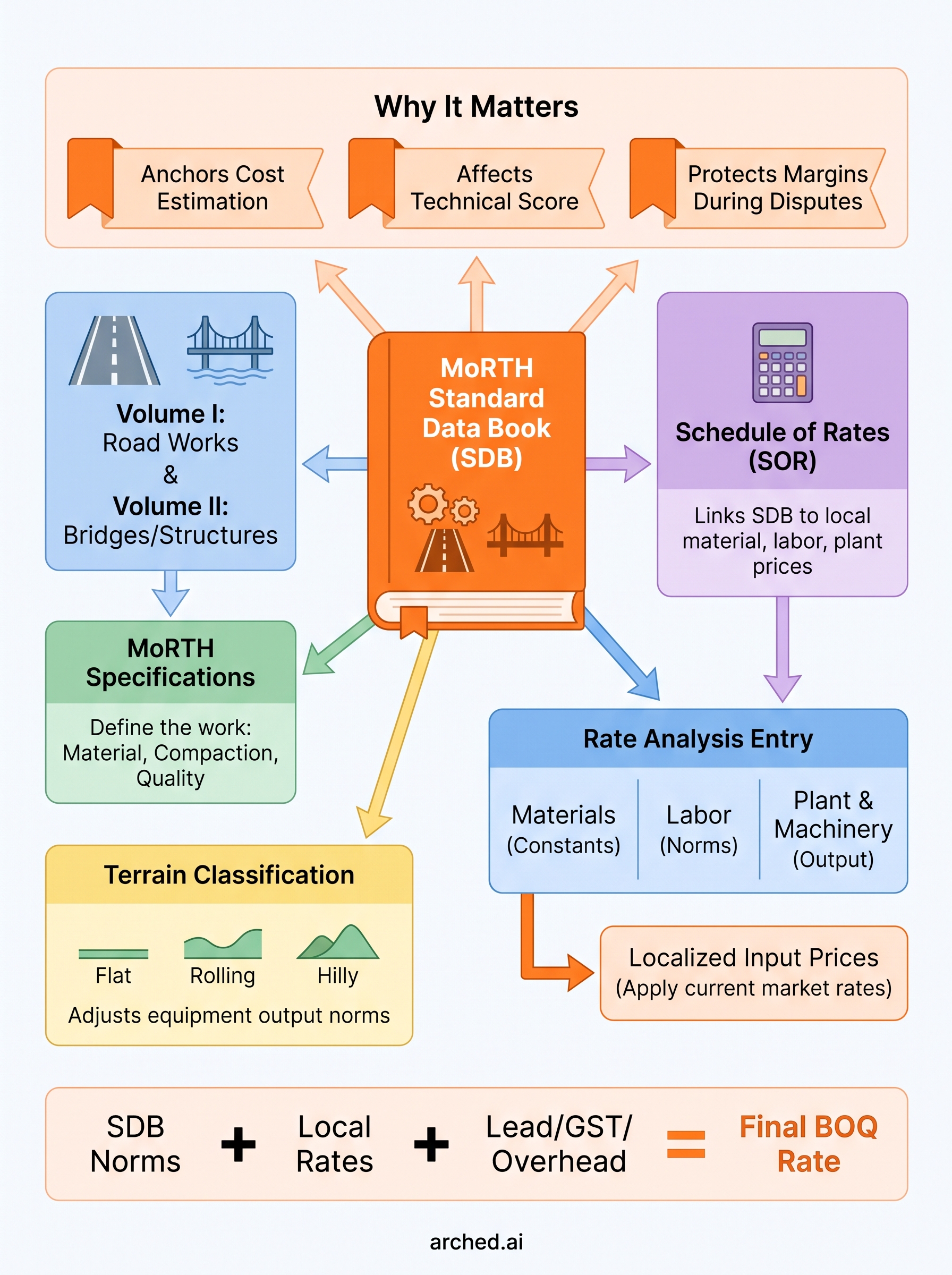
The MoRTH Standard Data Book does not work in isolation. It sits within a three-document system alongside the MoRTH Specifications for Road and Bridge Works and the Schedule of Rates (SOR). Each document plays a distinct role, and misunderstanding the relationship between them leads to estimation errors that are hard to catch until evaluation. When you understand how these three references connect, your bid preparation becomes faster and more defensible.

MoRTH specifications define the work; the SDB prices it
The MoRTH Specifications for Road and Bridge Works tells you exactly how every construction activity must be carried out: the material standards, compaction requirements, layer thicknesses, and quality benchmarks for each item from earthwork to wearing course. It does not tell you what the work costs. That is where the SDB picks up. The Standard Data Book translates those specification-defined activities into measurable cost components by assigning output rates for equipment, consumption factors for materials, and productivity norms for labor.
When you read a specification clause for granular sub-base, for instance, it describes the gradation requirements and compaction standards. The corresponding SDB entry tells you how many cubic meters a motor grader covers per hour and how much material you consume per unit of finished work. You cannot accurately price a specification-based BOQ without both documents open at the same time.
The SOR links the SDB to actual contract rates
The Schedule of Rates is the third piece of this system. State PWDs and central agencies publish their own SOR by combining SDB norms with prevailing local rates for materials, labor, and equipment hire. When a tender references a particular SOR, that document has already applied the SDB's output norms to local input costs to arrive at published item rates.
Your quoted rates in a bid carry more weight when they trace directly back to the SDB norms embedded in the relevant SOR, because evaluators use exactly that chain to verify your figures.
Understanding this flow matters when you prepare rate analysis sheets for non-SOR items or for items where your quoted rate differs from the published SOR figure. In those cases, you must rebuild the rate from SDB norms using current input prices and clearly show your working. Evaluators follow the same logical chain from specification to SDB to SOR to final rate, and your documentation needs to match that path exactly to avoid scrutiny delays.
SDB volumes, parts, and terrain differences
The MoRTH Standard Data Book is divided into multiple volumes, each covering a distinct category of road and bridge construction. The main split separates road works from bridge and culvert works, giving engineers and BD teams a clear reference structure rather than one monolithic document. Each volume then breaks down further into parts organized by work category, such as earthwork, pavement layers, drainage, and finishing items.
How the volumes split by work type
Volume I covers road works and remains the most frequently referenced volume for highway tenders. It addresses everything from site clearance and earthwork to granular base courses, bituminous work, and road furniture. Volume II covers bridges, culverts, and other structures, including concrete, steel reinforcement, and specialized substructure items. Some editions include supplementary parts that separate maintenance and rehabilitation work from new construction, which matters when you are bidding on overlay or resurfacing contracts rather than greenfield projects.
When your scope straddles both road and bridge items, you need both volumes open simultaneously to avoid missing critical rate references.
Using the wrong volume for a line item is a surprisingly common mistake during bid preparation. If your BOQ includes a box culvert or retaining wall, you should pull norms from Volume II rather than Volume I, even if the majority of your project scope falls under road works. Getting this wrong means your rate analysis rests on the wrong productivity assumptions from the start.
Why terrain classification changes your numbers
The data book breaks output norms down by terrain category: plain, rolling, hilly, and steep. This classification directly affects the productivity rates assigned to equipment like excavators, dozers, and compactors. A motor grader working on a flat national highway corridor covers significantly more ground per shift than the same machine working on a hill road with tight bends and unstable formations.

Your terrain classification must match the actual site conditions stated in the tender document before you finalize any rate analysis. If the tender classifies a project stretch as rolling terrain but your estimate uses plain terrain norms, your rates will not hold up during evaluation. Check the project location against site survey data and confirm that the terrain code you apply to each SDB entry is consistent with the classification the client has used in the BOQ preamble.
Plain and rolling terrain projects typically carry higher equipment output and lower cycle times, which compresses unit rates. Hilly and steep terrain projects reverse that pattern, and failing to account for the difference is one of the fastest ways to underprice a contract.
What you get in a typical rate analysis entry
When you open the MoRTH Standard Data Book to a specific item, you find a structured entry that breaks the cost of that activity into its measurable parts. Each entry is not a single rate but a formula for building one, showing you the exact quantities of materials, labor, and equipment needed to produce one unit of finished work. Once you understand how these entries are structured, reading them becomes fast and applying them to your BOQ becomes straightforward.
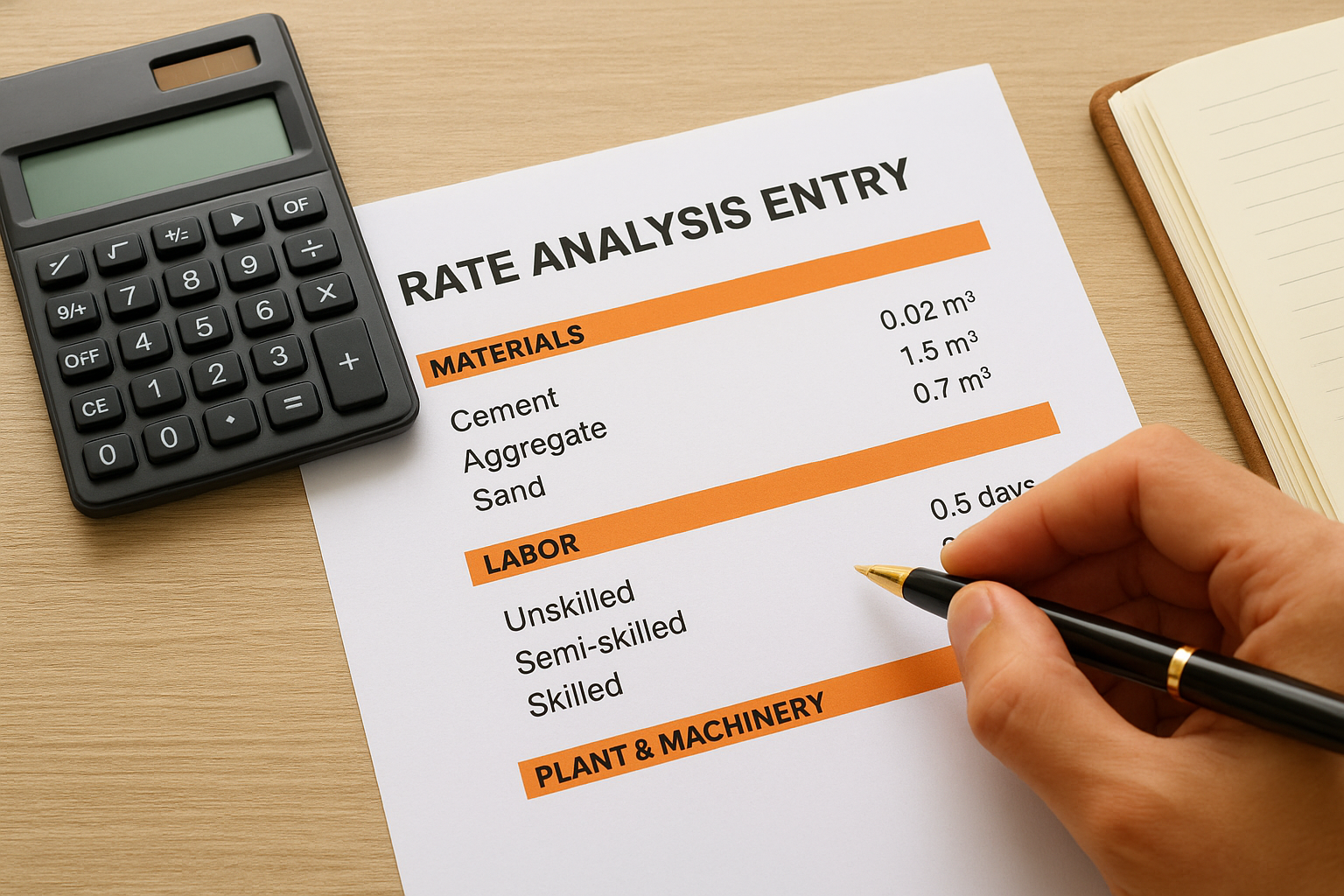
The three input categories every entry covers
Every rate analysis entry divides inputs into three categories: materials, labor, and plant and machinery. Materials appear with consumption constants expressed as a quantity per unit of output, for example, cubic meters of aggregate per cubic meter of compacted sub-base. Labor entries list the category of worker (unskilled, semi-skilled, or skilled) alongside the number of days or hours required per unit. Plant and machinery entries list each piece of equipment with its output rate per shift and the corresponding hire charge.
These three categories together give you a complete picture of production cost before you apply any local pricing. You build the rate by multiplying each input constant by its current market rate and summing the results. That total becomes your base rate for the item, which you then adjust for overhead, profit, and any site-specific factors the tender requires.
Treating the input constants as flexible is the most common mistake: the constants are standardized by the SDB, but the prices you apply to them must reflect current local market conditions.
How the entry handles equipment output
The equipment section of each entry deserves extra attention because it directly controls your unit rate calculation. Output rates for equipment are expressed as production per shift, typically eight hours, under defined terrain and soil conditions. When you calculate the plant cost per unit of output, you divide the hire rate per shift by the output per shift, giving you the equipment cost component per unit of finished work.
A small change in the output rate assumption can shift your rate significantly. Applying the plain terrain output rate to a rolling terrain project lowers your equipment cost per unit and produces a total rate that sits below the actual cost of executing that work. Always verify the terrain classification in the tender documents before you finalize any equipment cost calculation in your rate analysis sheet.
How to localize inputs without breaking logic
The MoRTH Standard Data Book sets the input constants, but it does not set the prices. Material costs, labor wages, and equipment hire rates all vary by state, district, and project timeline. Your job during estimation is to replace the placeholder pricing assumptions with current local figures while keeping the SDB's consumption constants and productivity norms exactly as published. Change the prices; never change the constants. That distinction is the entire logic of localization.
What inputs you can change without affecting accuracy
The SDB entries separate two types of data: quantities per unit of output (which you leave untouched) and the unit prices applied to those quantities (which you replace with current local rates). For example, if the SDB states that laying one cubic meter of dense bituminous macadam requires 2.45 tonnes of aggregate, that constant stays fixed. What you update is the price per tonne based on what quarries in the project district are currently charging.
The same logic applies to labor. The SDB specifies categories and hours, such as 0.25 days of a skilled worker per unit of output. Your localized input is the current daily wage rate for that category in the relevant state, drawn from state PWD schedules or recent market surveys. Changing the hours per unit to suit your assumption breaks the model; changing only the wage rate keeps the analysis defensible.
When an evaluator checks your rate analysis, they verify that your input constants match the SDB and that your prices are traceable to a recognized source, so document both clearly.
Where to source current local rates
State PWD schedule of rates publications are the most commonly accepted source for material, labor, and equipment hire rates in government bid submissions. Most state PWDs update these schedules annually or biannually, and quoting rates directly from the relevant state SOR gives your rate analysis an official reference point that evaluators recognize immediately.
For materials that fluctuate frequently, such as bitumen and steel, you can supplement state SOR prices with current MOPNG-notified bitumen prices or SAIL mill rates, depending on the item. Always attach a copy of the price reference you used to your rate analysis sheet when submitting. Equipment hire rates are best sourced from the state's published machinery hire charges schedule rather than estimated informally, because informal estimates are the first thing evaluators push back on during bid scrutiny.
How to build an estimate and BOQ from the SDB
Building a Bill of Quantities from the MoRTH Standard Data Book requires a specific sequence. You do not start with rates and work backward; you start with the project scope and map every line item to its corresponding SDB entry before you touch any pricing. That order keeps your estimate logically consistent and makes it defensible during evaluation.

Start with a complete scope breakdown
Before opening the SDB, list every distinct activity your project requires from site clearance through final road furniture. Your scope breakdown should follow the structure of the tender's BOQ preamble, which typically groups items by work category: earthwork, sub-base, base course, bituminous layers, drainage, and structures. Once you have that list, cross-reference each activity against the SDB volume and part that covers it. Road items pull from Volume I; structural items pull from Volume II. Mark every line item with its SDB item code before you begin any rate calculation.
Missing this mapping step early forces you to backfill item codes under time pressure, which is when errors in terrain classification and volume selection tend to appear.
Build item by item, not lump sum
Work through the BOQ one line item at a time using the SDB entry as your template. For each item, copy the input constants directly from the SDB into your rate analysis sheet without modification. Then attach current local prices to each input: state PWD schedule rates for labor and equipment, and verified market rates for materials. Sum the three cost components (materials, labor, plant) to arrive at your base rate per unit, then apply your overhead and profit percentage to reach the final quoted rate.
Repeat this process for every BOQ item rather than estimating a cluster of items as a single lump figure. Lump sum estimation hides cost distribution and makes it impossible to respond to evaluator queries about specific line items. When an evaluation engineer asks you to justify the rate for, say, lime-treated sub-grade, your item-by-item rate analysis sheet gives you an immediate, documented answer built directly from SDB norms.
Cross-check totals before submission
After completing all individual rate analyses, multiply each unit rate by the BOQ quantity and sum by work category. Compare these category totals to your internal benchmarks and to any published project cost estimates referenced in the tender notice. Large unexplained gaps between your total and the estimate signal either a missed item or a terrain classification error that you need to correct before submission.
How to use it during tendering and negotiations
The MoRTH Standard Data Book serves a purpose beyond building your internal estimate. During the active tendering phase and in post-award negotiations, it becomes a reference that both parties recognize as authoritative. Knowing how to deploy it at the right moment gives you a clear advantage over competitors who treat it purely as a pre-bid preparation tool.
Defend your rates under technical scrutiny
When an evaluation engineer queries your quoted rates, your first line of defense is a rate analysis sheet that traces every input back to a specific SDB entry. Present your working clearly: show the item code, the consumption constants taken directly from the SDB, and the local prices attached to each input. That paper trail shifts the burden back to the evaluator, who must now identify which specific norm you applied incorrectly rather than simply rejecting your figure on a general impression.
Evaluators are more likely to accept a rate that differs from the SOR when you can demonstrate it was built methodically from SDB norms with documented local price sources.
Prepare a summary table for your highest-value BOQ items before submission so you can respond to clarification requests within hours rather than days. Slow responses to technical queries signal poor preparation, and that perception affects your standing in the evaluation even when the rates themselves are sound.
Use it to price variation orders and extra items
Post-award, new items frequently emerge from design changes or site conditions the original BOQ did not anticipate. When the client's engineer proposes a rate for an extra item, compare it immediately against the relevant SDB entry and current state SOR input prices. If the proposed rate does not reflect current material costs or uses an outdated equipment output norm, you have a documented basis to negotiate upward before signing the variation order.
Many contractors accept variation rates without checking the SDB logic and later discover the agreed rate fails to cover actual site costs. Reviewing the SDB entry for every proposed extra item before you sign keeps your margin protected throughout execution rather than only at bid stage.
Support your claims during price escalation disputes
When you trigger a price escalation clause under a long-duration contract, the SDB's material consumption constants become critical evidence. Your claim for additional payment rests on showing how much of each material is legitimately required per unit of output. Because those constants come from the SDB rather than your own assumptions, they carry the official weight needed to resolve disputes without extended arbitration.
Common traps: leads, wastage, GST, and OH
The MoRTH Standard Data Book entries look straightforward until you try to finalize your quoted rates and realize four cost components are either missing or misapplied. Lead charges, wastage allowances, GST, and overhead percentages are the most common places where well-built rate analyses unravel right before submission. Each one follows a specific rule, and ignoring any of them produces a rate that either undersells your actual cost or fails technical scrutiny when an evaluator compares your working to the SDB norms.
Lead charges eat margins when left unaccounted
The SDB publishes base rates for materials at their source, not at your site. Lead charges cover the cost of transporting materials from quarry or supplier to the point of use, and they are not embedded in the standard SDB entry. You must calculate them separately and add them explicitly to your rate analysis sheet.
Lead distance directly affects your transport cost per unit of material. Confirm the actual haul distances from local quarries and suppliers using the project location data in the tender documents, then apply the current vehicle hire rates from the state SOR. Evaluators expect a separate lead calculation column in your rate analysis; omitting it produces a rate that looks artificially low and raises immediate questions.
Wastage factors are fixed, not optional
Every material entry in the SDB already incorporates a standard wastage factor for that item. Aggregate, bitumen, cement, and steel each carry a published wastage percentage that accounts for handling and on-site losses. If you add a second wastage allowance on top of what the SDB has already built in, you double-count the waste and your material cost inflates above the defensible norm.
Review each SDB entry's footnotes before adding any separate wastage line to confirm whether the consumption constant already includes the allowance.
GST and overhead require explicit treatment
GST applies to material supply and to plant hire charges at rates that vary by item category. The SDB base analysis does not include GST because tax treatment differs by contract type and supply arrangement. You must add it as a separate line item after your base rate calculation rather than burying it inside a material price.
Overhead and profit percentages need the same explicit treatment. Apply your overhead rate only to the base cost (materials plus labor plus plant), not to a figure that already includes GST, or you inflate your overhead claim beyond what the contract structure supports. State the overhead percentage clearly on your rate analysis sheet so an evaluator can verify it independently.
How to confirm authenticity and latest revision
Working from an outdated or unofficial copy of the MoRTH Standard Data Book is a risk that shows up at the worst possible moment: during technical evaluation, when an evaluator points out that your rate analysis references norms that were revised in a later edition. Confirming both the authenticity and the current revision status of your copy before you begin estimation takes less than fifteen minutes and eliminates a category of error that is entirely preventable.
Where to find the official source
The only authoritative source for the MoRTH Standard Data Book is the Ministry of Road Transport and Highways itself, either through its official publications or through the Indian Roads Congress (IRC), which distributes MoRTH technical publications. Do not rely on copies downloaded from third-party document-sharing sites, private forums, or contractor networks. These versions circulate widely but frequently carry formatting errors, missing annexures, or version numbers that do not match the edition currently in circulation.
Your safest practice is to source the document directly from the IRC sales office or the official MoRTH portal, and to keep a record of the purchase or download date alongside the edition details.
When you obtain the document officially, you receive a clear title page stating the edition year and the issuing authority. Keep that title page accessible when you submit your rate analysis sheets, because evaluators sometimes ask for the source reference during bid scrutiny.
How to verify the edition you are using
Every edition of the SDB carries an edition year and a revision history in its front matter. Open this section before you use any data and confirm that the edition matches what the tender document specifies or what the relevant state agency has adopted. Some state PWDs reference a specific SDB edition in their tender preamble, which means your rate analysis must align with that exact edition rather than the most recent national release.
Cross-check critical items between your copy and any official corrigendum notices published by MoRTH after the edition's release date. Corrigenda correct specific entries without triggering a full new edition, and ignoring them means your consumption constants or output rates may be wrong on those particular items. The IRC website and the MoRTH portal publish these notices when they are issued, so build a habit of checking for updates each time you begin a new estimation exercise rather than assuming your saved copy reflects the current state of the document.
What to do next
The MoRTH Standard Data Book is the foundation of every defensible highway bid, from your first rate analysis entry to your final variation order negotiation. You now know which volumes to pull by work type, how to apply terrain classifications correctly, where lead charges and wastage factors sit in the calculation, and how to confirm you are working from an authentic, current edition. These are not minor details; they determine whether your rates survive technical scrutiny or draw clarification requests that cost you time and credibility.
The next practical step is to match that estimation precision with an equally disciplined approach to finding the right tenders in the first place. Spending hours building an SDB-aligned rate analysis on a contract your firm does not qualify for wastes exactly the preparation effort this article describes. See how Arched identifies your most viable MoRTH and highway tenders before you commit that time, so your estimating work lands on bids you can realistically win.
The Data Book supplies the analysis; the rates it is applied against come from the applicable state schedule. The Schedule of Rates by state directory lists the current edition for each, with searchable rate tables where available. Some states run the same analysis-plus-basic-rates split internally: Andhra Pradesh prices civil work through the A.P. Revised Standard Data rather than through its schedule, which is the closest state-level analogue to how the Data Book works.