MoRTH Standard Bidding Document: Templates, Rules, Uses
MoRTH Standard Bidding Document: Templates, Rules, Uses
Every road construction or highway upgrade contract awarded by the Ministry of Road Transport & Highways follows a fixed procurement framework, and at the center of it sits the MoRTH standard bidding document. This document defines the rules of engagement: who can bid, what qualifications they need, how prices must be quoted, and what contractual terms govern the entire project lifecycle. If you're bidding on national highway projects, bridge construction, or any MoRTH-funded civil works, you're working within this template whether you like it or not.
The problem? These documents are dense, heavily cross-referenced, and updated periodically, meaning a clause you relied on last year may have shifted or been replaced entirely. Missing a single eligibility criterion buried on page 47 can disqualify an otherwise strong bid.
This article breaks down the MoRTH standard bidding document, its structure, key templates and annexures, the rules that govern its use, and how contractors and consultants should approach it. Whether you're preparing your first MoRTH bid or tightening your process for the next one, this is the reference you'll want to keep close.
What the MoRTH SBD is and what it contains
The MoRTH standard bidding document is the official procurement template issued by the Ministry of Road Transport & Highways for awarding civil construction contracts on national highway projects. It draws from the FIDIC Conditions of Contract framework, adapted to Indian public procurement norms, and governs everything from how bids are invited to how disputes are resolved after contract award. When any NHAI-linked or state highway authority tender references MoRTH guidelines, this document is driving the process.
Core structure of the SBD
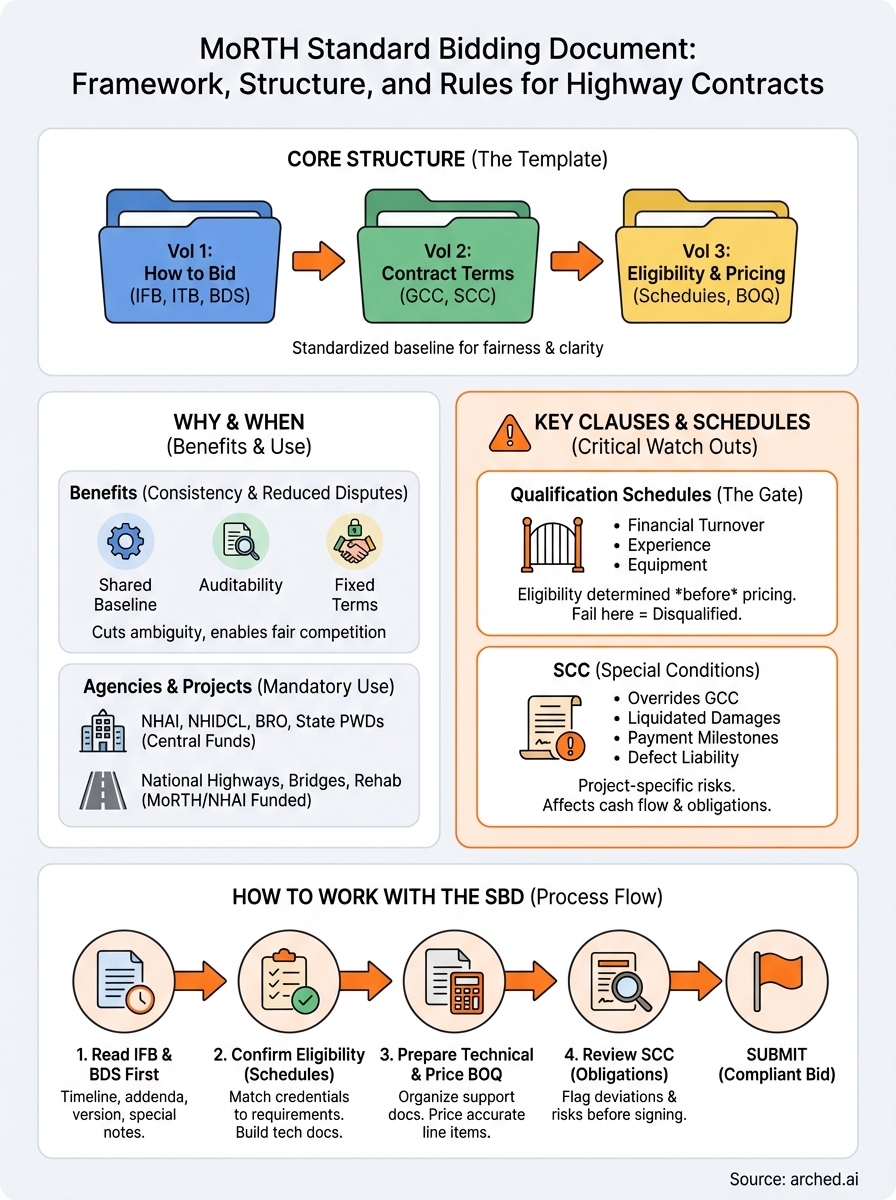
Divided into clearly defined volumes and sections, each part serves a specific role in the procurement process. The Invitation for Bids (IFB), Instructions to Bidders (ITB), and Bid Data Sheet (BDS) sit at the front and tell you exactly how to prepare and submit a compliant bid. The General Conditions of Contract (GCC) and Special Conditions of Contract (SCC) follow, setting the legal and operational terms that bind you once you win the contract.
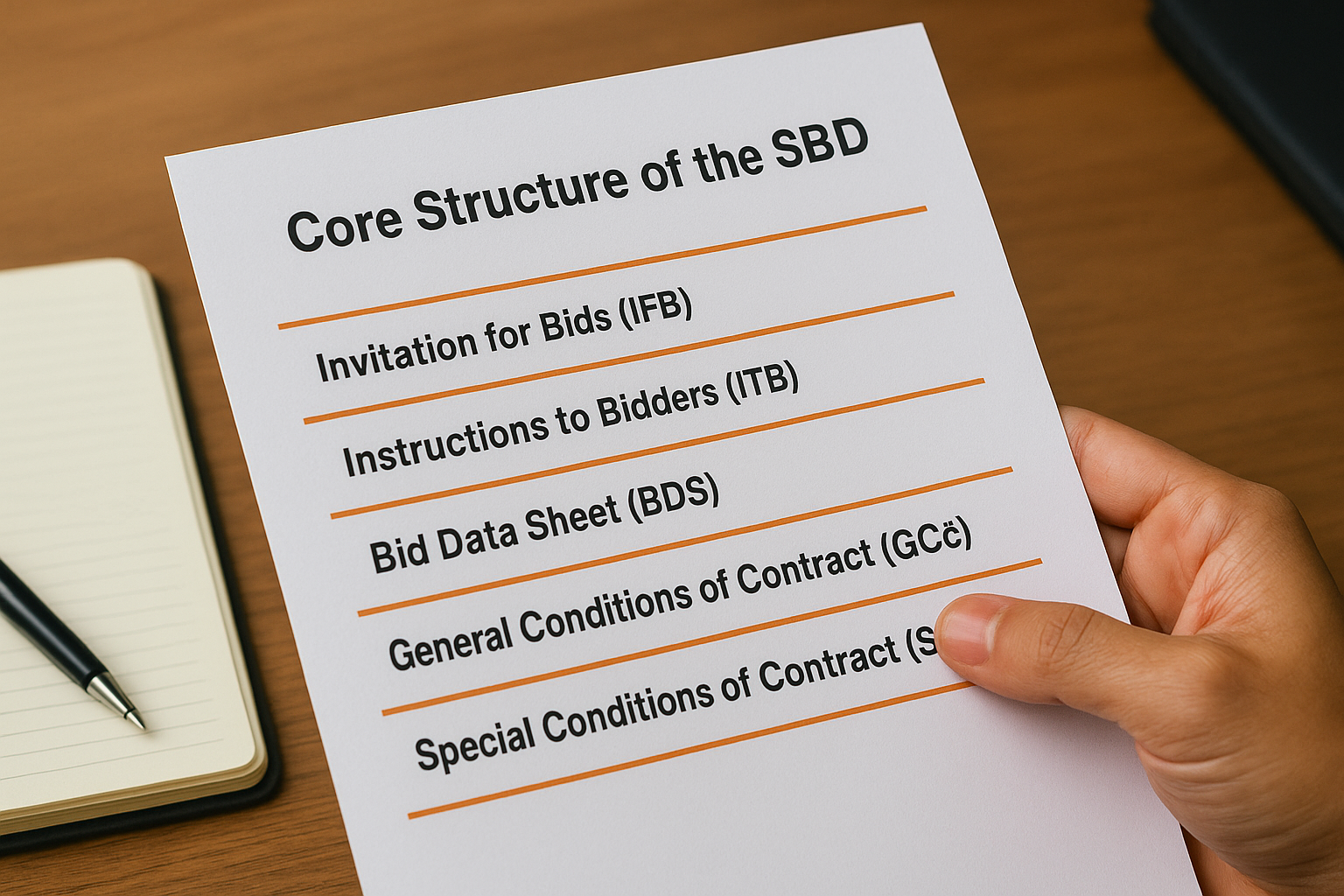
Missing or misreading any one of these sections before you submit can result in a non-responsive bid, regardless of how competitive your price is.
Key schedules and annexures
Beyond the main body, the SBD includes schedules covering equipment, personnel, and minimum financial turnover requirements that you must satisfy at the qualification stage. These schedules decide your eligibility before anyone even opens your price envelope. The Bill of Quantities (BOQ) is also embedded within the document and defines exact line items, units of measurement, and provisional sums you need to price accurately. Errors in the BOQ at submission are difficult to correct later and can expose you to significant contractual risk.
Taken together, these components make the SBD a complete contracting package, not just a bid form. Understanding every layer of it before you start preparing your response is what separates competitive bids from disqualified ones.
Why MoRTH uses standard bidding documents
The Indian public procurement landscape involves thousands of contractors, consultants, and government agencies operating across different states and project types. Without a consistent framework, every tender would follow different rules, making it nearly impossible for contractors to compare opportunities or prepare reliable bids. The morth standard bidding document solves this by giving every party a shared baseline, from the smallest regional contractor to the largest infrastructure firm bidding on multi-hundred-crore highway packages. Standardization also makes the evaluation process auditable, which matters enormously in a sector where public funds and accountability are both under scrutiny.
Consistency, Transparency, and Reduced Disputes
Standardization removes ambiguity from the process. When qualification criteria, contractual terms, and BOQ formats are fixed in advance, both the awarding authority and the bidder know exactly what's expected. This cuts down on post-award disputes that typically arise from vague contract language. It also makes it significantly harder for individual officials to insert unusual terms or bend eligibility rules, which directly supports fair competition and financial accountability across all public works spending.
A standardized document also means your legal and technical teams can build reusable review processes instead of starting from scratch on every new tender.
When to use it and which agencies follow it
The morth standard bidding document applies when a central or state body procures civil works on national highway corridors funded by MoRTH or NHAI. If the contract involves road construction, bridge works, or highway rehabilitation, this document governs the bid process. Knowing this upfront saves you from preparing a non-compliant submission.
Agencies that mandate the SBD
NHAI is the most prominent body requiring SBD compliance, but several others follow the same framework. Border Roads Organisation (BRO) and NHIDCL also adopt MoRTH templates for centrally funded projects.
Agencies that follow MoRTH SBD requirements:
- NHAI (national highway packages)
- NHIDCL (northeastern states and border regions)
- BRO (strategic road projects)
- State PWDs (for centrally funded contracts)
If project funding flows from MoRTH, assume the SBD framework applies until the tender document confirms otherwise.
When state tenders follow MoRTH rules
State highway authorities adopt the SBD when central funds or externally aided project money finances the contract. World Bank or ADB-funded road projects in India frequently reference MoRTH templates as their baseline.
The influence runs deeper than the bid forms: Uttar Pradesh PWD requires its circle Schedules of Rates to follow MoRT&H and MORD specifications for highway, district road and bridge works, so the rates themselves are built on the central specification even where no central money is involved.
Adapting only the special conditions to suit lender requirements is standard practice in these cases. Check the funding source early so you know which version you're working with before document preparation begins.
How to work with the SBD from notice to award
Working through the morth standard bidding document follows a predictable sequence, and getting each stage right matters more than rushing to submit. Your first job is understanding the procurement timeline set out in the IFB before you touch any other section.
Read the IFB and BDS first
The Invitation for Bids and Bid Data Sheet tell you submission deadlines, clarification windows, and any pre-bid meeting dates. These two sections also confirm which version of the SBD governs the contract and whether any special conditions have been layered on top of the standard template.
Missing a pre-bid meeting can leave your team working from wrong assumptions that carry through to your final submission.
Always download the final addenda from the official portal before locking your submission, since clarification responses can change critical requirements.
Build your submission in the right order
Treating each section as a gate you must pass before moving forward prevents wasted effort on pricing before your eligibility is confirmed. Follow this sequence:
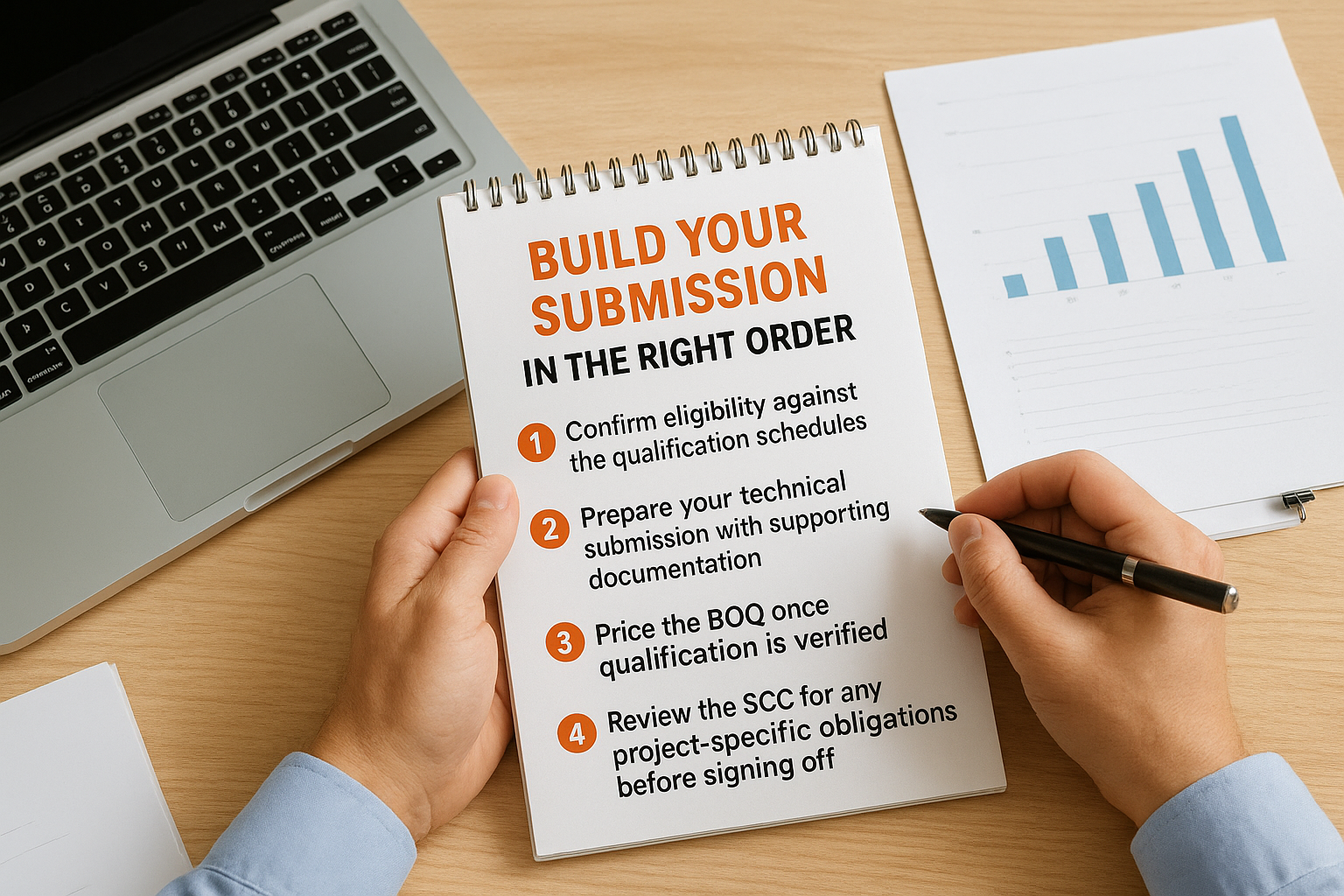
- Confirm eligibility against the qualification schedules
- Prepare your technical submission with supporting documentation
- Price the BOQ once qualification is verified
- Review the SCC for any project-specific obligations before signing off
Clauses and schedules that decide your bid
Two parts of the morth standard bidding document carry more weight than any other: the qualification schedules and the contract clauses. The qualification schedules set minimum financial turnover, equipment ownership, and past project experience thresholds before your price is ever considered. If your credentials don't clear these benchmarks, your technical envelope gets rejected outright.
Review the qualification schedules before committing any resources to bid preparation.
Key clauses to flag before submitting
The Special Conditions of Contract (SCC) often contain project-specific modifications that override the general conditions. Pay close attention to liquidated damages rates, defect liability periods, and payment milestone triggers, since these directly affect your cash flow planning and risk exposure. Flag each deviation from the standard GCC so your commercial and legal teams can price the risk correctly before submission.
Schedules that set your eligibility floor
The schedules covering minimum annual turnover and similar work experience are your first gate. Many firms fail here not because they lack the experience but because they submit poorly organized supporting documentation. Match each schedule requirement to a specific document in your submission and clearly label the correspondence. The evaluating committee should be able to confirm your eligibility without searching for evidence across a scattered file.
Next steps for your next MoRTH bid
The morth standard bidding document is a fixed framework, but how well you work within it determines whether you win or get disqualified before the price envelope opens. Start by mapping every qualification schedule to your firm's current credentials so you know your eligibility gaps before the next relevant tender appears. If you're missing specific experience thresholds or certifications, use smaller contracts to build toward the larger packages you want to win.
Your next bid preparation should follow the same sequence every time: confirm eligibility first, prepare technical documents second, price the BOQ last. This order prevents wasted effort and protects your commercial position. Tracking addenda and portal updates manually eats time you should spend on the bid itself.
If you want the pricing step handled for you, Arched can prepare the priced BOQ for your MoRTH bid: send the drawings and SBD, and we deliver a reviewed estimate with rate build-ups. See how our estimating service works.
Have a package your team can’t get to? Send it to us. Our engineers check and sign off everything we deliver.