CPWD Analysis of Rates 2023: Current Edition & DSR
Every government construction estimate in India built under CPWD specifications starts with one document: the CPWD Analysis of Rates, commonly called the Delhi Analysis of Rates (DAR). It breaks down the cost of each construction item, materials, labor, machinery, overhead, into a transparent, auditable formula that engineers and contractors can trace line by line.
If you bid on CPWD or state PWD tenders, the DAR directly shapes the rates you're competing against. Misreading a rate analysis, or worse, ignoring how a particular item was derived, can mean quoting too high and losing the bid, or quoting too low and bleeding money during execution. For BD managers and bid teams at infrastructure firms, understanding DAR isn't optional; it's the baseline for every cost decision you make on a government project.
This article covers what the CPWD Analysis of Rates includes, how each section is structured, and how to actually use it when preparing estimates and bids. We also explain where the DAR fits alongside other CPWD publications like the DSR and CSR. If you want to look up a specific analysis while you read, the full CPWD Analysis of Rates 2023 (Civil) is reproduced here as free, searchable tables — every item's material, labour and machinery build-up. At Arched, we build estimates and BOQs on DAR-derived rates, state SORs or market rates for contractors' tenders, with an engineer reviewing every rate build-up.
Which edition is current
The CPWD Analysis of Rates in force is the DAR 2023 (Civil). Both volumes carry 14 September 2023 on their title pages. There is no 2025-26 or 2026-27 Analysis of Rates: the CPWD publications page, checked on 8 September 2026, still lists the 2023 volumes as the current edition, and they stay in force until CPWD issues a successor.
This is worth stating plainly because two different CPWD documents get searched for under the same words, and they are on different cycles:
| Current edition | What it gives you | |
|---|---|---|
| Analysis of Rates (DAR) | 2023, dated 14 September 2023 | The cost formula — every material quantity, labour gang and machinery hour behind a rate |
| Schedule of Rates (DSR) | 2024, superseding 2021 | The finished composite rate for the same item, arithmetic already done |
If you searched for the "CPWD Schedule of Rates" and wanted a priced list to drop into a BOQ, the DSR is the document you want. If you need to defend or reconstruct a rate — to justify a quote at technical scrutiny, or to work out why a competitor's number is lower — the analysis below is where the arithmetic lives.
All 3,149 analyses, searchable
The DAR 2023 Civil volumes are reproduced here in full: 3,149 rate analyses across 26 sub-heads, each with its complete material, labour and machinery build-up and its derived rate. Some starting points:
- Earth Work — 80 analyses
- Concrete Work, Reinforced Cement Concrete and Mortars
- Masonry Work and Stone Work
- Water Supply — 698 analyses, the largest sub-head
- Road Work and Repairs to Buildings
Rates are worked at 18% GST, with contractor's profit and overheads applied as CPWD sets them. Source: the CPWD Delhi Analysis of Rates 2023 (Civil), Volumes I & II, from cpwd.gov.in, retrieved 8 September 2026.
What CPWD analysis of rates means in practice
When you open a DAR volume, you are looking at a cost formula, not a price list. Each item, whether it is brick masonry, reinforced concrete work, or external plaster finish, is broken into its raw components: the quantity of each material required to complete one unit of work, the labor hours needed, any machinery usage, and the overhead and contractor profit layered on top. The CPWD analysis of rates gives every party in a government contract, the client department, the estimating engineer, the auditor, and the bidder, a shared reference point for what any given item of work should cost under standard conditions. That shared reference is what makes government construction contracts auditable at the line-item level, and it is why the DAR carries so much weight in tender estimation across India.
The formula behind a single construction rate
A typical rate analysis entry for one cubic meter of M20 concrete will list the cement bags, sand in cubic feet, coarse aggregate in cubic feet, and water required, alongside the number of mason and unskilled labor days needed. Each of these inputs is multiplied by its basic rate, which CPWD publishes separately, and the totals are added to arrive at the composite rate for that item. You can verify every number independently, which is exactly what auditors do, and what your estimating team should do before committing those rates to a bid.
The rate analysis is the audit trail of a construction cost. Without it, a contractor cannot defend a price, and an engineer cannot verify one.
From a practical standpoint, this formula-based structure means no rate is arbitrary. If material prices shift in your region, you adjust the basic rate input, and the composite rate adjusts proportionally. If your project uses a higher cement content than the standard assumed in the analysis, you substitute that input and document the change. The analysis gives you a reproducible method, not just a number, and that reproducibility is what makes it defensible during scrutiny.
Why DAR functions as a shared contractual reference
CPWD publishes the DAR because government procurement requires a neutral, auditable baseline that all parties can reference without dispute. When a PWD engineer approves a rate in a detailed estimate, they are signing off on the arithmetic inside the analysis, not just the final figure. When a contractor submits a quoted rate that deviates from the DAR, they are implicitly asserting that their input costs, productivity assumptions, or overhead structure differ from the standard. They need to be prepared to justify that deviation during technical scrutiny or audit.
For your team, this means reading DAR correctly is a risk management activity, not just an estimation exercise. If you quote below the DAR-derived rate for a major item, you need to know exactly which input you are saving on and whether that saving holds up at execution in your project's location and conditions. Quoting above without documented justification invites rejection or negotiation pressure from the client department. The analysis gives you the evidence base to price confidently and defend that price if questioned.
Understanding this point also helps you read competitors' bids more clearly. When a rival quotes significantly below the DAR-derived rate on a high-volume item, that is a signal worth investigating, not just accepting. Either they have a genuine input cost advantage, or there is a gap between their bid and what execution will actually cost them.
What DAR includes and how it is organized
The CPWD analysis of rates is published in multiple volumes, each covering a specific category of construction work. CPWD organizes the DAR this way so that civil, electrical, horticulture, and specialized works are each handled by the relevant discipline without cluttering a single document. When you pull a volume for your project type, you are looking at a self-contained reference for that category, with all inputs, assumptions, and derivation steps already documented inside it.
The volume structure and scope
CPWD splits the DAR broadly across civil works, sanitary and plumbing, electrical installations, and horticulture, with additional volumes covering road works and specialized items as needed. Each volume follows the same internal logic: items are grouped by trade or work type, such as earthwork, concrete work, masonry, finishing, and structural steel. Within each group, items are ordered by unit of measurement, cubic meter, square meter, running meter, or per unit, so you can locate the right entry quickly once you know the trade and unit you are working with.
Once you identify which volume applies to your project scope, navigation inside that volume becomes straightforward because the grouping logic stays consistent throughout.
The practical benefit of this structure is that your estimating team does not need to hunt across an entire document every time they need a rate. A concrete item is always in the concrete section, a plastering item is always in the finishing section, and so on. That consistency reduces lookup time and lowers the chance of pulling the wrong rate by mistake.
How each item entry is laid out
Each entry in the DAR follows a fixed format. It opens with a brief description of the work item and its unit, then lists every material input with a quantity and a basic rate placeholder. Labor inputs follow, listed by skill category, such as mason, bhishti, and mazdoor, with the assumed gang composition and productivity rate for one unit of output. Machinery or plant items, where applicable, are listed with hire rate assumptions.
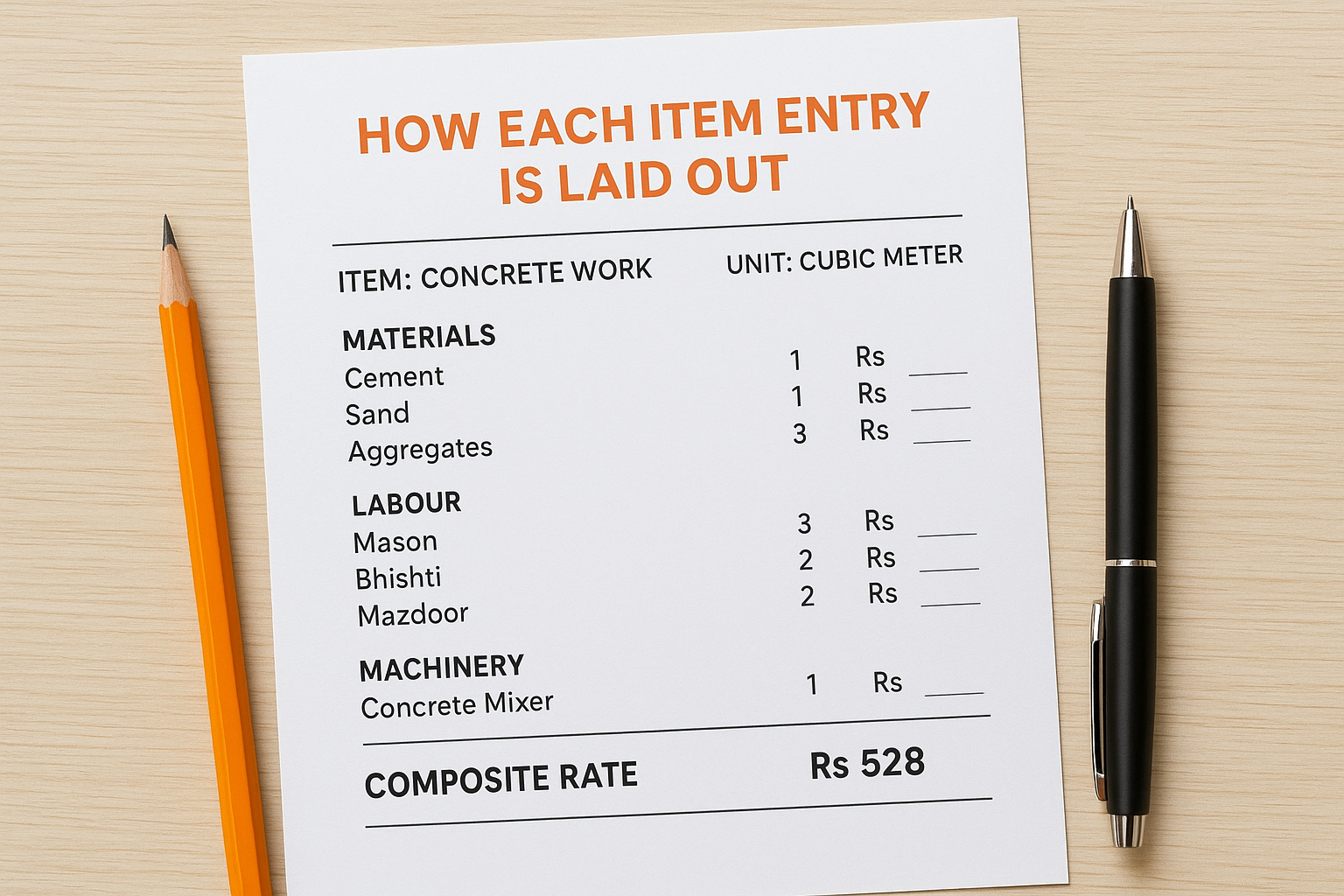
The final lines of each entry aggregate those inputs into a composite rate per unit, which then feeds into your Bill of Quantities. Seeing the full entry laid out this way makes it immediately clear which inputs drive the bulk of the cost for any given item.
DAR vs DSR vs specifications and plinth area rates
CPWD publishes several interconnected documents, and confusing them costs time and leads to estimation errors. The Delhi Analysis of Rates (DAR) gives you the cost formula for each item of work. The Delhi Schedule of Rates (DSR) gives you the final composite rate for that same item, with the arithmetic from the analysis already completed. Think of DAR as the working-out and DSR as the final answer. Both come from CPWD, but they serve different purposes at different stages of your project workflow.
How the DSR fits alongside the DAR
The DSR compiles the finished rates that come out of the DAR analysis, organized by work item and updated periodically to reflect changes in basic material and labor costs. When a CPWD engineer prepares a detailed estimate, they typically pull rates from the DSR. When a contractor or auditor wants to verify how that rate was derived, they go back to the CPWD analysis of rates in the DAR. The two documents are designed to work together, not substitute for each other.

Your state PWD publishes its own Schedule of Rates and corresponding analysis if you work on tenders outside Delhi, often calibrated to local material costs and labor norms. The structure mirrors CPWD's approach, but the input quantities and basic rates differ, so never apply Delhi-specific DSR rates directly to a project in another state without adjusting the underlying analysis first.
Using DSR rates from the wrong region without checking the analysis inputs is one of the fastest ways to produce an estimate that fails scrutiny.
How specifications and plinth area rates fit in
CPWD specifications define the quality standards and method of execution for each item listed in the DAR and DSR. They tell you what grade of cement to use, what compaction standard applies, and how workmanship will be tested. The analysis assumes you are working to those specifications, so if your project deviates, your rates need to reflect that adjustment. Plinth area rates, on the other hand, are broad approximations used for early-stage feasibility estimates. They express the approximate cost per square meter of a building type and work for rough budget sizing, but they carry no line-item defensibility. Once a project moves to the detailed estimate stage, you shift entirely to DAR-derived rates.
How CPWD builds basic rates, labour, and GST
Before you can use any rate from the CPWD analysis of rates, you need to understand what sits underneath it. CPWD derives its composite rates from three primary building blocks: basic material rates, labour costs, and applicable taxes. Each block is calculated separately and then combined to produce the final rate you see in the DAR. Knowing how each block works lets you spot where a rate may shift for your specific project conditions.
How basic material rates are set
CPWD sets basic material rates by surveying wholesale prices at specific market locations, typically Delhi for the standard DAR. The rates reflect the cost of materials delivered to the site at a notional standard distance, with a lead and lift allowance already factored in for common scenarios. When your project sits far from the standard supply point, or when materials are sourced regionally at different prices, you substitute the actual basic rate and the composite figure adjusts accordingly.
Always verify the basic material rates in your DAR edition against current market prices before finalizing your estimate, especially for steel, cement, and aggregates, which fluctuate significantly between regions and seasons.
Material inputs in each analysis entry are expressed as quantities per unit of finished work, so one cubic meter of brick masonry shows exactly how many bricks, how much mortar, and how much water the analysis assumes. Those quantities reflect CPWD's standard productivity and wastage assumptions, and you can challenge or adjust them if your project conditions differ from the standard.
How labour is costed in the analysis
Labour in the DAR is expressed as gang compositions per unit of output, listing skilled workers such as masons and carpenters alongside unskilled mazdoors and supporting trades. Each category carries a scheduled daily wage rate that CPWD updates periodically. Productivity assumptions embedded in the analysis determine how many labour days each trade contributes per unit of work, so if your project involves more complex site conditions or a tighter programme, those assumptions need direct review before you commit to a price.
Where GST sits in the rate structure
GST is not embedded inside the analysis arithmetic for individual items. It applies as a separate summary-level addition on top of the composite rate, at the applicable rate for works contracts under current GST rules. Adding GST at the summary level rather than inflating individual item rates keeps your line-item analysis clean and fully auditable during departmental scrutiny or audit.
How to use DAR to prepare a rate analysis
Using the CPWD analysis of rates effectively starts with treating it as a working template rather than a lookup table. Your goal is to move through each item in your Bill of Quantities, trace back to the relevant DAR entry, confirm the input quantities and basic rates, and then build your own documented rate sheet that mirrors the DAR's structure for your specific project. That documented sheet is what you submit, defend during scrutiny, and update if input prices change after the bid.
Step through the item entry before writing any numbers
Before you copy any composite rate from the DAR into your estimate, open the full item entry and read through every input line. Identify the material quantities assumed, the labor gang composition, and any machinery components listed. Compare those assumptions directly against your project scope and site conditions, because the DAR uses standard assumptions that may not match your actual situation. If your project uses a different mortar mix or a non-standard concrete grade, that difference needs to be documented before you commit to the rate.
Copying a composite rate without reading the underlying entry is the single biggest source of estimation errors on CPWD projects.
Cross-check your quantities against the analysis
Once you confirm the input assumptions are valid for your project, verify the basic material rates listed in your DAR edition against current market prices in your procurement region. The DAR assumes specific supply-point pricing for Delhi, so if you are working outside that region or if prices have shifted since the edition was published, you need to substitute the correct basic rates and recalculate the composite. Do this for high-value inputs first: cement, steel, and aggregate typically drive the largest share of the composite rate, so a small per-unit price difference multiplied across a large quantity creates a significant budget variance.
Build your summary sheet from the verified entries
After verifying each entry, compile your summary rate sheet by listing each BOQ item, its DAR reference number, the verified input quantities, the basic rates applied, and the resulting composite rate. This format mirrors how the DAR itself is structured, which makes departmental review straightforward. Any item where your inputs differ from the standard DAR assumptions should include a brief written justification in a notes column so that your deviation is visible and defensible from the start.
How to adapt DAR to your project and location
The CPWD analysis of rates is built around Delhi-centric pricing and standard site conditions. Your project almost certainly operates under different conditions, whether that is a remote hill site in Himachal Pradesh, a coastal location in Kerala, or an urban redevelopment project in Pune. Adapting the DAR to your specific context is not optional; it is the step that converts a generic government reference into a defensible, project-specific estimate that holds up when the client department reviews your numbers.
Adjusting for regional material costs
Material prices vary significantly across India, and the DAR's published basic rates reflect Delhi wholesale prices at the time of the edition. Before you finalize any composite rate, pull current market prices for cement, steel, sand, and aggregate from your actual procurement region and compare them directly against the DAR's assumed basic rates. Where the gap is large, substitute your regional price into the analysis entry and recalculate the composite.

Failing to update basic material rates for your region is the most common reason a technically correct DAR-based estimate still fails to reflect actual project economics.
You should also account for lead and transport costs specific to your site. If the nearest cement depot is 120 kilometers from your project location, the notional lead assumed in the standard DAR does not apply. Add the actual transport cost per unit as a separate adjustment line in your rate sheet so the deviation is visible and auditable rather than buried inside a lump sum.
Accounting for site-specific conditions
Physical site conditions directly affect the productivity assumptions embedded in each DAR entry. A project involving deep foundation work in waterlogged soil or masonry work at significant height above ground level will consume more labor time per unit than the standard gang output the DAR assumes. Review the labor composition and daily output rates in each relevant entry and apply a location or difficulty factor where your site deviates from level, dry, accessible ground.
Some state PWDs publish their own correction factors or location multipliers for this purpose, which you can apply formally within the rate sheet. Where no official multiplier exists, document your own site assessment rationale in writing so that your adjustment is traceable during technical scrutiny rather than appearing as an unsupported override of the standard analysis.
Common mistakes and quick validation checks
Even experienced estimators make avoidable errors when working with the CPWD analysis of rates. Most of these errors share a common root: treating the DAR as a static lookup table rather than a formula that requires active verification at every stage. Running a few structured validation checks before you finalize your estimate catches the majority of problems before they reach departmental review.
Mistakes that appear most often
The most damaging mistake is applying a composite rate from an outdated DAR edition without confirming that the basic material rates still reflect current market prices. Steel and cement prices shift frequently, and a rate built on old basic inputs can diverge significantly from actual execution costs. A second common error is pulling rates from the wrong volume or project region, particularly when a bid covers civil and electrical work at the same time and the estimator consolidates everything without distinguishing the source volumes.
Never merge rates from different DAR volumes or different regional schedules into a single estimate without labeling each source clearly.
Omitting the lead and transport cost adjustment for sites outside Delhi is another frequent gap. Estimators apply Delhi-based basic rates to projects in other states, then add a lump sum contingency instead of building the adjustment formally into each affected rate entry. That approach looks reasonable inside a spreadsheet but fails immediately under departmental scrutiny.
Quick checks to run before submission
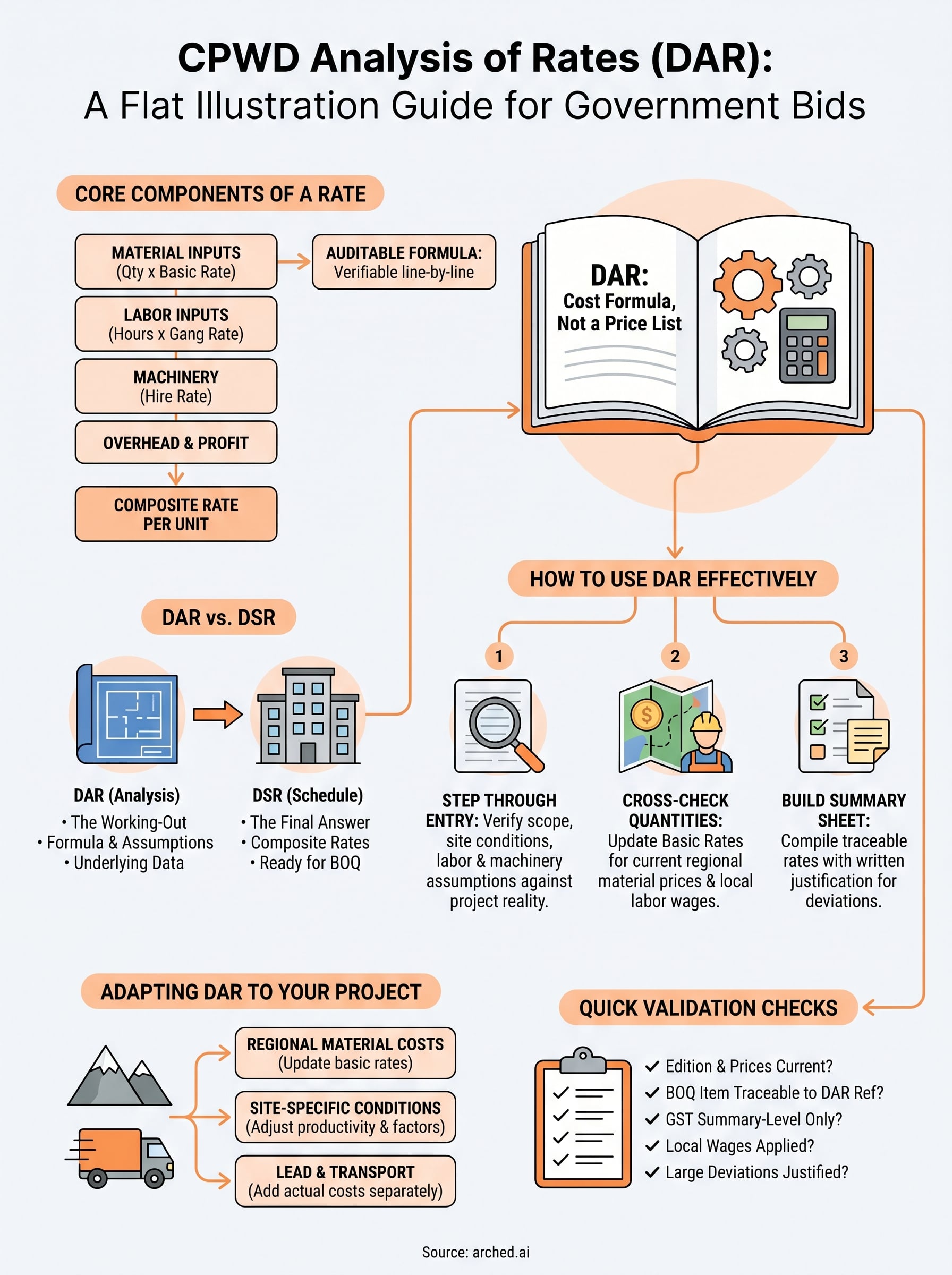
Before you finalize any estimate, confirm that your rate sheet is fully traceable back to specific DAR entries. A validated estimate holds up under audit; an untraced one does not. Run through these five checks before submission:
- Confirm the DAR edition year and cross-check cement, steel, and aggregate basic rates against current regional market prices.
- Verify that every BOQ item traces back to a specific DAR entry reference number, not a generic description.
- Check that GST is applied at the summary level only, not embedded inside individual composite item rates.
- Confirm labor rates reflect the current scheduled wage for your state, not the Delhi rate if your project is located elsewhere.
- Review any composite rate that deviates from the standard DAR entry by more than 10 percent and attach a written justification note to that line.
These five checks take under an hour and directly reduce the risk of a rate being challenged during scrutiny or audit.
Final takeaways
The CPWD analysis of rates is a cost formula, not a price list. Every composite rate in the DAR is built from auditable inputs, and your job as an estimator is to verify those inputs against your actual project conditions before committing any number to a bid. Outdated basic rates, wrong regional pricing, and untraced composite entries are the three failure points that cause estimates to collapse under departmental scrutiny.
Adapt the DAR to your location, document every deviation with a written justification, and apply GST only at the summary level. Your estimate is only as strong as the audit trail behind each rate. Run the five validation checks before submission and your team avoids the most common, most avoidable errors in government project bidding.
If you would rather not build every rate analysis yourself, see how Arched's estimating service works: we deliver a priced BOQ with rate build-ups on the rate basis you choose, reviewed by an engineer.
Where a state works to its own schedule rather than the CPWD analysis, the Schedule of Rates by state directory gives the current edition and official source, with searchable rate tables for the schedules already transcribed. The check on basic-rate currency above matters most where the state schedule is old — the Maharashtra PWD SSR has been effective since 25 July 2022 with no later edition published. The dependency also runs the other way: the Uttar Pradesh PWD circle schedules price cement, white lime and steel reinforcement as "As per CPWD DSR" rather than fixing a rate of their own, so a UP estimate cannot be closed without the central schedule.
Have a package your team can’t get to? Send it to us. Our engineers check and sign off everything we deliver.