CPWD DSR: Volumes, Updates, And Correction Slips Explained
Every cost estimate in a CPWD project starts with one document: the CPWD DSR. The Delhi Schedule of Rates is the official reference that defines unit rates for materials, labor, and construction activities across central government works. Whether you're preparing a detailed estimate for a road project or cross-checking a Bill of Quantities for a building contract, the DSR is where the numbers come from.
But staying current with DSR updates isn't straightforward. CPWD publishes multiple volumes, issues periodic correction slips, and revises rates across editions, most recently in 2024. Missing a correction slip or referencing an outdated rate can throw off your entire bid. For firms that handle government tenders regularly, this creates real risk, and real administrative overhead. At Arched, we build estimates on the DSR edition the tender specifies, with the correction slips that apply to it.
This article breaks down the CPWD DSR structure, volumes, editions, correction slips, and where to access them, so you have a clear, working reference for your next estimate. We'll cover what changed between the 2021 and 2024 editions, how correction slips modify published rates, and how to make sure you're always working with the right numbers.
What CPWD DSR is and what it covers
The CPWD DSR (Delhi Schedule of Rates) is the official rate schedule published by the Central Public Works Department of India. It sets standardized unit rates for construction materials, labor, equipment, and composite works used in central government projects. Every rate in the DSR reflects specific technical specifications and working conditions, so when you apply a rate from the schedule, you're applying a defined scope of work with built-in assumptions, not just a standalone number pulled from market data.
What the DSR includes
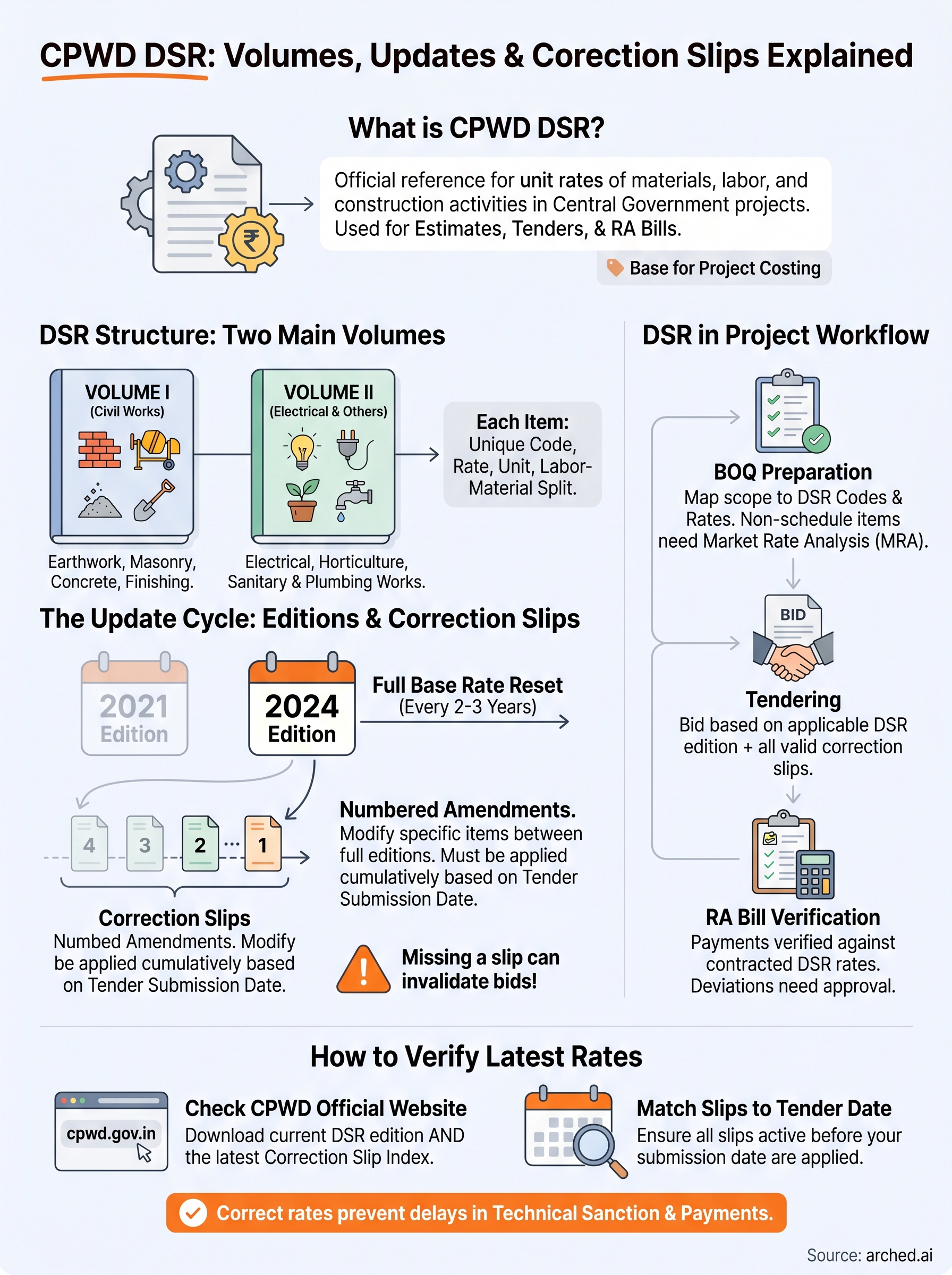
The schedule covers a broad range of construction activities organized across two main volumes. Volume I handles civil works, which includes earthwork, masonry, concrete structures, plastering, flooring, and finishing items. Volume II covers electrical installations, horticulture, and sanitary or plumbing works. Each line item in the schedule carries a unique code, a technical description, a unit of measurement, and a base rate. The DSR also specifies the percentage split between labor and material components within each rate, which directly affects how you calculate area-specific adjustments and escalation clauses in long-duration contracts.
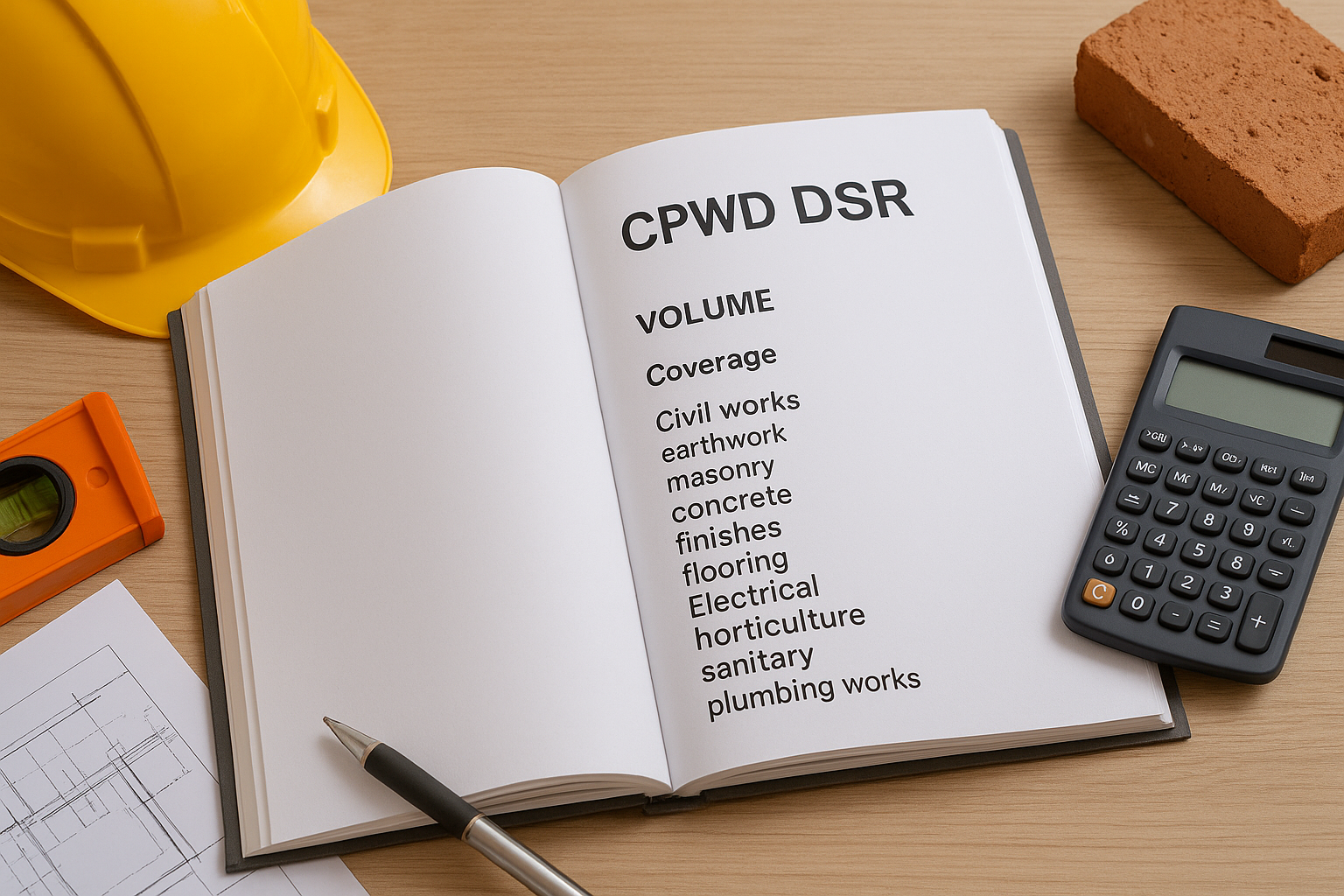
Each DSR item carries a labor-material breakdown that you must factor in when applying local rate multipliers or computing escalation on running account bills.
| Volume | Coverage |
|---|---|
| Volume I | Civil works: earthwork, masonry, concrete, finishes, flooring |
| Volume II | Electrical, horticulture, sanitary and plumbing works |
What the DSR does not cover
The DSR does not set rates for specialist or proprietary items that fall outside standard CPWD specifications. When a tender requires such items, the engineer prepares a market rate analysis (MRA) to justify a rate, which then gets attached to the contract as a non-schedule item with separate approval. Building one means deriving the rate from first principles — how to break a unit rate into materials, labour, plant and the 15% profit-and-overheads allowance covers the method an evaluator will expect to see.
You should also note that the DSR does not replace state schedule of rates. If your project involves state government funding or a mixed procurement structure, the applicable rate schedule depends on the contracting authority named in the tender, not on CPWD's document by default.
Why CPWD DSR matters for estimates and billing
The CPWD DSR sits at the center of how central government projects get priced, approved, and paid. Every detailed project estimate submitted to CPWD must reference DSR rates to gain technical sanction. Without a valid rate reference, your estimate does not move forward in the approval chain, which delays project start dates and funding releases.
Role in detailed estimates
When you prepare an estimate, each line item in your BOQ must map to a DSR code and description. The rates you apply directly determine the project ceiling value, which is the maximum amount CPWD will sanction for execution. If you use a rate from an outdated edition, the technical sanction team will flag the discrepancy and return your estimate for correction.
Using an outdated DSR edition is one of the most common reasons technical sanctions get delayed at CPWD field offices.
Impact on RA bills and payments
Running Account (RA) bills follow the same rate structure set at the time of tender. Your billing engineer references the contracted DSR rates to verify each work item executed on site. Any item billed beyond the agreed schedule must go through a separate non-schedule rate approval, which adds documentation load and slows payment. Getting your rate references right at the tender stage protects your cash flow throughout execution.
How volumes, revisions, and correction slips work
The CPWD DSR follows a structured update cycle that you need to understand before pulling any rate for an estimate. CPWD publishes full revised editions periodically, with the most recent being the 2024 edition, which supersedes the 2021 version. Between full editions, CPWD releases correction slips that amend specific line items without replacing the entire document.
How CPWD publishes revised editions
CPWD releases a complete DSR edition roughly every two to three years. Each new edition resets the base rates across all schedule items, reflecting updated material costs, revised labor rates, and changes to technical specifications. A new edition typically updates:
- Base unit rates for all schedule items
- Labor-to-material ratios for affected work categories
- Technical descriptions where specifications have changed
What correction slips do to published rates
Correction slips are numbered amendments that modify specific items in the current DSR without triggering a full new edition. Each slip carries a serial number and an effective date, and you must apply every correction slip issued between the base edition date and your tender submission date to keep your rates valid.

Missing a correction slip is a common cause of rate mismatches during technical scrutiny, and CPWD field offices will return your estimate for correction.
CPWD publishes these slips on its official website alongside the main schedule documents. Always download the full correction slip list when you access the DSR, not just the base document.
How to use CPWD DSR in BOQ, tendering, and RA bills
The CPWD DSR is not just a reference document, it is the structural backbone of your entire project pricing workflow. You apply it at three distinct stages: when you build the Bill of Quantities, when you submit a tender, and when you raise running account bills during execution. Getting each stage right reduces delays and protects your payment timeline.
Building your BOQ from DSR codes
When you prepare a BOQ, every work item must carry its corresponding DSR code, unit of measurement, and applicable rate. Start by matching each scope item in your project drawings to a schedule description. If a task falls outside standard DSR coverage, document it separately as a non-schedule item and attach a market rate analysis with it.
A BOQ that clearly maps all items to DSR codes moves through technical scrutiny faster and reduces back-and-forth with CPWD field offices.
Referencing DSR in tender bids and RA bills
Your tender bid must state the applicable DSR edition and all correction slips accepted as the rate basis for that contract. This locks in your pricing reference for the entire contract duration. During execution, your billing engineer uses these same contracted rates to verify each RA bill line by line. Any work executed beyond agreed schedule items requires a separate non-schedule rate approval before CPWD releases payment, so align your scope to DSR items as tightly as possible before submitting your bid.
How to verify you are using the latest CPWD rates
Before you finalize any estimate, confirm that the CPWD DSR edition you are referencing matches the version currently in force. CPWD updates its rates through full editions and numbered correction slips, so the base document alone is never enough to validate your rate set.
Check the CPWD official website directly
Your first stop is the CPWD official website at cpwd.gov.in, where the department publishes the current DSR volumes and all active correction slips. Download the correction slip index alongside the main document and note the highest correction slip number listed. That number tells you the full amendment chain you need to apply.
Always download the correction slip index on the same day you pull your base DSR document, because CPWD issues slips without a fixed calendar schedule.
Match correction slip numbers to your estimate date
Once you have the index, compare the effective dates on each correction slip against your tender submission deadline. Any slip issued before your submission date is mandatory. Mark each applicable slip as applied and keep a record of this checklist in your estimate file. CPWD field offices cross-check this during technical scrutiny, and a missing slip will trigger a return. Running this verification as a standard step before every bid submission removes the risk entirely.
Wrap-up and next steps
The CPWD DSR is the authoritative rate reference for every central government construction project, and working with it correctly requires more than just downloading the latest PDF. You need the right edition, every applicable correction slip, and a clear process for mapping each scope item to a valid schedule code before your estimate reaches technical scrutiny.
Keeping track of all this manually across active tenders adds up fast. Rate updates drop without a fixed schedule, correction slips accumulate, and a single missed amendment can delay your technical sanction or trigger a return from the field office. That overhead compounds when your team is monitoring multiple tenders at the same time.
The DSR's priced items are built up from the CPWD Analysis of Rates; the full CPWD Analysis of Rates 2023 (Civil) is published here as free, searchable tables, so you can see the material, labour and machinery derivation behind any rate. Where a state publishes its own schedule rather than adopting the DSR, the Schedule of Rates by state directory gives the current edition and official source for each, and searchable rate tables with Excel exports are published for the states whose schedules can be transcribed reliably. Not every state packages its schedule the way the DSR is packaged: Odisha splits its schedule across two documents, so that twenty of the SOR 2022's twenty-five chapters carry no rates at all and point the estimator to a separate Analysis of Rates from 2006.
If you want to reduce the time your team spends on manual verification, see how Arched's estimating service works: we deliver a priced BOQ on the DSR edition you specify, reviewed by an engineer.
Have a package your team can’t get to? Send it to us. Our engineers check and sign off everything we deliver.