10 Construction Cost Estimation Methods (With Examples)
Master 10 construction cost estimation methods with examples. Learn how to use BOQ, unit rates, and BIM to build accurate bids for infrastructure projects.
A bid that's off by even 5% can mean the difference between winning a government contract and burning through resources on a proposal that never had a chance. For infrastructure firms competing in India's public procurement space, mastering construction cost estimation methods isn't optional, it's the foundation of every profitable tender submission.
Yet the reality is that most firms rely on one or two estimation techniques for every project, regardless of scope, stage, or complexity. A ₹2 crore road resurfacing job and a ₹200 crore bridge project demand fundamentally different approaches. Using the wrong method leads to underbidding that erodes margins or overbidding that hands the contract to someone else. Neither outcome is acceptable when your pipeline depends on government work.
This guide breaks down 10 proven estimation methods, from quick analogous estimates to detailed unit-based calculations, with formulas, examples, and clear guidance on when each one fits. Whether you're preparing a rough budget for a feasibility study or finalizing a BOQ for a CPPP submission, you'll find the right approach here. And once your estimates are dialed in, tools like Arched can match those capabilities to the tenders where you're most likely to win, helping you bid smarter across 500+ government portals.
1. Tender BOQ Based Estimating with Arched
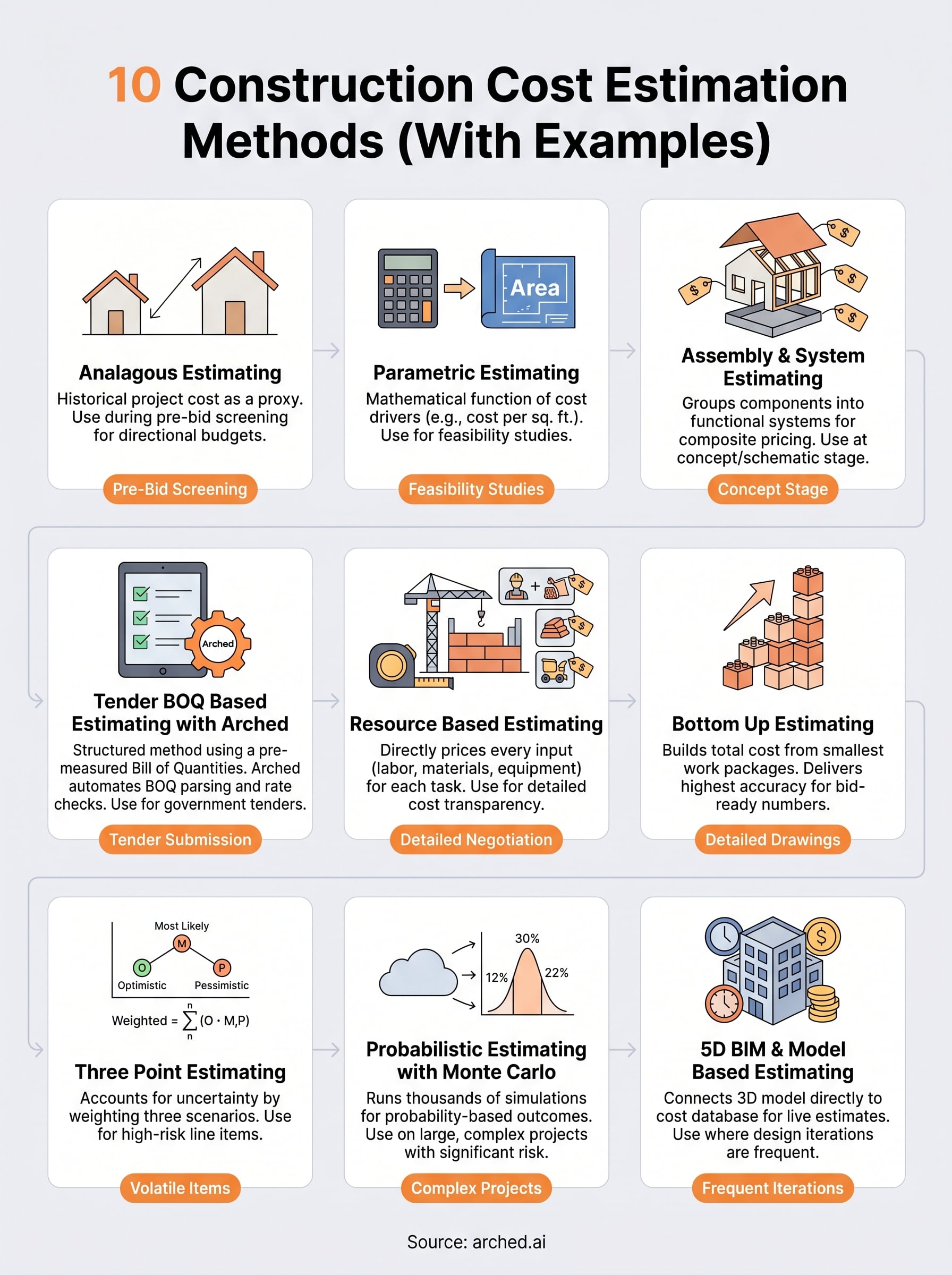
Tender BOQ based estimating is one of the most structured construction cost estimation methods available for government work. The client hands you a pre-measured list of items, quantities, and sometimes reference rates. Your job is to price each line item accurately, verify you meet the eligibility criteria, and submit a competitive total bid price.

What it is
A Bill of Quantities lists every work item and its measured quantity, prepared by the department's engineer. Your task is to apply a rate to each item and calculate the total. In Indian public procurement, the BOQ is embedded in the tender PDF or uploaded separately on portals like CPPP and state e-procurement systems.
How it works step by step
Arched reads the tender document automatically, parses the BOQ, and surfaces each line item with quantities already extracted. You apply your rates using DSR references, historical project data, or current market quotes, and Arched flags items where your pricing deviates from expected ranges, reducing submission errors before they cost you the bid.
Pricing accuracy at the line-item level determines competitiveness far more than any contingency buffer you add at the end.
Inputs you need from the tender
You need three core inputs to price a BOQ correctly:
- Item descriptions and units (m³, rm, m²)
- Quantities as measured by the department
- Qualification criteria covering minimum turnover, past project value, and required certifications
Example with item rates and eligibility constraints
A highway widening tender on CPPP might list 1,200 m³ of Granular Sub-Base at a department estimate of ₹850/m³. Your competitive rate, after checking current material costs and equipment utilization, might be ₹810/m³, saving ₹48,000 on that single item. Arched simultaneously verifies whether your past project credentials meet the stated threshold, such as one similar road project worth ₹5 crore completed within the last five years.
When to use it in Indian government tenders
Use this method whenever a tender provides a complete BOQ, which covers most works contracts on GeM, CPPP, and state-level portals.
Limits and watchouts
BOQ rates can go stale quickly. Material price volatility for steel, cement, and bitumen means a rate from three months ago may already cut into your margin. Always cross-check rates against current market quotes before submitting.
2. Bottom Up Estimating
Bottom up estimating builds your total project cost from the ground up, starting at the smallest measurable work package and rolling everything into a final number. Among all construction cost estimation methods, this approach delivers the highest accuracy when you have enough design detail to define individual tasks before submitting.
What it is
Bottom up estimating breaks a project into its smallest components, assigns a cost to each one, and sums everything to get a total. Each work package is priced independently, so errors stay contained rather than compounding across your entire bid figure.
How it works step by step
You start with a Work Breakdown Structure (WBS), divide it into discrete tasks, price each task, then aggregate upward. The core steps are:
- Define all work packages from the project scope
- Estimate labor, material, and equipment costs per package
- Add indirect costs and contingency at the top level
Quick formula
Total Cost = Sum of all work package costs + indirect costs + contingency
Example with a simple work breakdown
A ₹1.5 crore drainage project might break into earthworks at ₹40,000, pipe laying at ₹60,000, and backfilling at ₹20,000 per 100-meter stretch. Multiplying each rate across the full alignment and layering in site overhead gives you a defensible total you can justify line by line.
The more granular your breakdown, the more accurately your estimate reflects actual site conditions.
When to use it
Use bottom up estimating when you have detailed drawings or specifications and need a bid-ready number that survives scrutiny from the department's engineers.
Limits and watchouts
This method is time-intensive to build correctly. Running a full bottom up estimate for every tender you screen is impractical, so reserve it for shortlisted opportunities where the scope is clearly defined.
3. Unit Rate Estimating
Unit rate estimating is one of the most widely used construction cost estimation methods in Indian infrastructure work. You assign a pre-determined cost per unit of work to each measurable item, then multiply by quantity to get the line-item total.
What it is
Unit rate estimating prices each work item based on a fixed rate per unit of measurement, such as per cubic meter of concrete or per linear meter of pipe. Schedule of Rates (SOR) published by state PWDs and CPWD form the starting benchmark most estimators use.
How it works step by step
You pull the relevant SOR rates for your region, adjust for current material costs and site conditions, then apply each rate to the quantities from the drawings or BOQ.
Quick formula
Total Cost = Unit Rate × Quantity (summed across all line items)
Example using schedule of rates and market checks
A culvert project might show 80 m³ of M20 concrete at a state SOR rate of ₹5,800/m³. If current cement prices have risen, you adjust to ₹6,100/m³, bringing that single item to ₹4,88,000 before you reach the next line.
Always cross-reference SOR rates against current market quotes before finalizing, as published rates often lag real costs by six months or more.
The lag can be far longer than six months once a state separates its rate build-up from its input prices. Odisha's current schedule pairs basic rates published in 2022 with analysis constants dating from 2006, and fixes contractor's profit and overheads at 7.5 per cent each — figures worth checking against your own cost base before you accept the derived rate.
When to use it
Use unit rate estimating at the tender response stage when quantities are defined but you lack the task-level detail needed for a full bottom up build.
Limits and watchouts
Published SOR rates can be outdated, and regional variation in labor and material costs means a rate valid in one state may underperform in another. Build in a market adjustment factor to protect your margin before submission.
4. Assembly and System Estimating
Assembly and system estimating groups individual components into functional building systems, such as foundations, structural frames, or MEP installations, and prices each system as a single unit. Among the available construction cost estimation methods, this approach sits between the speed of analogous estimating and the precision of a full bottom up build.
What it is
Instead of pricing every bolt and meter of conduit separately, you treat a complete system as one costed assembly. A "drainage system" becomes a single priced unit rather than dozens of individual line items.
How it works step by step
You divide the project into its major functional systems, assign a composite cost per system based on historical data or published assembly rates, then sum each system total into an overall project budget.
Quick formula
Total Cost = Sum of (Assembly Unit Cost × Quantity) across all systems
Example by major building systems
A government office building might break into structural works at ₹45 lakh, external façade at ₹18 lakh, and HVAC at ₹22 lakh. Pricing each system independently lets you identify which component carries the most budget risk before committing to a final number.
Costing by system rather than by individual item lets you spot scope gaps that a line-by-line review often misses.
When to use it
Use assembly estimating at the concept or schematic design stage when you have system-level scope but not full working drawings.
Limits and watchouts
Assembly cost data requires regular updating against current market rates. Composite rates built from two-year-old project data will quietly understate your actual costs on site.
5. Parametric Estimating
Parametric estimating calculates project cost by multiplying a statistical cost driver, such as floor area or road length, by a cost factor derived from historical data. This makes it one of the fastest construction cost estimation methods available when you need a reliable budget figure early in the project cycle.
What it is
Parametric estimating treats cost as a mathematical function of measurable project characteristics. Instead of pricing individual items, you identify one or two dominant variables, apply a tested cost factor, and generate a budget-level figure in minutes rather than days.
How it works step by step
You pull cost-per-unit benchmarks from your completed project database or published industry data, verify the benchmark matches your project's region and specification level, then apply it to the key quantity driver for the scope in front of you.
Quick formula
Total Cost = Cost Rate per Unit × Total Quantity of the Driver
Example using cost per square foot and adjustments
A government office block with 3,000 m² of built-up area might use a benchmark of ₹22,000/m², giving you ₹6.6 crore before adjustments. You then apply a regional index of 1.08 for a Tier-1 city site, pushing the adjusted estimate to ₹7.13 crore.
A benchmark rate is only as reliable as the project data behind it, so document the source and vintage every time you use one.
When to use it
Use parametric estimating during feasibility studies or pre-bid screening when you need to decide quickly whether a tender is worth pursuing before investing hours in a detailed build.
Limits and watchouts
Outlier projects with unusual specifications, complex geotechnical conditions, or non-standard materials will drift significantly from any benchmark rate. Always flag the assumptions behind your parametric figure so decision-makers understand the margin of uncertainty before committing resources.
6. Analogous Estimating
Analogous estimating uses the actual cost of a completed project as your baseline for pricing a new one. Among all construction cost estimation methods, this is the fastest to apply when you need a directional budget figure without access to detailed drawings or quantities.
What it is
This method treats a past project as a cost proxy for the current scope. You identify a comparable job from your own records or industry benchmarks, then scale the cost up or down based on size or specification differences.
How it works step by step
You pull the final cost from a similar completed project, confirm the project type and spec level match closely enough to be comparable, and apply a scaling factor to account for any differences in size, location, or complexity.
Quick formula
Estimated Cost = Historical Project Cost × (New Project Size / Historical Project Size)
Example using a similar completed project
Your firm completed a 2-km rural road project in Bihar for ₹1.8 crore. A new tender covers 3 km of similar specification in the same region. Scaling up gives you an initial figure of ₹2.7 crore before any site-specific adjustments.
Analogous estimates are only as reliable as the quality and recency of your project cost records.
When to use it
Use analogous estimating during pre-bid screening to decide quickly whether a tender fits your target margin before committing to a detailed build.
Limits and watchouts
Scope differences between projects compound fast. A change in soil classification, pavement specification, or urban versus rural context can push your analogous figure far from actual costs.
7. Resource Based Estimating
Resource based estimating builds your project cost by pricing every input directly: the people, materials, and equipment required to complete each task. Among construction cost estimation methods, this one gives you the clearest picture of where your money actually goes before a single rupee leaves your account.
What it is
Resource based estimating calculates cost by identifying every resource type needed for each activity and pricing it at current market rates. You see labor, materials, and equipment costs as separate line items rather than a blended rate.
How it works step by step
You list every task, assign the required resources and durations, then multiply consumption by current rates for each input category.
- Define tasks and their resource requirements
- Assign labor hours, material quantities, and equipment hours per task
- Multiply each by current market rates and sum across all tasks
Quick formula
Total Cost = (Labor Hours × Labor Rate) + (Material Quantity × Material Rate) + (Equipment Hours × Equipment Rate)
Example using labor productivity, materials, and equipment
For a 500 m² RCC slab, you might estimate 120 labor-days at ₹800/day, 45 MT of steel at ₹58,000/MT, and a concrete pump for 3 days at ₹12,000/day. Adding those three streams gives you a fully transparent cost before contingency.
Separating resource streams lets you pinpoint exactly which input is driving cost overruns, rather than absorbing the variance into a blended rate.
When to use it
Use resource based estimating when you need detailed cost transparency for contract negotiation or for projects where labor productivity varies significantly across site conditions.
Limits and watchouts
Accurate productivity data is essential here. If your labor output assumptions are optimistic, every task cost in your estimate will be understated, and the errors accumulate fast across a large scope.
8. Three Point Estimating
Three point estimating accounts for uncertainty by building three cost scenarios into a single weighted figure. Instead of committing to one number, you model an optimistic, most likely, and pessimistic outcome, then calculate a probability-weighted estimate that reflects real-world variance.
What it is
Three point estimating is one of the construction cost estimation methods specifically designed for scope items where cost can swing significantly based on conditions outside your control, such as ground conditions, weather delays, or material availability.
How it works step by step
You produce three estimates for each uncertain item and weight them to generate a final figure.
- Optimistic (O): Best-case cost if everything goes smoothly
- Most Likely (M): Your expected cost under normal conditions
- Pessimistic (P): Worst-case cost if key risks materialize
Quick formula
Estimated Cost = (O + 4M + P) / 6
This is the PERT-weighted formula, giving the most likely scenario four times the weight of the extreme cases.
Example for a volatile scope item
Excavation through uncertain soil might cost ₹3.2 lakh optimistically, ₹4.5 lakh under normal conditions, and ₹7.1 lakh if rock is encountered. Applying the formula gives you ₹4.65 lakh, a figure that honestly reflects subsurface risk rather than ignoring it.
A single-point estimate on a volatile scope item is not a number, it is a guess with a rupee sign attached.
When to use it
Use three point estimating on specific high-risk line items within an otherwise detailed bottom up build.
Limits and watchouts
Your pessimistic estimate needs to be genuinely realistic, not artificially inflated. Padding the P value distorts the weighted output and inflates your bid unnecessarily.
9. Probabilistic Estimating with Monte Carlo Simulation
Probabilistic estimating takes uncertainty seriously by running thousands of simulated cost outcomes rather than committing to a single number. Among construction cost estimation methods, this is the most statistically rigorous approach, and it gives you a range of possible budget outcomes with a probability attached to each one.

What it is
Monte Carlo simulation treats every uncertain cost input as a probability distribution instead of a fixed value. Your software runs thousands of random iterations across all those distributions simultaneously and produces a full probability curve of possible project costs, from the best-case scenario to the worst.
How it works step by step
You assign minimum, most likely, and maximum cost values to each uncertain line item, then run the simulation engine through thousands of iterations to produce a probability distribution of total project cost.
Quick formula
P(X) = Number of iterations where cost is at or below X / Total iterations
This tells you the probability that your final project cost lands at or below any specific value.
Example with risk ranges and a P50 budget
A ₹12 crore highway project with uncertain earthworks might produce a P50 budget of ₹13.2 crore, meaning there is a 50% chance the final cost lands at or below that figure. Your P80 might reach ₹15.1 crore, which is the figure a risk-conscious bid team would use to set contingency reserves.
The P50 figure is not a safe budget. It means you have an equal chance of going over as under.
When to use it
Use Monte Carlo simulation on large, complex tenders where multiple cost variables carry significant uncertainty and underestimating carries serious financial consequences.
Limits and watchouts
This method demands specialized software and statistical expertise to apply correctly. Poorly defined input distributions produce output that looks precise but reflects nothing about your actual project risk.
10. 5D BIM and Model Based Estimating
5D BIM connects your three-dimensional project model directly to a cost database, turning geometry into a live estimate that updates whenever the design changes. Among all construction cost estimation methods, this approach offers the tightest link between what your team designs and what your team prices.
What it is
5D BIM adds cost and schedule dimensions to a standard 3D model. Every modeled element carries quantity and rate data, so your estimate reflects the current design state at all times rather than a snapshot taken weeks ago.
How it works step by step
Your BIM software extracts quantities automatically from the model geometry, links each element to a rate from your cost library, and calculates a running total as the design evolves.
Quick formula
Total Cost = Sum of (Model Quantity × Assigned Rate) for every modeled element
Example connecting quantities to current rates
A modeled concrete column with defined dimensions automatically generates its volume, links to your current M25 concrete rate of ₹6,200/m³, and contributes to the total without manual take-off.
When rates update in your cost library, every connected element reprices instantly across the entire model.
When to use it
Use 5D BIM on large infrastructure or building projects where design iterations are frequent and manual re-estimation after each change would consume too much time.
Limits and watchouts
Model quality directly controls estimate quality. Incomplete or inconsistently modeled elements produce quantity gaps that require manual correction before your figures are bid-ready.
Final Takeaways
No single approach covers every situation. The right construction cost estimation methods depend on where you are in the project cycle, how much design detail you have available, and how much risk the scope carries. A parametric rate works fine during pre-bid screening, but it has no place in a final BOQ submission where the department's engineers will check every line you submit.
Your competitive edge comes from matching the right method to the right moment. Use analogous and parametric approaches to filter opportunities fast, then shift to unit rate or bottom up methods when a tender is genuinely worth pursuing. For volatile scope items, layer in three-point or probabilistic estimates to protect your margin. And when the tender includes a BOQ, price it against current market data, not published SOR rates that are already six months behind reality.
If you want to find the tenders where your firm's credentials actually qualify before you spend time estimating, see how Arched matches firms to high-probability government contracts.
Unit-rate estimating depends on having the right published rates to hand: the Schedule of Rates by state directory lists each state's current edition, and searchable SOR tables carry the item rates with Excel exports.