What Is a Lump Sum Contract in Construction? Pros & Cons
Understand what is a lump sum contract in construction. Explore the pros, cons, and risk strategies to protect your margins and bid confidently on tenders.
Every government construction tender in India comes with a pricing structure baked into its terms, and the one you'll encounter most often is the lump sum contract in construction. Whether it's a bridge project listed on GeM or a highway widening tender on a state e-procurement portal, the contract type directly shapes how risk, cost, and scope get divided between the owner and the contractor. Misreading that structure can mean underbidding a project by crores or walking into liability you didn't anticipate.
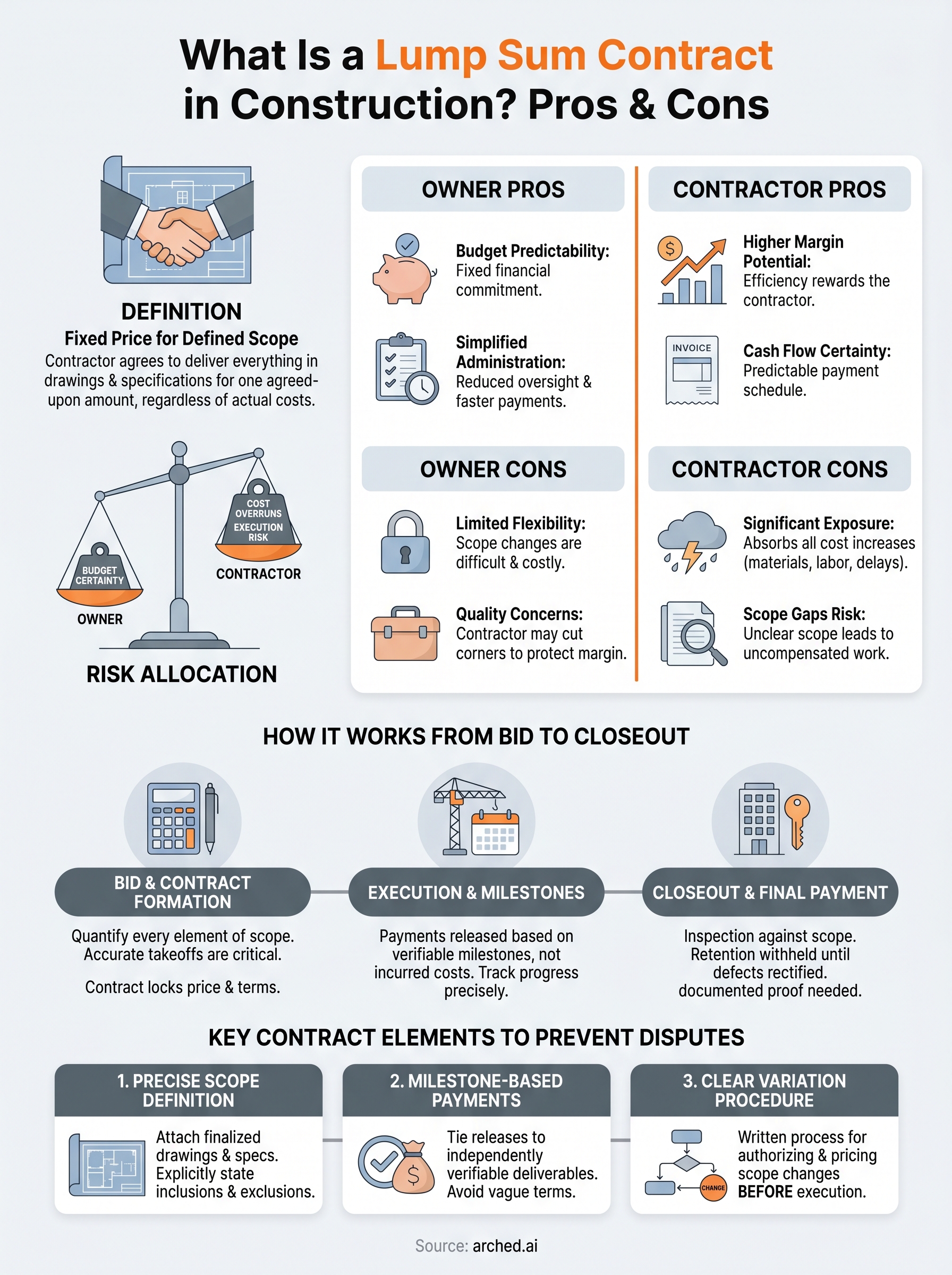
A lump sum contract fixes the total price for a defined scope of work. The contractor agrees to deliver everything described in the drawings and specifications for one agreed-upon amount, regardless of the actual costs incurred during execution. For owners, this offers budget certainty. For contractors, it offers higher margins, but only if the scope is truly locked down. The risk trade-off between the two parties is what makes this contract type both popular and misunderstood.
This article breaks down exactly how lump sum contracts work, where they fit within Indian public procurement, and the specific pros and cons each side should weigh before signing. We also cover how platforms like Arched help contractors parse tender documents automatically, extracting BOQs, flagging risk clauses, and identifying whether a lump sum structure actually aligns with your firm's capabilities and credentials. Understanding the contract type is step one; qualifying for the right opportunities is where real strategy begins.
Why lump sum contracts matter in construction
Understanding what is a lump sum contract in construction isn't just a matter of contract law. The structure fundamentally determines who absorbs cost overruns, who has incentive to work efficiently, and who carries the burden when site conditions differ from what the documents show. Both government clients and private developers in India gravitate toward this model because it transfers execution risk to the contractor the moment the ink dries. That shift changes how you price, plan, and manage every project you take on under this structure.
A lump sum contract does not protect the contractor from cost increases; it protects the owner from them.
Why owners and government clients prefer this structure
For any project owner, budget predictability is the primary concern. When a state government issues a lump sum tender for a road widening or a bridge rehabilitation, the finance department needs a fixed number to provision funds, seek approvals, and report to stakeholders. The contractor holds responsibility for every rupee spent beyond the agreed price. That accountability shifts substantial financial and execution risk away from the client and onto your firm, which is exactly what public procurement bodies in India want when they structure contracts through portals like CPPP or state e-procurement platforms.
Owners also benefit from simplified administration. With a fixed price in place, there is no need to audit every labor invoice or material receipt during execution. The owner reviews milestones, confirms deliverables, and releases payments according to the schedule written into the contract. This reduces oversight costs and shortens the payment approval cycle on both sides.
Why contractors take on significant exposure
Your firm carries the cost risk from the moment you submit a bid. If material prices rise, labor becomes scarce, or ground conditions turn out worse than the drawings suggested, none of those increases automatically translate into additional payments. You absorb them. This is why accurate quantity takeoffs, detailed site assessments, and realistic contingency provisions matter far more under a lump sum arrangement than under an item rate or cost-plus contract.
The risk is not theoretical. Construction projects in India regularly encounter delays tied to land acquisition, utility shifting, and monsoon interruptions that add months to timelines. Under a lump sum contract, extended site presence costs money you may not recover unless the contract specifically includes provisions for time-related cost escalation or force majeure relief. Reading those clauses carefully before you bid is not optional.
How lump sum contracts fit within Indian public procurement
Most government construction tenders in India, whether they appear on GeM, CPPP, or state e-procurement systems, use either a lump sum or an item rate format. Lump sum contracts are especially common for design-and-build projects, turnkey infrastructure packages, and contracts where the scope is tightly defined in a set of finalized engineering drawings. If the tender documents include detailed architectural plans, specifications, and a single price box for your bid, you are almost certainly looking at a lump sum structure.
Identifying the contract format early allows your business development team to flag the appropriate risk categories, line up the right subcontractors, and decide whether the project fits your firm's current financial position before spending days preparing a full bid response.
How a lump sum contract works from bid to closeout
Understanding what is a lump sum contract in construction becomes clearer when you follow the money and documentation through each phase. The contract begins long before construction starts and carries specific obligations all the way through final payment. Each phase presents distinct decision points where your team either captures value or concedes it, depending on how thoroughly you've read and responded to the tender documents.

The bid and contract formation phase
Before you submit a price, your team must quantify every element of the defined scope. Tendering authorities on portals like CPPP or state e-procurement systems typically provide drawings, specifications, and a schedule of requirements, and your job is to price them into a single total. This is where lump sum contracts demand the most from your estimating team. Any scope you miss at this stage comes out of your margin during execution, not from a variation claim.
Price everything in the scope document as if no clarifications will be granted after bid submission, because often they are not.
Once both parties agree on the price, the signed contract locks the total amount along with the payment schedule, milestone definitions, and variation procedures that govern any future scope changes.
Execution and payment milestones
During construction, the owner releases payments according to milestones written into the contract, not based on costs your firm actually incurs. Common milestones include foundation completion, structural framing, and handover of each phase, with a percentage of the lump sum tied to each. Your firm needs to track progress against those milestones precisely, because delays in meeting them delay your cash inflows regardless of how much money you've already spent on site.
Closeout and final payment
At project completion, the owner or their appointed engineer inspects the work against the original scope. Defects, incomplete items, or discrepancies between drawings and actual construction can result in withheld retention amounts until rectification is confirmed. Most government contracts in India retain five to ten percent of the contract value until the defects liability period ends. Clearing retention requires documented proof of completion, which means your team should maintain organized site records from day one rather than scrambling at handover.
What to include to prevent scope and payment disputes
The most common reason lump sum contracts end in arbitration is not a pricing error; it is a scope document that left too much room for interpretation. Knowing what is a lump sum contract in construction means knowing that every word in the scope definition carries financial weight. If your contract does not precisely define what work is included, both parties will fill that ambiguity with assumptions, and those assumptions will eventually collide. Front-loading your contract with detailed documentation saves your team from expensive disputes after mobilization.
Define the scope with precision
Your contract must attach finalized drawings, technical specifications, and a schedule of works as formal exhibits. Do not reference documents by title alone; attach the actual documents and version-number them so there is no confusion later about which revision governs. If the tender included a Bill of Quantities, include it as a schedule and clarify whether it is informational or binding, because that distinction determines who owns the risk if quantities differ from reality.
Scope ambiguity is not a legal problem you solve after signing; it is a drafting problem you prevent before signing.
The scope section should also define exclusions explicitly. Listing what is not included reduces the risk that the owner expects additional work without additional pay.
Set milestone-based payment terms
Your payment schedule should tie each release to a deliverable that both parties can independently verify. Vague milestones like "substantial completion of civil works" invite disagreement, while specific milestones such as "completion of pile cap casting for all six bridge piers, certified by the resident engineer" leave little room for dispute. Each milestone should state the percentage of contract value released, the documentation required, and the number of days the owner has to process payment after submission.
Include a retention clause that spells out the exact percentage withheld, the conditions for its release, and the maximum defects liability period. Most government contracts in India cap retention at five percent, but the release conditions vary widely across state procurement systems.
Include a clear variation procedure
Your contract needs a written process for handling changes to scope after award. Specify who can authorize variations, what form the instruction must take, and how pricing for additional work gets calculated before any change is executed on site. A variation clause without a pricing mechanism forces both parties into negotiation under pressure, which rarely produces fair outcomes.
Advantages, disadvantages, and risk allocation
Once you understand what is a lump sum contract in construction, you can evaluate whether the structure actually suits the project you are bidding on. The advantages and disadvantages are not evenly distributed between the two parties, and the way risk concentrates at specific points in the project lifecycle determines whether a lump sum structure works in your favor or against you.

Advantages that make this structure attractive
Owners gain firm budget control from the moment the contract is signed, which is the primary reason Indian government bodies default to lump sum pricing for tenders with complete design documentation. There is no need to review cost breakdowns or audit material invoices throughout execution. For contractors, the upside is equally direct: if your estimating is accurate and your execution is efficient, you capture the difference between your actual cost and your bid price as margin. No other contract type gives your firm that same opportunity to reward internal efficiency.
The contractor who wins on a lump sum contract is usually the one who found a smarter way to execute the scope, not the one who priced it lowest.
Lump sum contracts also simplify project administration for both sides. Payment milestones are agreed upfront, which means your accounts team can plan cash flow projections without waiting for monthly cost reconciliations.
Disadvantages and where risk concentrates
Your firm absorbs every cost increase that falls within the defined scope, regardless of the cause. Material price escalation, labor shortages, and underestimated quantities all land on your balance sheet, not the client's. This exposure becomes critical on long-duration projects, where inflation alone can erode margins that looked reasonable at bid stage. Government contracts in India rarely include automatic price adjustment clauses unless the project duration exceeds a specific threshold defined in the tender conditions.
Scope gaps in the tender documents create additional exposure because any work the owner considers included, even if not explicitly described, becomes a dispute rather than a variation. Your bid team needs to treat every ambiguous line in the specification as a potential cost that you, not the owner, will carry if the contract does not address it clearly. Thin contingency budgets and rushed takeoffs are the fastest way to turn a profitable-looking lump sum bid into a loss-making project.
Lump sum vs item rate, EPC, cost-plus, and T&M
When you ask what is a lump sum contract in construction, the answer only becomes fully useful when you compare it against the other pricing structures you will encounter in Indian government tenders. Each contract type allocates risk and payment differently, and misreading which structure a tender uses creates problems that compound from bid day through final payment. The table below shows how the four main contract types stack up across the factors that matter most to your business development team.
| Contract Type | Price Certainty | Risk Holder | Best Fit |
|---|---|---|---|
| Lump Sum | Fixed | Contractor | Fully designed scope |
| Item Rate | Variable | Shared | Quantity-uncertain projects |
| EPC | Fixed | Contractor | Design-build packages |
| Cost-Plus / T&M | Variable | Owner | Undefined or evolving scope |
Item rate contracts
Under an item rate contract, the owner pays for actual quantities measured on site multiplied by agreed unit rates. If the drawings show 500 cubic meters of concrete but the final measurement comes in at 620, you get paid for 620. This shared quantity risk makes item rate structures common in Indian road and irrigation tenders where ground conditions make final quantities genuinely uncertain at bid stage. Your firm carries unit rate risk but not quantity risk, which is a meaningful distinction when you are pricing projects with variable soil profiles or incomplete survey data.
EPC contracts
An EPC contract bundles engineering, procurement, and construction under one fixed price, so your firm takes on responsibility for the design itself in addition to physical execution. That added scope means your contingency budget needs to cover design errors and revisions alongside construction costs. Any design change your team generates mid-project becomes your financial responsibility, not the owner's, which makes pre-bid design reviews critical before committing to an EPC price.
EPC contracts carry more total risk than a standard lump sum structure because your firm owns both the design output and the construction outcome.
Cost-plus and T&M contracts
Cost-plus contracts reimburse your actual costs and add an agreed fee or percentage on top, while time-and-materials contracts pay labor at fixed rates plus material costs as invoiced. Both structures protect your firm from cost overruns, but they remove the upside that lump sum execution efficiency can generate for a well-run contractor. Indian government procurement rarely uses these formats for capital infrastructure works because they transfer budget risk entirely to the public client, which conflicts with how state finance departments provision funds.
Key takeaways
What is a lump sum contract in construction comes down to one core trade-off: the owner buys budget certainty, and your firm carries the cost risk in exchange for the chance to capture margin through efficient execution. The structure rewards firms that invest time in accurate estimating, detailed scope review, and precise contract drafting before a single shovel breaks ground.
Your exposure under this contract type grows in direct proportion to how much ambiguity your team tolerates in the scope documents and payment terms. Firms that read tender documents carefully, flag unclear clauses early, and build realistic contingencies consistently outperform those that rush bid preparation to hit submission deadlines. Choosing the right contract structure for each opportunity also matters as much as the price you submit.
If you want to identify lump sum tenders that match your firm's actual credentials and flag risk clauses before you commit, explore what Arched can do for your business development team.