Fixed Price Contract vs Cost Plus Contract: Key Differences
Compare fixed price contract vs cost plus contract to understand risk allocation. Learn which model protects your margins in Indian infrastructure projects.
Choosing between a fixed price contract vs cost plus contract can shape the entire financial outcome of a construction project. One locks in the total cost upfront. The other keeps the books open, reimbursing actual expenses as they come. Both models show up regularly across government tenders on platforms like GeM, CPPP, and state e-procurement portals, and picking the wrong one can erode margins before the first foundation is poured.
The real challenge isn't just knowing the definitions. It's understanding which model fits your project's scope, risk profile, and cash flow reality. A highway widening project with a well-defined BOQ calls for a very different pricing structure than an urban infrastructure job where ground conditions are uncertain and design changes are likely. For BD managers and bid teams evaluating hundreds of tender documents, this distinction directly affects win probability and profitability.
This is exactly the kind of contract-level analysis that Arched is built to support, parsing tender documents, flagging pricing structures, and helping firms assess risk before they commit to a bid. In this guide, we break down the core differences between fixed price and cost plus contracts, walk through when each model makes sense, and explain how to evaluate which structure aligns with your next opportunity.
Why contract choice matters in Indian projects
In Indian construction, the stakes around contract structure are unusually high. Material costs for steel, cement, and aggregates can swing 15-20% within a single financial year, and labor availability shifts sharply across monsoon seasons and regional migration patterns. The type of contract you sign determines who absorbs these swings. Get it wrong and a project that looked profitable at bid stage turns into a loss by the midpoint.
Material price volatility and scope uncertainty
Construction projects in India face a specific combination of unpredictable input costs and frequently changing project scopes. Road widening projects often encounter utility shifting requirements that weren't in the original drawings. Urban drainage or irrigation work regularly hits soil conditions that deviate from the geotechnical report. When scope is this fluid, locking into a fixed total price without adequate contingency can expose your firm to serious cost overruns.
The Ministry of Statistics and Programme Implementation (MoSPI) consistently reports that a significant share of central sector infrastructure projects face cost overruns, with material price escalation and scope changes listed as primary causes.
Cost-plus arrangements give contractors room to absorb these shifts without absorbing the full financial hit. However, they also require robust documentation and billing systems that many smaller firms in India still find difficult to maintain at scale.
Government tender norms and rate schedules
Most government tenders on platforms like CPPP and state e-procurement portals follow a Schedule of Rates (SOR) or item-rate format, which sits structurally closest to fixed-price contracting. These tenders specify quantities and rates, and your bid competes on the percentage above or below that schedule. Understanding the fixed price contract vs cost plus contract distinction helps you read these structures accurately and flag where the government has already pre-allocated risk.
Some contracts, particularly in design-build or EPC formats, blend both structures across different work packages. A civil works package might run on fixed rates while a specialized MEP or IT component runs on a cost-reimbursable basis. Your bid team needs to catch these hybrid structures early, because the risk profile of each package directly affects your pricing strategy.
Payment timing and cash flow pressure
Indian government contracts often carry delayed payment cycles, with running account bills processed monthly and retention amounts held until defect liability periods expire. Under a fixed-price contract, this means your firm carries both the cost risk and the cash flow risk simultaneously. Working capital requirements increase significantly if material prices rise but payments arrive 60 to 90 days after billing.
What fixed-price contracts cover and how they work
A fixed-price contract sets a single agreed amount for the full scope of work before any work begins. The contractor commits to delivering the project within that budget, regardless of what it actually costs to get there. All risk from cost overruns sits with the contractor, while the client gets certainty on total spend from day one. This structure shows up frequently in Indian government tenders where the BOQ is well-defined and quantities have been pre-verified by the tendering authority.
What the contract locks in
Under a fixed-price arrangement, you agree on total contract value, scope boundaries, and completion timeline before signing. Any change in material prices, subcontractor rates, or labor costs between bid submission and project completion becomes your firm's problem to absorb. This is why your pricing at bid stage needs to factor in realistic contingencies, not just the most competitive number you can submit.

In a fixed price contract vs cost plus contract comparison, fixed-price models give clients the strongest cost certainty, but they transfer maximum financial risk to the contractor.
The contract also defines variation order processes, which are the mechanism for handling scope changes that fall outside the original agreement. Without a clear variation clause, you have limited room to recover additional costs even when the client adds to the scope mid-project.
Where fixed-price works best
Fixed-price contracts perform well when scope is clearly defined and quantities are accurate. Projects with detailed drawings, verified soil investigations, and stable material requirements are good candidates. When your bid team can read the tender documents with confidence and verify BOQ quantities against site conditions, a fixed-price structure gives you a clean pricing baseline and a straightforward path to margin.
What cost-plus contracts cover and how they work
A cost-plus contract reimburses your firm for all allowable project expenses and then adds a separate fee on top. That fee is either a fixed amount or a percentage of total costs, depending on how the contract is structured. Unlike the fixed-price model, this arrangement keeps the financial books open throughout the project, which shifts cost risk away from the contractor and places it on the client.
What gets reimbursed and how fees are calculated
Under a cost-plus structure, the client pays for direct costs such as labor, materials, equipment, and subcontractor invoices, plus agreed indirect or overhead costs tied to the project. Your fee, which represents your margin, is defined at the start and does not change based on what the project actually costs. The two most common variants are cost-plus-fixed-fee (CPFF), where your fee stays constant regardless of final cost, and cost-plus-percentage-fee (CPPF), where your fee scales with total spend.
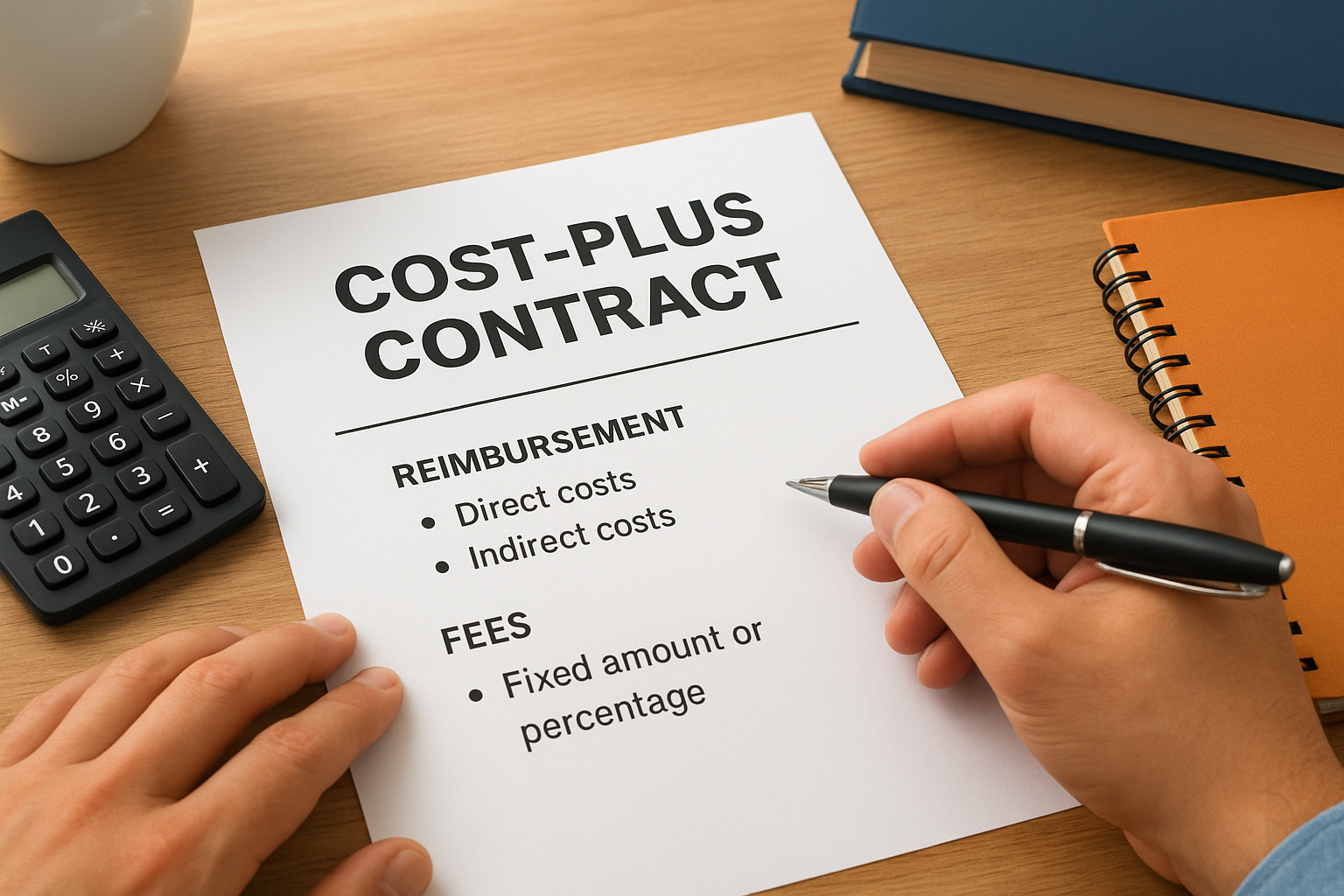
In a fixed price contract vs cost plus contract comparison, cost-plus arrangements protect contractors from cost escalation but require detailed, auditable records to support every billing cycle.
Where cost-plus works best
Cost-plus contracts suit projects where scope is genuinely unclear at the start, such as heritage building restoration, complex MEP retrofits, or research facility construction where design evolves in parallel with construction. When your team cannot define quantities with confidence at the bid stage, agreeing to a fixed total price creates unnecessary exposure.
These contracts also work well when the client wants full visibility into project spending and has the internal capacity to review cost submissions regularly. For Indian firms working on specialized or design-build mandates, cost-plus arrangements give both parties room to adapt without renegotiating the contract every time conditions change.
Fixed price vs cost plus: risk and cost control
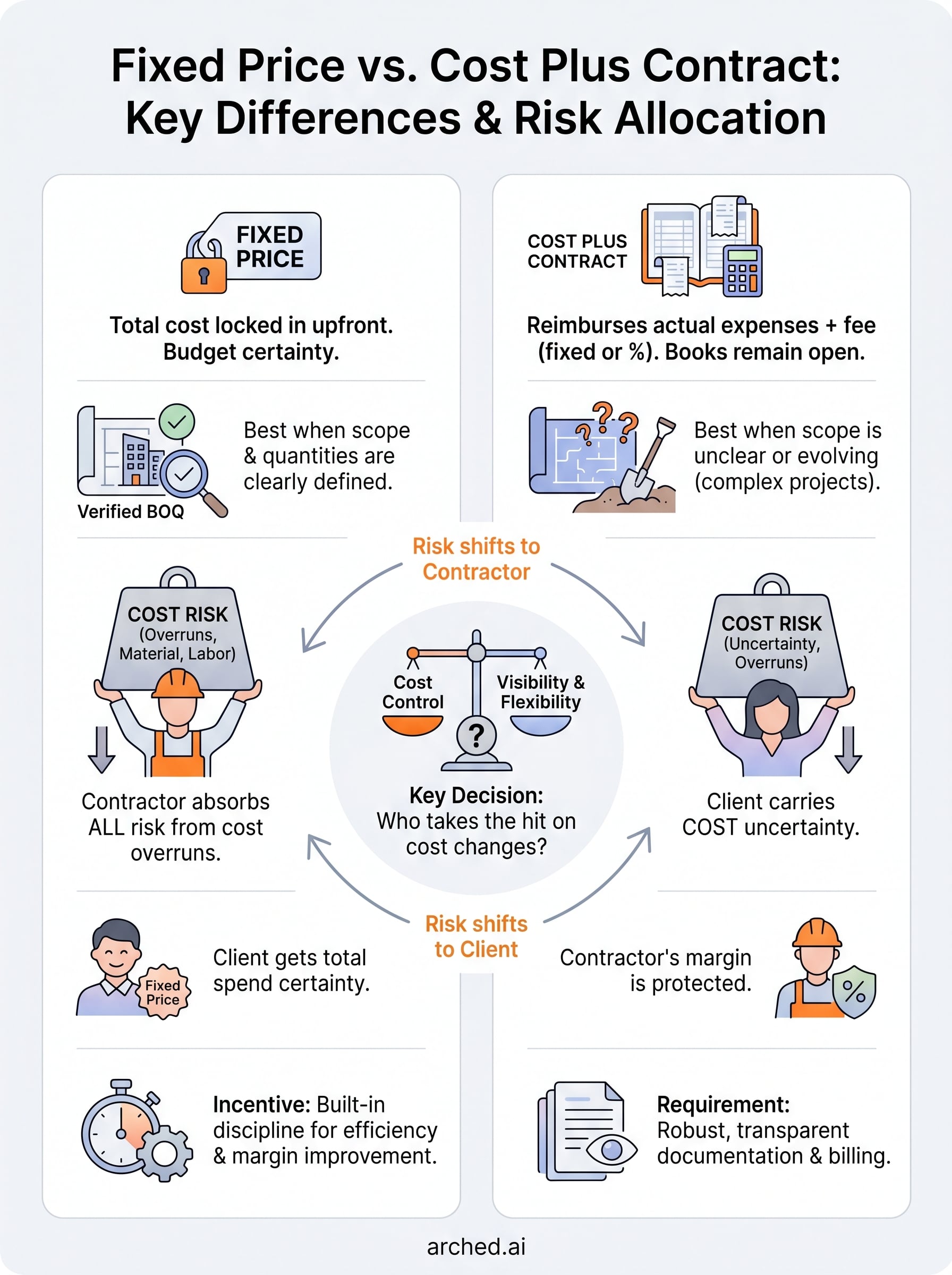
The core difference in fixed price contract vs cost plus contract comes down to one question: who takes the hit when costs go up? In a fixed-price model, your firm absorbs every overrun, from rising steel prices to unexpected ground conditions. In a cost-plus model, the client covers actual costs, so your margin stays protected even when the project gets more expensive.
Risk allocation between contractor and client
Under a fixed-price structure, you take on full financial exposure from the moment you sign. If your BOQ estimate misses a line item or material prices climb between bid submission and procurement, that gap comes out of your margin. Under cost-plus, the risk flows the other way: clients carry the cost uncertainty but gain detailed visibility into every rupee spent on the project.
Clients who choose cost-plus contracts often require independent cost audits or project management oversight to control total spend, which adds administrative burden for both parties.
Your bid team needs to map this risk allocation clearly before finalizing either contract type, because contract structure affects how you price contingencies and structure your working capital requirements across the project cycle.
Cost control mechanisms and oversight
Fixed-price contracts give you a built-in cost discipline: once the contract value is set, every efficiency you create on site directly improves your margin. You have a strong incentive to manage procurement, labor deployment, and subcontractor performance tightly throughout the project.
Cost-plus contracts shift that incentive structure. Your profit is predetermined, so cost control depends on the client's oversight systems and your firm's documentation standards rather than direct financial pressure. Firms that run cost-plus work well typically invest in detailed cost-tracking systems that support transparent billing at every stage.
How to choose and structure the right contract
When deciding between a fixed price contract vs cost plus contract, start with the scope document. If the BOQ is detailed, verified, and unlikely to shift significantly, a fixed-price structure protects your margin and keeps negotiations straightforward. If design is still evolving or ground conditions are uncertain, cost-plus gives you room to operate without absorbing costs the client should carry.
Evaluate scope clarity and risk before committing
Before you sign anything, audit the tender documents for three specific signals: BOQ completeness, geotechnical data quality, and variation order terms. If any of these are weak, a fixed-price commitment exposes you to overruns that are difficult to recover mid-project. Score each risk factor against your firm's contingency reserves before finalizing the contract type.
Projects that score high on both scope certainty and timeline stability are strong candidates for fixed-price. Projects with low scores on either axis need either a cost-plus structure or a fixed-price contract with clearly defined material escalation clauses.
Structure contract terms to match the risk you accept
Once you choose the model, build the contract terms to match your actual risk exposure. The clauses below apply regardless of which structure you use:
- Variation order process with clear approval timelines
- Escalation formula tied to published indices such as RBI commodity benchmarks
- Payment schedule aligned to project milestones
- Explicit definition of allowable costs for cost-plus work packages
- Dispute resolution mechanism with defined timelines
Poorly structured contracts create disputes regardless of whether the model is fixed-price or cost-plus. The terms you negotiate at the start determine how much protection you carry through to project completion.
Final takeaways
The fixed price contract vs cost plus contract decision comes down to how well you can define your scope before committing to a number. Fixed-price structures protect your client's budget and push cost risk onto your firm. Cost-plus arrangements shift that risk back to the client but demand rigorous documentation and transparent billing throughout the project lifecycle.
Neither model works in every situation. Your best path is to audit the tender documents before you choose, checking BOQ completeness, escalation terms, and variation order clauses carefully. Projects with solid scope definitions favor fixed-price. Projects with evolving designs or uncertain ground conditions favor cost-plus.
Getting this right at the bid stage protects your margin through to project close. If you want a faster, smarter way to analyze tender documents and flag contract risk before you commit, explore what Arched's tender intelligence platform can do for your bid team.