Schedule Of Rates Vs Bill Of Quantities: Key Differences
Every government tender document you open in India comes with a pricing framework attached, and whether that framework is a Schedule of Rates (SoR) or a Bill of Quantities (BoQ) changes how you estimate costs, structure your bid, and manage risk during execution. Confusing the two, or treating them as interchangeable, leads to underpriced bids or missed eligibility criteria that knock you out before technical evaluation even begins.
The distinction matters more than most contractors give it credit for. An SoR provides pre-fixed unit rates published by government bodies like CPWD or state PWDs, while a BoQ breaks a specific project into measured quantities with corresponding line items. One is a reference document; the other is a contract pricing tool. Understanding where each applies, and where they overlap, directly affects your bid accuracy and profit margins on public infrastructure projects.
This article breaks down the key differences between SoR and BoQ across structure, flexibility, risk allocation, and practical application in Indian government contracts. At Arched, we prepare BoQs and priced estimates for contractors bidding on Indian government contracts, so we work with both formats every day. Below, we'll give you the clarity you need to approach both formats with confidence.
Why this choice affects cost, risk, and claims
The moment you open a tender and identify which pricing framework it uses, you unlock how the entire financial structure of that contract works. The schedule of rates vs bill of quantities distinction is not a formatting preference; it determines how you calculate your bid price, who absorbs cost overruns, and how you support a variation claim if the scope shifts mid-project. Getting this wrong at the bid stage creates problems you cannot fix during execution.
How the pricing framework shapes your cost estimate
When a tender uses a Bill of Quantities, the client's quantity surveyor has already measured the work and listed every line item with defined quantities. Your job is to price each item, multiply by the given quantity, and arrive at a lump-sum tender price. The math is structured, and your risk on quantities is limited to what the client has measured. If those measurements turn out to be wrong, you have a documented basis to claim compensation.
Under a Schedule of Rates, the dynamic reverses. You quote unit rates for categories of work, and the actual quantities get measured as execution progresses. You may not know the final contract value at the time of bidding. This works well for maintenance contracts, annual rate contracts, and projects where scope cannot be precisely defined upfront, but it means your unit rates carry a heavier burden. If your rate does not account for site conditions, mobilization costs, or material price movement, there is no quantity-based cushion to absorb the error.
The pricing framework you encounter in a tender is not just administrative structure; it directly determines where financial risk sits and how you need to build your contingency.
Where risk lands when quantities change
In a BoQ-based contract, quantity variations above a threshold, typically 25 percent under standard CPWD and state PWD norms, usually trigger a rate revision clause. This protects you when the client changes scope significantly after contract award. Your contract sum is defined, and any deviation from the BoQ quantities becomes a variation order you can price and claim.
In an SoR-based contract, the risk profile works differently. Because the contract pays per unit of work completed, quantity fluctuations are expected and built into the structure. However, if the overall scope shifts in nature, not just volume, you may find that the pre-fixed rates no longer reflect actual cost. State PWD schedules are often revised annually or biannually, and if your contract runs longer than expected, you are still bound by the rates you quoted unless there is an explicit escalation clause in the tender conditions.
Why claims and variations work differently under each document
Filing a variation claim under a BoQ contract is relatively straightforward. You reference the specific BoQ line items, compare the original quantities with what was actually instructed, and build your claim around the documented difference. Engineers and dispute adjudicators find BoQ-based claims easier to evaluate because the baseline is fixed and visible to all parties.
Under an SoR-based contract, variation claims get more complex. Because quantities were never fixed to begin with, you need to demonstrate that the nature of the work changed, not just the volume. You also need to show that the existing schedule rates do not cover the type of work instructed. This requires stronger documentation, often including method statements, material invoices, and contemporaneous site records. Bid managers working on SoR tenders should build this documentation habit from day one of mobilization, not when a dispute is already forming.
What a bill of quantities is in construction tenders
A Bill of Quantities is a detailed, itemized document prepared by the client's quantity surveyor or design team that lists every distinct element of work needed to complete a specific project. Each line item carries a description, unit of measurement, and quantity, and your job as a bidder is to fill in the unit rate. The total contract value comes from multiplying your rates by the given quantities across every line item. This document is project-specific, meaning it only applies to the scope defined in that particular tender.
A BoQ gives you a pre-measured baseline to price against, which shifts the quantity risk onto the client and gives you a clear foundation for any variation claims later.
How a BoQ gets structured in government tenders
In Indian public infrastructure tenders, a BoQ typically follows a division-based structure that mirrors the physical breakdown of the project. A road project might separate earthwork, subbase, base course, surface course, and drainage into individual sections, each with dozens of sub-items. Every sub-item specifies the unit (cubic meters, square meters, running meters, or lump sum) alongside the quantity the client's team has measured. You enter your rate, and the sheet calculates your item total automatically.

Standard government BoQ formats under CPWD, MoRTH, and state PWDs follow prescribed item descriptions drawn from their respective specifications. This structure matters for the schedule of rates vs bill of quantities comparison because it shows how project-specific a BoQ is compared to a general rate schedule. You will often see items coded to a specification clause, which ties your rate directly to a defined quality and method standard.
What a BoQ means for your bid price
When you price a BoQ, your unit rates need to cover all direct costs including materials, labor, equipment, and any site-specific conditions, plus your overhead and profit margin. Because the quantities are fixed by the client, your risk concentrates on getting the unit rates right. Underpricing a high-volume item like concrete or earthwork can erase your margin across hundreds of measurements.
Your final tender sum is the sum of all priced line items, which gives both you and the client a transparent, auditable basis for the contract. This transparency also simplifies post-contract administration because any scope change gets evaluated by comparing new instructed quantities against the original BoQ, making variation pricing faster and less contentious for both parties.
What a schedule of rates is and how it gets used
A Schedule of Rates is a pre-published list of unit rates for standardized items of work, issued by a government body rather than a project-specific design team. Unlike a BoQ, it does not belong to a single contract. Instead, it serves as a reference pricing framework that applies across multiple projects within a department's jurisdiction. In Indian public works, you encounter SoR documents routinely in maintenance contracts, annual works programs, and any procurement where the exact scope cannot be measured in advance.
Where SoR comes from and who publishes it
Central and state government bodies publish their own schedules, updated periodically to reflect changes in material costs and labor rates. CPWD publishes its Delhi Schedule of Rates, while state PWDs maintain their own versions tied to local market conditions and regional specifications. Other departments such as railways, irrigation boards, and urban local bodies maintain separate schedules aligned with their specific work categories.
When you bid on a tender that references a state PWD schedule, your quoted percentage above or below that schedule becomes your effective contract price for every item of work executed.
These schedules get revised annually or biannually, which matters when you are bidding on multi-year contracts. If your contract runs into a second year and the SoR gets revised upward, you are still locked into the rates you quoted unless the tender includes an explicit price adjustment clause. Checking the schedule version referenced in the tender conditions is something your bid team should do before pricing, not after submission.
How bidders use an SoR in practice
When a tender is based on an SoR, you typically quote a percentage premium or discount on the published rates rather than entering individual unit rates from scratch. A quote of "+8% on DSR 2023" means you get paid 108 percent of the schedule rate for every measured item. This simplifies the bidding process considerably, but it also means your margin depends entirely on how accurately the published rates reflect your actual site costs.
Understanding the schedule of rates vs bill of quantities distinction becomes critical here because many contractors misread SoR-based tenders as having fixed scope. The quantities in an SoR contract get measured as work progresses, so your final payment depends on what actually gets executed. Your percentage quote needs to hold across all possible items in the schedule, including low-frequency items you might price casually but end up executing at volume.
Schedule of rates vs bill of quantities differences
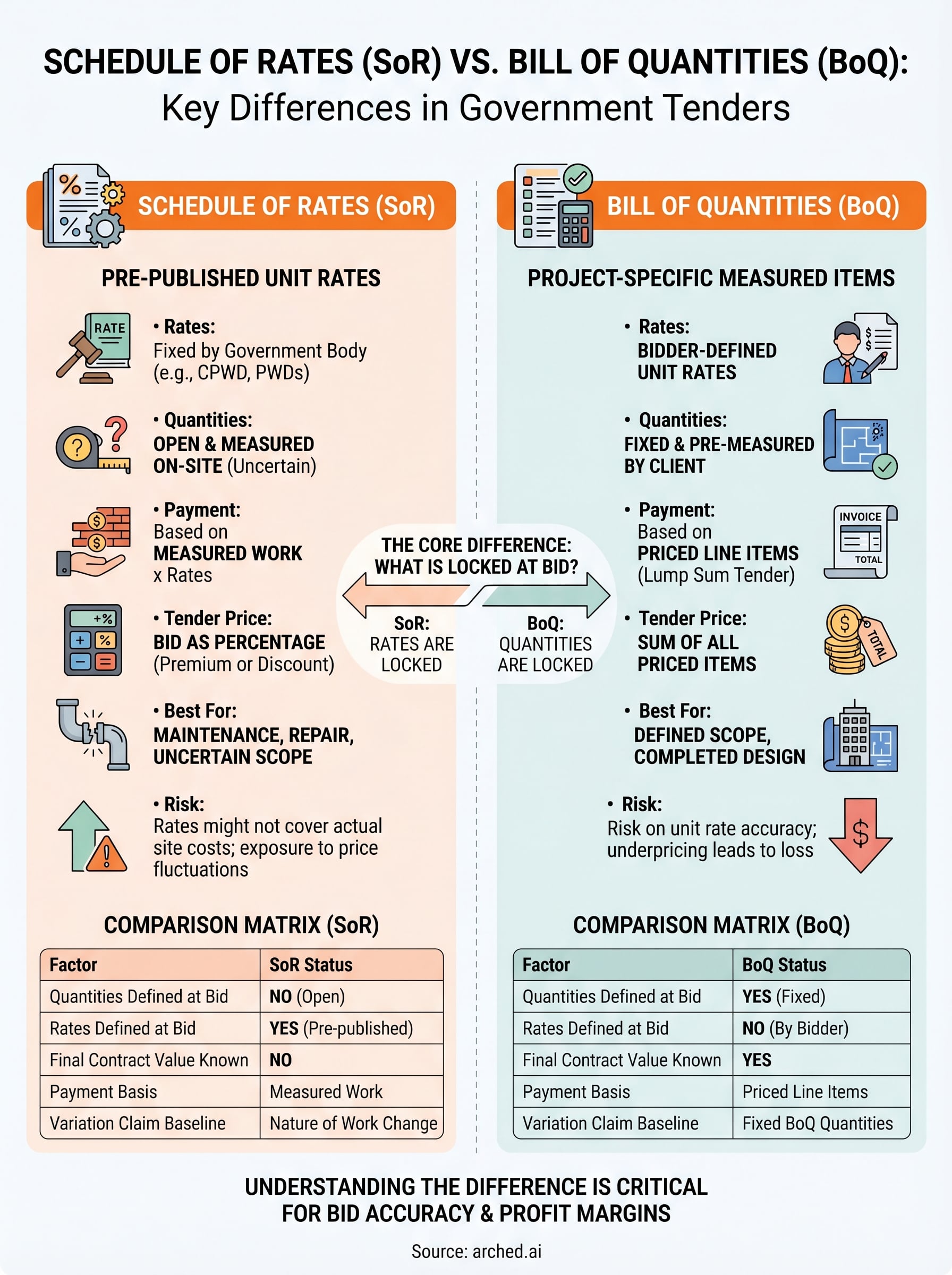
The clearest way to separate these two documents is to look at what they fix and what they leave open. A BoQ fixes both the items and the quantities, leaving you to price the rates. An SoR fixes the rates, leaving the quantities open until work gets measured in the field. That single structural difference drives everything else: your bid strategy, payment cycle, risk exposure, and how you handle variations. The schedule of rates vs bill of quantities comparison is fundamentally a question of which variable is locked at the time of contract award.
Document origin and ownership
A BoQ is produced specifically for one project by the client's design or quantity surveying team. It belongs to that tender and no other. An SoR is produced by a government department and applies across every project that department runs until it publishes a revised schedule. This means a BoQ reflects project-specific conditions, while an SoR reflects the department's general view of fair market rates across its entire portfolio of work. When you bid on an SoR-based contract, you are pricing against a document that was not designed with your specific site, access constraints, or material sourcing costs in mind.
The origin of each document tells you whose assumptions you are working with, and whose assumptions carry the financial risk.
Quantity certainty and payment structure
| Factor | Bill of Quantities | Schedule of Rates |
|---|---|---|
| Quantities defined at bid stage | Yes | No |
| Rates defined at bid stage | By bidder | Pre-published |
| Final contract value known upfront | Yes | No |
| Payment basis | Priced line items | Measured work |
| Variation claim baseline | Fixed BoQ quantities | Nature of work change |

Under a BoQ, your final contract value is calculable before you sign, which gives you a clear cash flow model to take to your finance team. Under an SoR, your payment accrues as work is measured and certified, so the total only becomes clear as execution moves forward. This matters when you are planning subcontractor payments or equipment hire schedules.
Flexibility and contract type fit
A BoQ suits projects with well-defined scope and completed design, such as a bridge reconstruction or a highway widening with issued drawings and completed survey data. An SoR suits projects with uncertain or recurring scope, such as annual road maintenance or emergency repair contracts where the department cannot predict exact volumes at the time of procurement. Forcing a BoQ format onto open-ended maintenance work creates fictitious quantities that mislead everyone, while using an SoR for a fully designed capital project leaves contract value undefined longer than your bank or bonding company will accept.
How to choose and use the right document
The choice between these two formats is rarely yours to make as a bidder. The client's procurement team selects the framework based on how well the project scope is defined. What you control is how well you read that framework before you price and submit. Misreading which document governs your contract, or applying BoQ pricing logic to an SoR tender, is a mistake that compounds through every stage of execution.
Match the document to your project's design stage
When you are evaluating an opportunity, check the design completion status before you spend time on pricing. A project with issued drawings, a completed survey, and defined specifications almost always uses a BoQ. A project described in general terms, covering an area or a period rather than a fixed scope, almost always uses an SoR. If the tender document includes a volume of measured items with fixed quantities, you are working with a BoQ. If it references a state PWD or CPWD schedule version and asks for a percentage quote, you are working with an SoR.
The design stage of a project is the strongest single indicator of which pricing framework you will find inside the tender documents.
Read the tender conditions before you price anything
Both document types come with conditions that govern rate adjustments, variation thresholds, and measurement rules. For BoQ-based tenders, locate the clause that defines when quantity variations trigger a rate revision. For SoR-based tenders, check whether the contract includes a price adjustment formula tied to material indices or labor notifications. Many contractors skip this step and price on the schedule or quantities alone, which leaves them exposed when conditions shift during execution.
Your bid team should also verify the schedule version cited in SoR tenders. Using an outdated rate schedule to benchmark your costs, when the tender references a newer revision with different rates, produces a flawed margin calculation before you have even started.
Apply the schedule of rates vs bill of quantities distinction to your risk review
Once you know which document governs the contract, adjust your risk assessment accordingly. For BoQ contracts, your risk review should focus on whether the client's quantities are realistic and whether site conditions match what the design team assumed. For SoR contracts, your risk review should focus on whether the published rates cover your actual input costs at the specific site, and whether the contract duration gives you exposure to material price movement that the fixed rates will not absorb.
Final takeaways for bidders
The schedule of rates vs bill of quantities distinction cuts through every stage of a government tender, from how you build your estimate to how you defend a claim. A BoQ locks quantities and leaves rates open; an SoR locks rates and leaves quantities open. That single difference determines where financial risk sits and how your payment accrues through execution.
Before you price any tender, identify which document governs the contract, read the conditions that control rate revisions and variation thresholds, and check the schedule version if you are working with an SoR. Treating both formats the same way is one of the fastest routes to a margin loss you cannot recover.
To check which schedule version governs your tender, the Schedule of Rates by state directory carries the current edition for every state, and the Chhattisgarh Building SOR 2026 is browsable item by item with the rates and units alongside. Edition age is part of the same question: where a schedule has stood unchanged for years, as with the Maharashtra PWD SSR still current from 2022-23, a percentage quote against it carries the drift in input prices since it was fixed.
Pricing against either format by hand across several tenders takes time your team may not have. If you would like help, see how our estimating service works and send us the project.
Have a package your team can’t get to? Send it to us. Our engineers check and sign off everything we deliver.