ADB Tenders: How To Find Latest Opportunities And Qualify
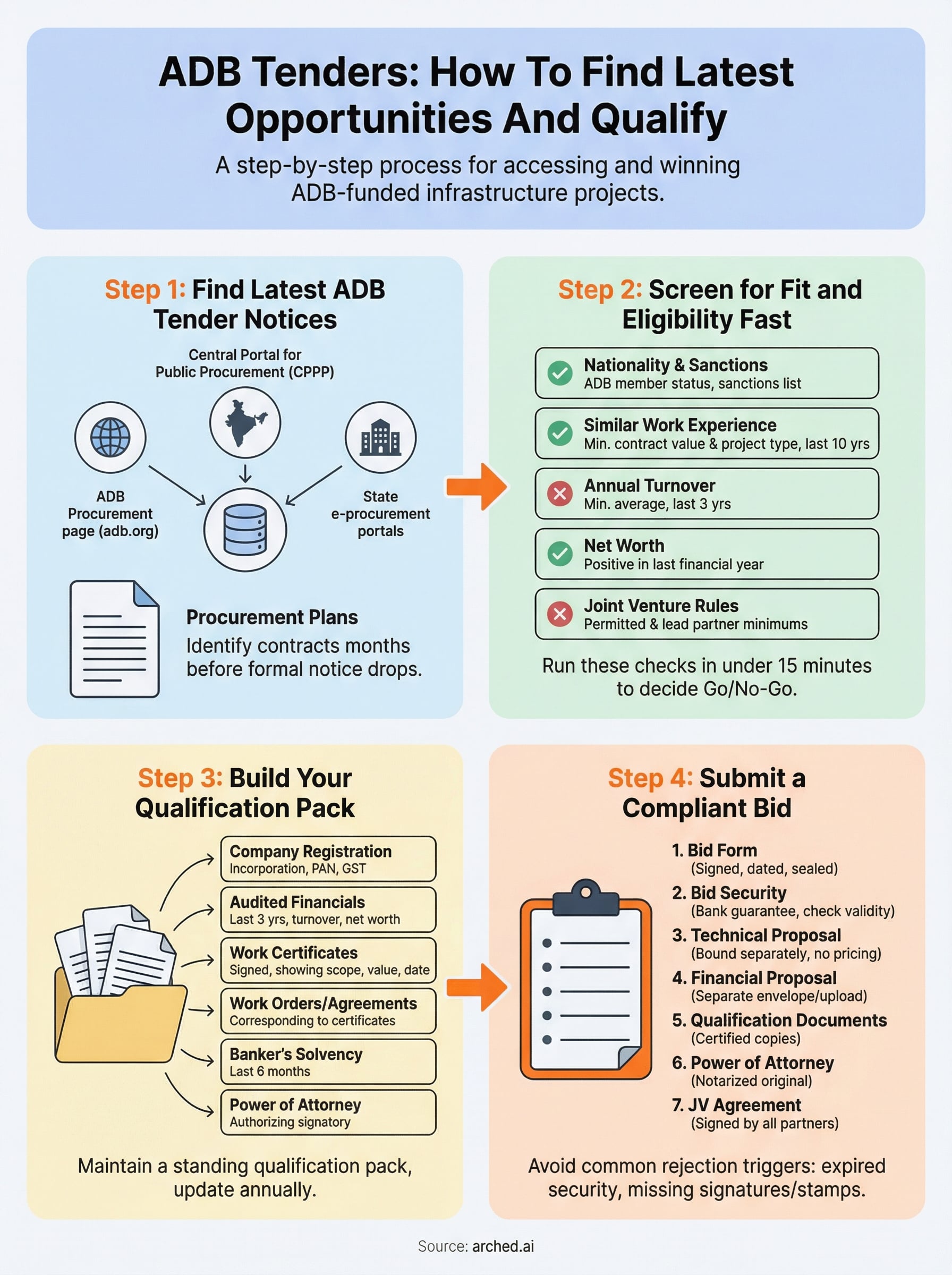
Find and qualify for the latest adb tenders in India. Learn to monitor procurement plans, screen technical eligibility, and prepare winning bid documents.
The Asian Development Bank funds billions of dollars in infrastructure projects across India every year, roads, bridges, urban transport, water supply, irrigation. For contractors and consultancies in the AEC sector, ADB tenders represent some of the most lucrative and well-structured opportunities available. But finding them consistently, understanding eligibility requirements, and actually qualifying for the bid? That's where most firms hit a wall.
ADB procurement notices are scattered across multiple platforms, the ADB's own portal, central and state e-procurement sites, and project-specific listings. Manually tracking these sources is time-consuming and unreliable. Miss a listing by a day, misread an eligibility clause in a 60-page document, or overlook a pre-qualification requirement, and the opportunity is gone before you even started.
This is exactly the problem Arched solves. Our platform monitors over 500 government and multilateral procurement portals, parses tender documents automatically, and matches opportunities to your firm's actual credentials, past projects, certifications, financial capacity. Instead of refreshing portals and scanning PDFs, you get relevant ADB opportunities surfaced directly to your dashboard, with eligibility gaps and risks already flagged.
In this guide, we'll walk you through how ADB procurement works, where to find active tenders, what qualification criteria you'll typically face, and how to position your firm to win. Whether you're bidding on your first ADB-funded project or looking to move up to higher-value contracts, this article covers the full process step by step.
How ADB tenders work in practice
The ADB doesn't directly procure contracts; it finances projects that borrowing governments execute. In India, that typically means a central ministry or state agency, like NHAI, NHIDCL, or a state PWD, acts as the Executing Agency (EA). The EA publishes tenders, evaluates bids, and awards contracts. ADB sets the procurement rules the EA must follow, and it reviews key steps before the EA can move forward. Understanding this structure tells you who to watch, what documents to track, and where actual bid notices appear.
From project approval to tender notice
Once ADB approves a loan or grant, the Executing Agency prepares a Procurement Plan, which lists every contract package, its estimated value, procurement method, and timeline. ADB publishes these plans on its website, and they are one of the most underused intelligence sources for firms chasing ADB tenders. Reading the Procurement Plan early lets you identify contract packages months before the formal notice drops, giving you time to prepare documentation and assess your eligibility.

Procurement Plans are public and updated regularly. Checking them before a notice is published is the single biggest advantage you can build into your pipeline.
The formal sequence from that point runs like this:
- Invitation for Bids (IFB) or Request for Proposals (RFP) is published on ADB's website and the Executing Agency's procurement portal
- Bidders download the Bid Document and study eligibility criteria, scope of work, and submission requirements
- Pre-bid meetings and written clarifications take place during the open bidding period
- Bids are submitted, opened publicly, and evaluated against the criteria in the document
- ADB reviews the evaluation report before the EA issues a Letter of Award
Procurement methods and what they mean for you
ADB uses several procurement methods, but Open Competitive Bidding (OCB) covers the majority of high-value civil works and consulting contracts in India. Under OCB, any eligible firm from any ADB member country can bid, which means your competition is international, not just domestic. For smaller packages, the EA may use Request for Quotation (RFQ) or direct selection, which carry simpler requirements but appear less often in large infrastructure work.
Your eligibility under ADB rules depends on three baseline factors: nationality (your firm must come from an ADB member country, India qualifies), conflict of interest (you cannot have designed or supervised the same project unless the bid document explicitly permits it), and debarment status (ADB maintains a public sanctions list, and appearing on it disqualifies you immediately). Beyond these checks, each contract package carries specific technical and financial thresholds set by the Executing Agency inside the bid document itself, and those thresholds vary significantly depending on contract value and sector.
Step 1. Find the latest ADB tender notices
Finding ADB tenders starts with knowing where the Executing Agency is required to publish notices. ADB mandates that all Invitations for Bids and Requests for Proposals appear on its own website, but contract notices also show up on the Executing Agency's procurement portal, which in India typically means CPPP, GeM, or a state-level e-tender site depending on the project. Checking only one source will cause you to miss active opportunities, sometimes by days.
The primary sources to check
ADB's procurement section at adb.org lists active contract notices organized by country, sector, and procurement method. You can filter for India-specific listings and sort by deadline date or estimated contract value to prioritize your review time. Beyond ADB's own portal, the Executing Agency's site carries the full bid document, addenda, and official clarification notices, documents that the ADB portal itself often does not replicate in full.
These three sources form your non-negotiable sourcing routine:
- ADB Procurement page (adb.org): Invitations for Bids, Requests for Proposals, and updated procurement plans
- Central Portal for Public Procurement (CPPP): Federal EA notices for projects under ministries like MoRTH, Jal Shakti, or MoHUA
- State e-procurement portals: Agencies like UPEIDA, TNRDC, or state PWDs managing ADB-funded state-level works
Reviewing the ADB Procurement Plan before a formal notice appears gives you weeks of lead time to prepare your qualification documentation.
Build a repeatable tracking routine
Relying on ad-hoc searches loses bids. Instead, bookmark the ADB procurement filter page for India and review it on a fixed schedule, at minimum twice a week. Set email alerts on CPPP using sector codes relevant to your firm's work, such as roads, water supply, or urban transport.
Your tracking log should capture five data points per tender: notice title, Executing Agency, submission deadline, estimated contract value, and procurement method. This takes under five minutes per listing and gives you a clean, scannable pipeline without any complex setup.
Step 2. Screen for fit and eligibility fast
Once you have a list of active opportunities, you need to cut through them quickly. Not every ADB tender that matches your sector is worth pursuing, and spending hours reading a document only to find a disqualifying criterion on page 34 wastes real bid capacity. The goal at this stage is to scan each listing in under 15 minutes and reach a clear go or no-go decision.
The five eligibility checks to run first
Every bid document carries eligibility requirements in a predictable structure. Qualification criteria typically appear in the Instructions to Bidders (ITB) section, and the key numbers, minimum annual turnover, similar work experience, and net worth thresholds, are almost always consolidated in a single table or Section III of the document. Read that section first, before the scope of work.
Running these five checks before reading anything else saves you from spending time on contracts your firm cannot legally submit for.
Run these checks in order for every tender you shortlist:
| Check | What to look for | Where it appears |
|---|---|---|
| Nationality and sanctions | ADB member country status, sanctions list | ITB Section 4 |
| Similar work experience | Minimum contract value and project type in last 10 years | Qualification Criteria |
| Annual turnover | Minimum average turnover over last 3 years | Financial Capacity |
| Net worth | Positive net worth in the last financial year | Financial Capacity |
| Joint Venture rules | Whether JVs are permitted and lead partner minimums | ITB Section 4 |
Flag the criteria you cannot meet today
After running the five checks, you will likely find one or two criteria your firm does not currently satisfy. Document every gap explicitly, not just a mental note. Write the shortfall against each criterion: for example, "required minimum similar work value: Rs 50 crore; our highest qualifying contract: Rs 32 crore." This record becomes the direct input for your qualification roadmap in Step 3.
Tracking gaps across multiple tenders also reveals patterns. If the same threshold keeps appearing across different bid documents, that is the credential to prioritize building next.
Step 3. Build your qualification pack
A qualification pack is the collection of documents that proves your firm meets every criterion listed in the bid document. ADB tenders require evidence, not assertions, so a claim that you have completed similar work is worthless without a signed completion certificate, a work order, and an audited turnover figure to back it up. Building this pack before a bid deadline opens up your time to focus on pricing and technical proposals instead.
Prepare your qualification pack as a standing document you update annually, not something you assemble under deadline pressure.
What goes into a standard qualification pack
Every ADB-funded civil works or consulting tender asks for roughly the same set of documents, though the specific thresholds change by contract value and sector. Knowing the standard list in advance lets you collect and organize evidence continuously rather than scrambling when a notice drops.
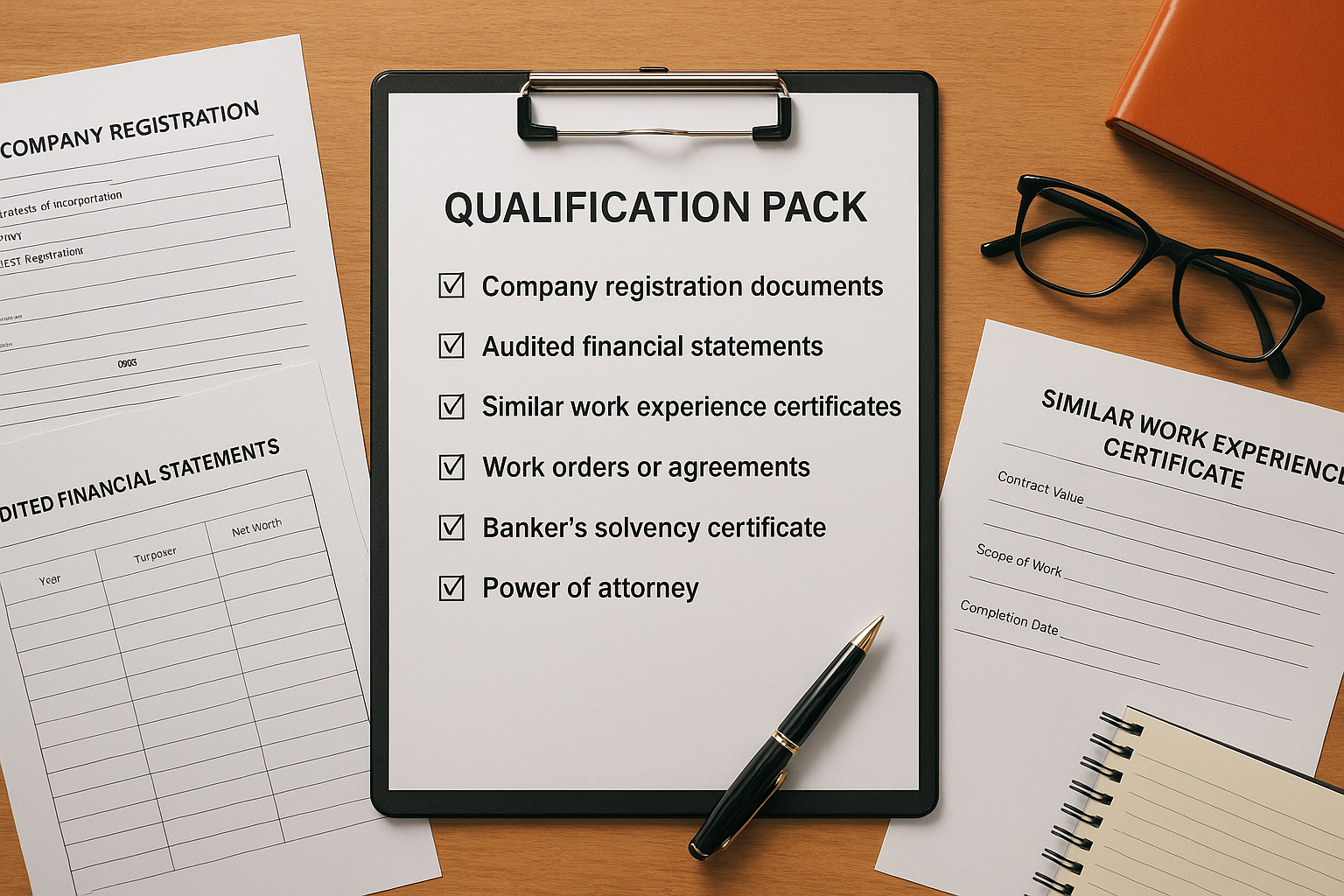
Your core pack should contain the following:
- Company registration documents: Certificate of Incorporation, PAN, GST registration
- Audited financial statements: Last three financial years showing annual turnover and net worth
- Similar work experience certificates: Signed by the employer, showing contract value, scope, and completion date
- Work orders or agreements: Corresponding to each experience certificate
- Banker's solvency certificate: Issued within the last six months
- Power of attorney: Authorizing the signatory named in the bid submission
Keep a live document log
Tracking what you have and what has expired matters as much as collecting the documents in the first place. Create a spreadsheet with one row per document, recording the document name, issuing authority, issue date, expiry date, and file storage path. Review this log monthly and flag anything expiring within 90 days so you can renew it without urgency.
Financial statements need auditor signatures and company seals on every page. If your current year's audit is still pending, check whether the bid document accepts provisional accounts or requires finalized statements. This condition appears in the eligibility section and varies by Executing Agency, so read it carefully before you assume either option is acceptable.
Step 4. Submit a compliant bid and avoid rejection
A technically strong bid gets rejected every week on ADB tenders because the submission itself is incomplete, incorrectly formatted, or missing a required signature. The Executing Agency evaluates bids against a compliance checklist before it even looks at your price or technical score, so a missing page nullifies hours of preparation. Compliance is not optional polish; it is the entry condition.
Assemble your submission package correctly
Your bid document specifies exactly how the submission must be structured. Follow that structure page by page, not from memory. Most bid documents require you to separate your technical submission from your financial submission, often in physically separate envelopes or separate digital uploads, and mixing them together is grounds for immediate rejection.
Read the submission instructions section of the bid document on the same day you decide to bid, not the day before the deadline.
Use this checklist template to verify your package before you seal or upload anything:
| Item | Required format | Status |
|---|---|---|
| Bid form | Signed, dated, company seal | |
| Bid security or declaration | Bank guarantee or declaration per ITB | |
| Technical proposal | Bound separately, no pricing visible | |
| Financial proposal | Separate envelope or upload folder | |
| Qualification documents | Certified copies with index | |
| Power of attorney | Notarized original | |
| Joint Venture agreement | Signed by all partners (if applicable) |
Eliminate common rejection triggers before you submit
Expired bid security is the most common disqualification reason in large civil works contracts. Confirm that your bank guarantee covers the full validity period stated in the ITB, which is typically 28 days beyond the bid validity itself. Your bank needs lead time to issue this, so initiate the request at least 10 working days before the submission deadline.
Unsigned forms and unstamped pages are the second most common cause. Print your complete package, review every signature line against the required signatory named in your power of attorney, and verify that your company seal appears wherever the bid document marks it as mandatory. One missed stamp ends your bid.
Next steps for your ADB tender pipeline
You now have a complete process: find notices early using procurement plans, screen for eligibility in under 15 minutes, maintain a standing qualification pack, and submit a compliant bid that clears the compliance check before evaluation begins. The firms that win ADB tenders consistently are not the most technically capable. They are the ones with the best intelligence and the tightest preparation routines. Start by pulling the current ADB Procurement Plan for India today and identifying contract packages that match your existing credentials.
Building that routine manually across 500+ portals is where most BD teams lose ground. Arched monitors every relevant portal in real time, parses bid documents automatically, and flags the exact gaps between your credentials and each contract's qualification criteria. You stop searching and start deciding. To see how it works for your firm's specific project history and credentials, explore the Arched platform and build your first pipeline today.