What Is Bid Management? Process, Roles, And Best Practices
What Is Bid Management? Process, Roles, And Best Practices
If you've ever asked what is bid management, the short answer is: it's the structured process of finding, preparing, and submitting proposals to win contracts. The longer answer, the one that actually matters, involves strategy, coordination across teams, strict deadline management, and a clear understanding of what makes your firm the right pick for a given project.
For infrastructure and engineering firms bidding on government tenders in India, bid management isn't just a back-office function. It's the engine behind revenue. Every road project on GeM, every irrigation contract on a state e-procurement portal, every bridge construction RFP on CPPP starts with someone deciding whether to bid and how to win. Get that process right, and you build a pipeline of high-value work. Get it wrong, and you burn hours on proposals that were never going to convert, or worse, miss the opportunities that were tailor-made for your credentials.
Good bid management starts with a sound process. This article breaks down bid management from the ground up, the process, the key roles involved, and the best practices that separate firms who consistently win work from those still refreshing portals and hoping for the best.
What bid management includes in government tenders
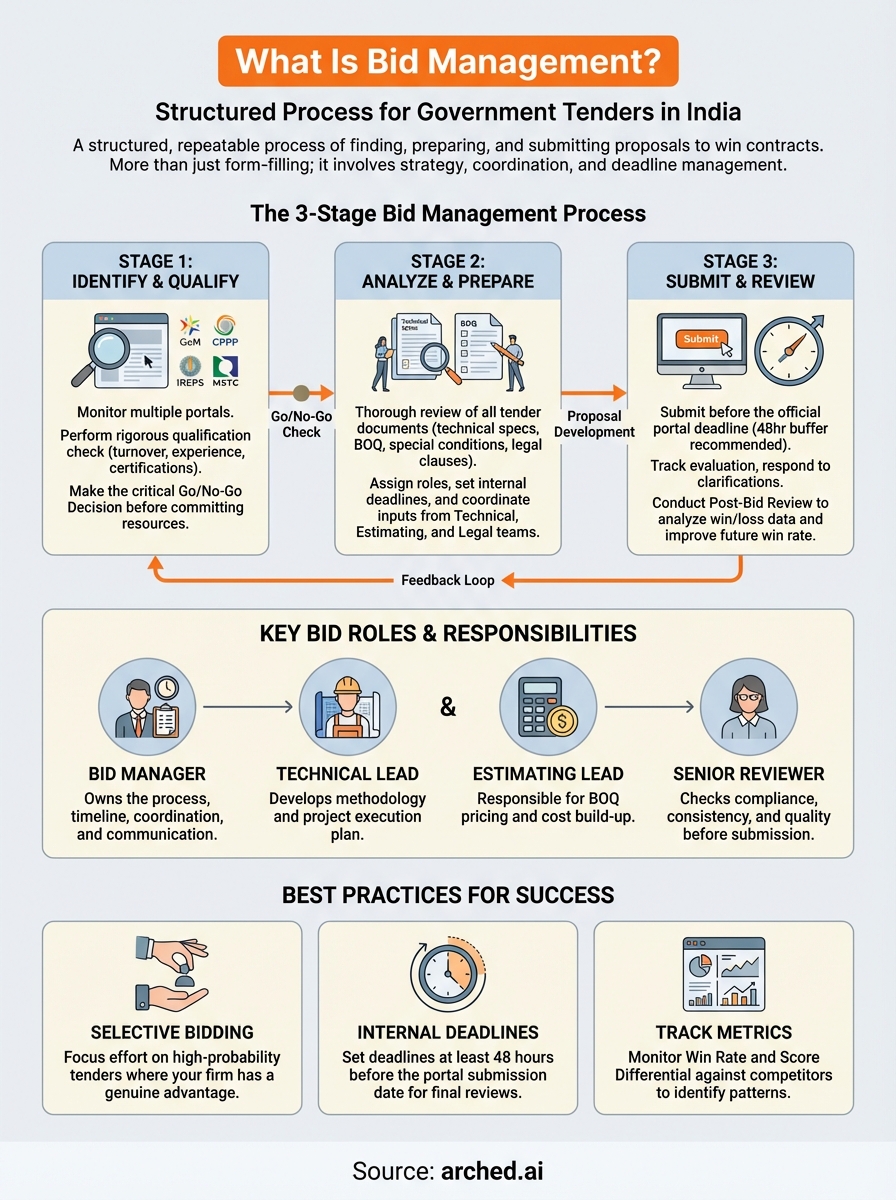
When you look at what is bid management in the context of Indian government contracts, it covers far more than filling out forms and hitting submit. Government tendering is a multi-stage process that requires your firm to track opportunities across dozens of portals, assess your eligibility before committing resources, compile technical and financial documents under tight deadlines, and follow up after submission to understand where you stood. Each of these stages has its own requirements and failure points, and skipping any one of them can disqualify a bid that would otherwise have been competitive.
Tender identification and qualification
The process starts well before any document gets written. Your bid team needs to know which tenders exist, where they are listed, and whether your firm actually qualifies to compete. In India, this means monitoring platforms like GeM, CPPP, IREPS, MSTC, and dozens of state-level e-procurement portals, each with different search interfaces, update schedules, and document formats. Without a systematic approach, opportunities slip through the gaps.
Qualification screening is where many firms waste the most time. Before investing hours in bid preparation, you need to confirm that your past project credentials, turnover figures, and certifications match the eligibility criteria in the tender notice. A firm that bids without doing this check regularly ends up submitting disqualifying proposals or, worse, never submitting at all because they assumed they were not eligible when they actually were.
The qualification check is not a formality. It is the first strategic decision in every bid.
Document analysis and bid preparation
Once you confirm eligibility, the real work begins. Government tender documents in India frequently run into hundreds of pages and include technical specifications, Bill of Quantities (BOQ), qualification criteria, special conditions, and legal clauses that need to be understood before a single price is entered. Missing a risk clause or miscalculating a BOQ line item can turn a winning bid into a costly contract.
Bid preparation involves coordinating multiple inputs at once. Estimators, legal reviewers, technical writers, and finance teams all need to contribute accurate information within the same deadline. A well-run bid management process assigns clear ownership to each section, sets internal deadlines ahead of the official submission date, and builds in review time so errors get caught before submission rather than after.
Submission, tracking, and post-bid review
Submitting the bid is not the end of the process. Your team needs to track the tender through its evaluation stages, respond to any queries or clarifications the issuing authority raises, and monitor the award decision. Many firms treat submission as the finish line and then have no visibility into why they lost or what score they received compared to the winning bidder.
Post-bid review is the part of bid management that most firms skip entirely, but it directly improves your win rate over time. Reviewing evaluated bids, comparing your pricing against award values, and identifying where your technical proposal fell short gives you concrete data to improve the next submission. Over time, this feedback loop is what separates firms with a 40% win rate from those still hovering around 10%.
Why bid management matters in Indian public works
India's public procurement market runs into tens of lakhs of crores annually, covering road construction, irrigation schemes, urban development, and building works across every state. For any firm competing in this space, understanding what is bid management is not a theoretical exercise. It is the practical difference between building a sustainable project pipeline and constantly reacting to deadlines with no real strategy behind your submissions. The firms that grow their contract revenue year over year almost always have one thing in common: a structured, repeatable bid management process that connects opportunity discovery to submission quality.
The volume problem in Indian tendering
The sheer number of active tenders across India makes unstructured bid management a serious liability. At any given time, thousands of tenders are live across GeM, CPPP, state e-procurement portals, and sector-specific platforms like IREPS and MSTC. Without a systematic process for monitoring, filtering, and prioritizing, your team ends up either missing relevant opportunities or burning time on tenders you were never going to win.
The firms that win consistently are not the ones chasing every tender. They are the ones with a clear process for identifying which tenders are worth pursuing.
Structured bid management gives your team a repeatable framework for deciding where to invest effort, which directly improves both your win rate and your capacity to handle higher volumes of quality submissions. It also prevents the common trap of bidding on high-competition, low-probability tenders while ignoring contracts where your credentials give you a genuine advantage.
Qualification requirements and competitive pressure
Indian public works contracts carry strict eligibility requirements. Prior project experience, annual turnover thresholds, and sector-specific certifications are all evaluated before your technical or financial proposal gets reviewed. If your bid management process does not include a rigorous qualification check at the front end, you risk submitting proposals that get rejected on technical grounds before anyone reads your pricing.
Competition in high-value segments is also intensifying. Larger firms with dedicated bid teams are increasingly entering mid-tier contracts that smaller firms previously won without much pressure. A structured approach lets you compete on the strength of your credentials and proposal quality rather than on price alone, which is where project margins get eroded.
How the bid management process works step by step
Understanding what is bid management at a conceptual level is useful, but the process only delivers results when you break it into clear, sequential steps that your team can execute consistently. Each stage builds on the one before it, and skipping a step rarely saves time; it typically costs you more time downstream when errors surface close to the submission deadline.
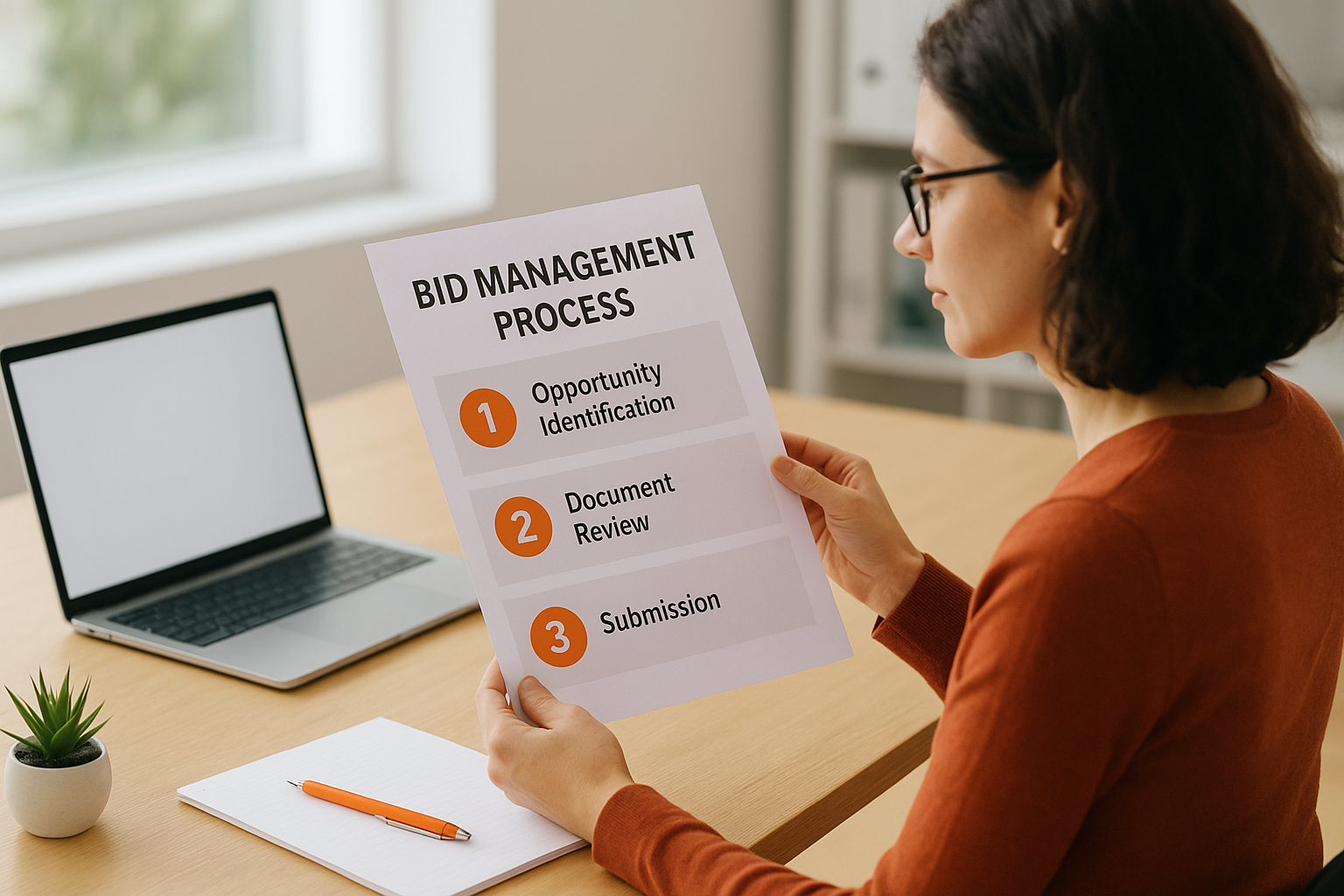
Step 1: Opportunity identification and go/no-go decision
Your process begins the moment a relevant tender surfaces. Before doing any real work, your team needs to confirm two things: that the opportunity is live and accessible, and that your firm meets the core eligibility requirements. This means checking turnover criteria, prior project experience thresholds, and any sector-specific certifications the tender demands before committing any resources.
Once eligibility is confirmed, the next call is whether the opportunity is worth the investment of effort relative to the likely return. Consider the competition level, the contract value, your delivery capacity, and how well the project aligns with your existing credentials. A disciplined go/no-go decision at this stage protects your team's time and keeps your bid pipeline focused on high-probability work.
Step 2: Document review and bid planning
After committing to bid, your team needs to pull apart the tender documents thoroughly before writing a single word of the proposal. That means reading technical specifications, the BOQ, special conditions, and qualification criteria that appear inside annexures or appendices rather than the main notice. Risks buried in legal clauses and payment terms should be flagged here, not after you have already priced the job.
Thorough document review at this stage directly reduces the risk of pricing errors and disqualification later.
Bid planning then assigns clear ownership to each section of the response and sets internal deadlines that give reviewers sufficient time before the official portal submission date.
Step 3: Submission and post-bid review
Your team submits on the portal before the deadline and then tracks the evaluation process actively. Clarification requests from the issuing authority need fast, accurate responses, and any corrigendum updates require you to re-check your submission for compatibility.
After the award is announced, review where your bid ranked against the winning submission on both technical and financial scores. This data directly informs your next bid strategy and tightens your approach over time.
Key bid roles and responsibilities
No matter where you are in understanding what is bid management, getting the roles right is what separates a well-coordinated submission from a last-minute scramble. Government tenders in India require inputs from multiple disciplines at the same time, and clear role ownership is what keeps each contribution accurate and on schedule. Without defined responsibilities, critical sections get duplicated, overlooked, or handed over too late to review properly before the portal deadline.

The bid manager
The bid manager owns the entire submission from the go/no-go call to the final portal upload. Their job is to set the internal timeline, assign tasks to the right contributors, and track every milestone against the submission date. They also serve as the primary point of contact with the issuing authority during evaluation, which means they need to understand the tender documents well enough to respond to clarification requests accurately and quickly.
A bid manager who reads every document in full before planning the response will consistently outperform one who delegates document review entirely.
On larger infrastructure contracts, this role demands strong coordination skills and a working knowledge of estimating, legal review, and technical writing so the bid manager can identify gaps and intervene before a weak section reaches the final draft.
Technical and estimating leads
The technical lead owns the methodology and project execution approach sections of the bid. In AEC and infrastructure contracts, this means translating your firm's delivery capability into a clear, credible plan that directly addresses the tender's scope requirements. The estimating lead owns the BOQ pricing and cost build-up, working from the technical specifications to produce a submission that competes on value without eroding project margins.
Both roles need access to the full tender document set as soon as the go decision is confirmed. Giving them that time upfront produces accurate, detailed inputs rather than rushed approximations that introduce pricing errors or technical gaps.
Senior reviewer
Every bid needs at least one person who reads the final submission with fresh eyes before it goes out. The senior reviewer checks for internal consistency, factual errors, and gaps between what the tender requires and what your proposal actually says. This step catches the kind of mistakes that disqualify technically strong bids on compliance or formatting grounds, which is a costly and entirely avoidable way to lose a contract your firm was qualified to win.
Best practices, metrics, and common pitfalls
Once you understand what is bid management as a process, the next step is running it well. The firms that win contracts consistently are not necessarily the ones with the largest teams; they are the ones with the tightest processes and clearest performance data. Three areas drive the most improvement: how you run each bid, how you measure results, and how you avoid the mistakes that quietly drain your win rate.
Best practices that actually move your win rate
Your biggest lever is the go/no-go decision. Before committing resources to any tender, confirm your eligibility against every qualification criterion and assess the competitive landscape honestly. Firms that chase every tender regardless of fit consistently produce lower quality proposals and burn out their bid teams.
Selective bidding produces better win rates than high-volume bidding every time.
Set internal deadlines at least 48 hours before the portal submission deadline. That buffer is what allows a final review pass to catch compliance gaps, pricing errors, and inconsistencies before they become disqualifications. Pair that with a standard checklist covering mandatory attachments, BOQ formatting requirements, and document naming conventions specific to the portal you are submitting on.
Metrics worth tracking
Three numbers tell you most of what you need to know about your bid function's health. Win rate is the ratio of contracts awarded to bids submitted. Bid-to-revenue ratio measures the cost of your bid team's time against the contract value secured. Average score differential compares your technical and financial scores against the winning bidder's, giving you a concrete view of where your proposals fall short.
Track these metrics across tender categories and portal types so you can identify patterns. If your win rate on state PWD contracts runs significantly lower than on GeM, that difference points to something specific in either your eligibility profile or your proposal quality for that segment.
Common pitfalls to avoid
The most expensive pitfall is submitting without a full document review. Firms that rely on the tender summary notice rather than reading the full document set routinely miss qualification criteria buried in annexures or risk clauses hidden in special conditions.
Failing to update your credentials data regularly is the second major pitfall. Stale figures on past project experience or annual turnover lead to eligibility miscalculations at the go/no-go stage and wasted effort on tenders your firm cannot win.
Key takeaways
What is bid management at its core? It is the structured, repeatable process that connects opportunity discovery to contract wins. You now know it covers tender identification, document analysis, submission coordination, and post-bid review, and that each step depends on clear role ownership and internal deadlines. Your win rate reflects how well you execute every stage, not just how many bids you submit. Selective bidding, thorough document review, and tracking your scores against winning competitors are the three habits that compound into consistent revenue growth over time.
Getting this right is significantly easier when the estimate is not the bottleneck. If your team has more tenders than estimators, Arched can prepare it: send the drawings and we deliver a priced BOQ with rate build-ups, reviewed by an engineer, by your bid deadline. See how our estimating service works.
Have a package your team can’t get to? Send it to us. Our engineers check and sign off everything we deliver.