Manual for Procurement of Consultancy and Other Services
Master the Manual for Procurement of Consultancy and Other Services. Learn to navigate QCBS evaluations and compliance for Indian government contracts.
Every government consultancy contract in India, whether it's a feasibility study for a highway project or a detailed project report for urban infrastructure, follows a specific set of procurement rules. The Manual for Procurement of Consultancy and Other Services, issued by the Ministry of Finance, is the rulebook that governs how central government agencies select, evaluate, and engage consultants. If you bid on public sector consultancy work, understanding this manual isn't optional, it's the baseline for every proposal you submit.
The manual lays out everything from eligibility criteria and evaluation methodologies to contract negotiations and quality-cost balancing. It draws heavily from the General Financial Rules (GFR) and aligns with guidelines from multilateral institutions like the World Bank. For BD managers and bid teams at AEC firms, the procedures outlined here directly affect how your technical and financial proposals are scored, what qualifications you need to demonstrate, and how shortlisting works.
This article breaks down the manual's key provisions, procurement methods, evaluation frameworks, and compliance requirements in plain terms. We built Arched to help infrastructure firms and consultancies navigate exactly this kind of complexity, our platform parses tender documents, flags qualification criteria, and matches your firm's credentials to relevant opportunities across 500+ government portals. Below, you'll find a comprehensive walkthrough of the manual that will help you understand the rules shaping every consultancy procurement decision in India's public sector.
Why this manual matters in public procurement
The Manual for Procurement of Consultancy and Other Services isn't just administrative guidance sitting in a government archive. It carries legal force for all central government ministries and departments, meaning procurement officers must follow it, and consultants who ignore it risk disqualification at any stage of the bidding process. Published by the Department of Expenditure under the Ministry of Finance, it translates decades of public procurement reform into a step-by-step operational framework that both buyers and sellers are expected to understand before a single document changes hands.
The legal weight behind the manual
India's public procurement system operates under multiple layers of authority. The General Financial Rules (GFR) 2017, particularly Rule 175, provide the statutory backbone for procuring consultancy services, while this manual converts those rules into specific operational procedures. When a Ministry issues a Request for Proposal, the structure of that document, the evaluation criteria, and the negotiation process all trace directly back to this manual.
For consultants, this means that any proposal you submit to a central government agency gets evaluated against criteria the manual defines, not criteria the client invented independently.
Your firm's eligibility isn't determined by a casual reading of the tender notice. It's determined by the specific qualification thresholds the manual requires procuring entities to set when shortlisting firms. If your credentials don't match those thresholds on paper, even a strong technical proposal won't reach the evaluation stage.
How it shapes evaluation and scoring
The manual introduces structured selection methodologies that directly affect your bid strategy. Quality and Cost Based Selection (QCBS) assigns a fixed weight to technical quality and a separate weight to financial cost, with the typical split running 80:20 in favor of technical quality. That weighting tells you exactly where to focus your effort. A technically weak proposal rarely survives QCBS, regardless of how competitive your fee quote is.
Beyond QCBS, the manual specifies when procuring entities should use other methods such as Least Cost Selection, Fixed Budget Selection, and Single Source Selection. Each method applies to a different type of assignment based on complexity, budget ceiling, and urgency. Your bid team needs to identify which method the client is using before building the proposal, because the scoring logic and your optimal bid positioning change significantly across these methods.
Why non-compliance is a real risk
Procurement officers in India face scrutiny from the Comptroller and Auditor General (CAG) and internal audit bodies that specifically check whether the manual's procedures were followed correctly. For consultants, non-compliance at the bid stage, such as missing certifications, incorrect bid security formats, or incomplete technical proposal structures, leads to outright rejection. For procuring entities, deviations from prescribed selection and evaluation procedures can trigger contract cancellations or re-tendering, which disrupts project timelines and erases revenue planning for all parties involved.
For AEC firms working in infrastructure sectors like highways, bridges, and urban development, these disruptions carry real financial consequences. A cancelled tender for a Detailed Project Report means months of pipeline effort disappears without return. Staying aligned with the manual's requirements from the first eligibility check protects your investment in bid preparation and keeps your revenue pipeline intact across quarters.
What the manual covers and how it fits with GFR
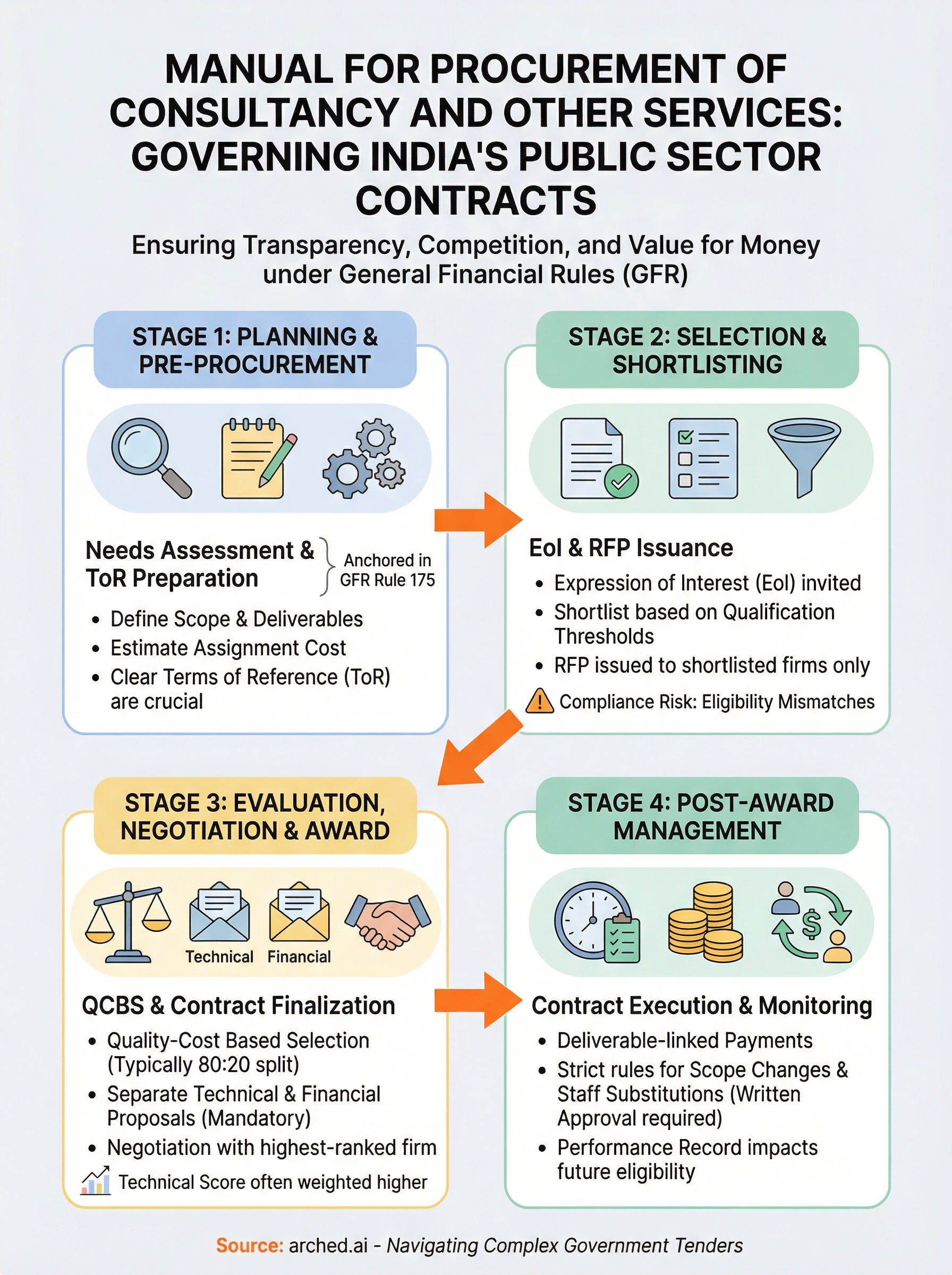
The manual for procurement of consultancy and other services organizes the entire consultancy engagement process into a structured sequence that central government entities must follow from the moment a need is identified to the point where a contract closes. It covers needs assessment, Terms of Reference preparation, shortlisting, RFP issuance, bid evaluation, contract negotiation, and post-award management. Each phase has defined rules for documentation, approvals, and timelines, so both procuring entities and bidding firms know exactly what is required at every step.
The structure of the manual's coverage
Its guidance spans several thematic areas. The first covers pre-procurement planning, including how to define the scope of services, estimate the cost of the assignment, and prepare a Terms of Reference specific enough to attract qualified proposals. The second area addresses selection methodology, detailing when to apply QCBS, Least Cost Selection, Quality Based Selection, or Fixed Budget Selection depending on the nature and complexity of the assignment.
A third area addresses contract forms and their conditions, including the provisions for payments, deliverables, intellectual property, and dispute resolution. A fourth covers contract administration, meaning the processes your team needs to monitor consultant performance, process invoices, and handle changes in scope after the contract starts. Understanding where your firm sits within each of these areas tells you which sections of the manual are most directly relevant to your current bid.
How GFR Rule 175 anchors the manual
The General Financial Rules 2017 provide the statutory authority that makes the manual binding. Rule 175 specifically governs the procurement of consultancy services for central government entities, and it sets the foundational principles around transparency, competition, and value for money that the manual then operationalizes. The manual does not override GFR; it expands on it by converting those statutory principles into step-by-step operational instructions that procurement officers can actually execute.

Every procedural step in the manual connects back to a GFR obligation, which means a deviation from the manual's process is also a potential violation of the GFR.
Your firm should treat these two documents as a pair rather than alternatives. When a procuring entity structures a shortlist or sets evaluation weights, that decision flows from GFR authority and gets executed through the manual's specific methodology. Knowing both helps you identify whether a client has deviated from prescribed procedures, which can affect your bid strategy and your rights during the evaluation process.
Who the manual applies to and key definitions
The manual for procurement of consultancy and other services applies to all central government ministries, departments, and entities that procure consultancy or specialized services using public funds. If your firm bids on assignments commissioned by central government bodies, including attached offices, subordinate offices, and autonomous bodies receiving government grants, the procedures in this manual govern how those clients evaluate and select you. State governments often adopt similar frameworks, but the manual itself carries direct binding authority only over central government procurement.
Which organizations are bound by the manual
All central government procuring entities fall under the manual's scope when the assignment involves engaging an external expert, firm, or organization to provide intellectual or advisory services rather than goods or works. This includes central public sector undertakings when they procure consultancy using government-allocated budgets. Entities using foreign aid or multilateral funding may also apply the manual's procedures, though they sometimes follow the funding agency's own procurement guidelines where these take precedence under the loan or grant agreement.
Your firm needs to confirm at the shortlisting stage which procurement framework the client is actually following, since a mismatch between the manual's procedures and a multilateral agency's rules can change evaluation criteria significantly.
For BD teams targeting central government assignments, knowing your client's institutional classification tells you whether the manual applies outright or alongside another framework. Autonomous bodies like national development authorities or statutory regulators typically follow the manual unless their own enabling legislation specifies otherwise.
Key definitions every bid team must know
Several definitions in the manual shape how procuring entities structure shortlists, evaluate proposals, and negotiate fees. The term "consultant" covers individual experts, consulting firms, and nonprofit organizations equally. The term "assignment" refers to the specific scope of work defined in the Terms of Reference. A clear grasp of these definitions matters because eligibility conditions the client sets will refer directly to these terms, and your proposal must use the same language to align with evaluation criteria.
The distinction between "consultancy services" and "other services" is also important to your bid positioning. Consultancy services involve intellectual and advisory work such as feasibility studies, project management, design, and supervision. Other services cover non-intellectual support functions like data entry, maintenance, or outsourced back-office tasks, which follow different selection methodologies and pricing norms under the manual. Misclassifying your service offering in a proposal can trigger disqualification or invite a contract dispute later.
The procurement cycle explained from start to finish
The manual for procurement of consultancy and other services breaks the entire engagement process into a defined sequence of phases that your client must complete before a contract can be awarded. Understanding this cycle from the inside gives your bid team a significant advantage over competitors who focus only on the proposal itself. Each phase has specific outputs, approvals, and timelines, and your firm's eligibility and readiness get tested at multiple checkpoints along the way, not just at the proposal submission stage.
Phase 1: Planning and Terms of Reference preparation
Before any tender notice goes public, the procuring entity must internally identify the need for external expertise, estimate the assignment cost, and prepare a Terms of Reference (ToR) that defines the scope, deliverables, and required qualifications. The quality of the ToR determines whether the eventual shortlist attracts genuinely qualified firms or triggers re-tendering due to vague eligibility criteria. Reading the ToR carefully as a bidder tells you exactly what credentials and experience the client expects to see documented in your technical proposal.
A weak ToR often signals that the procuring entity hasn't fully scoped the assignment, which can lead to scope creep and payment disputes after the contract starts.
Phase 2: Shortlisting and RFP issuance
Once the ToR is approved internally, the procuring entity issues an Expression of Interest (EoI) to invite firms to demonstrate their qualifications. Based on EoI responses, the client prepares a shortlist of typically three to six firms and sends them the full Request for Proposal, which includes the ToR, data sheet, evaluation criteria, and draft contract form. Your firm only receives the RFP if it clears the shortlisting stage, so your EoI response carries significantly more weight than most bid teams actually assign to it during planning. Treat your EoI as a filtered proposal, not a formality.

Phase 3: Evaluation, negotiation, and contract award
After the submission deadline, the client evaluates technical proposals first and only opens financial proposals from firms that meet the minimum technical score threshold, which is typically set at 70 to 75 points out of 100. The final ranking combines technical and financial scores based on the selected methodology, usually QCBS. The highest-ranked firm enters negotiations on the contract terms and fee schedule, after which the procuring entity issues a formal award letter and both parties sign the contract. Your engagement officially begins from the contract signing date, not from the date the award letter arrives, so building your project mobilization plan around that distinction matters for your internal scheduling.
How consultant selection works in practice
The manual for procurement of consultancy and other services lays out a selection process that runs on specific sequences your client must follow before choosing a winner. Understanding how that process works from the evaluator's perspective tells you exactly where your proposal gains or loses points before the financial envelope is even opened.
Reading the evaluation criteria before you write a single word
Every RFP issued under the manual includes a data sheet that specifies evaluation sub-criteria and their respective weights. These typically cover the firm's relevant experience, the proposed methodology, the qualifications of key staff, and sometimes a local content requirement. Your first task when you receive an RFP is to map these sub-criteria against your firm's documented credentials before writing anything.
Firms that build their proposal structure around the evaluation sub-criteria score significantly higher than firms that write general capability statements and hope evaluators find the relevant evidence on their own.
Key staff qualifications often carry 30 to 40 percent of the total technical score, which means your team composition decision is as consequential as your methodology write-up. If your proposed team leader's CV doesn't match the years of experience and sector background specified in the data sheet, you're conceding a large block of points before evaluation even begins.
How QCBS scoring affects your bid positioning
Under Quality and Cost Based Selection, your final combined score determines your rank, not your technical score alone. The typical weighting places 80 percent on technical quality and 20 percent on financial cost, which tells you that a significantly lower fee quote rarely compensates for a weak technical proposal. Your financial proposal needs to be competitive without undercutting your ability to actually deliver the assignment at the proposed cost.

Procuring entities normalize financial scores so that the lowest compliant bid receives a perfect financial score and all other bids get scored proportionally below it. This means that even a small fee reduction relative to competitors can shift your combined score meaningfully, but only if your technical score is already near the top of the shortlist. Focus your effort on maximizing technical quality first, then price your fee competitively within a realistic delivery budget.
What the negotiation stage requires from your team
After evaluation is complete, only the top-ranked firm enters contract negotiations with the procuring entity. The negotiation covers the work plan, staffing schedule, and deliverables, but it explicitly excludes renegotiating the technical scope or substituting key staff without prior written approval. Prepare your negotiation team with a clear understanding of your cost structure so you can respond quickly to any fee adjustments the client requests without compromising your delivery margins.
The core documents, committees, and approvals
The manual for procurement of consultancy and other services specifies a set of standard documents that every procurement must generate, along with the internal committees and approval authorities responsible for validating each stage. Your bid team benefits from understanding both sides of this process because it tells you what the client is building internally and what documentation standard your own submission must match.
The documents your bid team must prepare
Three documents form the backbone of any consultancy procurement: the Expression of Interest response, the Technical Proposal, and the Financial Proposal. Each has a prescribed format in the manual's standard RFP template, and deviations from that format often result in non-responsive bids regardless of how strong your underlying qualifications are. Your technical proposal must address the evaluation sub-criteria in the data sheet directly, covering firm experience, methodology, team qualifications, and work plan in the sequence the client specifies.
Your financial proposal must be submitted in a sealed envelope separate from the technical proposal and only opened after technical evaluation is complete. This separation is not administrative preference; it is a mandatory procedural control that protects the integrity of technical scoring. Mixing technical and financial content in the same submission triggers automatic disqualification under the manual's procedures.
| Document | Purpose | When It's Used |
|---|---|---|
| Expression of Interest | Demonstrate eligibility for shortlisting | Before RFP issuance |
| Technical Proposal | Detail methodology, team, and experience | At RFP submission |
| Financial Proposal | State your fee and cost breakdown | Opened after technical evaluation |
The committees and approvals that govern selection
Procuring entities must constitute a Technical Evaluation Committee (TEC) comprising subject matter experts who score technical proposals against the data sheet criteria. This committee's written report forms the official record of the evaluation and must document scores with supporting justification for each sub-criterion. The TEC's findings then go to a higher approval authority, often a financial advisor or dedicated procurement committee, depending on the contract value and the ministry's internal delegation of powers.
Your firm has the right to request a debrief after evaluation, which can reveal exactly where your proposal lost points and help you strengthen the next submission.
Approvals at each stage follow a tiered delegation of financial powers, where higher contract values require sign-off at progressively senior levels within the procuring entity. Understanding this delegation structure tells you how long the internal approval cycle typically runs after evaluation concludes, which directly affects your project mobilization timeline and your own resource planning for the assignment start date.
Managing the contract after award
Winning the contract is only the beginning. The manual for procurement of consultancy and other services dedicates significant attention to what happens after the award letter arrives, and your firm's conduct during contract execution determines both your payment security and your track record for future shortlisting. Post-award management under the manual follows structured rules around deliverable tracking, invoice processing, staff approvals, and scope change procedures that your project team must understand before mobilization begins.
Tracking deliverables and payments
Your contract will specify a schedule of deliverables tied directly to payment milestones, meaning invoices get processed only when the procuring entity formally accepts each deliverable in writing. Build your internal project schedule around those acceptance events rather than your own submission dates, because the client's review and acceptance period adds time between delivery and payment release. Delays in deliverable acceptance directly delay your invoice processing, so your project manager should follow up promptly after each submission to keep the review cycle moving.

Your contract's payment terms, including the percentage linked to each deliverable, are set during negotiation and cannot be modified unilaterally after signing, so negotiate these terms carefully before you put your signature on the document.
Maintain a written record of all submissions, acknowledgment receipts, and client communications throughout the assignment. These records protect your firm if payment disputes arise and provide documented evidence of performance if the client later raises quality concerns during an audit or evaluation review.
Handling scope changes and staff substitutions
The manual places strict controls on two specific areas during contract execution: changes to the agreed scope of work and substitutions of key personnel. Any addition or reduction in scope requires a formal amendment signed by both parties, and your firm cannot begin additional work without that written authorization even if the client makes a verbal request. Starting unauthorized work without a formal amendment puts your payment at risk because the procuring entity has no contractual obligation to pay for work outside the original scope.
Staff substitutions face equally strict scrutiny under the manual's provisions. Replacing a key expert named in your technical proposal requires advance written approval from the procuring entity, and the replacement must meet or exceed the qualifications of the original staff member. Submitting a substitution request with complete CV documentation and a clear explanation shortens the approval cycle and keeps your project on schedule without triggering compliance concerns from the client's evaluation or audit teams.
Common compliance risks and how to avoid them
The manual for procurement of consultancy and other services sets out clear procedural checkpoints at every stage of the procurement cycle, but bid teams routinely lose assignments not because of weak proposals but because they miss compliance requirements that disqualify their submissions before evaluation even begins. Identifying the most common failure points early in your bid preparation gives you a structured way to protect your investment in proposal development.
Eligibility mismatches at the shortlisting stage
Your EoI response is the first document the procuring entity reviews, and eligibility mismatches here end your participation before you ever receive the RFP. The most frequent issue is a gap between your firm's documented experience and the specific qualification thresholds the client sets, such as minimum years in a particular sector or a required turnover figure for the past three financial years. Submitting an EoI without first mapping your credentials precisely against these thresholds wastes resources on an assignment you cannot win at that stage.
Review every eligibility condition in the EoI notice against your firm's actual documentation before investing time in the response.
Build a credential inventory that captures your completed projects, sector-specific certifications, registered licenses, and annual turnover figures in a format your bid team can quickly cross-reference with eligibility criteria across multiple simultaneous opportunities.
Procedural errors during proposal submission
Many firms lose technically strong bids through procedural non-compliance at the submission stage. The most damaging error is mixing financial content into the technical proposal, which triggers automatic disqualification under the manual's mandatory separation rule. Your submission checklist must confirm that every financial figure, fee schedule, or cost reference stays out of the technical envelope before that document leaves your office.
A second common failure involves non-compliant bid security formats or missing validity periods on earnest money deposits. Procuring entities must reject bids with deficient bid security regardless of technical merit, so standardize your finance team's process to produce the correct format automatically for every submission.
Contract execution failures that affect future eligibility
Poor performance during contract execution creates evaluation records that follow your firm into future shortlisting decisions. Missed deliverable deadlines, unauthorized staff substitutions, and unresolved invoice disputes all generate documentation that procuring entities reference when assessing past performance in future EoI evaluations.
Your project delivery team needs to treat the manual's contract administration requirements with the same rigor your bid team applies to proposal preparation. Your execution record directly shapes your future pipeline, so managing performance documentation throughout the assignment is not optional; it is active business development.
Next steps for your next tender
The manual for procurement of consultancy and other services gives you a complete picture of how central government procurement works, from EoI eligibility through post-award contract administration. Every rule covered here translates directly into a decision point your bid team faces on the next live opportunity in your pipeline. Treating this manual as a reference document rather than a compliance afterthought puts your firm ahead of most competitors at the shortlisting stage.
Applying this knowledge manually across hundreds of active portals is where firms consistently lose time and miss high-probability opportunities. Arched monitors 500+ government portals, parses tender documents automatically, and matches your firm's credentials against specific eligibility criteria so your team focuses only on bids you can realistically win. Your shortlisting success rate shouldn't depend on whether someone on your team happened to catch the notice in time.
Start finding the right tenders for your firm before your competitors find them first.