What Is Contract Lifecycle Management? Stages & Benefits
Every government contract your firm wins starts long before the award letter arrives. It begins with discovering the right tender, parsing qualification criteria, preparing a compliant bid, and negotiating terms. After the award, there's execution, compliance tracking, and renewal. This entire arc, from first identification to final closeout, is what is contract lifecycle management, and most infrastructure firms in India handle it through scattered spreadsheets, disconnected portals, and institutional memory that walks out the door when someone leaves.
Contract lifecycle management (CLM) gives structure to this chaos. It defines clear stages, assigns accountability at each phase, and, when done well, turns contract management from a reactive scramble into a repeatable system. For firms bidding on government projects through GeM, CPPP, or state e-procurement portals, getting this right is the difference between a healthy pipeline and a string of missed deadlines.
CLM extends well beyond the bid. This article breaks down every stage of the contract lifecycle, explains where automation delivers real value, and helps you understand how CLM fits into your broader business development strategy.
Why contract lifecycle management matters
Most firms that ask what is contract lifecycle management are already feeling the pressure that makes it necessary. Contracts in the government infrastructure sector are dense, time-sensitive, and legally complex. A single missed renewal date or an overlooked qualification clause can cost you a bid, trigger a penalty, or disqualify your firm from an entire category of work. The problem compounds fast: the larger your portfolio of active tenders and running contracts, the harder it becomes to track everything manually without errors creeping in.
The cost of poor contract visibility
When your team manages contracts across disconnected tools, things slip. A bid manager tracks renewal deadlines in one spreadsheet, document revisions in a shared drive, and compliance obligations in their inbox. None of these systems talk to each other, which means your visibility into any single contract's status depends on how diligently one person updated their file last week. That is a fragile setup, and it is especially dangerous in government contracting where deadline extensions are rare and disqualification is final.
Poor contract visibility doesn't just create administrative problems; it creates revenue problems. A contract your firm should have won, but missed because the portal wasn't checked in time, is revenue that went directly to a competitor.
According to research from the World Commerce and Contracting association, companies lose an average of 9% of annual contract value due to poor contract management practices. For a mid-sized infrastructure firm managing a pipeline worth 50 crore, that figure represents real budget that never gets recovered.
How CLM reduces risk in government contracting
Government contracts carry specific risks that private-sector agreements rarely do. Qualification thresholds, performance security requirements, and tender-specific eligibility conditions each need to be tracked and met at every stage of the process. CLM gives you a structured framework to monitor these requirements continuously, not just at bid submission. When a contract is awarded, your CLM process should immediately flag which compliance milestones and reporting obligations are now active and who is responsible for each one.
Your firm also needs to manage the risk of scope creep and variation orders. In infrastructure projects, the original bill of quantities often shifts as ground realities change. Without a contract management process that captures and tracks variations formally, you can end up completing additional work without the documentation needed to claim payment. CLM builds that documentation discipline into the standard workflow so nothing falls through the gaps.
The strategic case for CLM
CLM is not just an administrative upgrade. It changes how your firm builds its contracting strategy over time. When you track which contract types your firm wins, what qualification gaps caused you to lose others, and how long each phase of the cycle takes, you generate data you can act on. That data tells you which sectors to pursue, which certifications to acquire next, and which contract sizes fall within your realistic win range.
Firms that manage their contract lifecycle well tend to build stronger, more predictable pipelines because they understand their own history clearly. They spend less time reacting to problems and more time positioning for the next opportunity before the tender even appears on a portal. That shift, from reactive to strategic, is the core reason CLM matters for any infrastructure firm serious about growth.
Stages of the CLM process
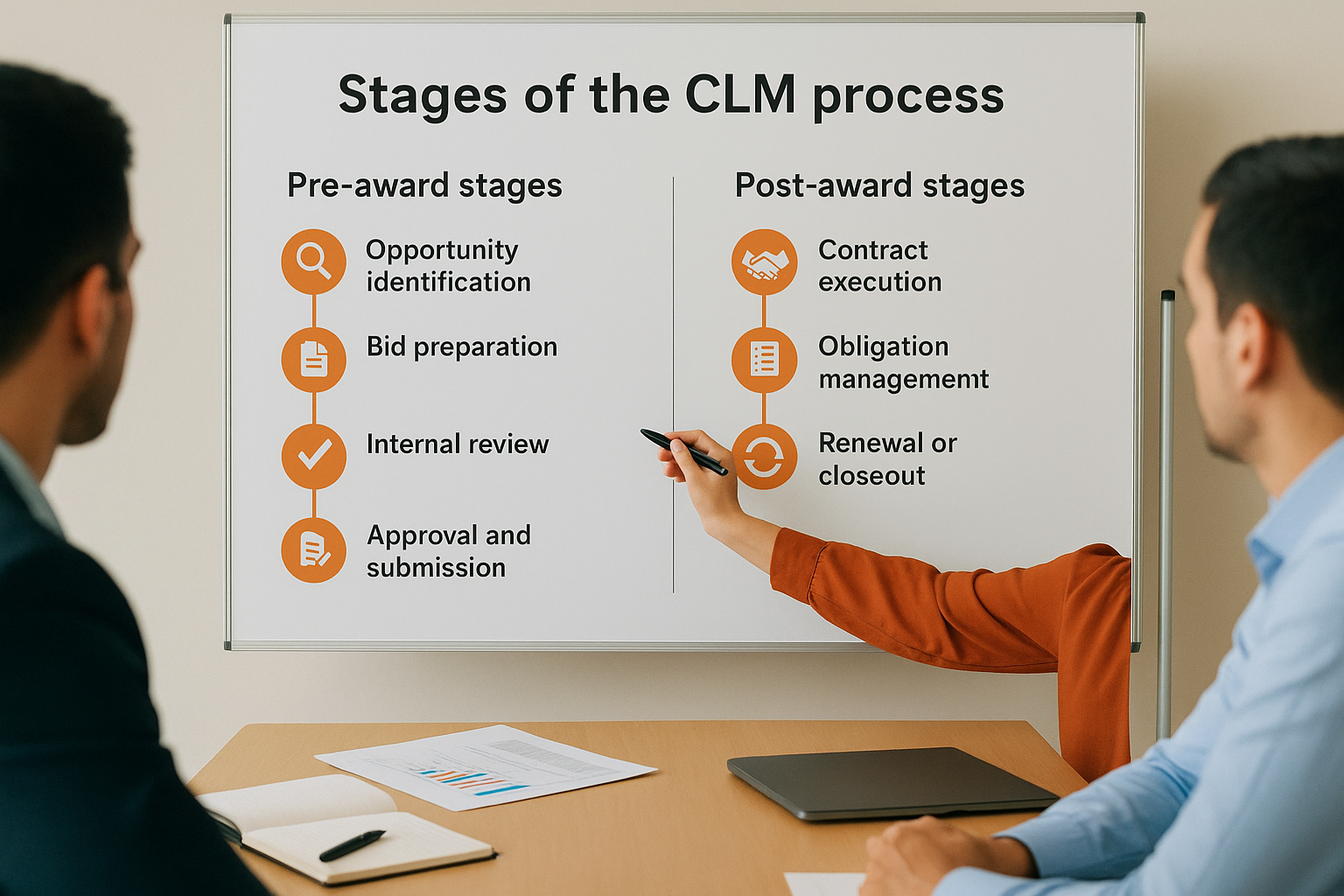
Understanding what is contract lifecycle management means understanding each stage your contract moves through, from the moment you identify an opportunity to the day the project closes out or renews. In government infrastructure contracting, each stage carries specific obligations and hard deadlines that produce real consequences when missed. Getting the full sequence clear helps you assign the right resources at the right time and prevents critical work from piling up at the submission or execution stage.
Pre-award stages
The pre-award phase covers everything before a contract is signed. Your team moves through four core steps, each building on the one before it, and skipping any one of them creates downstream risk when the bid reaches evaluation:
- Opportunity identification: Locating relevant tenders across portals like GeM, CPPP, and state e-procurement systems based on your firm's credentials and prior project history
- Bid preparation: Parsing tender documents, checking your eligibility against qualification criteria, and assembling the required technical and financial documentation
- Internal review: Verifying compliance with every condition in the tender notice before submission to avoid procedural disqualification
- Approval and submission: Getting final sign-off from the right stakeholders and submitting the bid within the portal's hard deadline
Post-award stages
Once you win a contract, the workflow shifts significantly. Contract execution begins when both parties sign and the agreement goes on record, which immediately activates your obligations: performance security deposits, mobilization timelines, and progress reporting schedules all go live simultaneously. Obligation management then runs for the full project duration, requiring continuous tracking so your firm hits every milestone, submits every required report, and formally documents any variation orders that alter the original scope.
The final stage is renewal or closeout. For framework agreements, renewal windows open before expiry, and missing them means losing continuity on work your firm already handles well. For project-based contracts, closeout involves submitting final deliverables, releasing retention payments, and archiving all contract documents in a searchable format your team can reference when preparing future bids in the same category.
Every post-award stage generates usable data: milestone completion rates, variation patterns, and payment cycle times that directly sharpen your strategy for the next tender.
CLM vs contract management, CRM, CPQ, and CMS
When people start exploring what is contract lifecycle management, they quickly run into a cluster of related terms that all sound similar but serve different purposes. Understanding where CLM starts and where other systems stop is important because overlapping tools create confusion, and buying the wrong one leaves you managing the same problem with a different interface.
CLM vs contract management
Contract lifecycle management and contract management are not the same thing, even though people often use them interchangeably. Contract management typically refers to administering a contract after it has been signed: tracking obligations, managing deliverables, and handling disputes. CLM is broader. It covers the entire arc from opportunity identification through closeout, including the stages that happen before a contract even exists.
If contract management is running the race, CLM is everything from registering and training to crossing the finish line and reviewing your performance afterward.
Your firm needs both, but CLM gives you the strategic layer that contract management alone cannot provide. It captures what happens before execution and uses that data to improve how you approach the next contract.
CLM vs CRM and CPQ
A Customer Relationship Management (CRM) system tracks your interactions with clients and prospects. It manages leads, call histories, and account relationships. Configure, Price, Quote (CPQ) software helps sales teams build accurate quotes quickly. Both tools feed into your commercial pipeline, but neither one manages the legal and compliance obligations that activate once a contract is signed.
CLM sits downstream from CRM and CPQ. Your CRM tells you who the client is; CLM governs the agreement you make with them. For infrastructure firms in India, where government contracts come through formal procurement portals rather than sales relationships, CRM has limited use in the pre-award phase, making CLM even more central to your operation.
CLM vs CMS
A Content Management System (CMS) manages your website content. The name overlap with contract management causes genuine confusion, but a CMS has no role in contract administration. CLM handles legally binding agreements, compliance timelines, and financial obligations, while a CMS handles blog posts and web pages. These two systems operate in entirely separate domains and solve entirely different problems for your team.
Benefits you can expect from CLM
Once you understand what is contract lifecycle management in full, the benefits become concrete and measurable. Structured process management reduces the cognitive load your team carries across dozens of active tenders and running contracts. Instead of relying on individual memory and manual checklists, your firm operates from a single source of truth that keeps every stage visible to the right people at exactly the right time.
Fewer missed opportunities and deadlines
Government portals do not wait. Tender windows close on fixed dates, and most state e-procurement systems enforce hard submission cutoffs with no exceptions. When your discovery and tracking process is structured, your team sees upcoming deadlines well in advance and has sufficient time to prepare a compliant bid. Missing a single high-value tender because of a late alert can represent a loss that far outweighs the total cost of building a proper CLM process.
A firm that catches an opportunity three weeks early bids with confidence; a firm that finds it three days before submission rushes, cuts corners, and loses on procedural grounds.
Better compliance and risk management
Running a government contract means managing a chain of obligations that activates the day you sign. Performance security deadlines, progress reporting schedules, and variation order documentation each carry real consequences if they slip. CLM forces your team to log and assign these obligations at the point of contract award, not six weeks later when someone notices a missed milestone and scrambles to recover.
Your firm also builds a cleaner audit trail when compliance activities are tracked within a structured system. If a dispute arises or a government client requests documentation of your performance history, you can pull complete and time-stamped records quickly rather than searching across inboxes and shared drives under deadline pressure.
Faster turnaround on future bids
Each completed contract generates usable data: which qualifications you met, which tender categories you won, and how long each stage took your team to complete. CLM turns that data into institutional knowledge your firm actually uses on the next bid cycle. When a new tender appears in a familiar category, your bid team already knows the qualification path, the typical risks, and which supporting documents your firm already has on file. Preparation time drops significantly because you are building on a structured record rather than reconstructing everything from scratch.
How to implement CLM in your organization
Implementing CLM does not require a complete technology overhaul from day one. The most effective approach starts with understanding your current process clearly, then building structure around the stages where your team loses the most time or makes the most errors. For firms still working out what is contract lifecycle management and how it fits their operation, starting small and expanding deliberately produces better adoption than rolling out a full system all at once.
Start with a process audit
Before selecting any tool or assigning new workflows, map out exactly what your team does today across each stage of the contract lifecycle. Walk through a recent tender cycle from discovery to closeout and note where handoffs happened informally, where deadlines lived in personal files, and where compliance obligations were tracked inconsistently. These friction points are your implementation priorities, not the stages that already run smoothly.
The gaps you find in your audit tell you exactly where to build structure first, which makes your CLM rollout faster and easier to justify internally.
Your audit should also identify who currently owns each stage and whether that ownership is formal or assumed by default. Many infrastructure firms find that bid preparation and post-award obligation tracking fall to the same person, creating a bottleneck that a proper CLM structure can break apart effectively.
Build your stage framework before buying software
Resist the urge to purchase a CLM platform before your process is defined. Software enforces whatever workflow you configure into it, and unclear stages at launch simply digitize existing confusion. Define each stage in writing, assign a responsible role, and set standard timelines before selecting a tool. A useful starting framework covers these core stages:
- Opportunity identification and eligibility screening
- Bid preparation and internal review
- Submission and award tracking
- Post-award obligation logging
- Renewal or closeout documentation
Once your framework is stable, selecting and configuring a tool becomes straightforward because you already know exactly what it needs to support.
Train your team and assign ownership
CLM only delivers value when every person in your process understands their role within it. Run a short onboarding session that walks bid managers, legal reviewers, and project leads through the new stage framework before anything goes live. Assign a single owner for each stage, not a team or department, so accountability stays clear and follow-through stays traceable.
CLM best practices and KPIs to track
When firms finally understand what is contract lifecycle management and start building their process, the most common failure mode is not choosing the wrong tool. It is building a system that no one consistently uses because expectations and measurement were never defined clearly. Best practices and KPIs solve this by giving your team concrete standards to work toward and concrete numbers to check against.
Best practices for CLM adoption
Standardize your document templates across every stage of the contract lifecycle before you try to automate anything. When bid teams use different formats for eligibility summaries, variation orders, and closeout records, your CLM process cannot generate consistent data. Standardized templates are the foundation that makes everything else, including tracking and reporting, actually work.
The firms that get the most value from CLM are the ones that treat process discipline as a non-negotiable standard, not a suggestion that individual bid managers can choose to follow.
Review your CLM process after every major contract closeout. Post-contract reviews should be short, structured, and focused on three questions: what stage created the most delays, which compliance obligation was hardest to track, and what you would do differently on the next similar bid. These reviews compound in value over time and turn your contract history into a continuous improvement engine.
KPIs that tell you if CLM is working
Tracking the right metrics keeps your CLM process honest and gives leadership a clear view of where bottlenecks persist. Without defined KPIs, you cannot tell whether your process improvements are working or whether you are simply completing the same workflows in a different format. Track the following metrics consistently across your active tender pipeline and running contracts:
| KPI | What it measures |
|---|---|
| Bid submission rate | Percentage of identified tenders your firm actually submits |
| Pre-award cycle time | Days from tender discovery to submission |
| Contract win rate | Percentage of submitted bids that result in awards |
| Compliance milestone hit rate | Percentage of post-award obligations met on time |
| Renewal capture rate | Percentage of eligible renewals your firm successfully pursues |
Review these numbers quarterly, not just at year-end. Quarterly reviews give you enough data to spot trends while leaving time to correct course before a pattern becomes a structural problem.
Bring your contracts under control
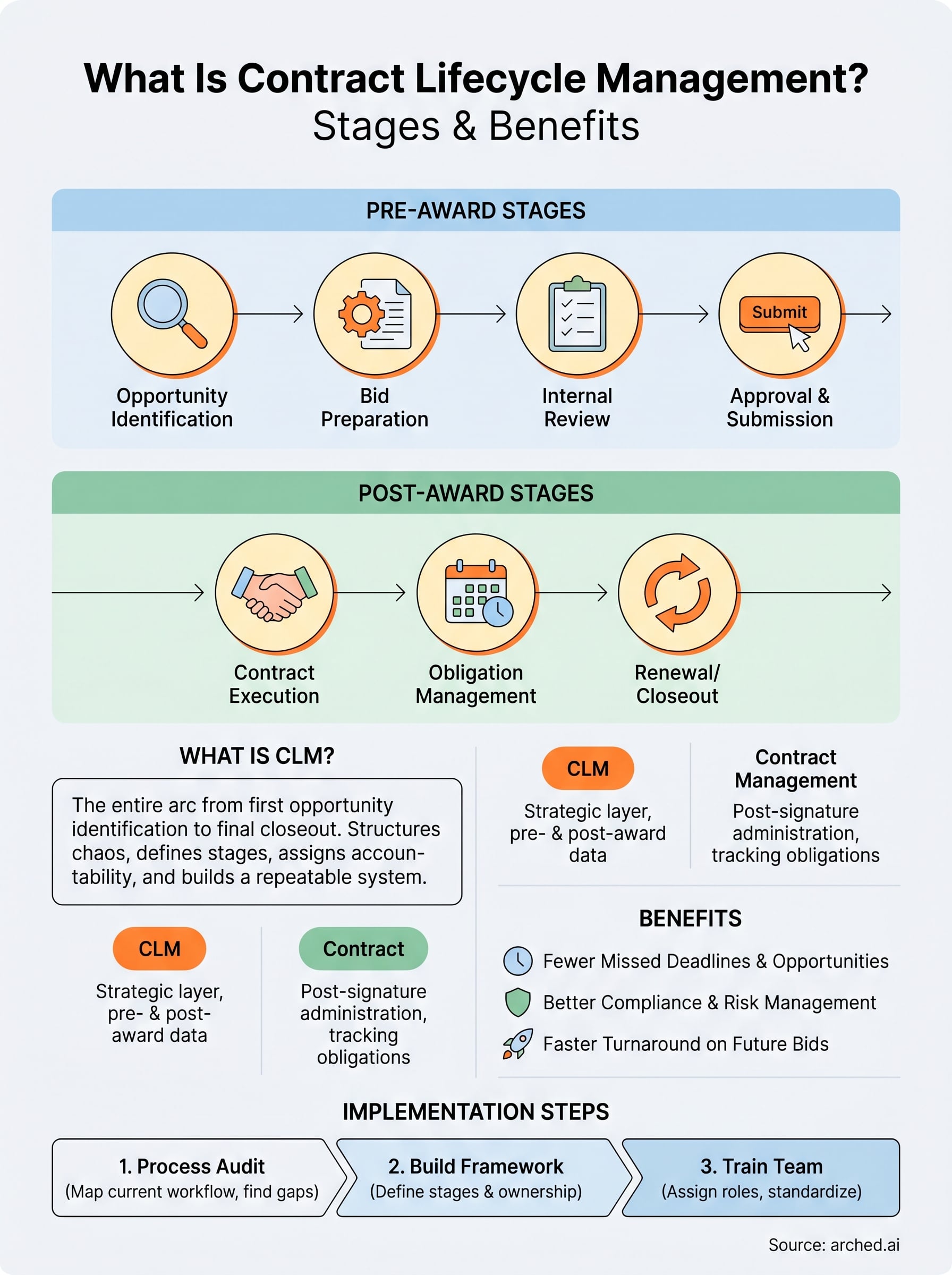
Now that you understand what is contract lifecycle management and how it structures every stage from tender discovery to closeout, the next step is applying that structure to your own operation. Most infrastructure firms in India lose time and revenue not because they lack talent, but because their contract process relies on personal judgment and disconnected tools instead of a repeatable system. Building CLM into your workflow fixes that at the root.
Start by auditing your current process, defining your stage framework, and assigning clear ownership before you introduce any new technology. The discipline you build around your contracts compounds over time: cleaner data, faster bids, fewer missed renewals, and a pipeline you can actually predict. The front end of the lifecycle is the estimate behind your bid. If you want that prepared for you, see how our estimating service works.
Have a package your team can’t get to? Send it to us. Our engineers check and sign off everything we deliver.