Procurement Analytics Use Cases: 12 High-Impact Examples
Most procurement teams in India's AEC sector still rely on manual processes, refreshing portals, scanning PDFs, cross-referencing eligibility criteria across dozens of tabs. The data exists, but it sits in silos, untouched by any real analysis. That gap between available data and actionable insight is exactly where procurement analytics use cases become relevant, and where firms either gain a strategic edge or keep losing bids they should have won.
Procurement analytics isn't a single tool or dashboard. It's a set of applied methods, spend analysis, supplier risk scoring, demand forecasting, document parsing, that turn raw procurement data into decisions. For government contractors and BD teams working across platforms like GeM, CPPP, and state e-procurement portals, these methods can cut through noise that would otherwise take hours of manual review.
This article breaks down 12 high-impact examples of procurement analytics in action, from opportunity discovery and bid qualification to gap analysis and competitor benchmarking. Each use case includes what it solves, how it works, and why it matters for teams bidding on public infrastructure contracts. Whether you're evaluating analytics tools or building a case internally for adopting one, this is the reference you need.
Why procurement analytics matters in India
India's public procurement market is one of the largest in the world. The government spends an estimated 20 to 30 percent of GDP on public procurement annually, and the AEC sector captures a major share through road projects, irrigation works, bridge construction, and urban development schemes. For firms operating in this space, the volume of opportunity is not the problem. The core problem is visibility and the ability to separate viable contracts from noise across hundreds of portals and thousands of monthly tender notices.
The scale of India's public procurement market
India's central and state governments collectively publish tens of thousands of tender notices every month across platforms like GeM, CPPP, IREPS, MSTC, and dozens of state-level e-procurement portals. A single BD manager trying to cover even a fraction of these manually will miss relevant opportunities, misread eligibility criteria, or spend most of the week just gathering information rather than analyzing it. That is not a bandwidth problem; it is a structural problem with how procurement intelligence gets collected and used.
When data lives in silos across 500+ portals, the real cost is the strategic decisions you never get to make.
The Indian government's push toward digital procurement through programs like Digital India has increased the number of available tender portals, but it has also increased complexity. More portals mean more data points to monitor, more document formats to parse, and more qualification criteria to cross-reference against your firm's actual credentials.
Why manual processes fail at this scale
Manual tracking methods, like spreadsheets, portal bookmarks, and basic keyword alerts, break down quickly when you monitor dozens of portals across multiple states and sectors. You miss tenders because the portal used different terminology. You waste hours reading a 120-page BOQ only to discover your firm lacks one qualifying certificate. These are not edge cases for AEC firms in India; they are weekly realities that directly affect win rates and revenue pipelines.
Procurement analytics use cases exist specifically to address these structural failures. When you apply data analysis systematically to your procurement function, you stop reacting to individual tenders and start building a real pipeline. You identify patterns in which contract types your firm consistently wins, which qualification gaps keep you out of high-value bids, and which portals generate the most relevant opportunities for your specific profile.
The competitive pressure driving adoption
Firms that adopt analytics don't just save time. They make fundamentally better decisions about where to invest their bid effort. In a market where preparing a serious tender response can consume significant internal hours across BD, technical, and finance teams, selecting the right opportunities matters as much as writing a strong proposal. Analytics gives you a filter that manual processes cannot provide at scale.
Your competitors are moving faster. As more firms use AI-assisted tools to monitor portals and parse documents, the gap between data-driven firms and manual-process firms widens every quarter. Acting on structured data rather than intuition is no longer an advantage reserved for large enterprises with dedicated research teams. In India's AEC procurement market, it is quickly becoming the baseline for staying competitive and growing your contract portfolio year on year.
What makes a use case high-impact and realistic
Not every analytics project delivers results. Most fail because they start with the tool rather than the problem. A high-impact use case starts with a specific decision someone on your team makes repeatedly, and asks whether better data would change the outcome of that decision. If the answer is yes, you have a real use case. If the answer is "it would be nice to know," you have a reporting exercise that will collect dust after the first month.
It must solve a decision that actually costs you money
The clearest test for any procurement analytics use case is whether it changes a decision with real financial stakes. Bid or no-bid decisions, supplier selection, qualification gap identification, these all have direct revenue or cost implications. If you bid on the wrong tender and lose, you have wasted internal hours. If you miss a tender that matched your credentials perfectly, you have lost pipeline. Analytics that connects directly to either of those outcomes is high-impact by definition.
The best use cases don't generate reports. They eliminate a specific, recurring decision error.
Consider what happens when your BD team selects tenders manually based on keyword searches. They will include tenders your firm cannot actually qualify for, and exclude tenders that used slightly different terminology. Eligibility-based matching, which analyzes your firm's credentials against actual qualification criteria, directly fixes that error. That is a realistic use case because the data already exists, the decision is already happening, and the failure mode is measurable.
It must work with the data you already have
High-impact does not mean complex. Many teams overcomplicate analytics by waiting for a perfect data environment before they start. The most actionable use cases run on data your firm generates every day: past project records, bid outcomes, portal alerts, document downloads, and vendor communications. You do not need a data warehouse to start identifying which portal generates your best conversion rate or which contract category produces your lowest win rate.
Realistic use cases also account for your team's actual capacity to act on output. Analytics that requires three weeks of manual follow-up to implement is not realistic for a BD team managing 40 active opportunities. The goal is insight that shortens your decision cycle, not one that adds steps to it.
How to set up data, dashboards, and ownership
Before you run any procurement analytics use cases, you need to establish three things: where your data comes from, what your dashboards are actually supposed to help you decide, and who is responsible for acting on the output. Skip any one of these, and your analytics project will produce reports that nobody reads and changes that nobody makes.
Start with the data sources you already own
Your firm already generates usable procurement data every week. Bid outcomes, past project records, portal alert logs, downloaded tender documents, and vendor evaluation notes all contain the raw material for meaningful analysis. You do not need to build a complex data infrastructure from scratch. Start by consolidating your existing records into a single location, whether that is a shared drive, a simple database, or a purpose-built platform, so that analysis runs on consistent inputs rather than scattered files.
The biggest mistake teams make is waiting for perfect data before starting. Start with what you have and clean as you go.
The portals you monitor, such as GeM and CPPP, also generate structured data through published tender notices. If you use a tool that parses these automatically, that feed becomes a live data source you can analyze for patterns in contract volume, sector activity, and eligibility criteria over time.
Build dashboards around decisions, not metrics
A dashboard that shows "total tenders monitored" tells you nothing useful. A dashboard that shows your bid-to-win ratio by contract category, broken down by quarter, tells you where to focus next. When you design your procurement dashboards, start by listing the three or four decisions your BD team makes every month, then build each view to directly inform one of those decisions.

Keep the layout simple. One screen for active pipeline, one for bid outcomes, and one for qualification gaps covers most of what a BD manager needs to act on daily.
Assign clear ownership for each analytics output
Analytics only drives action when a specific person is responsible for reviewing the output and deciding what to do with it. Assign one owner per dashboard view, and set a regular review cadence, weekly for active pipeline, monthly for win rate trends. Without ownership, even the most accurate data produces no change in behavior.
Four use cases to cut cost and increase compliance
Cost reduction and compliance are the two outcomes procurement decision-makers cite most often when building the case for analytics investments. For AEC firms bidding on public contracts in India, both goals connect directly to your bid selection process and how well your internal records align with published qualification criteria. The following four procurement analytics use cases show you where to apply structured data analysis to produce measurable financial and operational results.
1. Spend category analysis
Spend category analysis groups your historical contract spend by sector, geography, and contract type to reveal where your budget goes and what returns it generates. Most BD teams in India don't hold a consolidated view of this data, which means they allocate bid effort based on habit rather than evidence.
When you analyze spend by category, you quickly see which contract types produce your best win rates and which drain preparation hours without results. That visibility alone lets you redirect resources toward higher-probability opportunities.
2. Maverick spend detection
Maverick spend occurs when procurement happens outside approved processes, through untracked vendor payments, repeat purchases from unapproved suppliers, or bids submitted without internal review. Flagging these transactions through analytics protects your firm from compliance failures that can disqualify you from future government contracts.
Automated detection rules identify the patterns that manual reviews consistently miss, giving your compliance team a reliable early-warning system rather than a post-incident audit.
Compliance failures in government contracting rarely come from one large violation; they accumulate through small, repeated process gaps that go undetected until it's too late.
3. Contract compliance monitoring
Once you win a contract, tracking delivery milestones, invoicing timelines, and document submission deadlines becomes critical. Analytics dashboards that pull from your active contract records give project leads a live view of where each contract stands against its agreed terms.
Firms that monitor this data proactively catch delays before they trigger penalty clauses, protecting both the current contract relationship and their eligibility record for future bids.
4. Eligibility-based bid filtering
Submitting bids your firm cannot realistically qualify for wastes preparation hours and erodes internal credibility. Eligibility-based filtering uses your firm's credential data, past project values, certifications, and sector experience, to automatically exclude tenders where you fall short of published qualification criteria.
That filtering step alone redirects preparation time toward bids where your probability of winning is genuinely high, improving both your win rate and your team's focus.
Four use cases to improve suppliers and reduce risk
Supplier and vendor relationships carry significant risk for AEC firms in India's public procurement space. Qualification failures, delivery delays, and non-compliant subcontractors can all damage your eligibility record and expose your firm to contractual penalties. The following four procurement analytics use cases show how structured data analysis reduces those risks before they affect your active contracts or future bid eligibility.
5. Supplier performance scoring
Most firms evaluate suppliers informally, relying on project managers' memory or feedback shared during team reviews. Supplier performance scoring replaces that approach with a structured model that tracks delivery timeliness, quality records, and compliance history across every engagement your firm runs.
When you score suppliers consistently, poor performers become visible before you commit them to a high-value contract. That visibility protects your delivery record and strengthens the audit trail government clients often request during contract reviews.
6. Vendor risk mapping
Not every vendor carries the same risk profile. Financial instability, narrow geographic coverage, and single-point dependencies all create vulnerabilities that typically surface mid-project when switching costs are high.
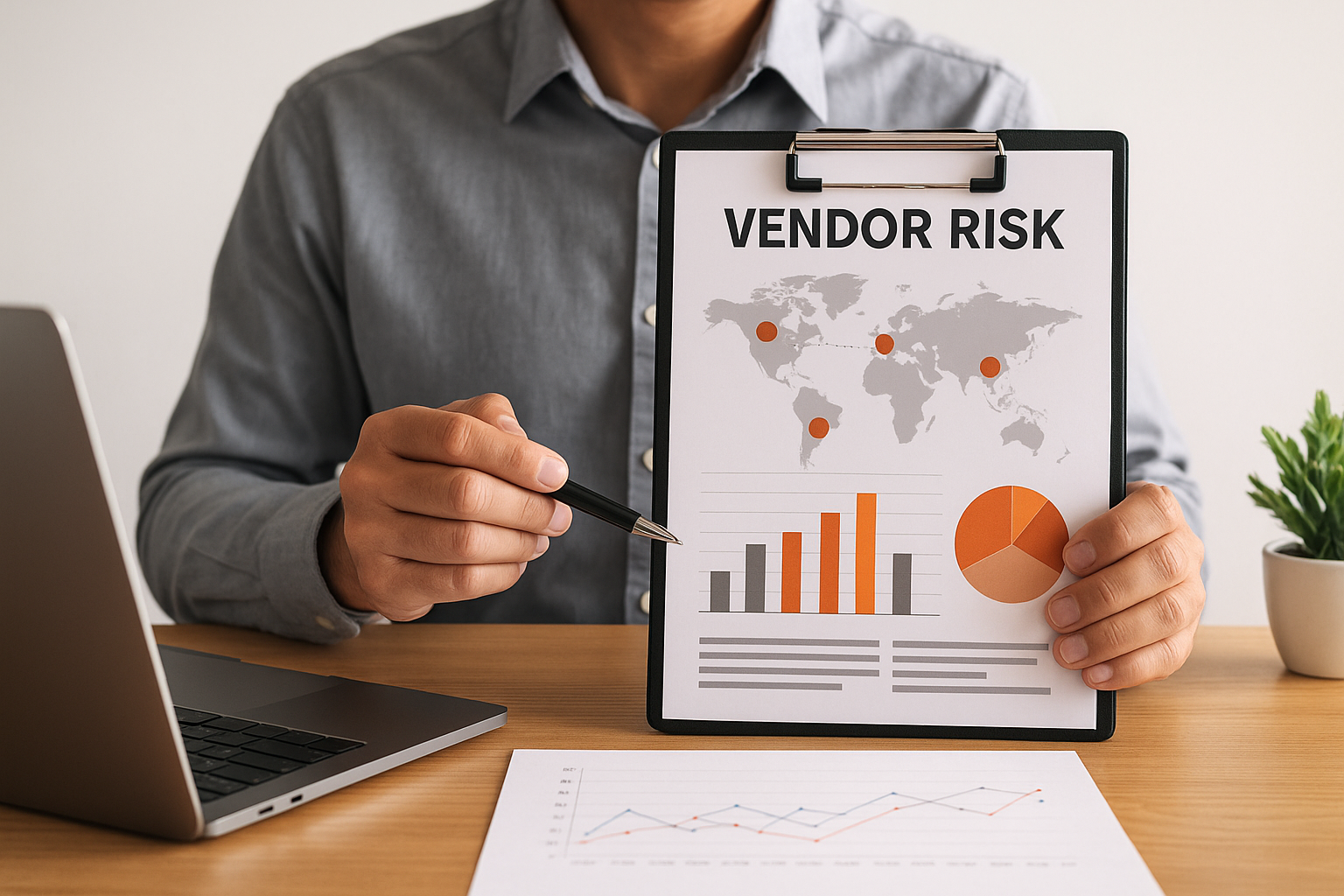
Vendor risk you don't map in advance becomes a delivery problem you manage under pressure.
Vendor risk mapping uses financial data, capacity records, and geographic reach to score each supplier against your active pipeline. Firms that run this analysis consistently reduce mid-project vendor failures and maintain stronger delivery timelines on government contracts.
7. Subcontractor due diligence
Government contracts in India often require detailed subcontractor disclosures. Incomplete or inaccurate subcontractor records create compliance gaps that can trigger contract reviews or disqualify your firm from future tenders on the same portal.
Running analytics against your subcontractor database helps you identify missing credentials, expired certifications, and undocumented work history before submission deadlines, removing a category of risk that manual document reviews consistently miss.
8. Supply chain disruption monitoring
Material delays and labor shortages hit AEC projects in patterns that are predictable with the right data. Monitoring supplier lead times, regional procurement volumes, and historical disruption records gives your project teams early warning signals rather than last-minute surprises.
Firms that track these signals adjust procurement timelines before delays cascade into contractual penalties, protecting both the current project and the performance record your firm carries into future bids.
Four use cases to win more government tenders in India
Winning government tenders in India requires more than finding the right notice at the right time. The procurement analytics use cases in this section focus on the specific actions that move you from passive monitoring to active bid strategy. Each one addresses a real gap that AEC firms face when trying to grow their public sector contract portfolio.
9. Tender matching by actual eligibility
Keyword-based portal searches miss tenders that use different terminology and include tenders your firm cannot qualify for. Eligibility-based matching analyzes your firm's past project values, certifications, and sector experience against the actual qualification criteria published in each tender notice, not just the title keywords.
Matching on credentials rather than keywords is the single fastest way to raise your bid-to-win ratio without increasing bid volume.
Your BD team stops wasting preparation hours on tenders that look relevant on the surface but fail on one or two qualification conditions buried deep in the document.
10. Gap analysis for qualification building
Some of the most valuable government contracts sit just outside your current credential profile. Gap analysis identifies exactly which certifications, project value thresholds, or sector experience your firm lacks to qualify for those high-value tenders.
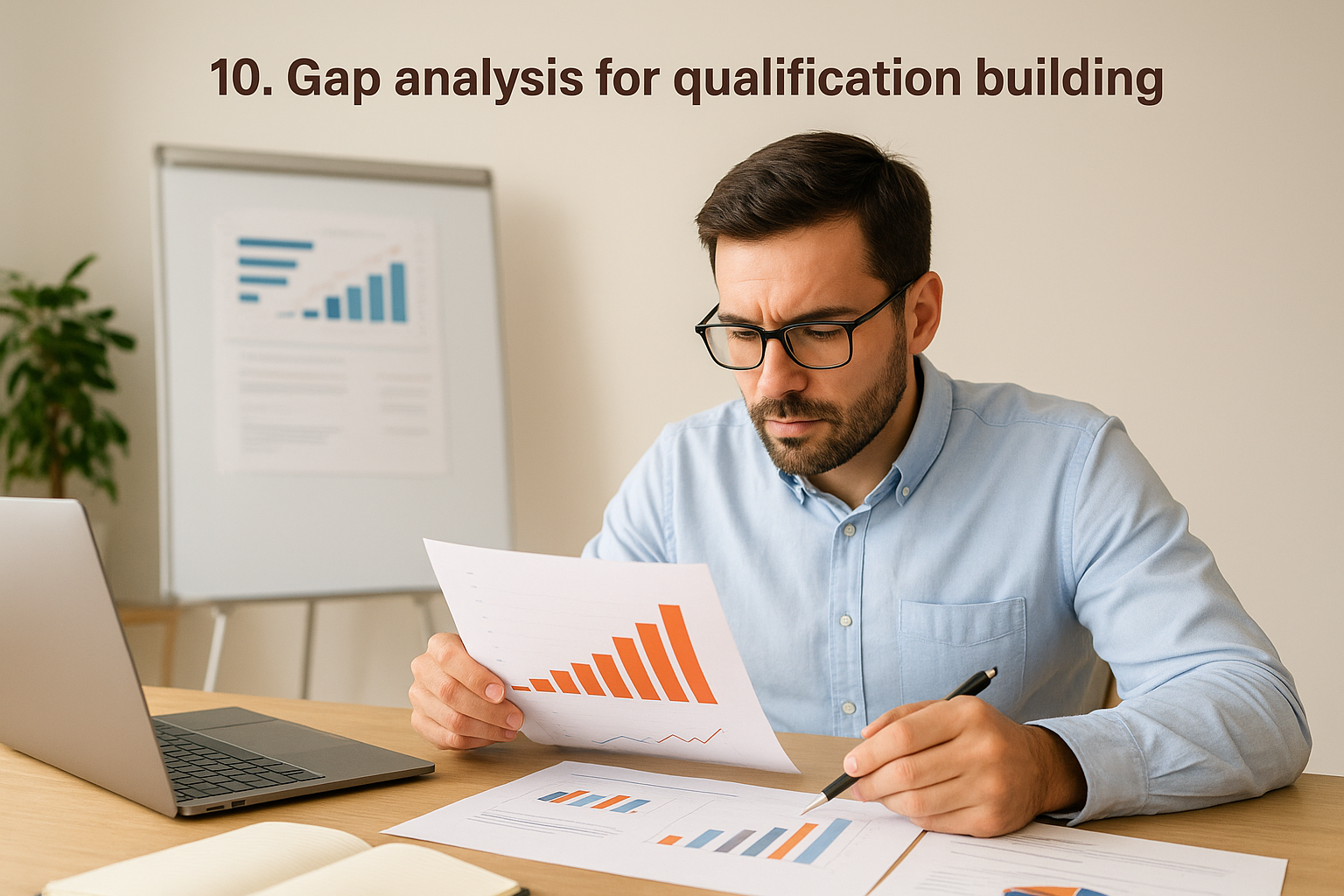
Beyond identifying the gap, structured analytics maps the smaller stepping-stone contracts that would build the missing credential. That turns a blocked opportunity into a two or three bid strategy with a clear revenue pathway.
11. Competitor activity benchmarking
Understanding which firms consistently win contracts in your target categories gives you concrete data about realistic competition levels and bid pricing patterns. Competitor benchmarking tracks published award data from portals like CPPP to show which contractors dominate specific sectors, geographies, or contract value ranges.
You use that data to decide where to compete aggressively, where to wait for a better match, and which sectors currently offer the least crowded path to a win.
12. Portal performance tracking by opportunity quality
Not all portals generate equal opportunity for your specific firm profile. Tracking which portals produce the most relevant tender matches, measured by eligibility hit rate and eventual bid outcomes, shows you where to concentrate your monitoring effort.
Firms that run this analysis consistently redirect alert resources toward the two or three portals that generate the majority of their qualified pipeline, cutting noise without missing genuine opportunities.
Common pitfalls that make analytics fail in procurement
Most procurement analytics use cases fail before they produce a single useful insight. The failure rarely comes from a lack of data or a weak tool. It comes from skipping the foundational decisions that make analytics actionable in the first place. Understanding where these projects break down helps you avoid the same patterns.
Starting with the tool instead of the problem
When teams lead with software selection before defining the decision they are trying to improve, they get dashboards that track activity metrics nobody uses. The tool becomes the goal, and the actual procurement problem stays unsolved. Before you evaluate any analytics platform, write down the specific decision it needs to improve and the financial cost of making that decision badly.
Buying a tool without a defined use case produces reports. Defining a use case first produces decisions.
Every feature you adopt should map directly to a recurring decision in your workflow, whether that is bid selection, supplier evaluation, or qualification gap identification. If you cannot name the decision, hold off on the tool.
Treating data quality as a future problem
Teams frequently delay analytics projects by waiting for clean, consolidated data before starting. In practice, data quality is a continuous process, not a prerequisite. Starting with the structured data you already own, past bid records, portal alert logs, award outcomes, and improving as you go produces faster results than waiting for a perfect data environment that never arrives.
Incomplete data handled transparently produces better decisions than no analysis at all. Flag the gaps, note the limitations, and act on what you have.
Assigning no clear owner to the output
Analytics output without a designated owner produces no behavior change. If the dashboard shows a drop in your bid-to-win ratio but nobody is responsible for investigating why, the insight disappears. Assign one person to each analytics view, give them a review cadence, and make their findings part of your regular BD meetings.
Ownership converts data into action. Without it, even accurate, well-designed analytics becomes background noise that your team learns to ignore within a few weeks of launch.
Final takeaways
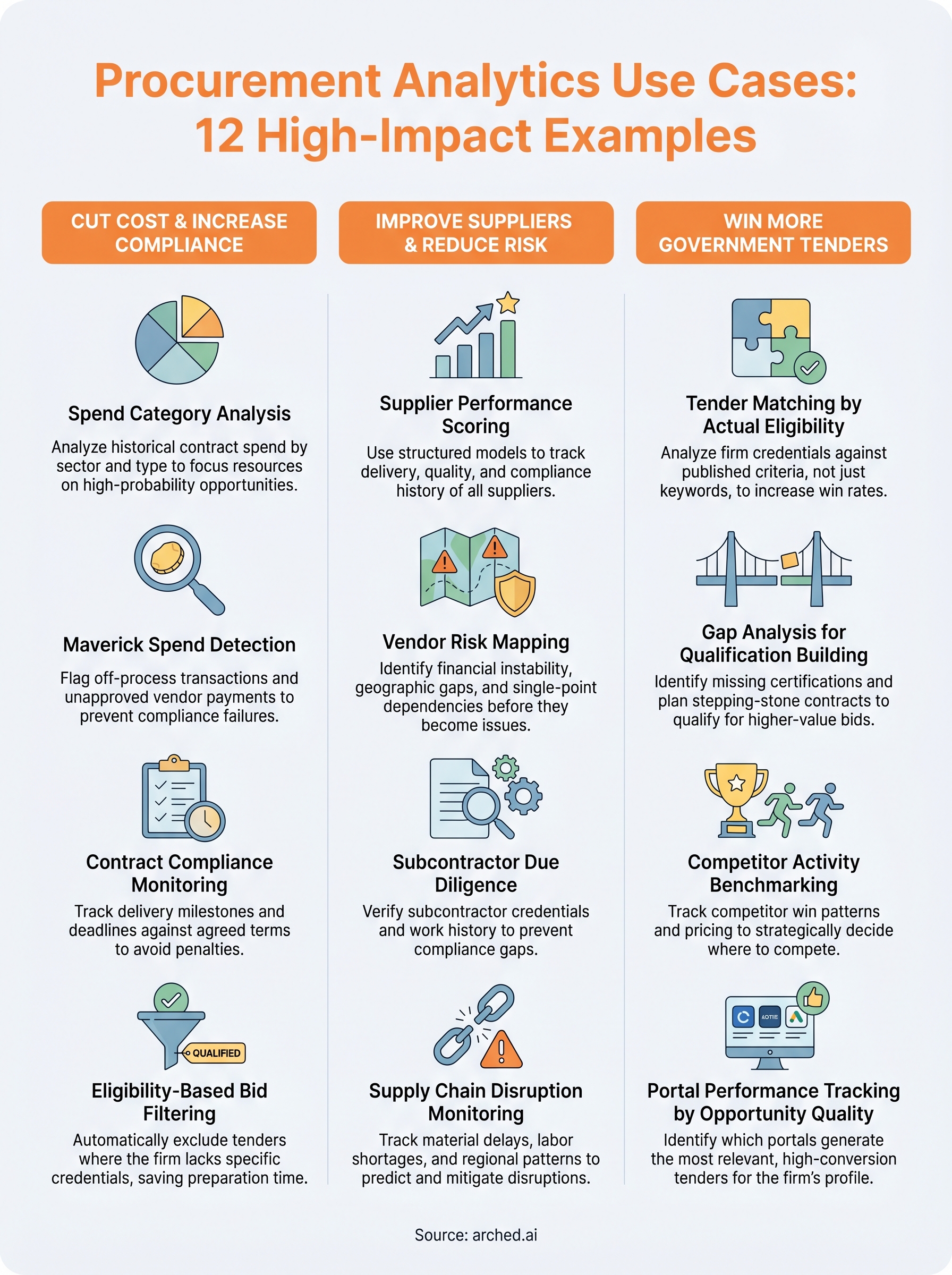
The 12 procurement analytics use cases in this article share one common thread: they all replace a recurring decision error with structured, data-driven action. Whether you are filtering tenders by actual eligibility, scoring supplier risk, or mapping the qualification gaps that block your access to high-value contracts, each use case works because it targets a specific failure point in your current process, not because it adds complexity to it.
Start with one use case that directly connects to a decision your BD team makes this week. Build ownership around it, act on the output, and measure whether your bid-to-win ratio or pipeline quality improves over the next quarter. That cycle of iteration is what separates firms that benefit from analytics from firms that collect dashboards.
If you want help putting these methods to work on the bid itself, send us the project and Arched will deliver an engineer-reviewed estimate and BOQ on your deadline.
Have a package your team can’t get to? Send it to us. Our engineers check and sign off everything we deliver.