Competitor Intelligence: What Is Competitor Intelligence?
Competitor Intelligence: What Is Competitor Intelligence?
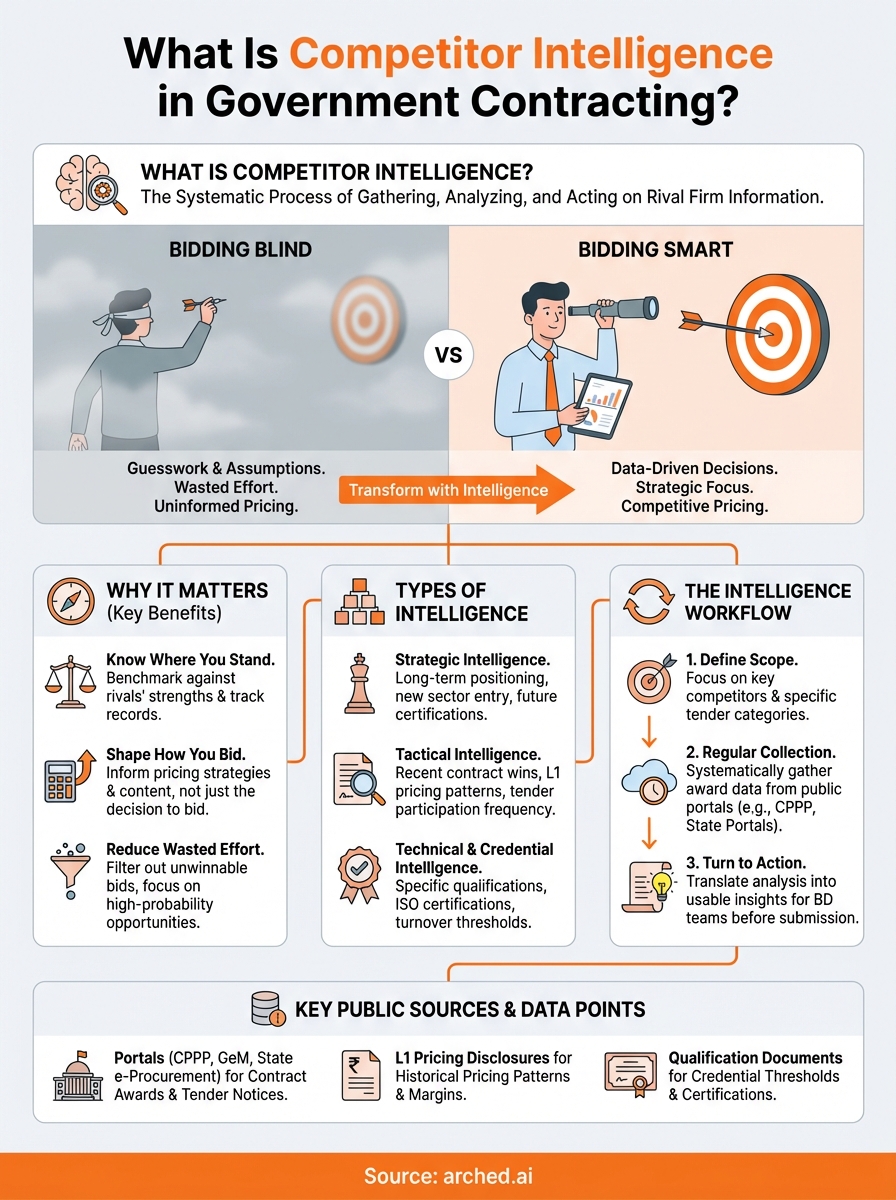
Every government tender your firm bids on has other companies eyeing the same contract. Some of them have stronger credentials, better pricing strategies, or a longer track record with that particular department. Knowing who they are and how they operate is what is competitor intelligence at its core, the systematic process of gathering, analyzing, and acting on information about the firms competing for the same work you want. For infrastructure companies and contractors in India's public procurement space, this isn't an abstract business school concept. It's the difference between bidding blind and bidding smart.
Competitor intelligence goes beyond a quick Google search of a rival firm's website. It involves studying their past project wins, understanding their qualification thresholds, tracking which tenders they consistently pursue, and identifying patterns in their pricing. When you're chasing contracts worth crores on platforms like GeM, CPPP, or state e-procurement portals, having this picture changes how you allocate your BD team's time and which opportunities you prioritize.
This article breaks down competitor intelligence from the ground up: what it means, why it matters for firms operating in government contracting, the different types you should track, and practical methods to collect and use it. Whether you're a bid manager filtering through hundreds of notices or an executive shaping your firm's growth strategy, understanding your competition is foundational. Let's get into how it actually works.
Why competitor intelligence matters
Most firms operating in India's government contracting space already know their direct competitors by name. What they rarely know is how those competitors are positioned, which agencies they have relationships with, what contract sizes they typically win, and how their pricing compares across similar project types. That gap in knowledge costs you. You end up bidding on contracts where a rival has a structural advantage you didn't account for, or you skip opportunities where you actually hold a stronger hand. Competitor intelligence closes that gap by turning vague awareness into a concrete, actionable picture.
It tells you where you actually stand
Before you can improve your competitive position, you need an honest read of where you currently sit relative to the firms chasing the same tenders. This means looking at win rates by tender category, the types of credentials competitors have built over time, and the departments or agencies they've developed consistent track records with. Without that baseline, your BD strategy is built on assumptions rather than evidence.
Knowing your competitors' strengths is not about copying them. It's about identifying where your firm's credentials create a genuine advantage and focusing your effort there.
When you map out which firms consistently win in road infrastructure versus urban drainage versus bridge rehabilitation, patterns emerge fast. You start to see that certain competitors dominate specific agencies while others spread thin across many categories. That information directly shapes where you invest your team's time and which upcoming tenders you treat as high-priority.
It shapes how you bid, not just whether you bid
Understanding what is competitor intelligence fully means recognizing it influences the content of your bids, not just the decision to submit one. If you know a rival firm has won three similar contracts at a certain L1 price range, you have real data to inform your pricing strategy rather than guessing. If you know they've recently added a key certification that opens up a new tier of tenders, you can anticipate the categories they'll begin competing in before they show up as competition on your radar.
This kind of forward visibility matters especially on high-value tenders above five crores, where the difference between winning and losing often comes down to how well you've anticipated the competitive field. Firms that treat intelligence gathering as ongoing, rather than scrambling before submission deadlines, consistently build better bids.
It reduces wasted effort on unwinnable bids
Your BD team's time is finite. Every hour spent preparing a bid for a contract where a competitor holds an insurmountable advantage is an hour not spent on one you could actually win. Competitor intelligence helps you filter aggressively, identifying tenders where you're genuinely positioned to be competitive versus those where you're entering a field dominated by firms with deeper credentials or longer agency relationships.
On platforms like CPPP and state e-procurement portals, hundreds of tenders get published every week. Without a competitive lens on that volume, your team defaults to keyword filtering and credential matching, which tells you what you're technically eligible for but not what you're realistically likely to win. Adding competitor context to your filtering criteria changes the quality of what moves forward in your pipeline, which means fewer submissions overall but a significantly higher conversion rate. That's the practical payoff of treating competitor intelligence as a core business function rather than a supplementary research task.
Competitor intelligence vs market and business intelligence
These three terms get used interchangeably in strategy discussions, but they cover different ground. Understanding what is competitor intelligence specifically, versus the related concepts of market and business intelligence, helps you avoid spreading your research effort too thin and ensures each type of data goes to the right decision.

Mixing up these three disciplines leads to teams that collect plenty of data but struggle to act on any of it.
Market intelligence focuses on the environment, not the players
Market intelligence looks at the broader landscape your firm operates within: policy changes, budget allocation trends in government infrastructure spending, sector growth patterns, and shifts in procurement regulations. It answers questions like "Is the central government increasing capex on highway projects this fiscal year?" or "Are state PWDs shifting toward design-build contracts?" This information is highly relevant for long-term strategy, but it doesn't tell you what a specific competitor is doing or how they're positioned to win the next contract you're chasing.
For government contractors in India, monitoring budget announcements from the Ministry of Finance or tracking National Infrastructure Pipeline updates counts as market intelligence. It sets the context within which your competitive activity happens, but it's one layer removed from the firm-level intelligence that shapes individual bid decisions.
Business intelligence draws on your own internal data
Business intelligence (BI) refers to data generated by your own operations: your historical win rates, revenue by project type, margin performance across contract categories, and the productivity of your BD team. BI tools aggregate and visualize this internal information to help you identify where your firm performs well and where it leaks money or effort. It's inward-facing by definition.
The distinction matters because BI tells you what your firm has done, while competitor intelligence tells you what the field around you is doing. Both are necessary. A BD manager who knows your firm wins 60% of bridge rehabilitation tenders but only 20% of road widening contracts needs competitor intelligence to understand whether that gap reflects a credential shortfall, a pricing issue, or simply stronger rivals who consistently dominate that category.
Used together, all three disciplines give you a complete picture: the environment you're operating in, how your firm is performing within it, and how the specific companies competing against you for each contract are positioned. Each layer informs the others, but only competitor intelligence gives you the firm-level specificity needed to sharpen a bid strategy.
Types of competitor intelligence
Understanding what is competitor intelligence fully requires recognizing it isn't one uniform category of data. Competitor intelligence breaks down into distinct types, each answering a different question about the firms you're up against. Knowing which type you need for a given decision prevents you from spending time collecting information that doesn't actually inform the choice in front of you.

Strategic competitor intelligence
Strategic competitor intelligence focuses on the long-term positioning and growth direction of rival firms. This includes tracking which sectors a competitor is expanding into, which certifications they're actively pursuing, and which geographic regions they're beginning to target. For a government contractor in India, spotting that a rival has started bidding on IREPS tenders after previously focusing on state PWD work signals a deliberate push into railway infrastructure.
Catching a competitor's strategic shift early gives you time to respond before they've already established a foothold in your territory.
This type of intelligence feeds executive-level decisions about where to build credentials and which agencies to develop relationships with. It's slower-moving data, but it shapes the decisions that matter most over a two-to-three-year horizon rather than the next submission deadline.
Tactical competitor intelligence
Tactical competitor intelligence sits closer to the individual bid level. It covers recent contract wins, L1 pricing patterns, and which tenders specific firms consistently pursue. When your BD manager is deciding whether to target a particular drainage contract on a state e-procurement portal, knowing that a rival has won four similar contracts in that district recently is directly actionable information.
Pricing intelligence within this category is particularly valuable because it gives you a reference point for your own rate positioning. If a competitor consistently wins at margins suggesting aggressive pricing, you know the threshold you need to hit to remain competitive on comparable contracts.
Technical and credential intelligence
Technical intelligence covers the specific qualifications, certifications, and empanelment statuses competitors hold that make them eligible for higher-value tenders. This includes ISO certifications, agency-specific registrations, and the turnover thresholds they've demonstrated through prior contract awards.
Tracking this category helps you identify gaps in your own credential profile relative to the firms winning the contracts you want. It converts the question of eligibility from a vague concern into a specific, addressable checklist you can act on systematically.
What to track and where to find it
Knowing what is competitor intelligence in theory is useful. Putting it into practice requires knowing exactly which data points to pursue and which sources actually contain reliable information. In India's public procurement context, the data you need exists in the public domain, scattered across dozens of portals, but only if you know where to look and what to extract.
Data points worth tracking
The most actionable competitor data falls into a few core categories. Contract award records tell you which firms are winning which types of tenders, at what value, and with which agencies. Over time, this builds a clear picture of a competitor's active sectors and their typical project scale. Qualification thresholds pulled from tender documents they've successfully bid on reveal the minimum turnover, experience, and certification requirements they've cleared, which in turn maps their eligibility ceiling.
Tracking a competitor's contract award history over 12 to 24 months gives you a far more reliable picture of their strategy than any single data point.
Pricing patterns from past L1 disclosures and tender participation frequency by category are also worth logging. If a firm consistently bids on bridge rehabilitation tenders in Maharashtra but rarely touches irrigation projects, that pattern tells you something deliberate about their focus area.
Where to find reliable source data
The Central Public Procurement Portal (CPPP) publishes awarded contract notices and corrigenda that include supplier names, bid values, and project scopes. The Government e-Marketplace (GeM) carries similar award data for goods and services contracts. For railways-related work, IREPS provides award records that are publicly accessible and updated regularly.
State-level e-procurement portals vary in how granularly they publish award data, but most major states, including Maharashtra, Tamil Nadu, and Uttar Pradesh, maintain searchable tender archives that go back several years. Cross-referencing these sources manually is time-intensive, but the data is there.
Your team can also use the Ministry of Corporate Affairs (MCA) portal to verify a competitor's registered turnover and directorship history, which gives you a financial baseline for understanding what contract values they're realistically equipped to handle. Combine these sources consistently and you'll have a working intelligence base that most firms in your space simply haven't built.
How to analyze competitor signals
Collecting data on rival firms is only the first step. The real work in understanding what is competitor intelligence is interpreting what that data actually means for your next move. Raw data points, a contract award here, a certification pickup there, don't carry much weight individually. Analysis turns those scattered signals into a coherent picture of how a competitor operates and where they're heading.
Look for patterns, not individual data points
A single contract win tells you a competitor was eligible and competitive on that particular tender. A dozen contract wins across the same agency over two years tells you they've built a relationship, understand that department's requirements, and have tuned their pricing accordingly. That's a fundamentally different level of insight, and it's the kind you can actually act on.
Patterns in competitor behavior are almost always more reliable than any single data point you pull from an award notice.
When you're reviewing contract award histories, group the data by agency, project type, and contract value range rather than looking at each record in isolation. This lets you spot where a firm is concentrated versus where they're experimenting, and it surfaces gaps in their portfolio that might represent an opening for your firm to move in with less resistance.
Connect signals to bid decisions
Analysis only has value if it reaches the person making the bid decision before the submission deadline. Once you've identified patterns, translate them into simple decision criteria your BD team can apply quickly: which competitors are likely to appear on a given tender, what L1 price range they've historically hit, and whether their credential profile gives them a structural advantage on this specific requirement.
Build a short competitor summary for every high-priority tender your team advances past initial screening. This doesn't need to be a lengthy report. A table showing the top two or three likely competitors, their recent wins in the same category, and their known qualification thresholds gives your bid team exactly what they need to calibrate their submission. Firms that operate this way stop treating competitor analysis as a background research task and start using it as a direct input to pricing, scope positioning, and qualification documentation. That shift in how you use the analysis is where the real competitive advantage builds.
How to build a competitor intelligence workflow
Most firms that understand what is competitor intelligence still struggle to put it into practice consistently because they treat it as a project rather than a process. A workflow changes that. It creates a repeatable system your BD team follows regardless of how busy the pipeline gets, which means you're never scrambling for competitive context right before a submission deadline.

Start with a defined scope
Before you collect anything, decide which competitors you're actually tracking and which tender categories you're focusing on. Trying to monitor every firm across every sector burns time without producing usable insight. Pick the five to ten firms that appear most frequently in the categories you actively pursue, and define the geographic and sectoral boundaries of your monitoring effort upfront. This gives your team a clear target rather than an open-ended research mandate.
A narrow, well-maintained competitor list beats a sprawling one that nobody keeps current.
Once you've scoped it, assign ownership. One person or a small team needs to be accountable for keeping the tracker updated, pulling fresh award data from CPPP and state portals on a set schedule, and flagging changes in competitor activity to the relevant bid managers.
Set up a regular collection cadence
Intelligence that sits in someone's inbox decays fast. Build a fixed weekly or fortnightly review where your team pulls the latest award notices, checks for new certifications or empanelment updates, and logs any new contract wins by the firms you're tracking. This doesn't need to take hours. A structured 30-minute session with a shared tracking document is enough if your scope is well-defined from the previous step.
Consistency matters more than depth at this stage. A lightweight update run every two weeks beats a thorough deep-dive done once a quarter.
Turn findings into usable outputs
Data sitting in a spreadsheet doesn't improve your bids. The final step in any functional workflow is translating your findings into a format your BD team can act on at the moment they need it, typically a short competitor brief attached to each high-priority tender that advances past initial screening. Include recent wins in the same category, estimated L1 price ranges, and known qualification thresholds for the two or three firms most likely to appear on that submission. Keep it brief and focused on what actually changes your bid decision.
Risks, ethics, and legal boundaries
Any honest discussion of what is competitor intelligence has to include where the practice can go wrong. Gathering information on rival firms is legitimate and widely practiced, but the methods you use matter. Crossing into legally or ethically questionable territory can expose your firm to serious consequences that far outweigh any short-term competitive gain. Knowing where the boundaries sit keeps your program defensible and sustainable.
What crosses the line
The clearest legal risk in competitor intelligence comes from accessing information you weren't meant to see. This includes obtaining confidential documents through deception, misrepresenting your identity to extract information from a competitor's staff, or accessing restricted portals using someone else's credentials. India's Information Technology Act and contract law both carry penalties for unauthorized data access, and the fact that your goal was business research doesn't provide protection.
Publicly available information is fair game. Information obtained through deception, coercion, or unauthorized access is not, regardless of how useful it would be.
Social engineering tactics, like calling a competitor's office under a false pretext to extract bid pricing, fall into this category. Your intelligence gathering should be something you're comfortable describing openly to a client or a regulatory body. If you'd hesitate to explain the method, don't use it.
Keeping your methods defensible
The good news is that ethically sound competitor intelligence produces more reliable data than methods that cut corners. Award records on CPPP, empanelment lists, published tender results, and MCA filings are all legitimate sources. Information shared publicly by competitor firms through project announcements, association memberships, or conference presentations is fair to use. What matters is that the source is public and your collection method is transparent.
Build this standard into your workflow by documenting where each piece of competitor data came from. This protects your firm if a question ever arises about your research practices, and it also improves data quality because public sources tend to be verifiable in ways that informal or questionable ones aren't. Treat your competitor intelligence program as something you could present to a client as evidence of professional rigor, and you'll naturally stay inside boundaries that keep your firm protected.
Key takeaways
What is competitor intelligence is a straightforward question with a high-stakes answer for any firm competing in India's government contracting market. At its core, it's the practice of systematically gathering and analyzing information about rival firms so you can make smarter decisions about where to bid, how to price, and which credentials to build next. It covers everything from tracking contract award histories on CPPP to monitoring the certifications competitors are picking up that signal where they're heading next.
The firms that win more tenders aren't necessarily the ones with the biggest teams or the deepest technical credentials. They're the ones who combine opportunity discovery with competitive context and build a consistent workflow around both. When your BD decisions are grounded in real data about the field you're entering, your conversion rate improves and your team's time goes where it actually counts. Whatever you learn about the field, your own number still has to be right. If you want the estimate prepared for you, see how our estimating service works.
Have a package your team can’t get to? Send it to us. Our engineers check and sign off everything we deliver.