Procurement Analysis Software: Tools, Features & Platforms
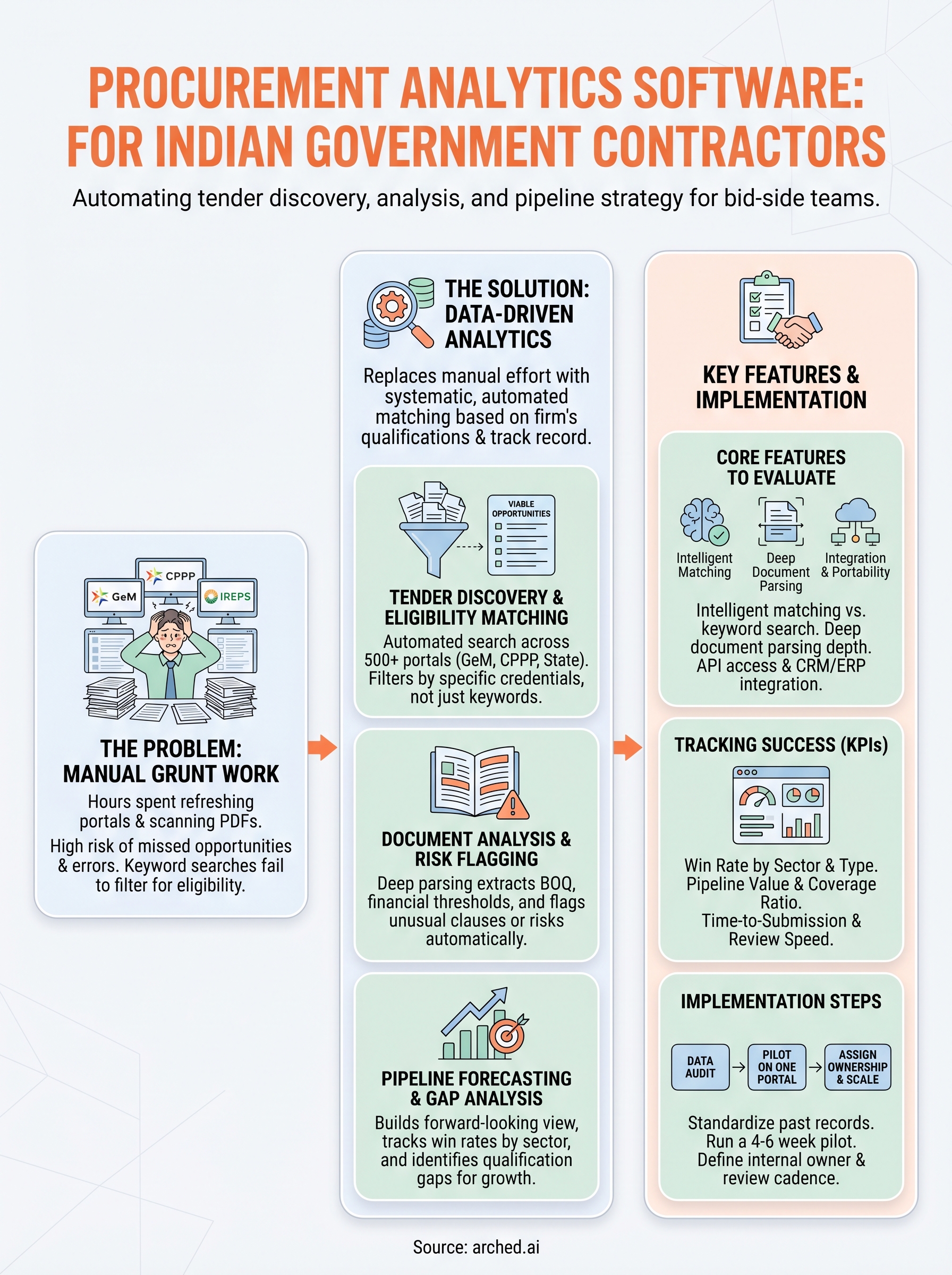
Government contractors in India spend hours each day refreshing portals, scanning PDFs, and cross-referencing eligibility criteria across GeM, CPPP, IREPS, and dozens of state e-procurement sites. Most of that effort goes toward tenders they were never going to win. Procurement analytics software exists to fix exactly this problem, replacing manual grunt work with data-driven filtering, document parsing, and opportunity matching that actually accounts for a firm's qualifications and track record.
But not every tool does the same thing, and the category has grown fast. Some platforms focus narrowly on spend analysis for enterprise procurement teams. Others are built specifically for the bid side, helping infrastructure firms and BD teams in the Indian AEC sector identify viable contract opportunities across 500+ portals and understand what it takes to qualify for higher-value work. The differences between these tools matter, especially when contract values run into hundreds of crores and a missed deadline or overlooked clause can cost you the bid entirely.
This article breaks down what procurement analytics software actually does, the core features to evaluate, the measurable benefits firms are seeing, and a comparison of top vendors across the market. Whether you're a bid manager filtering through thousands of irrelevant tenders or an executive trying to build a smarter pipeline strategy, this guide gives you what you need to make an informed decision.
Why procurement analytics software matters
Manual procurement tracking is expensive, not just in time but in missed revenue and avoidable errors. In India's public sector contracting environment, a typical BD team might monitor 20 to 30 portals daily, each with its own search logic, document format, and submission deadline. That process eats hours per day and still produces a list of tenders that are mostly irrelevant because keyword searches do not filter for actual eligibility. When the average infrastructure tender runs hundreds of pages and contract values reach tens of crores, the cost of a missed opportunity or an incomplete qualification check is significant. Procurement analytics software exists to replace that manual overhead with systematic, data-driven discovery and analysis.
The real cost of working without data
Most firms underestimate how much time and money they lose before a single bid is submitted. A BD manager refreshing portals manually might spend three to four hours per day on discovery alone, only to surface a shortlist where half the tenders fail basic eligibility checks after reading. Multiply that across a team of five over a quarter, and you are looking at hundreds of hours invested before any actual bid work begins. The problem is not effort; it is the absence of a system that filters for what your firm can actually win.
When you replace manual discovery with analytics-driven matching, you shift your team's time from searching to strategizing.
Firms that rely on keyword-only searches also miss tenders regularly because government portals use inconsistent terminology. A road widening project in Rajasthan might be listed under "highway improvement," "carriageway expansion," or simply a project code. Without a system that reads document content and maps it to your firm's credentials, you will not find those opportunities until they have already closed.
How analytics shifts procurement from reactive to strategic
When you have structured data across your entire pipeline, procurement moves from a reactive function to a strategic one. Instead of chasing every open tender and hoping for a shortlist, you can build a forward-looking view of which opportunities align with your current qualifications, which ones require additional credentials, and how long it will take to close that gap. That kind of visibility is not possible when your pipeline lives in spreadsheets and portal bookmarks.
Procurement analytics software gives your leadership team the numbers to make better resource allocation decisions. If your win rate on road contracts is 30% but drops to 8% on bridges, that data tells you where to build capability and where to concentrate bid effort. Without it, you are making those calls based on gut instinct and memory.
Why India's contracting environment makes this urgent
India's GeM and CPPP portals alone aggregate thousands of active tenders at any given time, and that volume is only increasing as central and state governments accelerate infrastructure spending under programs like PM Gati Shakti. For a mid-sized AEC firm, the volume of potentially relevant opportunities far exceeds what any manual process can handle. The firms winning the most work in this environment are not necessarily the most experienced; they are the ones with the fastest, most accurate opportunity identification and qualification review processes.
State-level e-procurement systems add another layer of complexity. Each state runs its own portal with different document structures, submission formats, and eligibility definitions. Keeping track of all of them manually is not a strategy; it is a liability. The firms that treat procurement data as a core business input, rather than an administrative task, are the ones building durable pipelines in this market.
Understand the main use cases in procurement
Procurement analytics software covers a wide range of applications depending on whether your team is on the buy side managing vendors and spend, or the bid side pursuing government contracts. Understanding which use cases apply to your firm helps you shortlist the right tools instead of buying capabilities you will never use.
Tender discovery and eligibility matching
The most immediate use case for government contractors is automated opportunity discovery. Instead of manually checking dozens of portals, your team specifies firm credentials, past project types, and certifications, and the platform surfaces only the tenders where your firm meets the eligibility bar. This filtering cuts through irrelevant volume and puts only viable opportunities in front of your BD team.
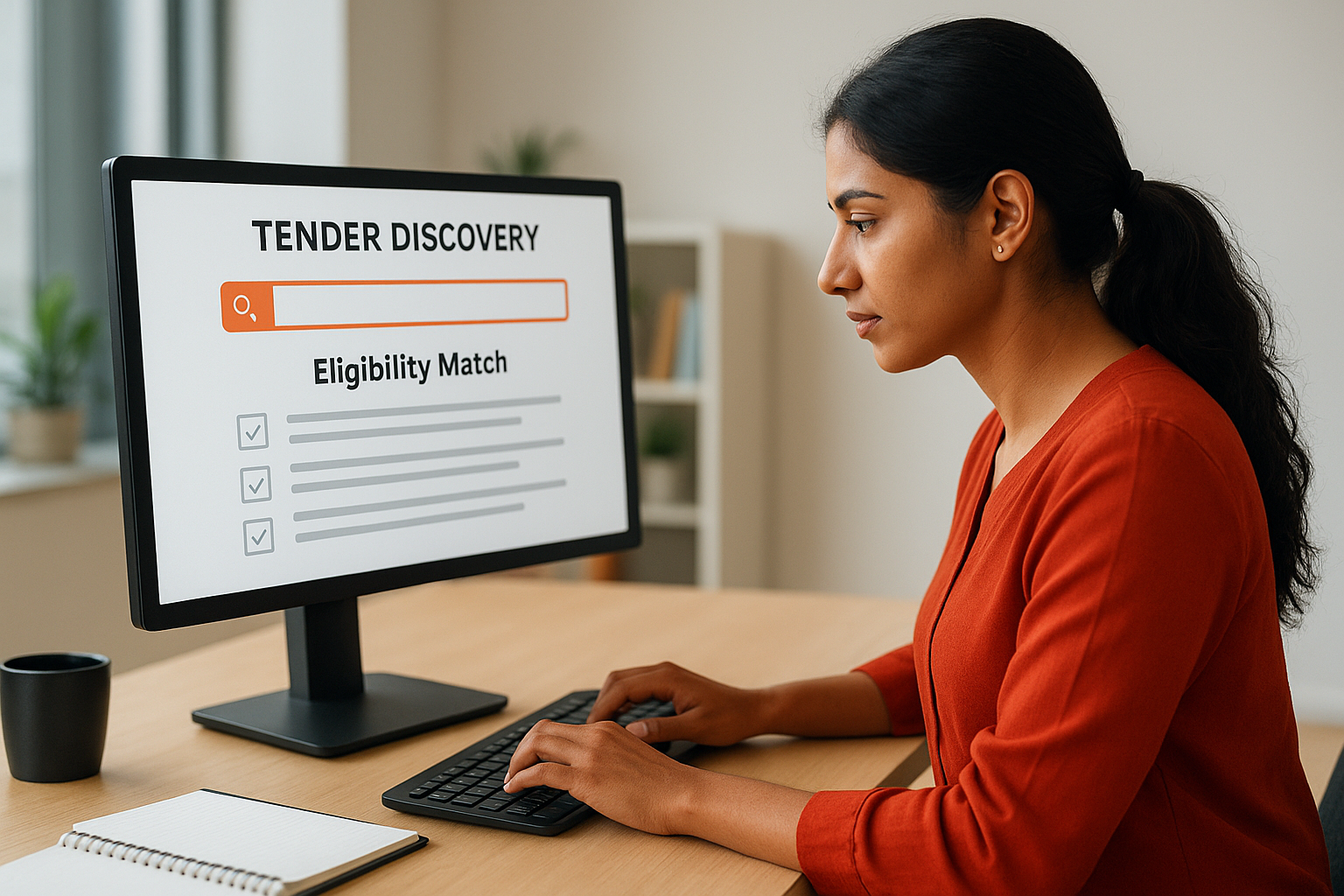
When a platform matches tenders against your actual qualifications rather than generic keywords, your discovery process shifts from a daily chore to a reliable pipeline feed.
For firms active across central and state portals in India, this single use case alone justifies the investment. A well-configured matching engine reduces tender review time significantly, letting your team focus on bid preparation rather than repetitive portal management across GeM, CPPP, IREPS, and state-level sites.
Document analysis and risk flagging
After you identify a relevant tender, the next step is reading the document, and for large infrastructure contracts that can mean 200-plus pages covering BOQ, qualification criteria, insurance requirements, and legal clauses. Document parsing capabilities extract the critical information automatically, flagging unusual indemnity clauses or financial turnover thresholds your firm does not currently meet.
This use case saves your team hours of review time per tender and reduces the risk of submitting a bid that fails on a qualification condition buried on page 150. It also creates a structured record of each tender's requirements, which feeds into broader analytics on where your firm consistently falls short.
Pipeline forecasting and gap analysis
Beyond individual tenders, a procurement analytics platform helps you build a forward-looking pipeline view. You can see total pipeline value by sector, track win rate trends over time, and identify which credential gaps are blocking access to higher-value contracts. Gap analysis is particularly useful for firms in the Indian AEC sector looking to scale from smaller municipal contracts into central government infrastructure programs over a defined timeline, rather than bidding reactively on whatever happens to appear that week.
Know the features that separate good tools from noise
Not every procurement analytics software platform delivers the same depth, and the marketing language across vendors makes it easy to overestimate what a tool actually does. Before you evaluate a shortlist, you need a clear picture of which features produce real outcomes and which ones look good in a demo but add little in daily use. The right features reduce your team's manual workload, improve bid quality, and give leadership reliable data to plan around, not just a dashboard with colorful charts.
Intelligent matching vs. keyword search
The most important differentiator between strong platforms and weak ones is how they surface opportunities. Keyword-based search returns every tender that contains a target term, which means your team still does the filtering work manually. Intelligent matching, by contrast, reads your firm's qualifications, past project values, certifications, and sector history, then scores tenders based on actual eligibility before surfacing them.

The gap between keyword search and eligibility-based matching is the difference between a longer inbox and a shorter, more accurate shortlist.
For a firm bidding across GeM, CPPP, and state portals simultaneously, this distinction is the one that determines whether the platform saves your team meaningful time or just adds another tool to manage.
Document parsing depth
A platform that surfaces a tender is only half the job. Deep document parsing means the system reads the full PDF, extracts the Bill of Quantities, identifies financial turnover thresholds, flags unusual indemnity clauses, and surfaces the qualification conditions that matter before your team opens the file. Shallow parsing pulls metadata like submission deadlines and estimated value, which any portal already shows you.
Look for platforms that can handle inconsistent formatting across government document templates, because Indian procurement notices vary significantly in structure between central ministries, state PWDs, and autonomous bodies. If a tool fails on unstructured PDFs, your team ends up doing the review work manually anyway.
Integration and data portability
Your procurement data has limited value if it stays locked inside a single platform. Integration with your existing CRM, ERP, or project management tools lets you carry tender data into bid preparation workflows without re-entering information manually. Data portability also matters when you want to build custom reports or export pipeline data for board presentations.
Check whether a platform offers API access or standard export formats before you commit, because switching costs rise sharply once your historical bid data lives exclusively inside a vendor's system.
Track the KPIs and dashboards that drive action
A dashboard that shows you everything shows you nothing useful. The value of procurement analytics software comes from tracking the specific metrics that connect daily bid activity to business outcomes your leadership team cares about, like revenue growth, win rate improvement, and pipeline coverage. Before you configure any tool, decide which KPIs your team reviews weekly and which ones feed into quarterly strategy discussions.
Win rate by sector and contract type
Your overall win rate tells you little on its own. What matters is win rate broken down by sector, contract type, and portal source, because that breakdown reveals where your firm is genuinely competitive and where you are burning bid resources on low-probability work. If your win rate on CPPP road contracts sits at 28% but your rate on state irrigation tenders is 6%, that data tells you where to concentrate effort and where to build credentials first.
Tracking win rate by category turns a single number into a strategic planning tool.
Track this metric on a rolling 12-month basis rather than quarterly, because government contracting cycles are long and small sample sizes in any given quarter can produce misleading conclusions.
Pipeline value and coverage ratio
Pipeline value measures the total estimated contract value of the tenders currently in your active bid queue. Coverage ratio compares that figure against your revenue target, telling you whether you have enough opportunities in play to hit your numbers even at your current win rate. A firm targeting 50 crore in new contract revenue needs a pipeline that accounts for its historical conversion rate, not just the tenders it plans to submit.
Your dashboard should display pipeline value segmented by stage, from identified opportunities through submitted bids to contracts under evaluation. That segmentation shows you where tenders are stalling and which stages need a process correction before the next bid cycle.
Time-to-submission and document review speed
Time-to-submission tracks how long it takes your team from tender discovery to bid submission. Shortening this window gives you more time for quality review and competitive pricing, which directly affects bid outcomes. Document review speed measures how quickly your team processes each tender's qualification criteria and BOQ, a metric that improves sharply when your platform handles parsing automatically.
Both metrics should appear together in your operations dashboard, because a fast discovery process that bottlenecks at document review still loses you time. Monitor them as a pair, not in isolation.
Plan your data sources and integrations upfront
The value you get from procurement analytics software depends directly on the quality and completeness of the data feeding it. Before you deploy any platform, map out every portal your team currently monitors, every internal system that holds your firm's credentials and past project records, and every output format your BD and finance teams rely on. Getting this right at the start saves you weeks of retroactive configuration and prevents the common problem of a tool that runs on incomplete data and produces misleading insights.
Connect to the portals your team already monitors
Your platform is only as useful as its portal coverage. For firms working in India's AEC sector, that means verifying the tool monitors central portals like GeM, CPPP, and IREPS alongside the state e-procurement systems relevant to your target markets. Not every platform covers all 500-plus active procurement sites in India, so ask vendors for a specific list before you sign anything.
A platform that misses the portals where your highest-value contracts appear is not a discovery tool; it is a gap in your process wearing a dashboard.
Beyond portal coverage, confirm how frequently the system refreshes its data feed. A platform that scans portals once every 24 hours will still cause your team to miss tenders with short submission windows, which is common in state-level PWD notices. Real-time or near-real-time monitoring changes how your team responds to new opportunities entirely.
Link procurement data to your existing workflows
Your tender data needs to flow into the tools your team already uses, not sit in an isolated system that requires manual re-entry at every handoff. If your BD team tracks pipeline in a CRM, your procurement platform should push opportunity data there directly. If your project management system holds your past contract records and certifications, the analytics platform needs to read from it to run accurate eligibility matching.
Confirm whether the platform offers API access or standard export formats like CSV or Excel before you commit. Switching vendors later becomes significantly harder once your historical bid data, win rates, and pipeline records live exclusively inside one system. Integration is not a technical afterthought you handle after go-live; it is a core procurement decision that shapes how much value the platform actually delivers from day one.
How to implement procurement analytics software
Implementation fails most often because teams treat it as a software installation rather than a process change. Before you configure anything, document how your BD team currently discovers tenders, reviews documents, and tracks pipeline. That baseline tells you exactly where the platform needs to plug in and which manual steps you can eliminate immediately. Without it, you are likely to replicate broken workflows inside a new tool instead of fixing them.
Start with a data audit
Your first concrete step is a structured audit of every data source your team uses today: the portals you monitor, the spreadsheets that track active bids, and the internal records that hold your firm's past project values, certifications, and sector history. Feed incomplete or outdated credentials into your matching engine and the platform surfaces opportunities your firm cannot actually win, which defeats the purpose entirely.
Garbage in, garbage out applies to procurement analytics more than almost any other business tool, because bad matches waste bid resources, not just screen time.
During this audit, prioritize standardizing your past project records. Eligibility matching works best when the system has clean, structured data on contract values, project types, and completion dates rather than inconsistent notes scattered across email threads and folder drives.
Run a pilot on one portal before scaling
Rather than connecting every portal and enabling all features at once, pick one high-priority source, such as GeM or your most active state e-procurement system, and run a four-to-six-week pilot. Measure discovery time, shortlist quality, and the accuracy of document parsing before you expand coverage. This approach surfaces configuration problems early, when fixing them is straightforward rather than disruptive.
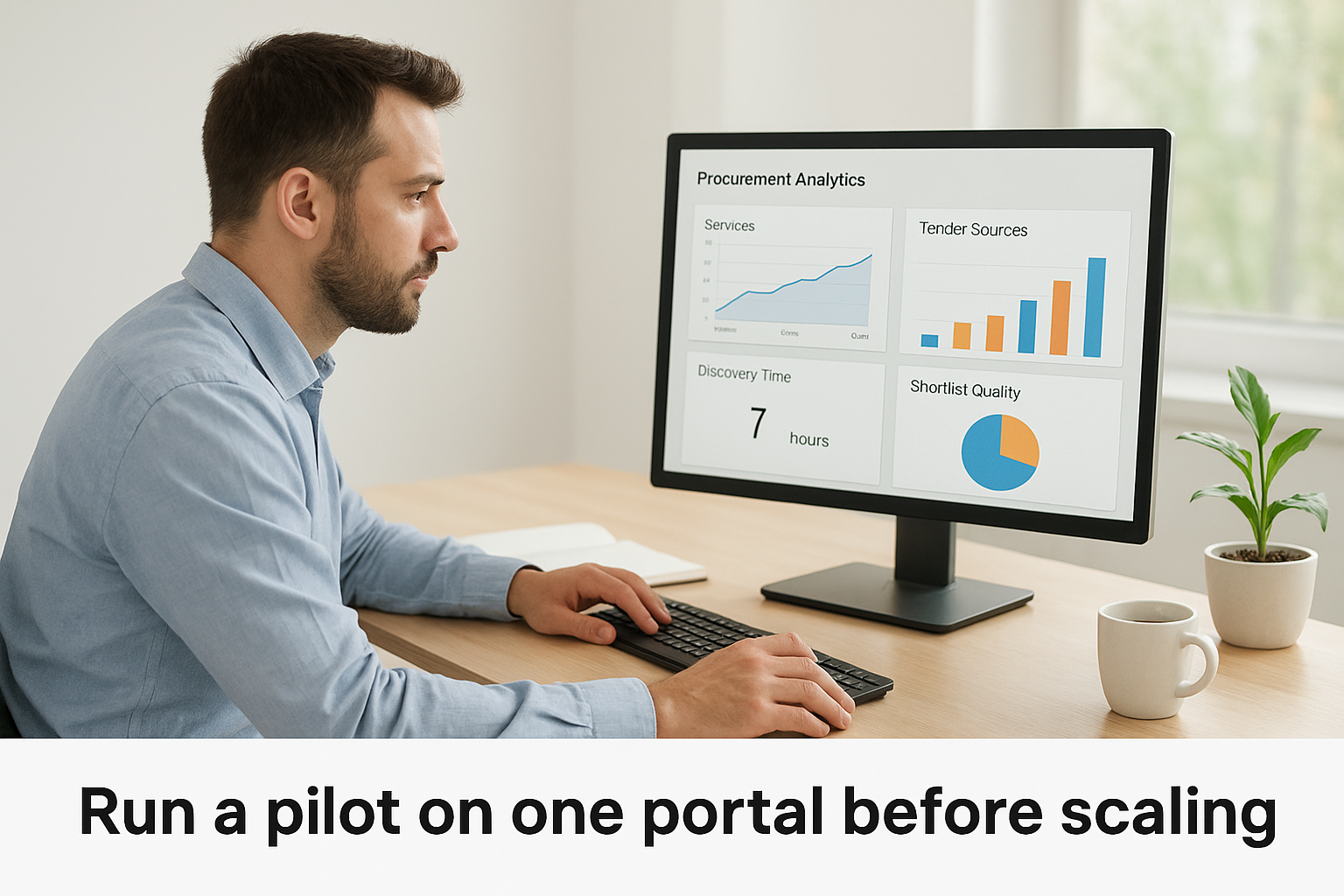
Track two or three simple metrics during the pilot: how many tenders the platform surfaces per week, how many pass manual eligibility review, and how long document review takes compared to your pre-implementation baseline. Those numbers tell you whether the tool is working and where to adjust settings before you scale.
Assign ownership and set a review cadence
Every implementation needs a named internal owner, typically your BD manager or a senior bid coordinator, who is responsible for keeping the platform configured accurately and running weekly pipeline reviews against the data it produces. Without clear ownership, configuration drifts, alerts get ignored, and the tool stops reflecting your firm's current qualifications and target markets within a few months.
Compare vendors and build a shortlist
The procurement analytics software market splits broadly into two categories: general-purpose spend analysis tools built for enterprise procurement teams on the buy side, and bid-side platforms designed for firms pursuing government contracts. Evaluating vendors without making this distinction first wastes your team's time, because a spend analysis tool built for a corporate procurement department shares almost nothing in common with what a BD team in India's AEC sector actually needs.
Separate general-purpose platforms from specialized tools
General-purpose platforms like Coupa, Jaggaer, and SAP Ariba are built around supplier management, spend categorization, and contract lifecycle tracking for large organizations managing their own procurement budgets. If your primary goal is discovering and winning government tenders, these tools do not address your workflow. You need a platform that monitors public procurement portals, parses tender documents, and matches opportunities against your firm's specific credentials rather than helping you manage your own vendor relationships.
Buying the wrong category of tool is more expensive than buying no tool, because it still costs you the subscription, the implementation time, and the opportunity cost of delay.
Evaluate vendors on portal coverage and document depth
When you review bid-side platforms, ask each vendor for a specific, verifiable list of the portals it monitors rather than accepting a round number like "500+ portals." Confirm that the list includes GeM, CPPP, IREPS, and the state e-procurement systems most relevant to your target sectors. Portal coverage is the foundation of discovery, and gaps in coverage mean missed tenders, regardless of how strong the rest of the platform is.
Document parsing depth is your second filter. Ask vendors to demonstrate the tool on a real tender PDF from a state PWD or central ministry, not a curated sample document. Specifically, check whether it extracts BOQ line items, financial turnover thresholds, and qualification conditions accurately without manual cleanup. If a vendor cannot show you that in a live demo, the parsing capability is either limited or unreliable in practice.
Build a shortlist with a structured scoring process
Narrow your vendor list to three or four options using a simple scoring matrix that weights the factors your firm prioritizes most. A structured comparison prevents subjective impressions from the demo from overriding the practical gaps you identified during evaluation.
| Criteria | Weight | Vendor A | Vendor B | Vendor C |
|---|---|---|---|---|
| Portal coverage (India) | 30% | |||
| Document parsing depth | 25% | |||
| Eligibility matching accuracy | 25% | |||
| Integration and data export | 10% | |||
| Support and onboarding | 10% |
Score each vendor from one to five on each criterion, multiply by the weight, and total the columns. That number gives you a defensible shortlist you can present to leadership, rather than a preference based on which sales team ran the most polished demo.
Wrap up
Procurement analytics software is not a single category, and the right choice depends entirely on what your team needs to do. If you are on the bid side in India's AEC sector, you need a platform that monitors the portals you actually use, parses tender documents accurately, and matches opportunities against your firm's real qualifications, not generic keywords. Get those fundamentals right, and the downstream benefits become measurable: less time on discovery, higher-quality shortlists, and a pipeline your leadership team can actually plan around.
Start with the use cases that matter most to your firm, build your vendor evaluation around portal coverage and document depth, and assign clear internal ownership before you go live. Getting those three things right from the start determines whether the platform pays for itself or sits unused within six months. And if the bottleneck is pricing the bids you find rather than finding them, our estimating service can take the estimate off your team.
Have a package your team can’t get to? Send it to us. Our engineers check and sign off everything we deliver.