Procurement Analytics Tools: Top Platforms, Use Cases & Tips
Compare top procurement analytics tools and learn how to automate tender matching, parse BOQs, and win more Indian government contracts.
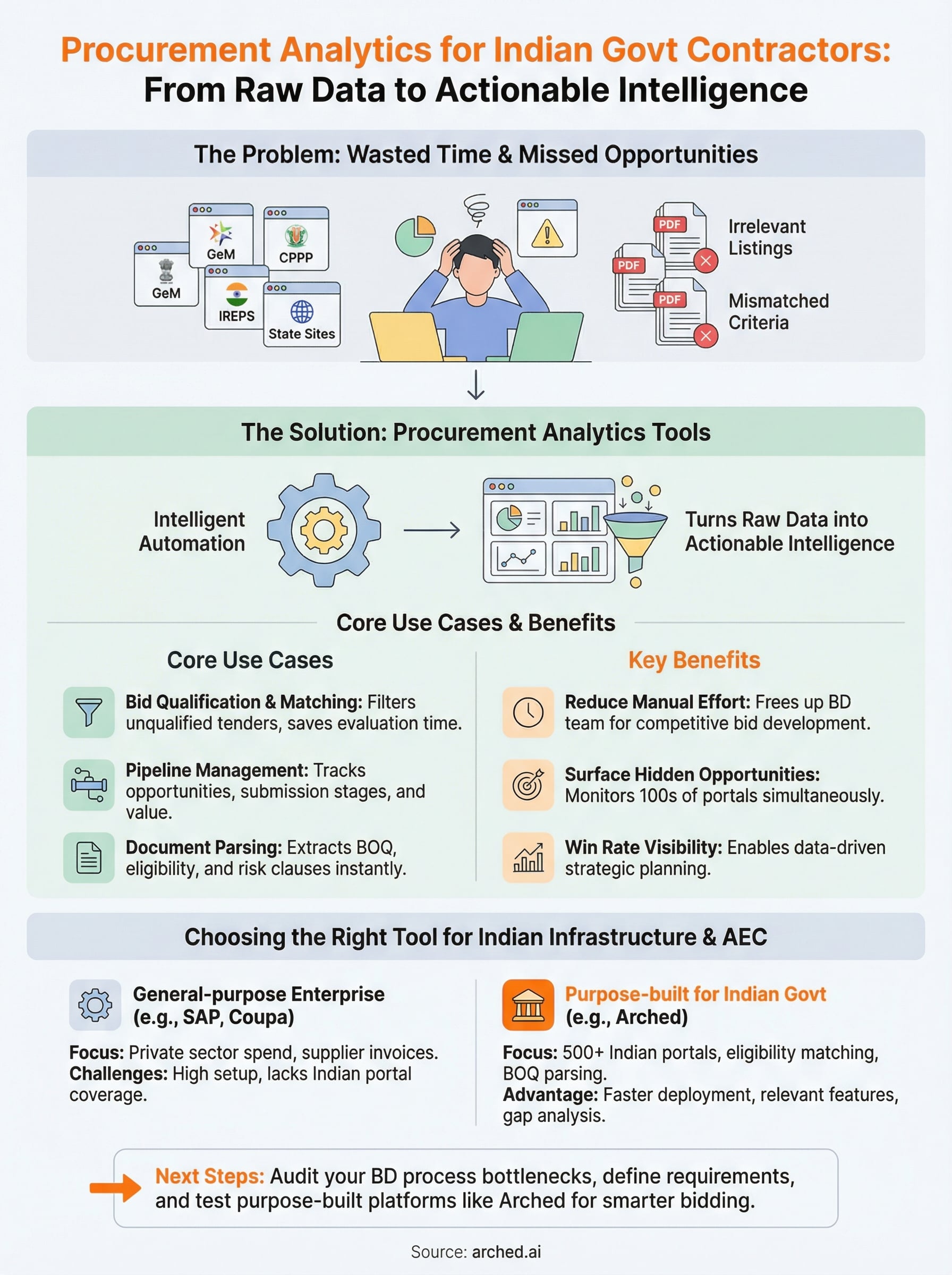
Government contractors in India sift through hundreds of portals daily, GeM, CPPP, IREPS, state e-procurement sites, hunting for the right tenders. Most of that time is wasted on irrelevant listings, mismatched eligibility criteria, and PDF documents that take hours to parse. Procurement analytics tools exist to solve exactly this problem: they turn raw procurement data into actionable intelligence that helps firms find, evaluate, and win contracts faster.
But not all platforms work the same way, and picking the wrong one can mean paying for features that don't match how public procurement actually operates in India. Understanding what these tools do, and where their real value lies, matters before you commit budget to one. Whether you're a BD manager at an infrastructure firm or running a mid-size consultancy chasing road and bridge contracts, the right tool should reduce manual effort and surface opportunities you'd otherwise miss entirely.
This article breaks down how procurement analytics platforms work, their core use cases, and which ones are worth evaluating in 2026. We also cover how Arched fits into this space as an AI-driven command center built specifically for Indian government contracting, and share practical tips to help you get the most from whichever platform you choose.
What procurement analytics tools do
At their core, procurement analytics tools collect, organize, and interpret procurement data from multiple sources so you can make faster, better-informed decisions. Without these platforms, your team manually checks portals, downloads PDFs, and reads through pages of qualification criteria to figure out whether a tender is even worth pursuing. That process costs hours every day, and it still misses contracts because no human team can monitor hundreds of portals simultaneously without dropping something important.
From raw data to ranked opportunities
The most immediate function these tools serve is aggregating tender listings from dozens or hundreds of portals into a single, searchable interface. But simple aggregation is table stakes. What separates effective procurement analytics platforms from basic listing services is the layer of intelligence applied on top of that raw data: relevance scoring, eligibility matching, and firm-specific filtering that tells you whether a particular tender actually fits your credentials and past project history.
The difference between a tender aggregator and a true analytics platform is what happens after the data is collected. Analysis, not just access, is what creates competitive advantage.
For firms operating in India's AEC sector, this matters more than it might elsewhere. GeM, CPPP, IREPS, and state e-procurement portals each use different terminology, document formats, and classification systems. A tool that simply pulls listings without normalizing or analyzing them forces you to do the hard interpretive work yourself, which defeats the purpose of using a platform at all.
Document intelligence and risk flagging
Reading a full tender document properly can take two to four hours. You need to extract the Bill of Quantities (BOQ), identify technical qualification thresholds, verify financial turnover requirements, and scan for unusual clauses that could expose your firm to undue contractual risk. Procurement analytics tools with document parsing capabilities handle this work automatically, surfacing the key figures and flagging clauses that fall outside standard contract language.
This capability directly reduces your pre-bid evaluation time. Instead of assigning a senior engineer or BD manager to spend half a day on a single document, you get a structured summary within minutes that covers eligibility, scope, risk flags, and required certifications. That frees your team to focus on developing competitive bids rather than doing document triage on tenders that may not even be winnable.
Strategic pipeline and competitor visibility
Beyond individual tenders, the best procurement analytics tools give you a portfolio-level view of your active pipeline. You can track how many contracts sit at each bid stage, what the aggregate pipeline value looks like, and where your win rate sits across different project categories. That kind of visibility helps leadership make resource allocation decisions based on real data rather than instinct.
Some platforms also track competitor bid activity and award patterns, which tells you which firms are winning contracts in your target categories and at what price levels. In a market as competitive as Indian public procurement, knowing who consistently outbids you, and in which project types, is information that directly shapes your forward bidding strategy. It shifts your planning from reactive to deliberate, which is where the real commercial advantage comes from.
How procurement analytics software works
Understanding the mechanics behind these platforms helps you evaluate them more clearly. Most procurement analytics tools run on a three-layer architecture: data collection, processing, and output delivery. Each layer handles a specific job, and the quality of each layer directly determines how useful the final output is for your team on a daily basis.
Data ingestion and normalization
The first layer is where the platform pulls raw data from procurement portals. Automated scrapers and API integrations continuously monitor sources like GeM, CPPP, and IREPS, as well as dozens of state e-procurement sites, capturing new listings as they go live. Because each portal uses different document formats, classification codes, and terminology, the platform's normalization engine maps all of that inconsistent data into a common structured format that you can search and filter consistently across sources.
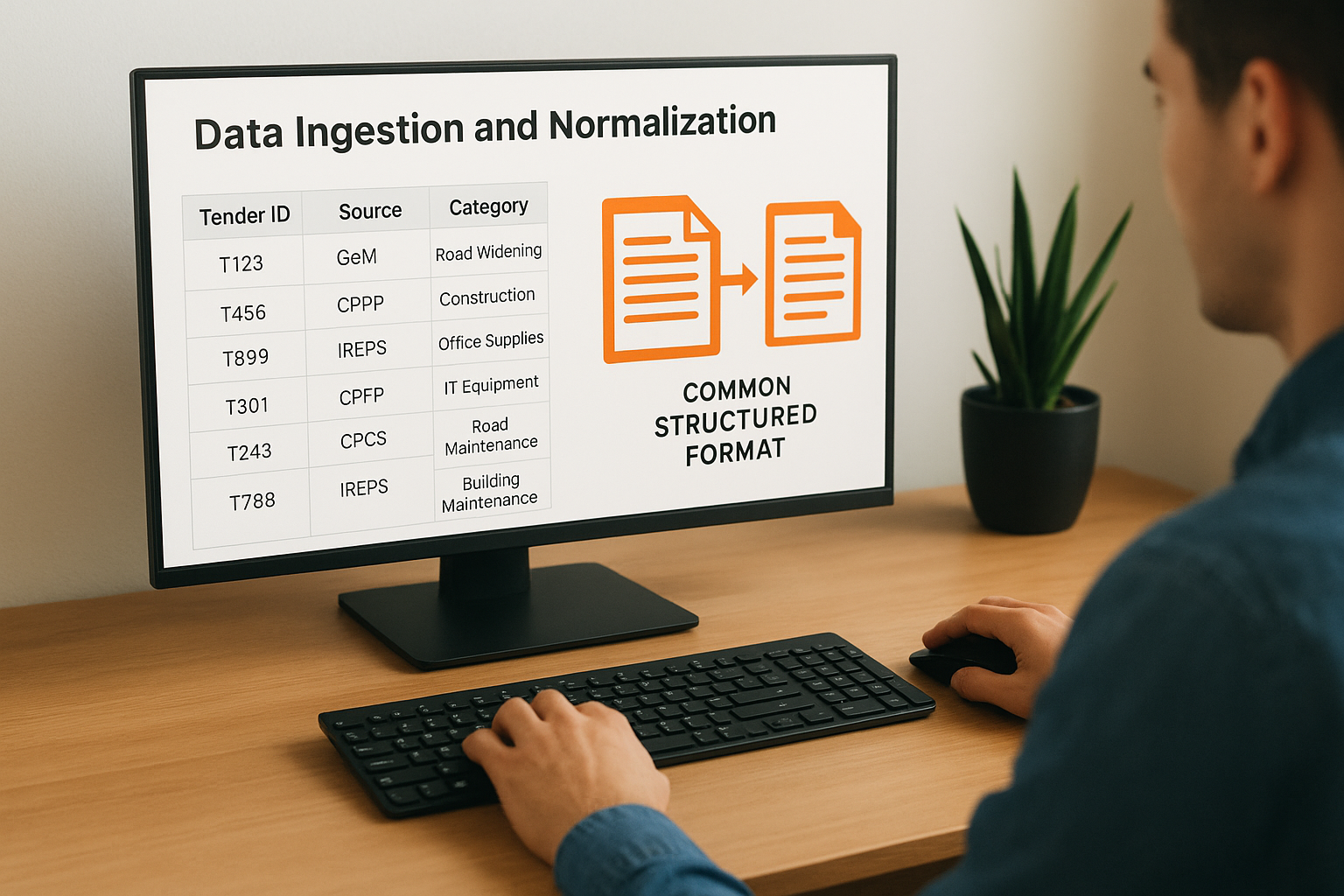
The quality of a platform's normalization layer determines whether two tenders from different portals are actually comparable, or just adjacent rows in a table.
Without proper normalization, cross-portal search produces misleading results. You might search for "road widening" contracts and miss relevant tenders classified differently on a state portal. A well-built normalization layer handles synonym mappings and classification differences automatically, so you see relevant results without needing to know every portal's internal taxonomy.
Matching, scoring, and alert delivery
Once data is normalized, the platform's matching engine compares tender requirements against your firm's profile, which typically includes past project categories, completed contract values, certifications held, and geographic coverage. Tenders that align with your credentials receive higher relevance scores and surface at the top of your dashboard. Those that fall outside your eligibility threshold get filtered out or flagged for future consideration as you build the necessary experience.
Alerts then push high-priority matches to your team through email, dashboard notifications, or mobile alerts depending on how you configure the system. The best platforms let you set thresholds based on contract value, project type, submission deadline, and location so you receive precise notifications rather than a flood of loosely matched listings. This design keeps your team focused on actionable opportunities rather than spending the first two hours of each morning sifting through noise.
Core use cases and KPIs to track
Procurement analytics tools serve different teams in different ways, but a handful of use cases show up consistently across infrastructure and AEC firms operating in Indian public procurement. Knowing which use cases are most relevant to your operation helps you configure the platform correctly from day one and ensures you track metrics that reflect real business outcomes rather than vanity numbers.
Bid qualification and pipeline management
The most common use case is using the platform to filter out unqualified tenders before they waste anyone's time. Instead of having a BD manager read through a 40-page document only to discover your firm lacks the required annual turnover or a specific IS certification, the platform's matching engine surfaces that disqualifying factor immediately. You only evaluate tenders where your credentials actually clear the threshold.
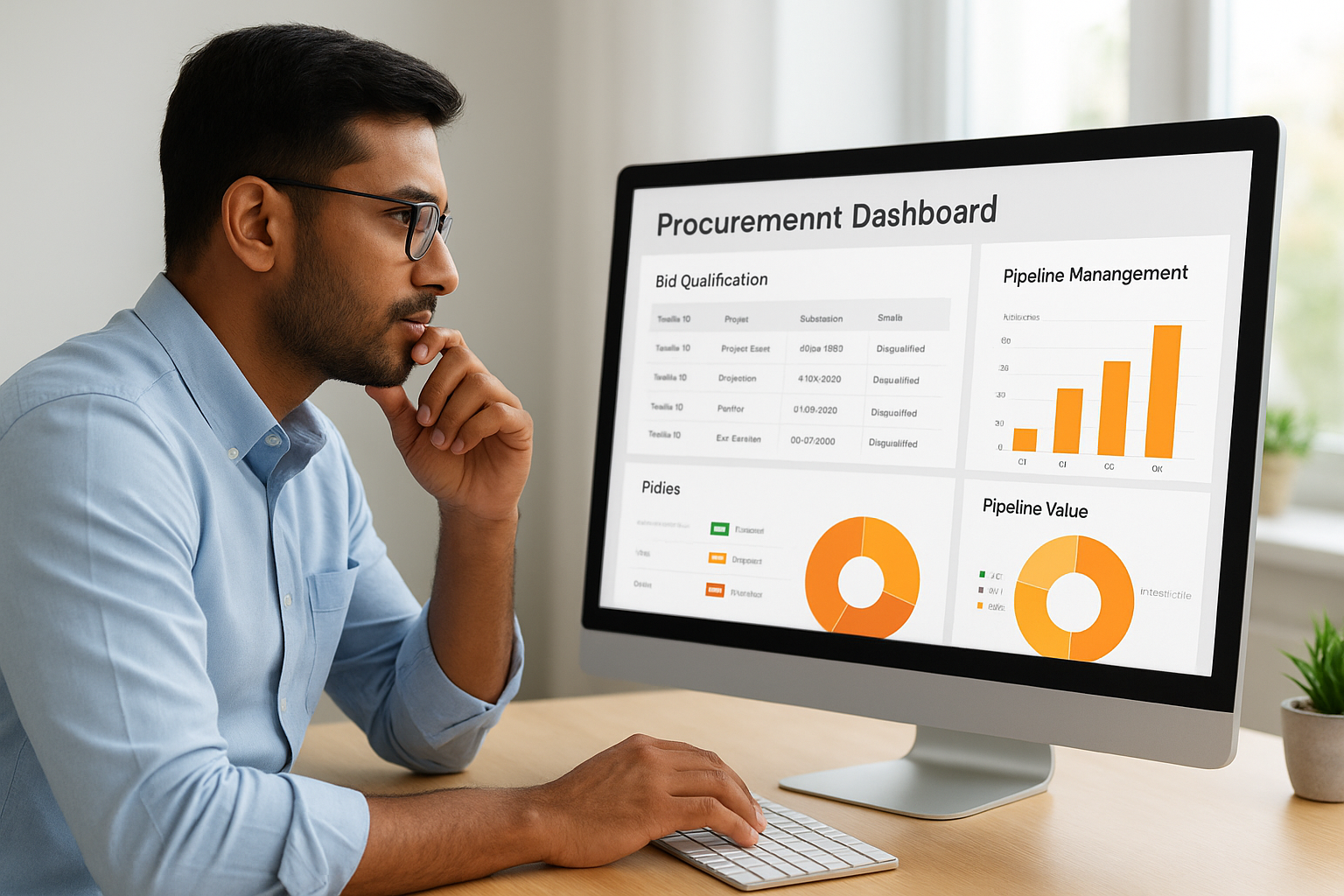
Firms that implement systematic bid qualification reporting typically see a significant drop in no-bid decisions made late in the evaluation cycle, which frees up senior staff time for tenders that are actually winnable.
Beyond individual bids, you use the pipeline management layer to see your entire book of active opportunities in one view: how many tenders you've submitted this quarter, total pipeline value by project category, and where each bid stands in the submission cycle. This gives leadership a real basis for resource planning and revenue forecasting rather than relying on informal updates from individual team members.
Tracking the KPIs that actually matter
Once your platform is live, the metrics below give you a clear picture of whether it's delivering value. These are the numbers worth reviewing in your monthly BD review:
| KPI | What it measures | Why it matters |
|---|---|---|
| Tender match rate | Relevant listings as a share of total monitored | Shows how well your firm profile is configured |
| Pre-bid evaluation time | Hours spent per tender before submission decision | Tracks efficiency gains from document parsing |
| Win rate by project type | Contracts won divided by bids submitted, per category | Identifies where your firm is most competitive |
| Pipeline value | Total contract value of active bids | Supports revenue forecasting for leadership |
| Credential gap frequency | How often gap analysis flags a missing qualification | Guides your strategic certification roadmap |
Reviewing these five metrics together each month gives you a far more honest picture of procurement performance than tracking bid volume alone.
Top procurement analytics platforms compared
The procurement analytics market splits into two broad categories: general-purpose enterprise platforms built for corporate spend management and sector-specific tools built for government contracting in defined markets. For infrastructure firms chasing public tenders in India, that distinction matters more than any feature checklist, so understanding which category each platform falls into saves you from evaluating tools that simply weren't built for your context.
General-purpose enterprise platforms
Tools like SAP Ariba, Coupa, and GEP SMART are built for large organizations managing private-sector supplier relationships, purchase orders, and internal spend categories. They handle supplier onboarding, contract lifecycle management, and spend analytics across complex procurement functions well. However, these platforms were not designed around public portal monitoring or government tender matching, which means they require significant customization before they add value in an Indian AEC context. Their licensing structures also tend to assume enterprise IT teams and multi-year rollout timelines, which rarely suits mid-size infrastructure firms looking for faster deployment.
If a platform was built for managing supplier invoices and corporate spend, retrofitting it to track GeM listings and parse BOQ documents will cost you more time and budget than starting with a fit-for-purpose tool.
Purpose-built tools for Indian government contracting
Arched sits in this second category. It monitors over 500 procurement portals, including GeM, CPPP, IREPS, MSTC, and state e-procurement systems, and matches tender opportunities against your firm's actual credentials rather than generic keywords. The platform's document parsing engine extracts BOQ data, qualification criteria, and risk clauses automatically, cutting out the hours your team currently spends reading full tender PDFs before making a bid or no-bid call.
Gap analysis sets Arched further apart from general procurement analytics tools. It identifies the specific certifications or past project experience your firm needs to qualify for higher-value tenders and maps out smaller stepping-stone contracts to build that track record systematically. That kind of forward-planning capability is not something general-purpose platforms offer without heavy configuration work.
| Feature | General-purpose platforms | Arched |
|---|---|---|
| Indian portal coverage | Limited or none | 500+ portals |
| Firm-specific eligibility matching | No | Yes |
| BOQ and document parsing | No | Yes |
| Gap analysis for credential building | No | Yes |
| Setup complexity | High | Low |
How to choose the right tool for your team
Choosing between procurement analytics tools starts with an honest look at your firm's current workflow, not with a vendor feature list. Before you book a demo or request a trial, you need to know which problems cost you the most time right now: missed tenders because of portal coverage gaps, slow document review, poor bid qualification filtering, or lack of pipeline visibility. That answer shapes every evaluation decision that follows.
Define your firm's actual requirements first
Start by mapping out where your BD process breaks down. If your team spends most of its time manually checking state e-procurement portals, portal coverage depth should be your primary selection criterion. If the bottleneck is document review, look for platforms with strong document parsing and automatic BOQ extraction rather than prioritizing a sleek dashboard. Matching the tool to the actual constraint gives you a faster return on the investment.
The tool that fixes your real bottleneck will always outperform a feature-rich platform that doesn't address how your team actually works.
A structured checklist helps here. Before you evaluate any platform, get your BD and bid management teams to answer these questions together:
- Which portals do you currently miss or check inconsistently?
- How many hours per week does your team spend on pre-bid document review?
- Do you have visibility into your win rate by project category?
- Can you quickly identify which tenders your firm is ineligible for?
Evaluate data coverage and ease of deployment
Once you have clarity on your requirements, assess each platform against portal coverage relevant to your project categories. For AEC firms bidding on road, bridge, irrigation, or urban infrastructure contracts in India, that means confirming coverage of GeM, CPPP, IREPS, and the specific state e-procurement portals where your target agencies publish tenders. A platform that covers 50 portals means little if it misses the three portals where your highest-value opportunities actually appear.
Deployment speed also matters practically. Enterprise platforms built for corporate spend management require lengthy implementation timelines and dedicated IT resources. If you need value within weeks rather than months, a purpose-built platform with a shorter onboarding cycle is the more realistic choice for your team.
Next steps
Procurement analytics tools work best when they match your firm's specific workflow gaps, not just a generic list of features. The platforms and frameworks in this article give you a clear starting point, but the real value comes from applying them to your actual bid pipeline and portal coverage needs. If you're chasing contracts on GeM, CPPP, IREPS, or state e-procurement systems and spending too many hours on manual document review, a purpose-built platform will close that gap faster than a general-purpose enterprise tool ever will.
Your next move is to audit where your BD process loses the most time each week, then test a tool against that specific constraint. Arched is built precisely for Indian AEC firms that need intelligent tender matching, automatic document parsing, and strategic gap analysis in one place. If that matches your situation, explore what Arched can do for your firm and see how the platform fits your contracting pipeline.