7 Bid Management Best Practices for Government Tenders 2026
Most government contractors in India will tell you the same thing: they lose more bids to poor process than to poor capability. Missed deadlines, misread eligibility clauses, and chasing tenders that were never winnable in the first place, these are the real killers. Getting serious about bid management best practices isn't optional anymore, especially when you're competing across portals like GeM, CPPP, and dozens of state e-procurement sites for contracts worth hundreds of crores.
The difference between a 15% win rate and a 35% win rate rarely comes down to technical skill. It comes down to how your team decides what to bid on, how fast you parse requirements, and whether you have a repeatable system or a chaotic scramble every time a new tender drops.
This article breaks down seven specific practices that high-performing bid teams across Indian infrastructure are using right now. Whether you're a BD manager at a mid-size contractor or leading proposals at a large consultancy, these are actionable changes you can implement this quarter to tighten your pipeline and stop wasting effort on dead-end bids.
1. Make bid or no-bid a scored decision
One of the most damaging habits in proposal teams is the gut-feel bid decision. BD managers feel pressure to chase volume, so every tender that lands remotely in scope gets a "let's try it" response. This burns hours on bids you were never positioned to win and starves your actual high-probability opportunities of the attention they deserve.

What it solves
A scored bid or no-bid process forces your team to evaluate each opportunity against fixed criteria before committing any resources. It replaces subjective enthusiasm with a repeatable framework that protects your team's capacity for bids where you hold a genuine competitive edge.
A structured go/no-go score eliminates the single biggest source of wasted proposal effort: working on bids you cannot win.
How to apply it to Indian government tenders
Build a simple scorecard with five to seven weighted criteria: eligibility match, experience alignment, estimated competition level, strategic value, timeline feasibility, and margin potential. Score each incoming tender against these criteria and set a minimum threshold, say 60 out of 100, below which your team does not pursue. Applying this kind of discipline is one of the core bid management best practices that separates high-performing firms from reactive ones.
Pitfalls to avoid
Don't let senior leadership override the scorecard regularly based on client relationships or perceived prestige. One-off exceptions quickly become the norm and erode the entire framework your team built.
Metrics to track
Track your bid-to-win ratio segmented by score band. Over time, you should see a clear correlation between higher scores and stronger win rates, which validates your criteria weighting.
2. Build an always-on tender pipeline
Most BD teams treat tender discovery as a periodic task rather than a continuous process. That approach creates dead weeks where your pipeline runs dry and panic weeks where everything collides. A high-functioning team treats its pipeline as a living system that feeds new opportunities steadily throughout the year, not in bursts.
What it solves
An always-on pipeline eliminates the feast-or-famine cycle that forces teams to bid on weak opportunities just to keep revenue moving. When you maintain a steady flow of matched tenders, you can afford to apply your bid or no-bid scorecard without fear of running empty. That selective discipline is one of the core bid management best practices that consistently separates high-win teams from reactive ones.
A dry pipeline is the single biggest reason teams lower their go/no-bid threshold and chase bids they should walk away from.
How to apply it to Indian government tenders
Set up automated alerts across all relevant portals, including state e-procurement sites specific to your target geography. Review your pipeline weekly, not monthly, to flag upcoming submission deadlines and assign early-stage owners to tenders before the document analysis phase begins.
Pitfalls to avoid
Avoid loading your pipeline with low-score tenders just to make it look full. Pipeline volume means nothing if the quality is poor; you will overextend your team and still lose most of what you pursue.
Metrics to track
Track active pipeline value by quarter and monitor how many tenders move from discovery to submission. A healthy ratio signals your qualification filters are working correctly.
3. Parse tender documents into a compliance matrix
When a new tender document drops, your team typically faces 60 to 120 pages of dense PDF text covering eligibility clauses, BOQ details, qualification criteria, and legal conditions. Reading through all of that manually for every bid is both slow and error-prone, and a single missed requirement can disqualify a submission after weeks of work.

What it solves
A compliance matrix converts a raw tender document into a structured checklist of every requirement your bid must address, mapped against your current submission. It eliminates the guesswork around missed clauses and gives your proposal team a clear, shared view of what still needs to be completed before submission.
Missing one technical qualification clause in a government tender can void an otherwise strong bid entirely.
How to apply it to Indian government tenders
Extract BOQ line items, qualification criteria, and flagged risk clauses from the tender documents. Then build a matrix that maps each requirement to a responsible owner and a completion status. This is a core bid management best practice that prevents last-minute scrambles when the submission window closes. Each row in your matrix should capture:
- Requirement description and source clause reference
- Assigned owner and due date
- Current completion status
Pitfalls to avoid
Don't build your matrix from memory or a quick scan of the document. Manual readers routinely miss clauses, including buried subcontractor eligibility conditions and turnover thresholds hidden in annexures.
Metrics to track
Track your compliance completion rate at the 72-hour and 24-hour marks before each deadline. A consistently high rate at both checkpoints signals your document review process is working as it should.
4. Close eligibility gaps with a credential roadmap
Many firms discover they're missing a required certification or minimum turnover threshold only after they've already invested time in a tender. That reactive discovery wastes effort and forces your team to abandon bids mid-cycle. Fixing this means knowing your eligibility gaps before the tender arrives, not after.
What it solves
A credential roadmap gives you a structured view of what your firm currently lacks to qualify for higher-value contracts, and it maps a specific path to closing those gaps through smaller, targeted projects. This turns eligibility management from a reactive fire drill into a proactive growth strategy, which is one of the most underused bid management best practices in the Indian AEC sector.
Firms that plan credentials 12 to 18 months out consistently qualify for contract tiers their competitors can't reach.
How to apply it to Indian government tenders
Identify which certifications, project experience thresholds, or financial criteria your firm needs for your target contract size. Then identify two or three stepping-stone tenders in the 1 to 5 crore range that build the specific credentials you're missing. Assign owners and deadlines to each credential milestone so the roadmap stays active.
Pitfalls to avoid
Don't treat the roadmap as a one-time document that sits in a folder. Your target contract tiers will shift as you win work, and your credential gaps need to be updated accordingly.
Metrics to track
Track the number of active credential gaps each quarter and how many have a concrete project or action plan attached to them.
5. Run the bid from one workspace and one source of truth
Bid teams that rely on email threads, shared drives, and scattered spreadsheets will consistently produce inconsistent proposals. When your estimator is working from a different version of the BOQ than your technical writer, or when your compliance matrix lives in one person's inbox, you're not running a bid. You're running five parallel bids that contradict each other.
What it solves
Fragmented workspaces create version conflicts and accountability gaps that compound as the submission deadline approaches. A single shared workspace gives every team member one place to track requirements, assign tasks, and access the latest documents, which is a foundational element of strong bid management best practices.
A bid lost to an outdated document version is a bid lost to a process failure, not a capability gap.
How to apply it to Indian government tenders
Designate one platform as your bid workspace for every active tender, whether that's a project management tool or a shared drive with a tracker. Store your compliance matrix, BOQ, pricing drafts, and supporting documents in that single location. Assign named owners to every task with clear due dates so nothing falls between team members.
Pitfalls to avoid
Avoid letting team members maintain personal working copies of any bid document outside the shared workspace. Even well-intentioned offline edits break version control and introduce errors that are hard to trace under deadline pressure.
Metrics to track
Track version conflicts caught during review and the number of tasks completed on schedule per bid cycle. Both numbers should trend down and up respectively as your workspace discipline improves.
6. Lock BOQ, pricing, and risk before you write narrative
Many proposal teams open a blank document and start writing technical narrative before their numbers are finalized. That sequence creates a rework loop: when your BOQ or pricing shifts mid-draft, every claim in your proposal needs updating at the worst possible time.
What it solves
Jumping into narrative writing before your BOQ is confirmed means your writers are working on unstable assumptions. Locking your pricing and risk register first gives the entire team a single, accurate foundation so your technical and commercial sections stay aligned throughout the proposal cycle.
A proposal narrative built on preliminary numbers is one revision cycle away from a compliance failure.
How to apply it to Indian government tenders
Before any narrative writing begins, run a structured three-step sequence: finalize your BOQ line items, confirm your cost build-up, and complete a risk register that captures abnormal clauses flagged during document parsing. This sequencing is a core bid management best practice that prevents costly divergence between your technical claims and your commercial figures. If estimates are the bottleneck, Arched can prepare the BOQ and cost build-up for you, reviewed by an engineer. See how our estimating service works.
Pitfalls to avoid
Avoid letting narrative drafts run in parallel with open pricing. The time your estimator saves by not waiting almost always costs your team more in late-stage rework and inconsistencies caught during final review.
Metrics to track
Track your BOQ sign-off date relative to narrative start date for each bid. Maintaining at least a two-to-three working day gap between those two milestones signals your sequencing discipline is holding.
7. Standardize reviews and submission rehearsals
Many teams treat their final review as a quick read-through the night before submission. Without a standardized review process and submission rehearsal, errors compound, compliance gaps surface too late to fix, and your team discovers portal upload issues at the worst possible moment.
What it solves
Skipping structured reviews is one of the most common failures in bid management best practices. An ad-hoc review lets critical errors slip through because no single person owns the checklist. Standardizing your cycle forces your team to check compliance, pricing consistency, and document formatting against a fixed structure on every bid.
A submission rehearsal that reveals a missing document 48 hours before the deadline is manageable. One that reveals it at hour zero is not.
How to apply it to Indian government tenders
Schedule two mandatory review gates for every bid: one at 72 hours before submission and one at 24 hours. At each gate, run your compliance matrix against the final document set and confirm that every BOQ figure, certification copy, and eligibility declaration is present and consistent. Then run a full rehearsal on the actual portal, whether GeM, CPPP, or a state e-procurement system, so your team knows exactly where to upload each file before the clock runs out.
Pitfalls to avoid
Don't assign review responsibilities to the same person who wrote the content. Fresh eyes catch the errors that an author's own brain skips automatically after repeated exposure to the same document.
Metrics to track
Track errors caught per review gate and how early your team completes each rehearsal relative to the submission deadline. Both numbers improve as your standardized process matures across bid cycles.
Next steps
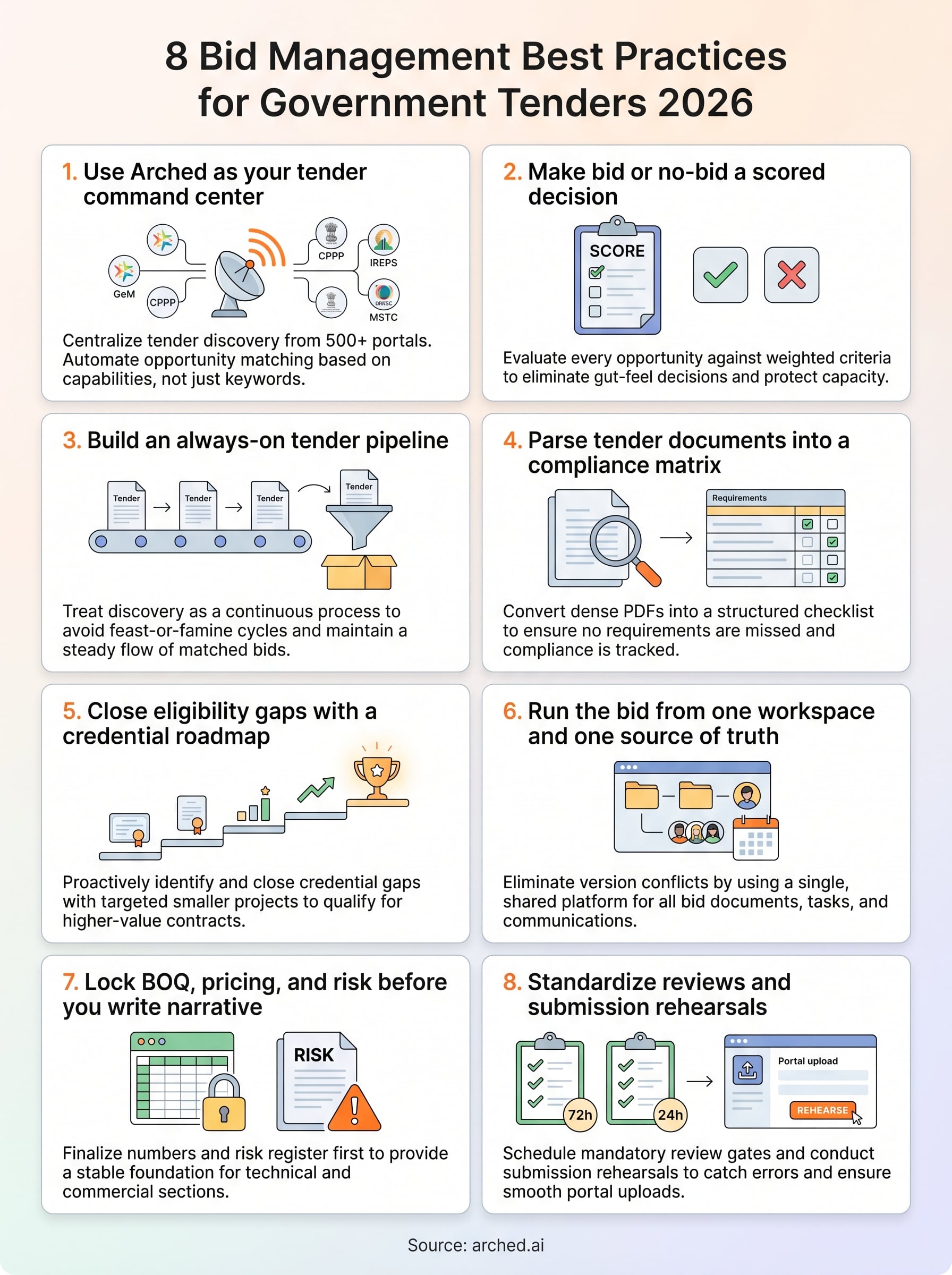
These eight bid management best practices give you a repeatable system for every stage of the tender cycle, from discovery through final submission. The firms winning more government contracts in India aren't more talented than their competitors; they run tighter processes and make better decisions earlier in each bid cycle.
Start with the two practices that will have the fastest impact on your team's capacity: centralizing tender discovery and scoring every bid or no-bid decision before committing resources. Both changes reduce wasted effort immediately and create the headroom your team needs to execute the remaining practices well.
Your next step is to pick the one practice that is costing your team the most today and fix it first. If pricing and BOQ preparation are the bottleneck, Arched can take the estimate off your plate: send us the project and we deliver a detailed, engineer-reviewed estimate and BOQ on your deadline. See how our estimating service works or send us the project.
Have a package your team can’t get to? Send it to us. Our engineers check and sign off everything we deliver.