Residual Bid Capacity: Meaning, Formula, And Eligibility
Learn how to calculate residual bid capacity for Indian tenders. Master the formula, understand eligibility, and avoid technical bid rejections.
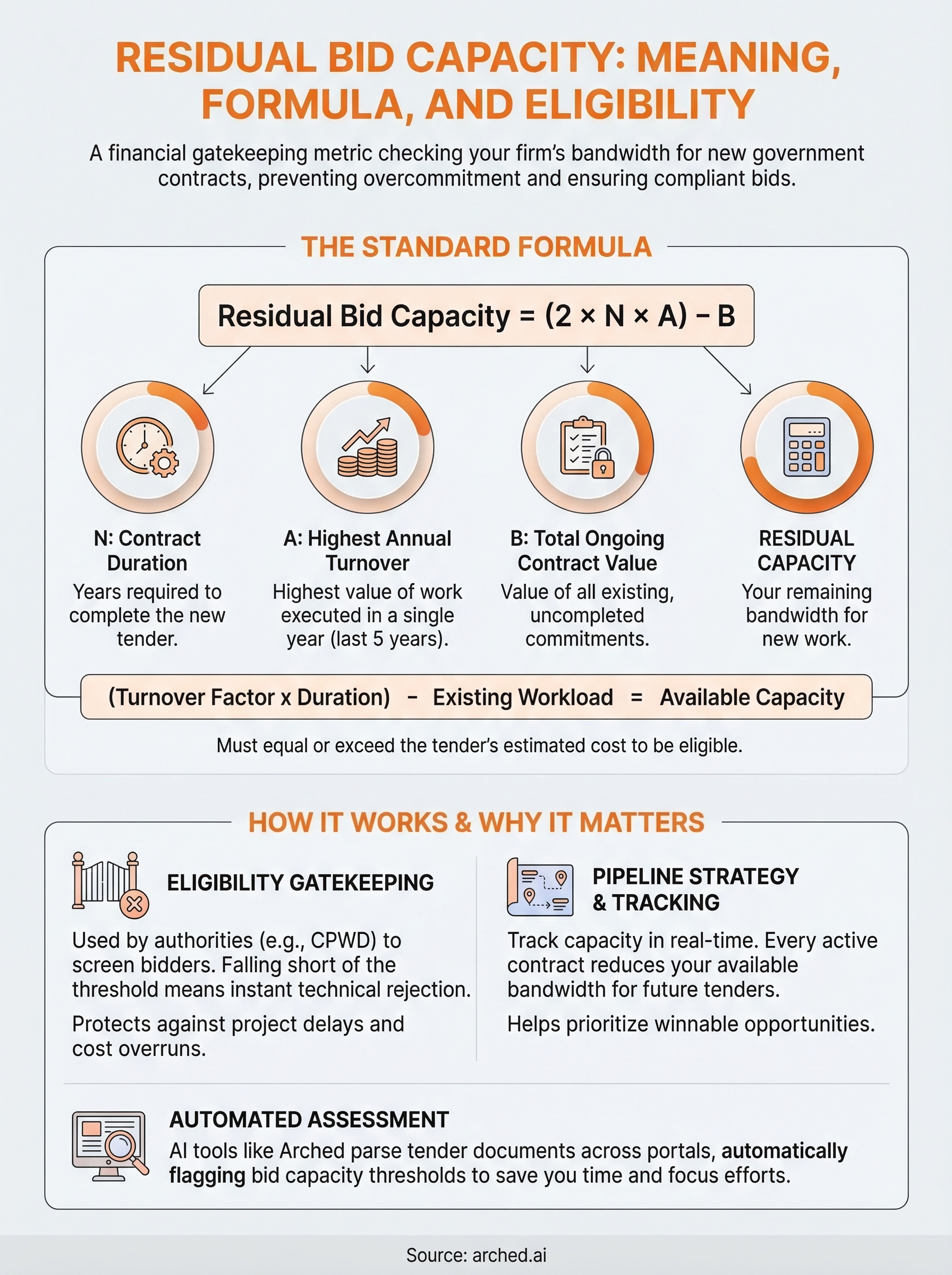
TL;DR — Residual bid capacity is what a firm can still legally bid for after its current workload is accounted for. Indian procuring authorities calculate it as (2 × N × A) − B, where N is the contract period in years, A is the firm's highest single-year execution value over the last five financial years, and B is the value of works in hand. Fall below the tender's threshold and the bid is rejected on eligibility, whatever the price.
Every government tender you chase in India's infrastructure sector comes with a gatekeeping metric that can disqualify you before you even submit a bid. That metric is residual bid capacity, a financial threshold that determines whether your firm has enough bandwidth to take on a new contract, given the work already on your plate. Miscalculate it, and you're either locked out of a project you could have won or overcommitted on one you can't deliver.
Understanding how residual bid capacity works isn't optional if you bid on public works contracts. It's the difference between a compliant bid and a rejected one. Yet the formula, its variables, and how different procuring authorities interpret it can vary enough to trip up even experienced BD teams.
This article breaks down what residual bid capacity means, how to calculate it step by step, and the eligibility criteria tied to it. We'll also cover where platforms like Arched fit in, our AI parses tender documents across 500+ government portals to flag qualification criteria like bid capacity thresholds automatically, so you know whether a tender is worth pursuing before you spend hours on the paperwork.
Why residual bid capacity matters in tenders
Procuring authorities don't just want to know if you've done similar work before. They want proof that you can actually take on another contract right now without your existing workload getting in the way. Residual bid capacity is the mechanism they use to make that judgment. It caps how much new work you can commit to based on your financial and operational bandwidth, calculated against what you're already contracted to deliver.
It protects both sides of the contract
When a government agency awards a contract to a firm already stretched thin, the risk of delays, cost overruns, and poor-quality output goes up significantly. Bid capacity thresholds exist precisely to prevent that scenario. They give the procuring authority a defensible, formula-based way to screen out firms that are technically qualified on paper but operationally overloaded.
A firm that wins more work than it can handle doesn't just fail itself; it delays public infrastructure that communities depend on.
For you as a bidder, understanding this threshold early protects your time and your bid costs. If your residual capacity falls short of the tender's minimum requirement, submitting a bid is wasted effort. A consistent pattern of non-compliant bids can also damage your credibility with procuring authorities over time.
It directly affects your pipeline strategy
Every tender you're currently executing reduces your available capacity for the next one. Your existing contract commitments directly shrink the pool of new work you can legally bid on. Teams that track this number in real time make faster decisions about which tenders to pursue, which to skip, and when to time a new submission based on expected project completions. Treating bid capacity as a live metric, rather than a static number, gives you a meaningful edge in competitive procurement cycles.
What residual bid capacity means in Indian procurement
In Indian public works contracting, residual bid capacity is defined by CPWD, state PWDs, and other procuring authorities as the net available capacity a firm holds after subtracting the value of ongoing work from its assessed maximum bid capacity. The Central Vigilance Commission has reinforced this concept in procurement guidelines to standardize how agencies evaluate contractor bandwidth across public infrastructure projects.
How Indian procurement authorities apply the concept
Indian procurement guidelines, particularly those following CPWD norms, require bidders to submit a statement of ongoing contracts as part of their bid package. This document lists every active project, its contracted value, and the estimated completion date. The procuring authority then uses this information alongside your assessed turnover to verify whether your residual capacity clears the tender's minimum threshold.
If your stated ongoing work value is inaccurate or incomplete, the authority can reject your bid outright on eligibility grounds.
Authorities across different states interpret the formula with minor variations, but the underlying logic stays consistent: you can only take on new work up to the point where your total commitments do not exceed a defined multiple of your average annual turnover.
Residual bid capacity formula and variables
Most Indian procuring authorities use a standardized formula to assess whether your firm holds enough capacity to take on a new tender. The formula ties your financial track record directly to your current workload, giving authorities a repeatable, objective way to compare bidders.
The standard formula
The formula most widely applied across CPWD and state PWD tenders is:

Residual Bid Capacity = (2 × N × A) - B
Getting this formula right before you submit saves you from a rejection on purely technical grounds.
Breaking down the variables
Each variable in the formula carries a specific definition that procuring authorities verify against your submitted documents. N is the number of years required to complete the contract you're bidding on, and A is the highest value of work your firm executed in any single year over the last five financial years.
B represents the total value of all your existing contract commitments, meaning every ongoing project you have not yet completed at the time of submission. Authorities derive this figure from the statement of works in hand that you submit with your bid package. Understating B is one of the most common reasons bids get flagged during scrutiny.
How to calculate and prove residual capacity
Once you understand the formula, applying it is straightforward. Take your highest annual turnover figure from the last five years, multiply it by two and then by N (the contract duration in years), and subtract your total ongoing contract value. If the resulting residual bid capacity equals or exceeds the tender's estimated cost, you meet the threshold.
Gathering the right documents
Your calculation is only as strong as the documents backing it. You need audited financial statements for the last five years to establish your highest annual turnover (A), and a complete statement of works in hand listing every ongoing project, its contract value, and its expected completion date.

Missing even one active project from your works-in-hand statement can inflate your residual capacity figure and trigger rejection during scrutiny.
Presenting your calculation to the authority
Most authorities require you to submit your bid capacity working sheet as a numbered exhibit within your bid package. Present the calculation clearly, referencing each variable directly to its source document.
Authorities cross-check these numbers during technical evaluation. A clean, auditable trail from your financial statements to the final figure removes ambiguity and reduces the risk of a technical rejection on what is otherwise a winnable bid.
Eligibility rules and common disqualifiers
Beyond the formula itself, procuring authorities apply specific eligibility rules that determine whether your residual bid capacity calculation is even considered. Meeting the numerical threshold is necessary but not sufficient. Your firm must also clear a set of baseline eligibility conditions before authorities evaluate your capacity figure at all.
When your capacity number disqualifies you
If your residual bid capacity falls below the estimated contract value of the tender, the authority rejects your bid at the technical stage without reviewing your financial or technical scores. No appeal based on goodwill or past performance overrides this hard cutoff.
Submitting a bid when your residual capacity falls short wastes your bid costs and signals poor pre-qualification screening to the authority.
Other common disqualifiers
Incomplete works-in-hand statements rank as the most frequent reason for rejection outside the capacity formula itself. Authorities also flag bids where your highest annual turnover figure cannot be verified against audited financials or where the financial year used to establish A does not match your submitted accounts.
Common triggers for disqualification include:
- Missing active projects from your works-in-hand list
- Mismatched financial years between the A variable and submitted accounts
- Unsigned or undated capacity working sheets
Key takeaways
Residual bid capacity is not a formality you can approximate. It's a hard eligibility gate that procuring authorities apply before reviewing any other part of your submission. The formula, (2 × N × A) - B, ties your highest annual turnover directly to your existing workload. Get your works-in-hand statement wrong, misquote your turnover year, or submit below the threshold, and your bid is out before technical scoring begins.
Your pipeline strategy depends on tracking this number continuously, not just when a deadline is close. Every active contract you carry reduces the new work you can legally pursue. Knowing your residual capacity in real time tells you which tenders are worth the effort and which to skip.
Arched parses tender documents across 500+ government portals and flags bid capacity thresholds automatically, so your BD team spends time on tenders you can actually win.