Bid Intelligence: What It Is and How AI Improves Win Rates
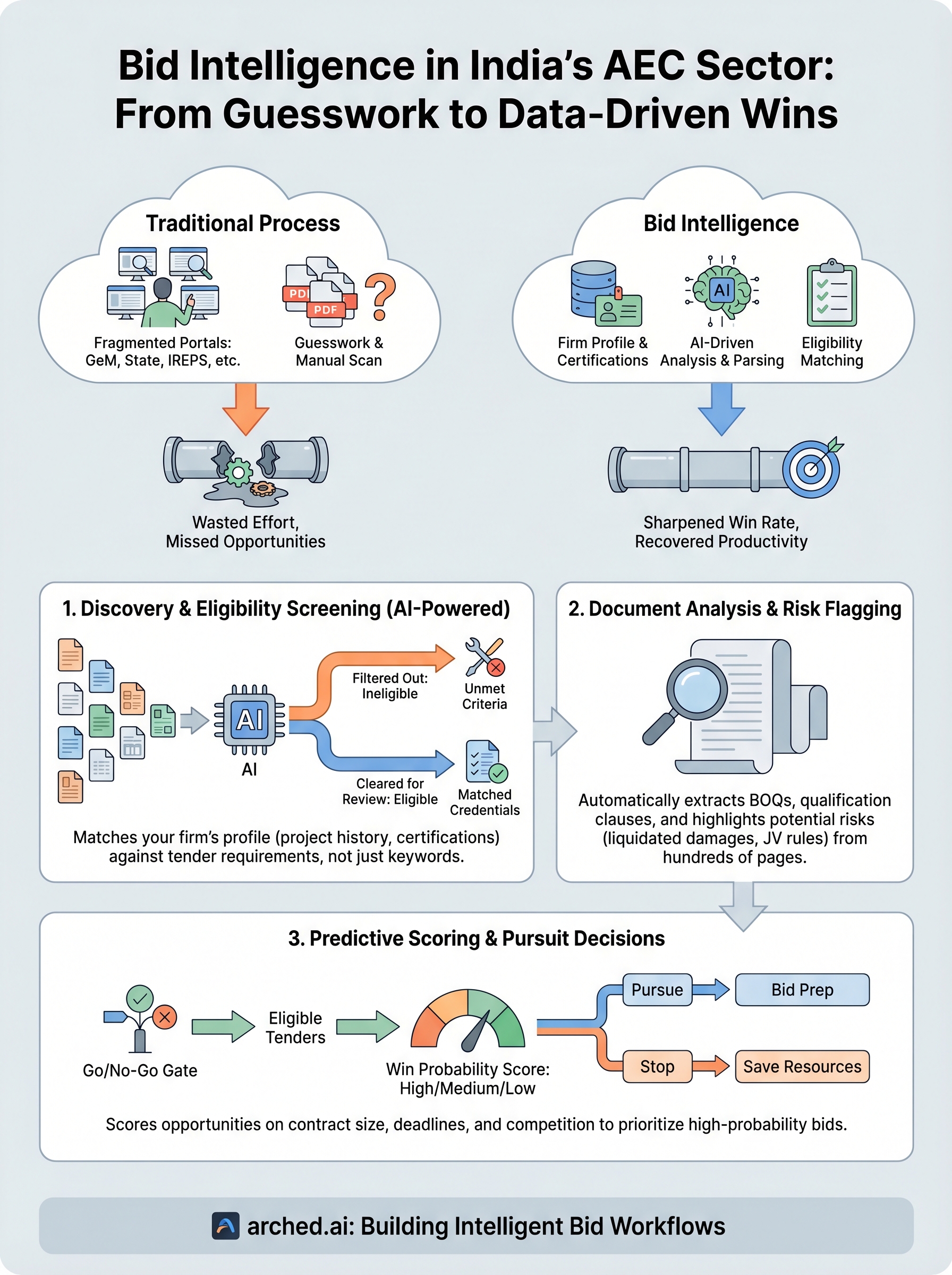
Most bid teams in India's AEC sector still rely on keyword searches across dozens of government portals, manually scanning PDFs, and gut instinct to decide which tenders to chase. The result is predictable: wasted effort on bids they were never going to win, and missed opportunities on contracts they could have captured. Bid intelligence changes that equation by replacing guesswork with data-driven analysis, matching your firm's actual credentials, past project history, and certifications against tender requirements before you commit a single hour to bid preparation.
Think of it this way: tender aggregation tells you what's out there. Bid intelligence tells you what's worth pursuing and why. It parses qualification criteria, flags risks buried in legal clauses, estimates competitive intensity, and scores opportunities based on your realistic probability of winning. For firms bidding on road, bridge, irrigation, or urban infrastructure contracts, where a single pursuit can consume weeks of effort, that distinction is worth crores in recovered productivity.
This article is a practical breakdown of what bid intelligence actually means, how AI makes it work at scale, and what to look for if you're evaluating tools to sharpen your win rate on government contracts.
Why bid intelligence matters in Indian contracting
India's public procurement landscape is one of the most fragmented in the world. Central government portals like GeM and CPPP operate alongside dozens of state-level e-procurement systems, IREPS for railways, MSTC for industrial and commercial auctions, and hundreds of department-specific portals. For a BD manager at a mid-sized infrastructure firm, tracking all of these manually is not just inefficient - it is structurally impossible. That fragmentation is precisely why bid intelligence has moved from a nice-to-have to a core operational requirement for firms that want to compete seriously.
The volume and fragmentation problem
Most firms handle discovery by assigning team members to refresh portals every morning, run keyword searches, and forward PDF links over group chats. This process misses tenders that use different terminology in their titles, tenders published on lesser-known state portals, and time-sensitive opportunities that appear and close within days. Your team ends up with a filtered list that reflects what they searched for, not what your firm can actually win.
The real risk is not that you lose a bid you pursued. It is that you never saw the bid in the first place.
India publishes tens of thousands of tenders per month across infrastructure sectors alone. A team of three BD professionals cannot manually screen more than a fraction of that volume while also preparing actual bid documents. The result is a selection bias where firms keep pursuing the same familiar tenders because those are the ones they know how to find, not because they represent the best fit.
The cost of chasing the wrong tenders
Pursuing the wrong tenders does not just waste time. Each bid attempt carries real costs: document procurement fees, technical team hours spent on BOQ analysis, management review time, and coordination with JV partners or subcontractors. When a firm submits a bid it had little realistic chance of winning, because it lacked a required certification or fell short on prior project value thresholds, those costs produce zero return.
Applying proper eligibility screening before any pursuit decision addresses this problem at the source. Firms that build this discipline into their workflow consistently report sharper pipelines, fewer wasted submissions, and better-informed choices about when to partner rather than bid solo. In a sector where contract cycles run long and BD resources are stretched, that discipline compounds over time into a measurable advantage.
What bid intelligence covers across the bid lifecycle
Bid intelligence is not a single feature or a point-in-time report. It operates across the entire lifecycle of a bid, from the moment a tender appears on a portal to the final submission decision. Understanding which stages it covers helps you identify where your current process is losing ground and where structured data analysis would deliver the most immediate impact.
Discovery and eligibility screening
The first stage is opportunity discovery, and this is where most firms leak the most value. A bid intelligence system does not stop at surface-level keyword matching. It reads tender eligibility criteria and cross-references them against your firm's credentials, prior project values, sector experience, and certifications to filter out tenders you cannot win before anyone spends time reading the full document.

Eligibility screening before pursuit is the single fastest way to raise your win rate without submitting a single additional bid.
Once a tender clears your eligibility threshold, the system scores it against factors like contract size fit, deadline viability, and geographic requirements so your BD team can prioritize the strongest opportunities rather than treating every match as equally worth pursuing.
Document analysis and risk flagging
Tender documents in India routinely run to hundreds of pages. BOQ extraction, qualification clause identification, and unusual penalty structures are buried in that volume, and manual review takes significant professional time per document. A bid intelligence layer reads those documents automatically and surfaces the critical details your team needs to make a go or no-go call within minutes.
This stage also covers risk flagging, identifying clauses around liquidated damages, performance guarantees, or joint venture requirements that could affect your bid strategy before you commit to preparation.
How AI improves bid intelligence and win rates
Manual bid intelligence depends on what your team knows to look for. AI-driven bid intelligence removes that ceiling by processing far more data than any team could review, finding patterns across your firm's history, and returning matches based on actual fit rather than search terms you happened to enter. The practical result is a sharper, faster pipeline with fewer wasted pursuits.
Natural language matching over keyword search
Traditional portal searches return results based on the exact words you type. If a tender for road rehabilitation is published under "surface improvement works," your keyword search misses it. AI models trained on procurement language understand context and intent, so they surface relevant opportunities even when the terminology varies across portals or states.
The tenders you never see are the ones that hurt your win rate the most.
This approach also works against your firm's specific eligibility data. Instead of returning every tender in your sector, the system filters by what you can actually win given your certifications, prior project values, and sector history. That combination of language understanding and eligibility matching is what separates AI-powered discovery from basic aggregation.
Predictive scoring and competitive context
Beyond discovery, AI models can score each opportunity by analyzing signals like contract size, deadline pressure, qualification complexity, and geographic scope relative to your firm's profile. This gives your BD team a ranked list rather than a flat one, so they spend preparation time on bids with realistic probability of success rather than volume for its own sake. Firms that apply this scoring discipline consistently shorten their bid cycles and improve their ratio of submissions to awards.

How to build a bid intelligence workflow that scales
A scalable bid intelligence workflow is not built around adding more people to your BD team. It is built around structured data inputs, consistent decision criteria, and a process that produces the same quality of output whether you are reviewing 10 tenders or 1,000. The two foundations that make this possible are a clean firm profile and a defined go or no-go gate.
Start with a clean firm profile
Your system is only as useful as the data you feed it. Before you can match opportunities to your firm, you need a complete and current record of your credentials: sector experience, prior project values by category, certifications held, and geographic coverage. Most firms underestimate how incomplete their own records are until they try to use them for automated eligibility screening.
Update this profile whenever you complete a project, gain a certification, or bring in a new JV partner. Stale credential data produces false negatives, meaning tenders you could realistically win get filtered out because your profile does not reflect your current qualifications. Treat your firm profile as a live document, not a one-time setup task.
Build a standard go or no-go gate
The firms with the highest win rates are not the ones who bid the most. They are the ones who stop the most bids early.
Every opportunity that clears your eligibility filter should pass through a defined scoring gate before anyone starts preparing documents. Set clear criteria: minimum contract value, deadline feasibility, required JV structure, and technical team availability. Documenting these thresholds removes the need for senior review on every opportunity and lets your team make faster, more consistent pursuit decisions without constant escalation.
What to look for in bid intelligence software
Not every platform that claims to offer bid intelligence delivers meaningful analysis. Many tools stop at aggregation, pulling tenders from a limited set of portals and presenting them as a list with no scoring, no eligibility filtering, and no document parsing. Before you commit to a platform, evaluate it against the criteria below to make sure it can actually improve your win rate rather than just adding another dashboard to your workflow.
The right software reduces the decisions your team has to make, not just the portals they have to check.
Portal coverage and data freshness
Your software needs to monitor the portals your contracts actually come from, not just the well-known national platforms. For firms operating across India, that means coverage of state-level e-procurement systems, IREPS, MSTC, and sector-specific portals alongside GeM and CPPP. Equally important is how frequently the system refreshes its data. A platform that updates once daily will miss tenders with short publication windows. Look for real-time or near-real-time monitoring with instant alerts when a relevant match appears.
Eligibility matching and document parsing depth
A credible platform does not match you to tenders based on keywords alone. It reads your firm's credential profile and screens tenders against your actual qualifications, prior project values, and certifications before surfacing results. Equally, its document parsing capability should extract BOQ data, qualification clauses, and risk-relevant legal terms automatically rather than requiring your team to read hundreds of pages per tender. Platforms that combine both functions give your BD team the go or no-go information they need without adding manual review steps to an already stretched workflow.
Final takeaways
Bid intelligence is the difference between a BD process built on volume and one built on accuracy. India's procurement landscape is too fragmented and too fast-moving for manual tracking to keep pace. Firms that rely on keyword searches and portal refreshes will keep missing the tenders they could win and spending resources on the ones they cannot.
The core shift is straightforward: match your firm's actual credentials against tender requirements before you commit any pursuit effort, parse documents automatically to surface eligibility and risk information, and score every opportunity against clear criteria so your team focuses where the probability is real. Each of these steps compounds over time into a measurably sharper pipeline.
If you would rather spend your bid effort on go/no-go decisions than on estimate preparation, Arched can deliver a reviewed estimate and BOQ for the tenders you choose to pursue. See how our estimating service works or send us the project.
Have a package your team can’t get to? Send it to us. Our engineers check and sign off everything we deliver.