What Is Rate Analysis In Construction? Method & Example
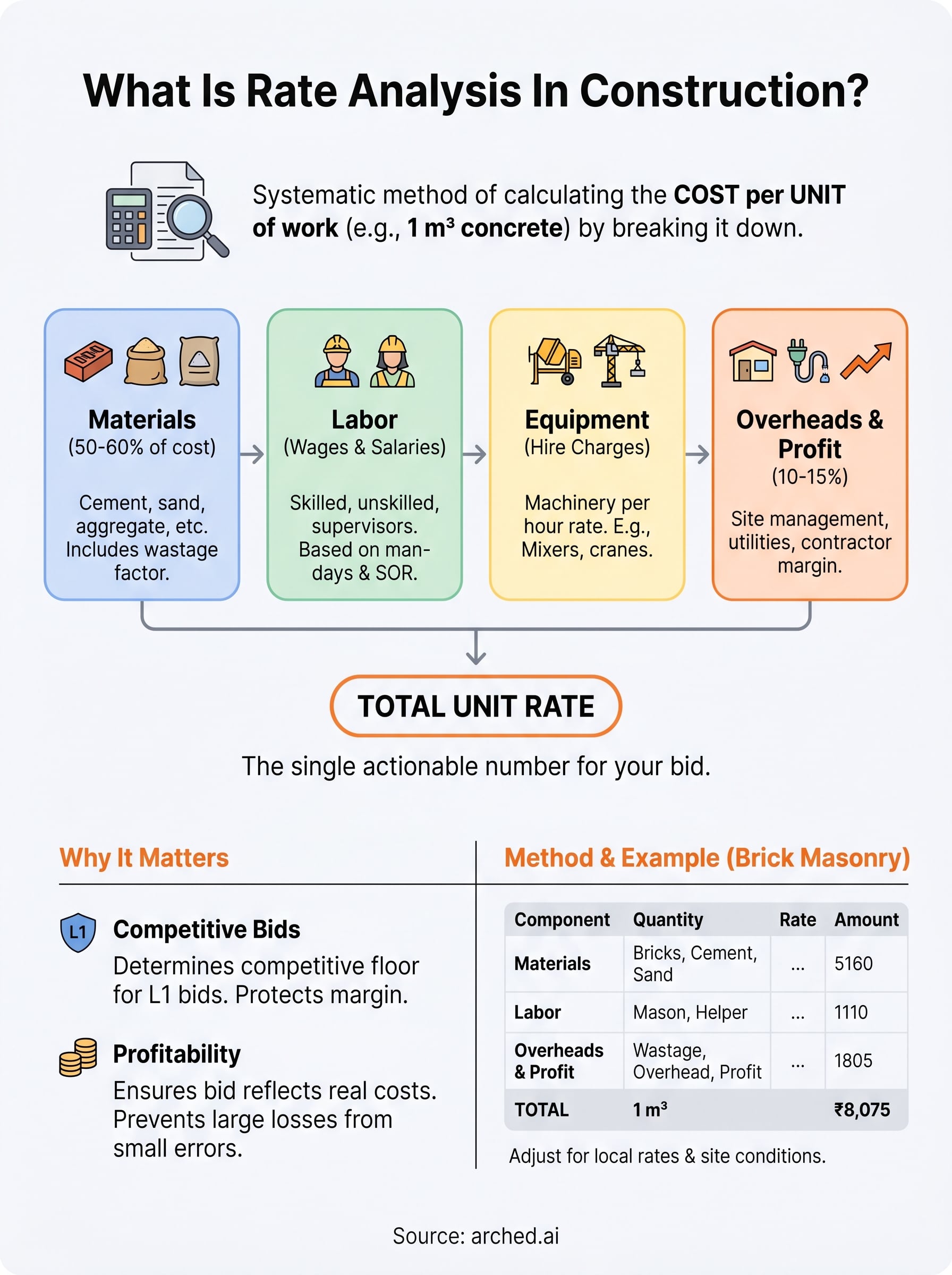
Every government tender in India comes down to one thing: your quoted rate. Quote too high, and you lose the bid. Quote too low, and you win a project that bleeds money. What is rate analysis in construction? It's the systematic method of calculating the cost of completing one unit of work, say, one cubic meter of concrete or one square meter of plastering, by breaking it down into materials, labor, equipment, and overheads.
For contractors and BD teams bidding on public infrastructure projects, road widening, bridges, irrigation systems, rate analysis is the backbone of every BOQ (Bill of Quantities) submission. It determines whether your bid is competitive and profitable. Get it wrong, and you're either priced out or locked into a loss-making contract worth crores. Accurate rate analysis separates firms that grow from firms that survive.
This article breaks down the complete method behind rate analysis: its core components, the step-by-step calculation process, and a worked example you can apply to your next bid. We also cover where Arched can help: we build rate analyses for contractors' BOQs on their chosen rate basis, reviewed by an engineer.
What rate analysis includes in construction
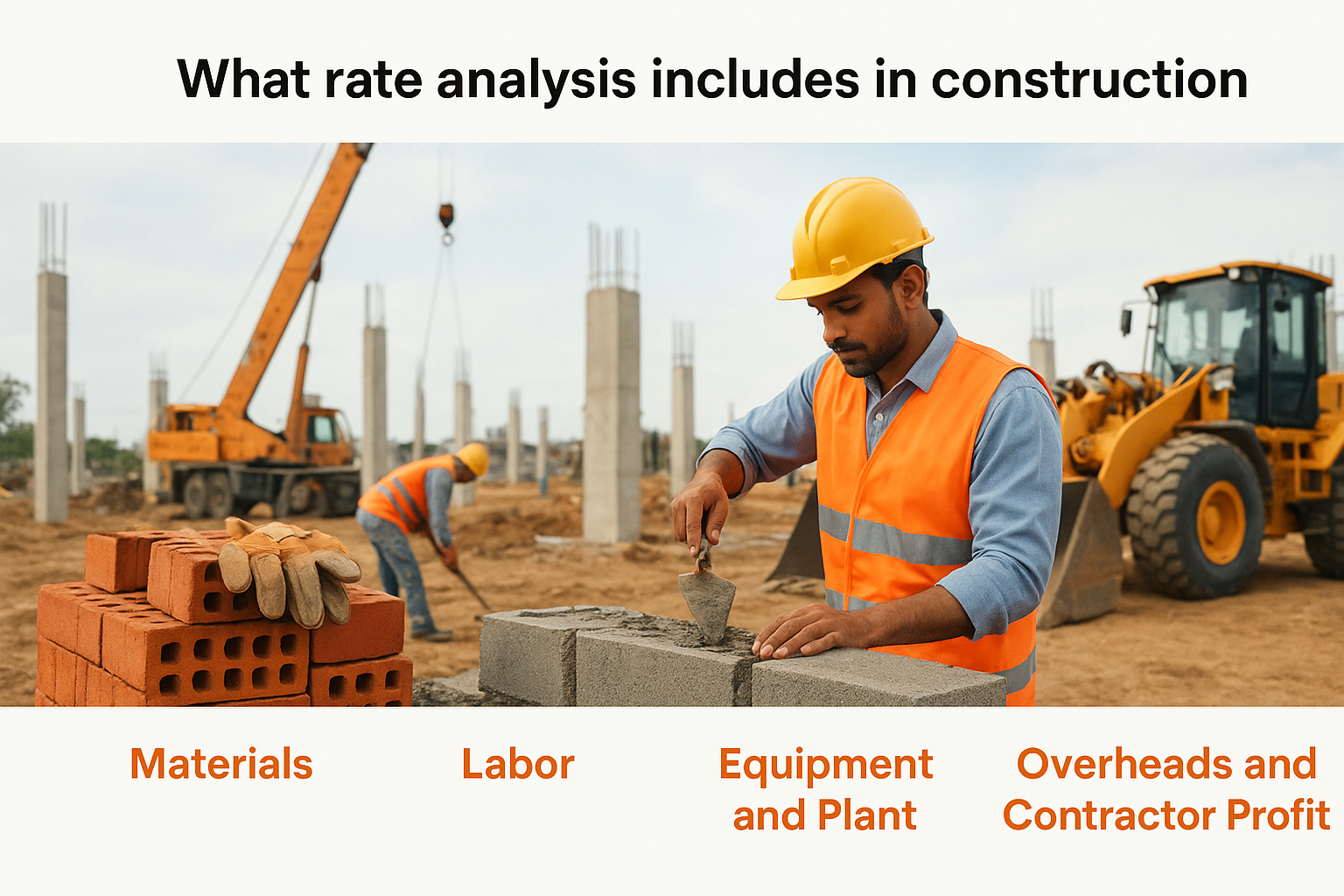
Rate analysis breaks every unit of work into four core cost components: materials, labor, equipment, and overheads. Each component carries a specific quantity and a current market rate. You multiply quantity by rate for each component, then add them together to arrive at the total cost per unit. Understanding what is rate analysis in construction starts with knowing exactly what goes into each of these four buckets.
Materials
Materials are typically the largest cost driver, often accounting for 50 to 60 percent of a unit rate in civil works. You estimate the quantity of each material required to complete one unit of work, including a wastage factor that reflects site conditions. For one cubic meter of M20 concrete, for example, you calculate cement bags, sand volume, and aggregate volume separately, then apply current market prices for each.
Accurate material quantities depend on mix designs and local wastage norms, both of which vary by project type and site location.
Labor
Labor costs cover wages for every category of worker involved in completing the unit: skilled masons, unskilled helpers, and supervisory staff. You estimate the number of man-days required per unit, then multiply by the prevailing Schedule of Rates (SOR) or market wage for your state. Labor productivity norms from CPWD or state PWD data are a reliable baseline.
Equipment and Plant
Equipment costs apply when the work requires machinery such as mixers, compactors, or cranes. You calculate the hire rate per hour for each machine and multiply it by the time needed to complete one unit of work.
Overheads and Contractor Profit
Overheads cover site management, temporary structures, utilities, and administrative costs. Contractor profit is added as a percentage on top of the base cost. Under CPWD's Analysis of Rates the two are combined into a single 15% allowance for contractor's profit and overheads — the section below breaks down how that figure is built and where your own commercial margin differs from it.
Why rate analysis matters for estimates and bids
Understanding what is rate analysis in construction tells you how to build a number, but knowing why it matters tells you how to protect your business. Every BOQ you submit to a government agency is a binding commitment. A unit rate you calculate today becomes the rate you're held to throughout the entire contract duration, regardless of material price changes or site conditions that shift mid-project.
Competitive Bids That Hold Up
Government tenders in India, including those under GeM, CPPP, and state PWD portals, are evaluated on an L1 (lowest bid) basis. Your rate analysis gives you the floor: the minimum rate below which you start losing money. Without a solid breakdown, you're guessing. With one, you can price aggressively at L1 while knowing your margin is intact.
Rate analysis is your evidence trail. If a dispute arises during execution, a documented cost breakdown justifies your claims for variation orders or price escalation.
Profitability Over the Project Lifecycle
Projects with crore-level contract values can swing significantly based on small per-unit errors multiplied across thousands of BOQ line items. Solid rate analysis ensures your aggregate bid value reflects real costs, not assumptions built on outdated SOR data or rough estimates from a previous project.
How to do rate analysis step by step
Rate analysis follows a repeatable sequence. Start by defining the exact unit of work you are pricing: for instance, one cubic meter of earthwork excavation or one square meter of brick masonry. This unit becomes the denominator for every calculation you run.
Collect Inputs and Apply Current Rates
Once you define the unit, list every resource that goes into completing it: materials, labor categories, and equipment. Assign quantities to each input using CPWD norms, state SOR data, or your firm's own productivity records.
Always verify your material rates against current market prices, not last quarter's data, since cement and steel prices shift frequently in the Indian market.
After assigning quantities, multiply each input quantity by its current rate to get a sub-cost. Sum all sub-costs, then add your wastage factor, site overhead percentage, and contractor profit margin. The total gives you what is rate analysis in construction distilled into a single actionable number: your unit rate. Cross-check the final figure against the published SOR for your state to confirm your rate sits within a defensible range before submitting any bid.
Worked example of a unit rate calculation
Here is a practical illustration of what is rate analysis in construction, applied to 1 cubic meter of brick masonry in cement mortar (1:6), one of the most common BOQ line items in building and infrastructure tenders across India. Walking through a real calculation makes the method far clearer than any abstract description.

Breaking Down the Numbers
The table below uses current approximate market rates for a metro-city project in India. Quantities follow standard CPWD productivity norms, which your team can adjust to match your state SOR or your firm's actual site productivity data.
| Component | Quantity | Unit | Rate (₹) | Amount (₹) |
|---|---|---|---|---|
| Bricks | 500 | Nos | 8.00 | 4,000 |
| Cement | 0.22 | Bag | 380 | 836 |
| Sand | 0.27 | m³ | 1,200 | 324 |
| Skilled mason | 1.2 | Day | 700 | 840 |
| Unskilled helper | 0.6 | Day | 450 | 270 |
| Wastage (5%) | 314 | |||
| Overhead (10%) | 627 | |||
| Profit (12%) | 864 | |||
| Total unit rate | 8,075 |
Always cross-check your final figure against your state PWD's published Schedule of Rates before submitting any bid.
Which edition to check against is not always obvious. The Schedule of Rates by state directory lists the current edition for every state, and a few states complicate it further by publishing rates per district rather than statewide — see Uttarakhand's district-wise SOR, where two financial years are live at once.
Your total unit rate lands at approximately ₹8,075 per cubic meter. Multiply this by the BOQ quantity for that line item, and you get your bid value for that work item alone. A five-rupee error per unit compounds into lakhs across a large tender, so every input in this breakdown needs a verified, current source.
Contractor's profit and overheads in rate analysis
The single component bidders most often get wrong is the percentage layered on top of the base cost. It matters because it is the only line in a rate breakdown that is partly set by the department rather than by your costs, and because the number published in a Schedule of Rates is not the same number you should be quoting from.
The CPWD standard: 15 percent, combined
CPWD's Analysis of Rates applies 15% toward contractor's profit and overheads as a combined allowance. That figure is split internally as 7.5% contractor's profit and 7.5% overheads. It was raised to 15% from an earlier 10% — which had been composed of 7.5% profit and only 2.5% overheads — by a CPWD order issued in December 2007, and the 15% figure has been the working standard in CPWD rate analysis since.
Two details decide whether you apply it correctly:
- It sits on the base cost only. Apply the percentage to materials plus labour plus plant and machinery. Applying it to a subtotal that already includes GST inflates the claim beyond what the contract structure supports, and an evaluator checking your arithmetic will find it.
- It is a combined figure, not two stacked ones. Adding 7.5% profit and then a separate 7.5% overhead to an already-uplifted subtotal compounds the two and overstates the rate. The 15% is applied once.
In a CPWD-derived rate, the 15% is part of how the published rate was derived. It is not a margin sitting on top of the published rate waiting for you to collect it.
Why the worked example above uses different percentages
The brick masonry example earlier in this article applies a 10% overhead and a 12% profit separately, which is a market-rate illustration for a private or negotiated job, not a CPWD-standard derivation. Both are legitimate; they answer different questions.
| Context | What the percentage represents | Typical treatment |
|---|---|---|
| CPWD / DSR-derived rate | Departmental allowance built into the published rate | 15% combined on base cost |
| State PWD SOR | Whatever that state's schedule preamble specifies | Varies by state — read the preamble |
| Your quoted rate on a tender | Your own commercial margin and recovery | Set by your cost structure and risk |
This is the distinction that trips up bid teams: the SOR's built-in percentage and your commercial margin are not the same number. When a tender asks you to quote at a percentage above or below the SOR, the SOR rate already contains the department's 15%. Your quoted variation is applied to that finished rate. Treating the 15% as your margin means you have priced in no margin of your own.
Reading the governing figure for your state
Do not carry the CPWD number into a state tender by default. State PWDs publish their own schedules with their own allowances, and the governing figure for any given tender sits in the SOR preamble or the tender's own rate-analysis conditions, not in a general reference. Where a state publishes rates per district or keeps two financial years live simultaneously, the preamble is also where that is stated.
The Schedule of Rates by state directory lists the current edition for every state so you can confirm which document governs before you derive anything. For how the derivation itself is structured under CPWD, the CPWD Analysis of Rates guide covers the relationship between the DAR and the finished DSR rate, and MoRTH's Standard Data Book sets out the equivalent input constants for road and bridge works.
Common mistakes and quick checks to avoid them
Even experienced bid teams get rate analysis wrong in predictable ways. Knowing what is rate analysis in construction is one thing; applying it consistently under bid deadlines is another. The mistakes below appear repeatedly across Indian government tenders, and each one has a straightforward fix.
Using stale market rates
The most common error is pulling material rates from a previous project rather than verifying current prices. Cement and steel prices shift month to month, and a six-month-old rate can push your unit cost off by 8 to 12 percent.
Before finalizing any BOQ, verify your material rates against current supplier quotes or your state's latest Schedule of Rates circular.
Skipping wastage and productivity adjustments
Many teams apply a flat 5 percent wastage factor across every material regardless of work type. Earthwork carries a different wastage profile than concrete, and site productivity varies by location and crew size. Cross-check your labor productivity norms against CPWD data for the specific work category you are pricing, and adjust wastage percentages to match the actual site conditions stated in the tender document.
Final takeaway
Rate analysis is not a formality you complete before submitting a bid. It is the core discipline that determines whether a contract generates profit or erodes it. Understanding what is rate analysis in construction means building every unit rate from verified inputs: current material prices, accurate labor productivity norms, equipment hire rates, and a realistic overhead and profit margin. Skip any component, and the error compounds across thousands of BOQ line items.
Your bid team should verify material rates before every submission, adjust wastage factors to match specific work categories, and cross-check final figures against your state's published Schedule of Rates. Small per-unit errors multiply into lakh-level losses on large government tenders. The method is straightforward when you follow it consistently.
For the published rates to check your derivations against, the Schedule of Rates by state directory lists every state's current edition, and the Chhattisgarh Building SOR 2026 is available as a searchable table with an Excel export.
If you would rather not build every rate analysis yourself, Arched can do it: send the drawings and we deliver a priced BOQ with rate build-ups on your rate basis (state SOR, CPWD DSR or market rates), reviewed by an engineer. See how our estimating service works.
Have a package your team can’t get to? Send it to us. Our engineers check and sign off everything we deliver.