What Is Retention Money in Construction Contracts? Overview
Understand what is retention money in construction contracts. Learn about deduction limits, release milestones, and how to protect your firm's cash flow.
Every construction contract in India's public procurement ecosystem comes with financial mechanisms designed to protect the employer. One of the most common, and most misunderstood, is retention money in construction contracts. It's the portion of each running bill that the client holds back, typically as security against defective work or incomplete obligations during and after project execution.
For contractors bidding on government projects worth crores, retention money directly affects cash flow, working capital planning, and even the decision to pursue a tender in the first place. Yet many firms don't fully account for it until they're already locked into a contract. Understanding how retention works, the typical percentages, release timelines, and conditions, is fundamental to accurate bid pricing and healthy project finances.
This article breaks down retention money from the ground up: what it is, why employers insist on it, how much gets withheld, and when you can expect to get it back. At Arched, our platform parses tender documents to flag exactly these kinds of financial terms and risk clauses before you commit to a bid, so you're never caught off guard by what's buried on page 47 of a PDF.
What retention money means in a contract
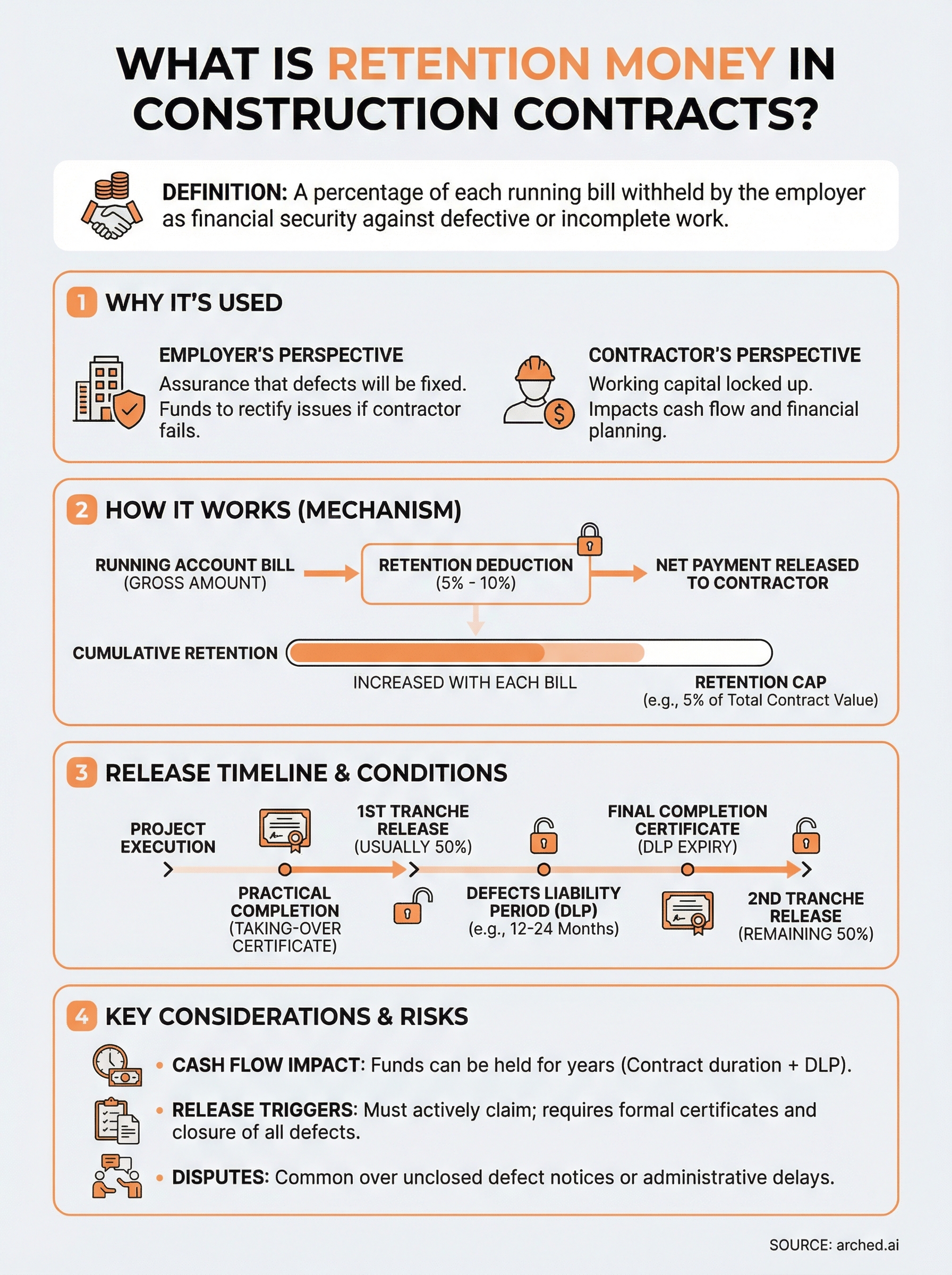
Retention money, sometimes called retainage, is a contractually agreed percentage of each interim payment (running account bill) that the employer withholds from the contractor throughout project execution. The employer holds this accumulated sum and releases it only after the contractor satisfies specific conditions, typically the completion of work and the expiry of the defects liability period. If you want to understand what is retention money in construction contracts, the core idea is simple: it is a financial guarantee built directly into the payment structure, ensuring the contractor returns to address any defects that appear after handover without the employer needing to chase separate legal remedies.
Where retention appears in the contract document
Every standard government contract in India, from CPWD agreements to state PWD conditions of contract, includes a dedicated clause covering retention. You will typically find it under the "Payment Terms" or "Conditions of Contract" section. That clause specifies the percentage to be withheld per running bill, the maximum retention cap (often 5% to 10% of the total contract value), and the precise conditions the employer must fulfill before releasing the funds back to you.
Retention is not a penalty. It is security that the employer holds, and you have a contractual right to claim every rupee of it back once you satisfy the agreed conditions.
The two tranches and when each gets released
Most contracts split retention into two distinct tranches tied to separate project milestones. The first tranche, usually half the total withheld amount, is released when the employer issues the taking-over certificate or practical completion certificate at the end of construction. The second tranche remains held until the defects liability period (DLP) ends and the employer formally issues the final completion certificate. The DLP commonly runs for 12 to 24 months after handover, depending on the contract type and the complexity of the work involved.

Some contracts permit you to substitute the second tranche with a retention bond issued by a bank or an approved insurance company. This releases your working capital while still giving the employer the security they require. Not every employer accepts this arrangement, so you need to verify the specific contract clauses before treating a retention bond as a guaranteed option.
Why owners use retention and why contractors care
Retention money sits at the center of a tension that runs through every government contract: the employer wants assurance that defects will be fixed, and you want your money as soon as the work is done. Both positions are legitimate, and understanding each side helps you manage the arrangement rather than simply accept it.
The employer's perspective
Government clients, from CPWD to state PWDs, manage projects funded with public money, which makes accountability a core obligation. Retention gives the employer a practical tool: if you walk away after handover without addressing a structural failure or a drainage defect, the employer can use the withheld funds to engage another contractor and fix it. Without retention, recovering these costs through legal channels would take years and significant resources that most public bodies are not set up to pursue.
Retention is the employer's insurance policy against incomplete or defective work, and it costs them nothing to maintain until release conditions are met.
The contractor's perspective
For you, understanding what is retention money in construction contracts matters most because it is working capital that gets locked up for the entire contract duration plus the defects liability period. On a three-year project with a 12-month DLP, funds could be held for four years or more. Firms that don't model retention into their cash flow projections often find themselves under financial pressure mid-project, well before the final certificate arrives. The impact typically shows up in three specific ways:
- Reduced capital available for concurrent bids and mobilization
- Increased reliance on short-term bank credit at additional cost
- Cash flow gaps when subcontractors expect payment on schedule
How retention gets calculated and deducted
Understanding what is retention money in construction contracts also means knowing how the numbers actually work on each bill. The employer does not take one lump sum upfront. Instead, they deduct retention progressively from each running account bill you raise as work advances. The employer applies the agreed percentage to the gross certified amount before releasing your payment, which means your net receipt on every bill is consistently lower than what you billed.
The percentage applied per running bill
Standard government contracts in India typically withhold between 5% and 10% of each running bill. CPWD contracts most commonly apply 5%, while some state PWD contracts run higher depending on project type and risk classification. You should read the specific payment clause in every tender document to confirm the exact rate before you price your bid.

A contract worth ₹10 crore at 5% retention means up to ₹50 lakh stays with the employer until release conditions are satisfied.
Here is how the deduction works on a single interim bill:
| Bill Component | Amount (₹) |
|---|---|
| Gross certified work | 1,00,00,000 |
| Retention deducted (5%) | 5,00,000 |
| Net payment released | 95,00,000 |
The retention cap and when deductions stop
Most contracts set a maximum retention ceiling, expressed as a percentage of the total contract value. Once the cumulative withheld amount reaches this cap, the employer stops deducting retention from subsequent bills even while the project continues. For long projects running multiple years, hitting the cap early gives you more predictable cash flow in the later billing cycles and reduces the total amount locked with the employer.
When retention gets released and what can delay it
Release of retention money does not happen automatically. You have to actively trigger the process by satisfying the conditions written into the contract and then formally requesting the payment from the employer. If you wait passively, the funds simply stay parked with the employer indefinitely, and no provision in a standard government contract requires them to release it without your written claim.
The two release triggers you need to track
Understanding what is retention money in construction contracts also means knowing exactly which milestones unlock each tranche of your withheld funds. The first tranche releases when the employer issues the taking-over certificate, confirming that the works meet the contractual completion criteria. The second tranche releases once the defects liability period ends and you receive the final completion certificate. Both of these documents carry specific dates, and you should track them formally throughout the project to avoid missing your claim window.
Mark the DLP expiry date in your project calendar on the day you receive the taking-over certificate, not later.
What delays release and how to respond
Delays in retention release are common on government infrastructure projects, and they typically fall into two categories. Administrative delays happen when the employer's internal certification process moves slowly, often because the defects liability inspection gets deprioritized after project handover. Disputes over outstanding defects or incomplete snag items create the second category, where the employer withholds the final certificate until you close every item on their punch list. Your best response is to maintain a documented correspondence trail throughout the DLP, respond to every defect notice in writing, and submit your release claim with supporting certificates attached the moment the DLP expires.
Common retention disputes and how to avoid them
Disputes over retention money are among the most frequent financial conflicts in government construction contracts. Most of them trace back to poor documentation and unclear communication during the defects liability period rather than genuine disagreements about work quality. Knowing where disputes commonly arise gives you the tools to prevent them before they become formal claims.
Disputes over defect notices and closure
The most common dispute pattern involves defect notices that were never formally closed before you submitted your retention release claim. Employers reject the claim, citing unresolved snag items. You prevent this by responding to every defect notice in writing, confirming the remedial work completed, and requesting written acknowledgment from the employer's site representative that each item is closed. Keep copies of all correspondence organized by notice number throughout the entire DLP so you have a clean record when the release claim is due.
Contractors often assume verbal confirmation that a defect is fixed is sufficient. It is not. On government infrastructure projects, verbal sign-offs carry no contractual weight, and an employer's team can change personnel between handover and final certification.
Disputes over the release timeline itself
Understanding what is retention money in construction contracts also means knowing that employers sometimes delay issuing the final completion certificate without any stated reason, leaving your second retention tranche in limbo. If the DLP has expired and you have no outstanding defect notices, send a formal written request to the employer citing the specific contract clause that governs release. Follow up at regular intervals and keep a dated paper trail, as this documentation forms the basis for any escalation through the contract's dispute resolution process.
Submit your retention release claim in writing on the day the DLP expires, not weeks later.
Conclusion
Understanding what is retention money in construction contracts shapes how you price bids, plan working capital, and manage the defects liability period. Every percentage point withheld from your running bills adds up across a multi-year project, and funds locked with the employer for four or more years carry a real cost that belongs in your financial model from day one. Track your release triggers, close every defect notice in writing, and submit your claim the moment the DLP expires.
Retention is just one of dozens of financial clauses buried in government tender documents that can reshape a project's profitability before you even sign the contract. Arched parses tender documents automatically, flagging retention rates, release conditions, and unusual risk clauses so your team can evaluate the true financial picture before committing to a bid. If you want to stop missing these details, explore what Arched can do for your bidding process.