Turnkey Contract vs EPC Contract: Scope, Risk, Control
If you've spent any time reviewing government tender documents in India, you've likely seen the terms "turnkey" and "EPC" used almost interchangeably. On the surface, they look identical, a single contractor handles design, procurement, and construction. But when you dig into the contract clauses, the differences in risk, control, and scope become significant. Understanding the turnkey contract vs EPC contract distinction can directly affect how you price a bid and what liabilities you're signing up for.
The confusion isn't academic. It shows up in real tender evaluations, on platforms like GeM, CPPP, and state e-procurement portals, where contract type shapes eligibility criteria, payment structures, and performance guarantees. Misreading which model a project follows can mean underbidding, over-committing, or missing a qualification requirement entirely.
This article breaks down the actual differences between EPC and turnkey contracts, covering scope boundaries, risk allocation, owner involvement, and when each model typically appears in Indian public procurement. By the end, you'll have a clear framework for distinguishing the two and know how each one affects your bidding strategy on the ground.
EPC vs turnkey in plain English
Both contract types assign design, procurement, and construction to a single contractor. The owner hands over a scope of work and receives a completed asset. That shared structure is why the terms get used interchangeably in everyday conversation. But each model draws the line between contractor responsibility and owner control in a different place, and that line matters when you're pricing a bid or reviewing liability clauses.
The EPC model
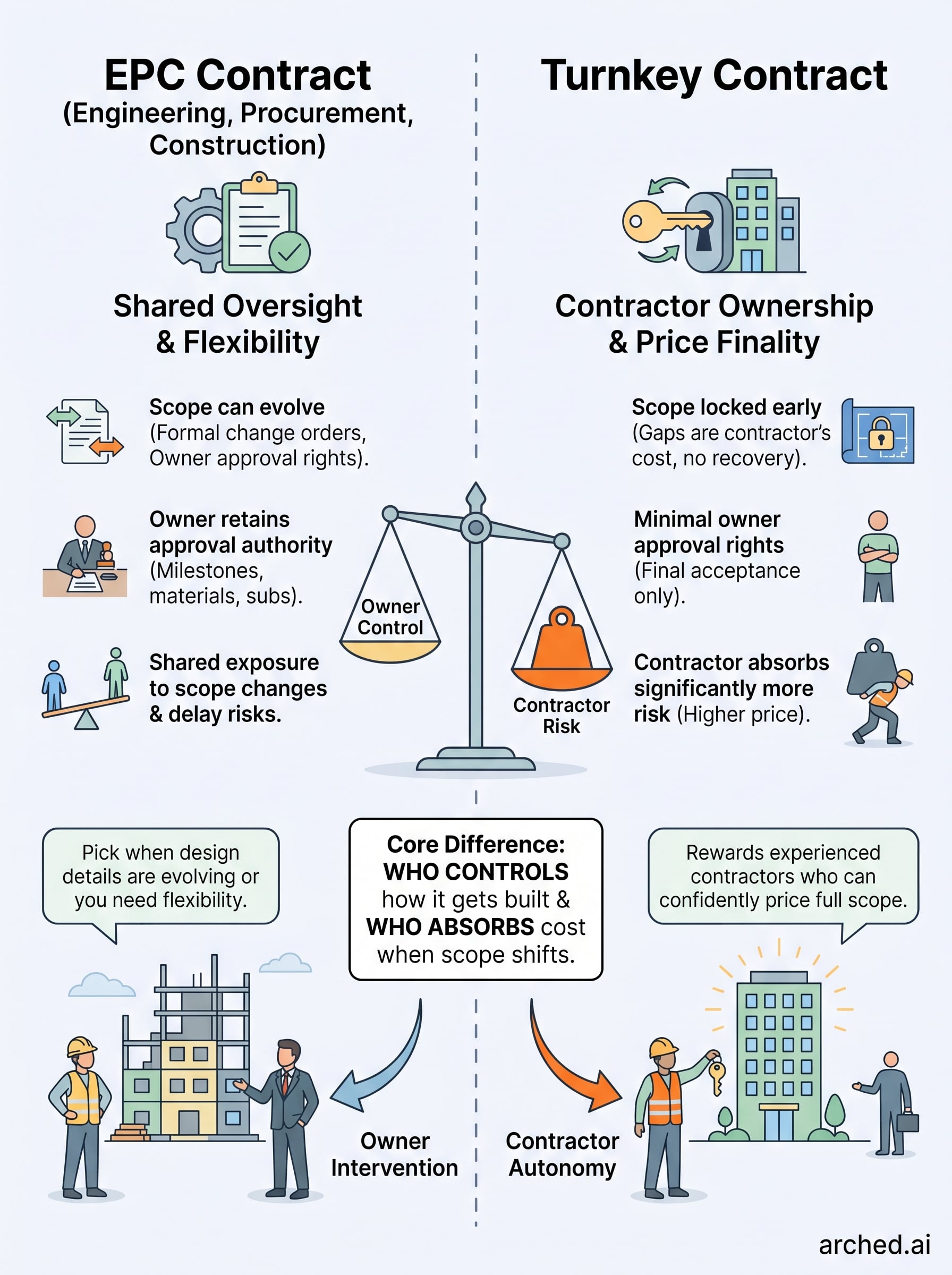
In an EPC (Engineering, Procurement, Construction) contract, the contractor takes full responsibility for all three phases but works within a framework that the owner still influences. The owner typically defines performance specifications and key milestones, then monitors progress against them. If the owner wants to approve specific materials or subcontractors, the EPC structure usually allows that. You have an active role in oversight, which means you carry some shared exposure to scope changes and delay risks.
- The owner sets performance benchmarks upfront
- The contractor handles execution across all three phases
- Owner approval rights are built into the contract structure
The turnkey model
A turnkey contract pushes ownership of the outcome further onto the contractor. The name comes from the idea that the owner simply "turns a key" to operate a fully finished facility. The contractor controls every decision from design through commissioning, and the owner steps back from day-to-day oversight almost entirely.
In a turnkey contract vs EPC contract comparison, the core difference is not what gets built but who controls how it gets built and who absorbs the cost when the scope shifts.
When you see a turnkey clause, the contractor is absorbing significantly more risk, and that higher exposure typically reflects in the contract price. Unlike EPC, owner approval rights are minimal, and changes requested mid-project usually trigger formal variation orders with direct cost implications.
What changes between EPC and turnkey contracts
The turnkey contract vs EPC contract distinction comes down to three variables: scope finality, owner intervention rights, and risk transfer depth. Each shifts depending on which model governs your project, and each one directly affects how you structure your bid price.

Scope finality
In an EPC contract, the project scope can evolve through formal change orders, and the owner retains the right to modify requirements within defined limits. A turnkey contract locks the scope much earlier. Once signed, the contractor owns the outcome completely, meaning any scope gaps become your cost, not the owner's. Price that exposure in from day one.
If you underestimate scope in a turnkey contract, you absorb the difference with no recovery path through the owner.
Owner intervention rights
Under EPC, the owner holds approval authority over key milestones, material selections, and subcontractor appointments. Turnkey contracts strip most of that back. The owner receives progress reports but rarely intervenes in execution decisions. This means your project management autonomy is higher, but your liability for delivery failures is harder to share or dispute.
Key approval rights under each model:
- EPC: material approvals, subcontractor sign-off, milestone acceptance
- Turnkey: final commissioning acceptance only
Why this difference matters in Indian tenders
Indian government tenders rarely spell out the contractual model in plain language at the top of the notice. You often need to read deep into the qualification criteria and payment schedule before you understand whether the project runs as EPC or turnkey. Getting that wrong at the bid stage can cost you significantly.

Contract labeling on government portals
On platforms like CPPP and state e-procurement portals, project titles frequently use EPC and turnkey interchangeably, even when the underlying clauses follow one model strictly. You need to check the general conditions of contract (GCC) and the scope of work section together, not just the title.
In Indian public procurement, the contract label in the title and the actual risk allocation inside the document often do not match.
Payment and performance guarantee structures
The two models also trigger different payment milestone structures in Indian tenders. EPC contracts typically link payments to verified stage completions, while turnkey contracts front-load contractor risk and tie most payment to final acceptance. Your performance bank guarantee value and retention percentage will reflect which model governs, so reading the financial conditions carefully before you price your bid is not optional.
How to choose the right contract model
Choosing between EPC and turnkey comes down to two primary factors: how much control you want to retain during execution, and how much risk your firm can price into a competitive bid. Neither model is better across the board. Each fits a different combination of project complexity, owner capacity, and contractor experience. Before you commit to a model, map your firm's credentials and bandwidth against what the contract actually requires.
When EPC works in your favor
EPC suits projects where design details are still evolving at the time of bidding, or where the owner has in-house technical capacity to review and approve decisions along the way. If your firm is new to a sector, the shared oversight structure of EPC gives you a clearer dispute pathway when scope changes arise mid-project.
In a turnkey contract vs EPC contract decision, pick EPC when you need flexibility to renegotiate scope mid-execution.
When turnkey fits your position
Turnkey contracts reward experienced contractors who can confidently price a full scope from day one. If your firm has completed similar projects and carries strong technical credentials, the higher risk transfer in a turnkey model works in your favor since you control every execution decision and face fewer owner-driven delays.
Clauses to watch before you sign
Before you commit to any contract, read the risk allocation and variation clauses in detail. Whether you're reviewing a turnkey contract vs EPC contract structure, these two sections determine how much financial exposure you actually carry, and they rarely get enough attention during the bid stage.
The clause language controls your liability, not the contract title on the portal notice.
Risk allocation clause
This clause defines who absorbs cost when unforeseen conditions, design errors, or procurement delays occur. In a turnkey contract, the contractor carries most of that weight. In an EPC structure, the owner retains more shared exposure. Check whether the clause includes a force majeure carve-out and whether delay penalties are capped or open-ended.
Variation and change order terms
Variation clauses dictate your ability to recover costs when the scope shifts mid-project. In EPC contracts, formal change orders are a standard mechanism you can invoke. Turnkey contracts often restrict variations heavily, which means any undocumented scope gap becomes your cost with no recovery path. Confirm the notice period required to raise a variation claim, because missing that window typically voids your right to additional payment entirely.
Key takeaways
The turnkey contract vs EPC contract distinction comes down to where control sits and how much risk you absorb. In an EPC contract, the owner retains approval rights throughout execution, which gives you a clearer path to recovering costs when scope changes. A turnkey contract transfers nearly all decisions and financial exposure to you as the contractor, which rewards experience but punishes gaps in your initial pricing.
Both models appear regularly in Indian government tenders, and the contract title rarely tells you which model applies. You need to read the GCC, the payment schedule, and the variation clauses together before you can accurately assess your exposure and price your bid.
Picking the right model starts with knowing your firm's credentials and risk capacity before you open the tender document. Whichever model applies, the price has to reflect it. If your team needs a detailed estimate for a turnkey or EPC tender, Arched can prepare it: send us the drawings and specifications and we deliver a priced BOQ reviewed by an engineer. See how our estimating service works
Have a package your team can’t get to? Send it to us. Our engineers check and sign off everything we deliver.