What Is a Turnkey Contract in Construction? Pros & Cons
Understand what is a turnkey contract in construction, its pros and cons, and how this model shapes risk and responsibility in Indian infrastructure tenders.
When a government agency issues a tender that bundles design, procurement, and construction under a single contract, they're typically referring to a turnkey arrangement. Understanding what is a turnkey contract in construction matters because these projects represent some of the highest-value opportunities on portals like GeM, CPPP, and state e-procurement sites, and they come with a distinct risk-reward profile that every bidder needs to evaluate before committing.
In a turnkey contract, the contractor takes full responsibility for delivering a completed, functional project. The client essentially "turns the key" and walks into a finished facility. This sounds straightforward, but the structure carries specific implications for pricing, liability, and qualification criteria that differ sharply from traditional item-rate or percentage-rate contracts. For BD managers and bid teams scanning hundreds of tenders, recognizing these differences early can be the gap between a strategic bid and a costly misread.
This article breaks down how turnkey contracts work, where they overlap with EPC agreements, and what their real advantages and disadvantages look like in practice. At Arched, our platform parses tender documents to flag exactly these contract structures, so our users know what they're walking into before they invest hours in bid preparation. Whether you're evaluating a turnkey opportunity right now or building your knowledge base for future bids, this guide covers what you need to know.
Why turnkey contracts matter in Indian construction
India's infrastructure push over the last decade has fundamentally shifted how the government procures large projects. Ministries and state agencies no longer want to manage separate architects, contractors, and equipment suppliers through fragmented contracts. Instead, they issue single-point responsibility tenders that hand the full scope to one contractor. If you work in BD or bid management, the volume of turnkey-structured tenders appearing on portals like CPWD, NHAI, and state PWDs has grown substantially, which means you encounter them regularly whether you've studied them formally or not.
The sectors driving turnkey adoption
Turnkey procurement shows up heavily in sectors where technical complexity and interdependency between design and construction make fragmented contracting impractical. Power plants, water treatment facilities, highway packages with toll infrastructure, metro rail stations, and affordable housing schemes under PMAY are frequent examples. In each case, the client agency wants a completed, tested, and commissioned asset, not a partially built structure that requires them to coordinate the remaining work themselves.
Government bodies also favor turnkey structures because they transfer schedule and cost risk to the contractor. When you understand what is a turnkey contract in construction, you recognize that this risk transfer is precisely why these tenders attract a narrower field of qualified bidders, which can work in your favor if your firm's credentials are well-positioned and your pricing is accurate.
The fewer bidders who qualify for a turnkey tender, the higher your probability of winning it, provided your bid reflects the full scope of risk you're absorbing.
What this means for your bid pipeline
For BD teams, turnkey tenders represent higher average contract values compared to item-rate packages in the same sector. A road widening project issued as an item-rate contract might sit at 15-20 crore, while a turnkey highway package covering design, construction, and commissioning can exceed 200 crore. That spread makes turnkey opportunities disproportionately important to your annual pipeline targets.
Qualification criteria on turnkey tenders are also stricter than on standard packages. You typically need to demonstrate prior experience across the complete scope, not just one phase of it. Recognizing these tenders early, parsing their eligibility requirements quickly, and deciding whether your firm qualifies outright or needs a JV partner are decisions that directly affect your bid conversion rate over the course of a year.
What a turnkey contract covers
When you ask what is a turnkey contract in construction, the answer starts with scope. A turnkey contract covers three interconnected phases: design, procurement, and construction, all bundled under a single contractual obligation. The contractor owns every decision across these phases and delivers a fully operational asset at handover, not a partially finished structure that requires additional fit-out or separate commissioning work by the client.
The three core phases
Each phase carries its own financial and technical weight. Design means your team or a designated sub-consultant prepares all drawings, structural calculations, and specifications to satisfy the client's requirements document, which replaces a traditional employer-issued design brief. Procurement covers sourcing all materials, equipment, and specialist systems, including long-lead items like transformers, pumps, or prefabricated structural components. Construction then converts those inputs into a finished, testable facility.
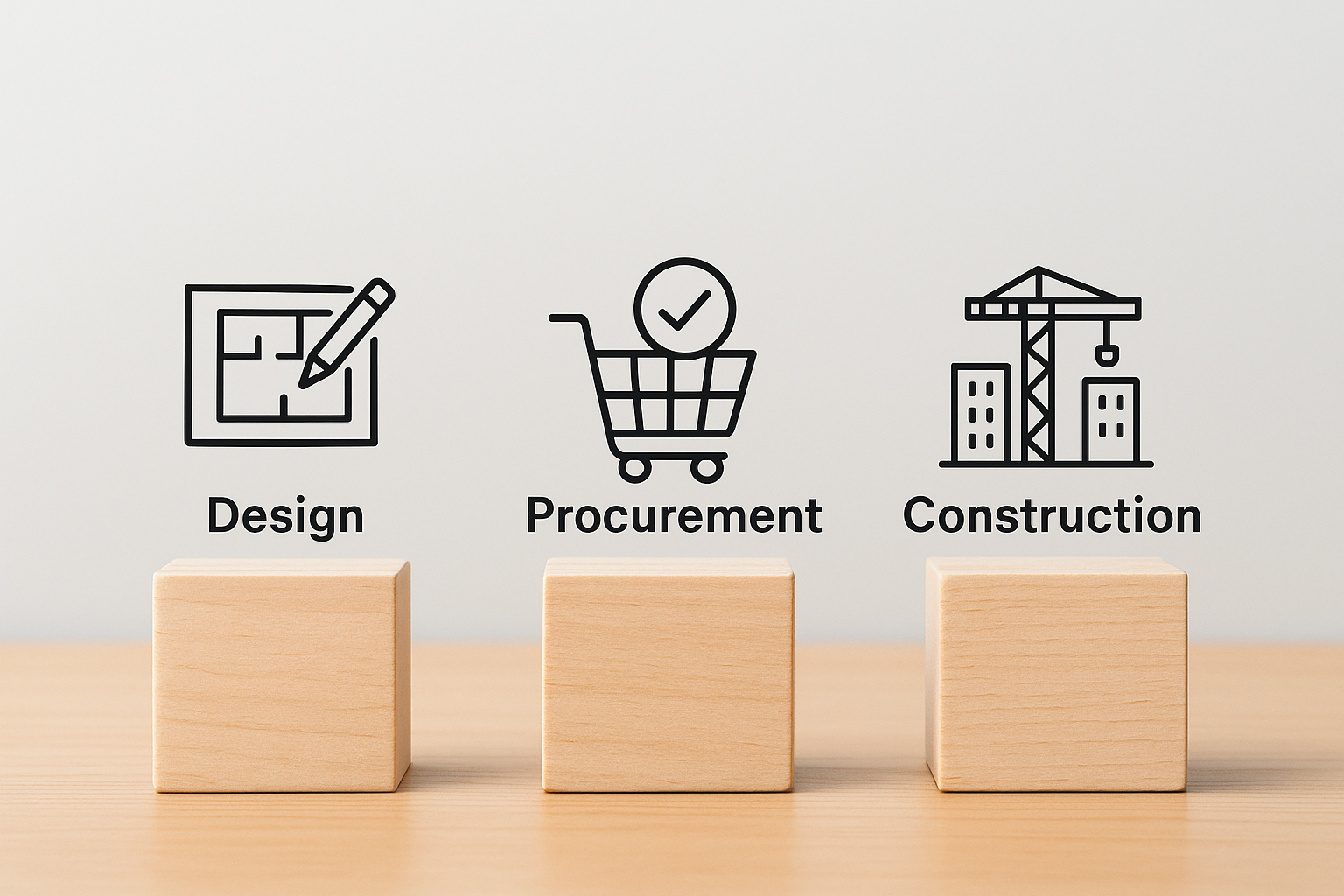
These phases rarely run in strict sequence. Overlapping design and construction is standard practice in most turnkey projects, which compresses the overall schedule but means your procurement decisions happen before the design is fully locked. That overlap creates pricing risk that your bid team needs to quantify and account for explicitly, not absorb as a contingency after award.
Scope boundaries and what stays with the client
Not everything transfers to the contractor. Land acquisition, statutory approvals, and utility connections typically remain the client's responsibility, even in a full turnkey arrangement. Your contract documents will define the precise scope boundary, and reading the conditions of contract thoroughly before you finalize your pricing strategy is non-negotiable.
If your contract documents are ambiguous about where client responsibility ends, raise formal clarifications before bid submission, not after award.
How a turnkey project runs from start to handover
Understanding what is a turnkey contract in construction goes beyond scope. The project lifecycle follows a distinct sequence that shapes how your team allocates resources and manages cash flow. The process starts at contract award and ends only when the client formally accepts a tested, operational facility, not when the last brick is laid.
From award to design freeze
Your first priority after contract award is submitting design documentation for client approval. Most turnkey contracts specify a design submission schedule with defined review periods, and delays at this stage cascade directly into procurement and construction.
Finalizing structural, architectural, and MEP designs in parallel, not sequentially, keeps your program on track. Design freeze is the milestone that unlocks full procurement and site mobilization, so treat it as a hard deadline and build the client's review cycles into your master program before you break ground.
Map the client's design approval window onto your critical path from day one, because a delayed review is a delayed procurement, which is a delayed handover.
Construction through to commissioning
Once design approval is in place, procurement of long-lead materials and specialist equipment runs alongside early construction activities. Your site team begins enabling works, earthworks, and foundations while the supply chain delivers components. This deliberate overlap compresses the overall schedule without shortening any individual phase.
Commissioning is the final and most underestimated stage. Testing, balancing, and certifying each system before handover is a contractual obligation, not an administrative formality. Your team must document performance against the client's output specification and clear all deficiencies. Only after the client issues the taking-over certificate does your liability transition from active contractor to the defects period.
Turnkey vs EPC vs design-bid-build
When you research what is a turnkey contract in construction, you will encounter the term EPC frequently in the same documents. These two structures overlap significantly, but they are not identical. Understanding where they differ, and how both compare to the traditional design-bid-build approach, helps you read procurement notices accurately and determine which contract type you are actually dealing with before you commit any bid preparation time.
Turnkey and EPC: where they overlap and where they differ
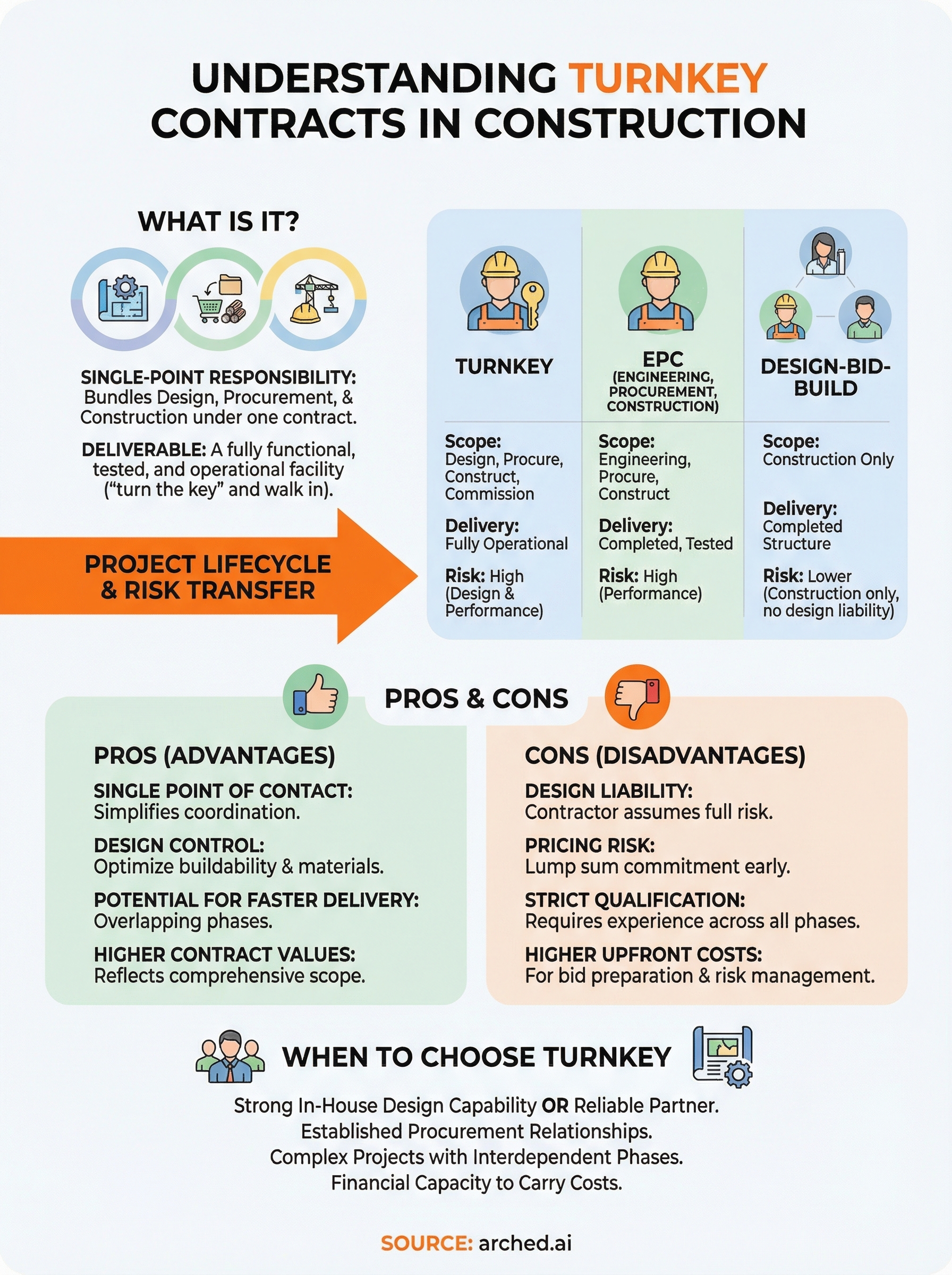
EPC stands for Engineering, Procurement, and Construction, which covers the same three core phases as a turnkey arrangement. The practical distinction lies in what the contractor delivers at handover. A pure EPC contract typically ends when construction finishes and basic commissioning tests pass. A turnkey contract goes further: the contractor must hand over a facility that is fully operational and ready for immediate use, sometimes including operating manuals, staff familiarization, and consumables for the initial operating period. EPC describes the work phases; turnkey describes the delivery condition.
If the tender specifies "ready for operations" or "commissioned and tested to client's performance standards," you are dealing with a turnkey obligation, not a bare EPC scope.
Design-bid-build: a fundamentally different risk split
In a design-bid-build contract, the client appoints a designer separately, finalizes drawings, and then invites contractors to price against a complete document set. Your exposure as a contractor covers construction risk only, not design liability, which reduces your financial exposure but removes your ability to influence specifications or optimize buildability.
When government agencies shift from design-bid-build to turnkey, they explicitly transfer design and performance risk onto the contractor. That shift is precisely why turnkey tenders carry stricter qualification thresholds and typically command higher margin expectations from experienced bidders.
Pros, cons, and when to choose turnkey
Understanding what is a turnkey contract in construction gives you the foundation, but the real decision is whether it fits your firm's current capabilities and risk appetite. Single-point responsibility simplifies the client relationship and removes coordination friction between separate designers and contractors, which is a genuine operational advantage for both sides.
Advantages that make turnkey attractive
Turnkey contracts give your firm full control over design decisions, which means you can optimize buildability, select materials you know, and compress the schedule by overlapping phases deliberately. Clients also tend to offer higher contract values on turnkey packages precisely because they are paying for certainty, and that premium can improve your margin if your cost estimates are accurate.
- Your team controls procurement timing and supplier selection
- Design optimization can reduce material costs directly
- Single contract structure simplifies progress claims and dispute resolution
The trade-offs you need to weigh
Design liability sits entirely on your firm in a turnkey arrangement. If the completed facility underperforms against the client's output specification, you bear the cost of rectification regardless of where the design error originated. Pricing risk is equally significant: you commit to a lump sum before design is fully resolved, which means scope gaps discovered during construction come out of your contingency.
Price every turnkey bid on your worst-case scope interpretation, not your best-case assumption, because ambiguity in a lump-sum contract always resolves against the contractor.
When turnkey is the right fit
Choose turnkey when your firm has in-house design capability or a reliable design partner, strong procurement relationships for specialist equipment, and the financial capacity to carry costs during a long payment cycle. If any of those three elements are weak, a joint venture or a conventional item-rate contract is the lower-risk path.
Final takeaways
Knowing what is a turnkey contract in construction changes how you read procurement notices and evaluate bid opportunities. The structure bundles design, procurement, and construction under a single contractual obligation, which transfers full performance risk to your firm in exchange for greater control over how you deliver the project. That trade-off works in your favor when your team has the design capability, procurement relationships, and financial resilience to carry it through. When those foundations are weak, the same structure becomes a liability rather than an advantage.
Every turnkey tender you encounter deserves careful document analysis before your bid team commits time to pricing. Scope boundaries, qualification criteria, and performance obligations are all embedded in documents that can run hundreds of pages. Arched parses those documents automatically, flags contract structure, and matches opportunities to your firm's actual credentials. If you want to stop spending hours on tenders that don't fit, explore what Arched can do for your bid pipeline.