Karnataka PWD Schedule of Rates (SR) 2024-25: Volumes & Codes
The Karnataka PWD Schedule of Rates is the pricing backbone for every public works contract issued by the state's Public Works Department. If you're bidding on road, bridge, or building projects in Karnataka, this document dictates how your estimates are built, how your bids are evaluated, and ultimately whether your numbers hold up under scrutiny. Getting it wrong, or working off an outdated edition, can mean underpriced bids that bleed money or overpriced ones that never get shortlisted.
Yet finding the right volume for the right financial year isn't always straightforward. The SR is split across multiple volumes covering buildings, roads, bridges, irrigation, and more, each updated on its own cycle. Many contractors still waste hours hunting across government portals for the correct PDF, only to discover they've downloaded a superseded version. For firms that bid across multiple Karnataka divisions, this problem multiplies fast, eating into time that should go toward actual bid preparation and strategy.
This article breaks down every volume of the Karnataka PWD Schedule of Rates, covers the editions currently in effect (including 2024-25), explains how rates are structured, and shows you where to access them. We'll also look at how the SR connects to tender eligibility and pricing decisions, something Arched handles every day when we price BOQs against the applicable schedule.
What the Karnataka PWD schedule of rates covers
The Karnataka PWD Schedule of Rates is not a single document. It is a collection of volumes, each covering a distinct category of public works, and each published and revised on its own cycle. When contractors, consultants, or BD managers refer to "the SR," they're usually pointing to the volume most relevant to their active bid, such as buildings, roads, or bridges. Understanding how these volumes are organized is the first step to making sure your estimates are based on the correct and current rates.
The Main Volumes
The PWD divides its schedule across volumes that map directly to the type of civil work involved. Each volume lists individual line items, material specifications, labor rates, and unit costs that apply within Karnataka's jurisdiction. Here are the primary volumes you'll encounter:
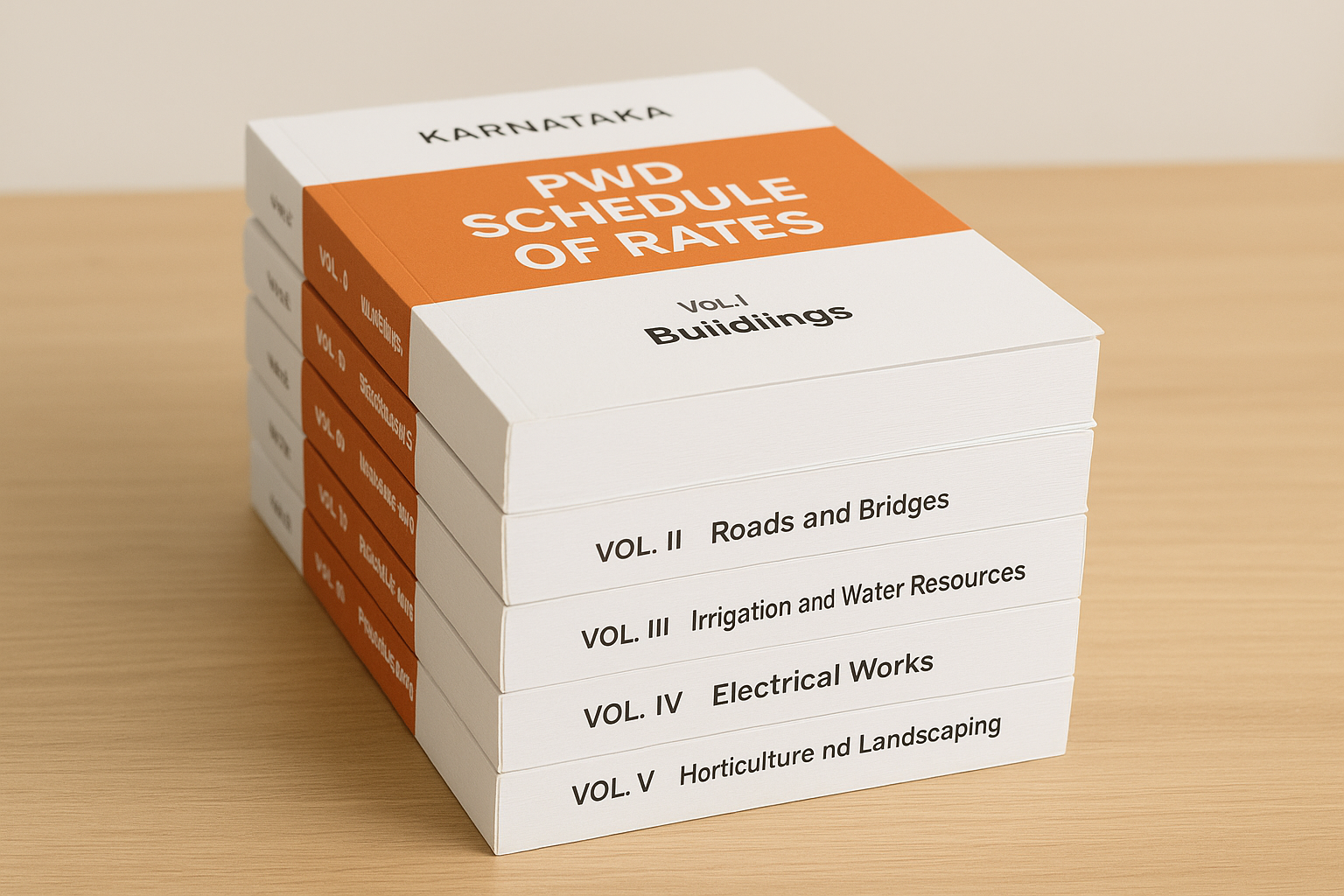
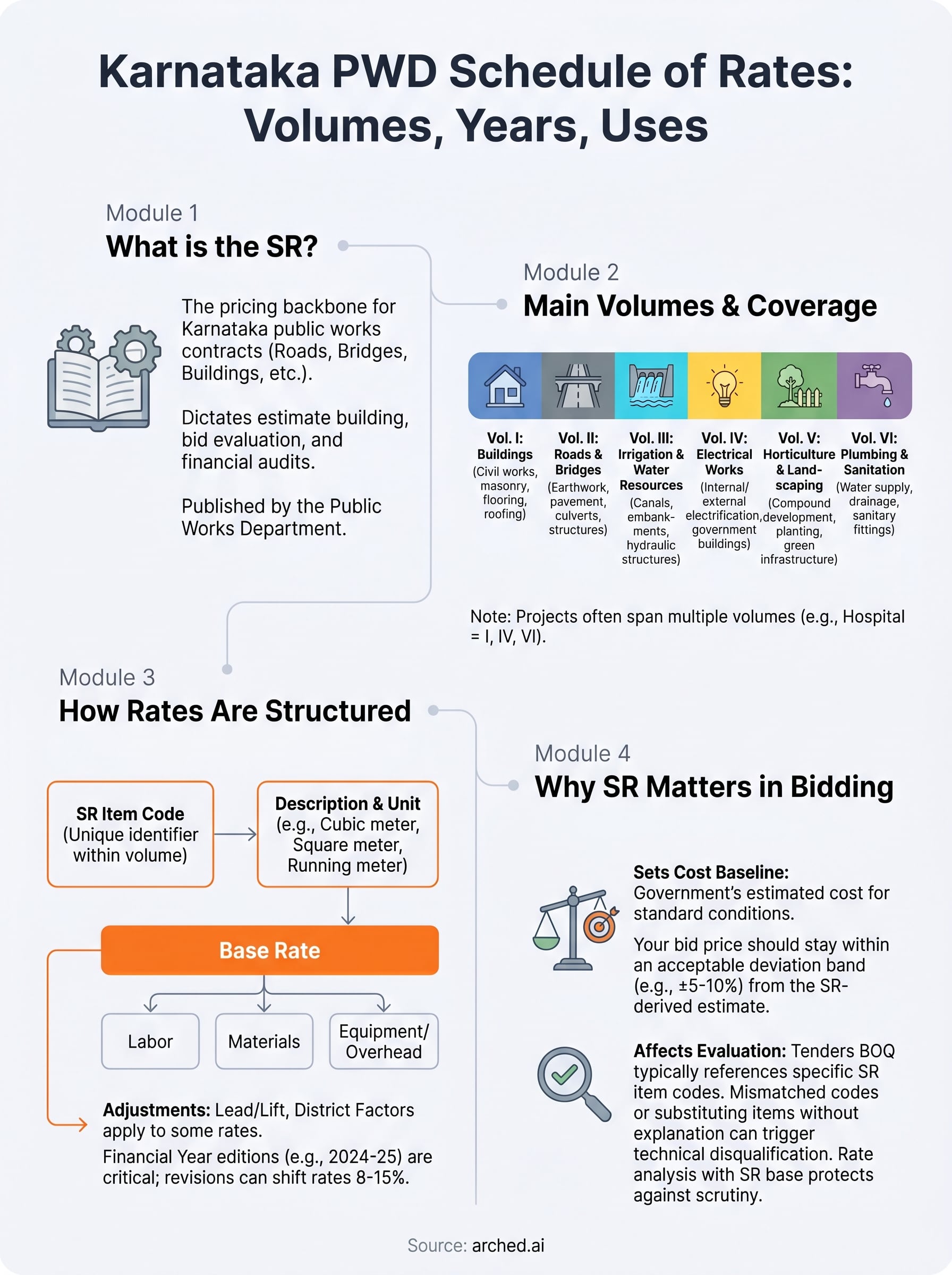
- Vol. I - Buildings: Covers civil works for government buildings, including masonry, flooring, plastering, doors, windows, roofing, and finishes.
- Vol. II - Roads and Bridges: Covers earthwork, pavement layers, culverts, bridge substructure and superstructure, and road furniture.
- Vol. III - Irrigation and Water Resources: Applies to canal works, embankments, lining, and hydraulic structures.
- Vol. IV - Electrical Works: Covers internal and external electrification for government buildings and infrastructure.
- Vol. V - Horticulture and Landscaping: Used for projects involving compound development, tree planting, and green infrastructure.
- Vol. VI - Plumbing and Sanitation: Applies to water supply, drainage systems, and sanitary fittings.
Contractors frequently bid on projects that span more than one volume, for example, a government hospital may require Buildings (Vol. I), Electrical (Vol. IV), and Plumbing (Vol. VI) rates simultaneously.
How Rates Are Structured Within Each Volume
Inside each volume, items are organized by work type and given a unique SR code. Each item specifies the unit of measurement (square meter, cubic meter, running meter, etc.), a base rate, and sometimes a note on the material specification that applies. The rate reflects the combined cost of labor, materials, equipment, and contractor overhead as estimated by the PWD for a given financial year.
Material rates and labor rates are often listed separately in supporting schedules, allowing estimators to adjust for local market variation through a lead-and-lift calculation or a district-specific factor. Your estimating team needs to understand which base rates are fixed and which allow adjustment, because applying the wrong interpretation can push your bid outside the acceptable deviation range.
Financial Year Editions and Updates
The Karnataka PWD revises its schedule periodically, typically aligned with the financial year (April to March). The 2024-25 edition is the most current reference for tenders floated in that cycle, but many departments still reference older SR editions as a baseline with a price escalation index applied on top. Checking the tender document for the specific SR year cited is non-negotiable before you build any estimate.
Revisions between years can shift individual item rates by 8-15%, sometimes more for material-intensive items like steel and cement. Working off a 2022-23 SR when the tender specifies 2024-25 rates creates a pricing gap that directly affects your bid's competitiveness and, if you win, your project margin.
Why the schedule of rates matters in bidding
When a Karnataka government agency issues a tender, the bid evaluation process is built around the same schedule of rates your estimate should be using. The tender's estimated project cost, the acceptable deviation band, and the quantity-based comparisons all trace back to a single source: the PWD's published SR for that financial year. If your rates don't match that foundation, your bid either looks inflated or raises red flags about your cost understanding.
SR rates set your cost baseline
The Karnataka PWD schedule of rates gives you the government's own view of what each work item should cost under standard conditions. Your bid price for any item can deviate from this baseline, but going too far in either direction creates problems. Significantly underbidding signals to the evaluation committee that you have miscalculated quantities or plan to cut corners on specifications. Overbidding against a well-established SR item signals poor cost control and typically pushes you out of the competitive range.
Knowing the SR rate for every major item in your BOQ before you finalize your bid is the single most reliable way to stay within the evaluation window.
Most departments set a justified deviation range, often plus or minus 5 to 10 percent from the SR-derived estimate. Preparing your breakdown with the correct SR items, their codes, and unit rates shows the evaluation committee that your pricing is methodical rather than guessed.
How SR alignment affects bid evaluation
Tender documents in Karnataka typically include a detailed BOQ that references specific SR item codes. When your bid submission maps line items back to those same codes, the comparison becomes fast and transparent for the evaluation team. Mismatched codes or substituted items without explanation slow down evaluation and can trigger technical disqualification.
Your pricing notes and rate analysis sheets should show how you arrived at each figure, starting from the SR base rate, then adjusting for lead, lift, site conditions, or sub-contractor costs. Evaluation officers are trained to check these derivations, and a clean paper trail built from the correct SR edition protects your bid from objections during scrutiny.
How to find the right SR for your work
Finding the correct volume and edition of the Karnataka PWD schedule of rates starts with knowing where the department officially publishes these documents. The primary source is the Karnataka PWD's official website (pwd.karnataka.gov.in), where schedule of rates PDFs are uploaded under the "Schedule of Rates" or "Documents" section. Before you download anything, confirm the financial year shown on the document matches the year cited in your tender notice.
Always verify the SR year on the cover page of the PDF before using any rates in your estimate.
Where the official PDFs are published
The Karnataka PWD website organizes SR documents by volume and financial year. You can access current and past editions directly from the department's publications page. When you download a volume, check the revision date and the issuing circular number on the cover page, since some volumes carry mid-year amendments that supersede earlier rates for specific items.
State-level portals like the Karnataka Public Procurement Portal (KPPP) sometimes attach the applicable SR as a reference document directly within the tender package. If your tender includes this attachment, treat it as your primary working reference, since it confirms exactly which edition the evaluation committee will use when reviewing your BOQ.
Matching the SR edition to your tender
Every tender document specifies the SR edition and financial year that applies to its BOQ. You'll typically find this reference in the "Conditions of Contract" section or in a preamble note placed before the BOQ tables. Once you locate that reference, pull the matching SR volume before you touch any quantity or rate calculation. Starting your estimate before confirming this detail is one of the most common and costly preparation errors bid teams make.

If a tender references an older SR year but was floated during a newer financial year, the department has usually applied a price escalation factor to bridge the difference. Your bid preparation notes should document this factor clearly, showing the base SR rate, the escalation applied, and the final unit rate you've used. Evaluation officers routinely check these derivations, and a well-structured rate analysis sheet built from the right edition significantly reduces the risk of your bid being queried during scrutiny.
How to read SR items and build estimates
Each item in the Karnataka PWD schedule of rates follows a consistent structure that, once you understand it, speeds up your entire estimate-building process. Every line carries an SR item code, a description, a unit of measurement, and a base rate. Your job as a bidder is to map your scope of work against these items accurately before you touch any quantity calculation.
Understanding SR Item Codes and Units
The SR item code is the reference number that ties your BOQ line item to the department's published rate. Codes are organized hierarchically within each volume, so road earthwork items cluster together under one prefix and pavement items under another. When you read a tender BOQ, the item description and code must match the SR edition specified in the tender conditions. If they don't align, you need to raise a pre-bid query rather than guess at the correct substitution.
Mismatching SR codes between your bid and the tender BOQ is one of the fastest ways to trigger a technical objection during evaluation.
Each item also specifies a unit of measurement: cubic meters for earthwork, square meters for flooring, running meters for kerb stones, and so on. Before you apply any rate, confirm your quantity takeoff uses the exact same unit. Converting between units mid-estimate introduces compounding errors that are hard to catch before submission.
Building Your Rate Analysis Sheet
A rate analysis sheet shows how you derived each unit rate starting from the SR base, then adding adjustments for lead, lift, site conditions, or material sourcing costs. Evaluation officers in Karnataka departments are trained to review these derivations, so building a clean, item-by-item breakdown protects your bid during scrutiny. Work through each major BOQ item systematically: pull the base SR rate, document any permissible adjustments, and arrive at your final rate with a clear arithmetic trail.
Your rate analysis sheet should also flag items where your actual cost exceeds the SR base rate. These are the items where your bid is most vulnerable to a pricing objection, and having a documented justification ready, such as higher transport costs for remote site access, significantly reduces back-and-forth with the evaluation committee.
Common mistakes and how to avoid them
Even experienced bid teams make avoidable errors when working with the Karnataka PWD schedule of rates, and most of those errors trace back to a small set of repeatable habits. Catching these patterns early saves your team from last-minute corrections or, worse, a submitted bid that gets queried or disqualified.
Using an Outdated SR Edition
The single most common mistake is pulling a previous year's SR PDF without checking whether it matches the edition cited in the tender. Rates shift between financial years, sometimes significantly for material-heavy items, and your estimate built on 2022-23 rates will produce a mispriced BOQ when the tender specifies 2024-25 figures. Always open the tender's conditions section first, confirm the SR year referenced, and only then download the matching volume from the Karnataka PWD portal.
If the tender references an older SR year with an escalation factor applied, document the escalation explicitly in your rate analysis sheet rather than silently adjusting figures.
Applying Incorrect Units of Measurement
Unit mismatches are quieter than pricing errors but just as damaging. An SR item priced per cubic meter applied to a quantity taken off in square meters shifts your total cost by an order of magnitude. Before you enter any rate into your estimate, verify the unit in both the SR item description and your takeoff sheet. If they differ, recalculate your quantities first. This check takes two minutes per item and prevents the type of pricing anomaly that gets flagged during technical evaluation.
Skipping the Rate Analysis Documentation
Many firms submit a BOQ with final rates and no derivation trail showing how those rates were built from the SR base. Evaluation officers in Karnataka departments are trained to ask for rate analysis sheets when bid prices deviate from expected ranges. Firms that can't produce a clean, item-by-item derivation often face delayed approvals or formal queries that slow down the award process. Build your rate analysis as you go, not after submission, and tie every final figure back to the applicable SR item code and any adjustments you applied.
Next steps
The Karnataka PWD schedule of rates is not a document you check once and set aside. Every new tender you pursue requires you to confirm the correct volume, verify the financial year cited in the bid conditions, and build your rate analysis from that specific edition. Following the steps in this article, from matching the SR year to documenting your rate derivations, puts your estimate on solid ground before you submit a single figure.
Karnataka's split-by-work-type structure is one of three patterns in use across India. Uttarakhand distributes rates district by district, and Maharashtra publishes one statewide book that has not been revised since 2022-23. For every other state, see the Schedule of Rates by state directory, and the searchable SOR tables where rate items are published with Excel and CSV downloads.
Your team's bigger challenge is speed and volume. Mapping each tender's BOQ line items to the right schedule item and rate, across every bid cycle, takes estimator time that compounds. If you want that done for you, Arched can price the BOQ against the Karnataka SR (or your preferred rate basis): send the drawings and we deliver a reviewed estimate with rate build-ups. See how our estimating service works.
Have a package your team can’t get to? Send it to us. Our engineers check and sign off everything we deliver.