CPWD Cost Index: Latest Circulars, Tables, And Use In India
Master the cpwd cost index to calculate accurate project rates. Access latest circulars, adjust DSR values, and avoid errors that lead to bid rejection.
Every government construction estimate in India references the CPWD cost index at some point in the calculation chain. Whether you're preparing a plinth area estimate for a new building or adjusting project costs for regional price differences, this index is the baseline that CPWD and dozens of other departments rely on to keep figures current and defensible.
The index gets updated through official circulars, and each revision directly affects how construction costs are calculated across states. Missing an update, or misreading the applicable table, can mean submitting a bid built on outdated numbers, which either erodes your margins or prices you out entirely. For contractors and BD teams tracking tenders across platforms like GeM, CPPP, and state e-procurement portals, staying current on these figures is non-negotiable. That's partly why we built Arched to parse tender documents automatically, flagging cost references and qualification criteria so teams spend less time digging through PDFs.
This article breaks down what the CPWD cost index actually is, where to find the latest circulars and historical data tables, and how to apply the index correctly when estimating construction costs for different regions across India.
Why CPWD cost index matters in India
The CPWD cost index is not a background detail you can skip when preparing construction estimates. It directly controls the conversion of base schedule rates into current, location-adjusted figures. If you apply an outdated index, your estimates drift from actual market conditions, which either cuts into your margins or flags your submission as non-compliant during technical scrutiny.
It anchors every government construction estimate
CPWD publishes Plinth Area Rates (PAR) and updates them through circulars that incorporate the latest cost index values. State PWDs, municipal bodies, and central agencies all reference these rates when preparing preliminary project estimates, detailed project reports, and budget allocations. The index ties all of these figures to a consistent national baseline, which makes it straightforward for auditors and approving authorities to verify your numbers without ambiguity.
Without an accurate cost index figure, even a well-prepared estimate can be rejected at the approval stage or result in a cost overrun that falls entirely on the contractor.
Regional variation makes it essential
India's construction costs differ significantly across states due to labor rates, material availability, and transport constraints. The cost index accounts for this by providing location factors that adjust base CPWD rates for specific zones. If you're bidding on a project in a hilly or remote region, the applicable index multiplier will run higher than in a metro area, and applying the wrong figure can make your bid financially unviable before work even starts. Some states skip the index entirely and publish rates per district instead — Uttarakhand's district-wise Schedule of Rates is the clearest example, with thirteen separate rate sets and revisions concentrated in the hill districts. Odisha handles the same problem by revenue division, publishing three separate schedules of basic material rates for its Central, Northern and Southern RDC Divisions.
Different project categories, from residential buildings to industrial or institutional structures, carry separate index-linked rate tables. You need to match the right circular to the right project type, and the right zone to the right location, before any figure in your estimate carries real weight.
Where to find official CPWD cost index circulars
CPWD publishes its cost index circulars through its official government web portal, and that remains the only reliable source you should use. Third-party summaries and older PDFs circulating in contractor groups frequently carry outdated figures that no longer match the current approved rates.
The official CPWD website
The CPWD website (cpwd.gov.in) hosts the circulars under its technical documents and orders section. You can locate the latest Plinth Area Rates circular, along with the cost index tables for each zone, directly from the downloads or circulars section. Always confirm the circular number and date of issue before pulling any figure into your estimate.
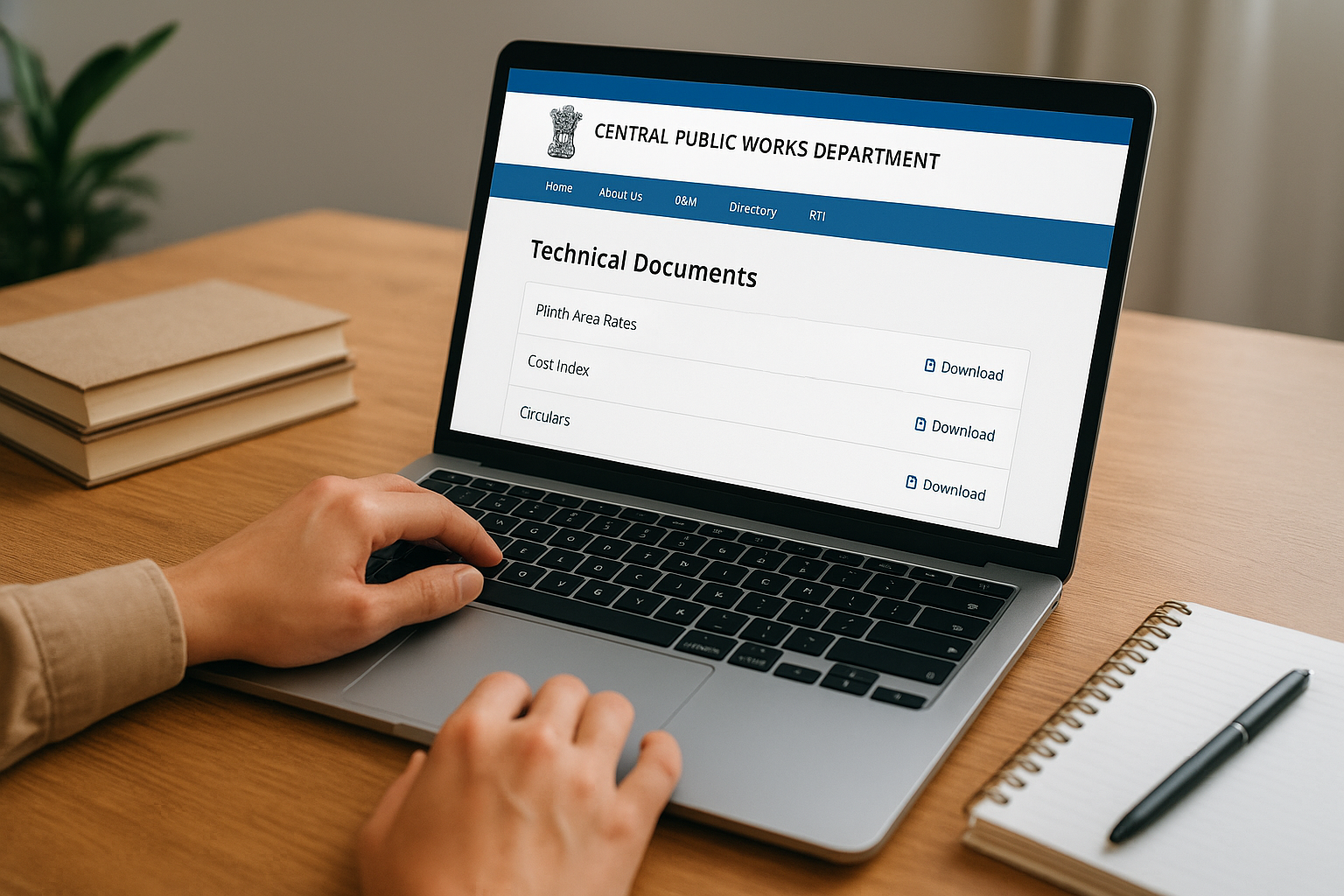
A circular referenced without its issue date is unverifiable during scrutiny, so always record both the number and the date.
What to download and keep on file
When you access the portal, download the full circular PDF rather than copying individual figures from a screen. Store each version with its circular number in your records because approving authorities often ask you to cite the exact circular reference during bid evaluation. Keeping a version history also helps you track how rates have shifted across quarters.
How CPWD cost index works with PAR, DPAR, and DSR
The CPWD cost index links three rate systems into one calculation framework. PAR, DPAR, and the DSR each handle different levels of estimation detail, but all three require the index to adjust base rates to current market conditions.
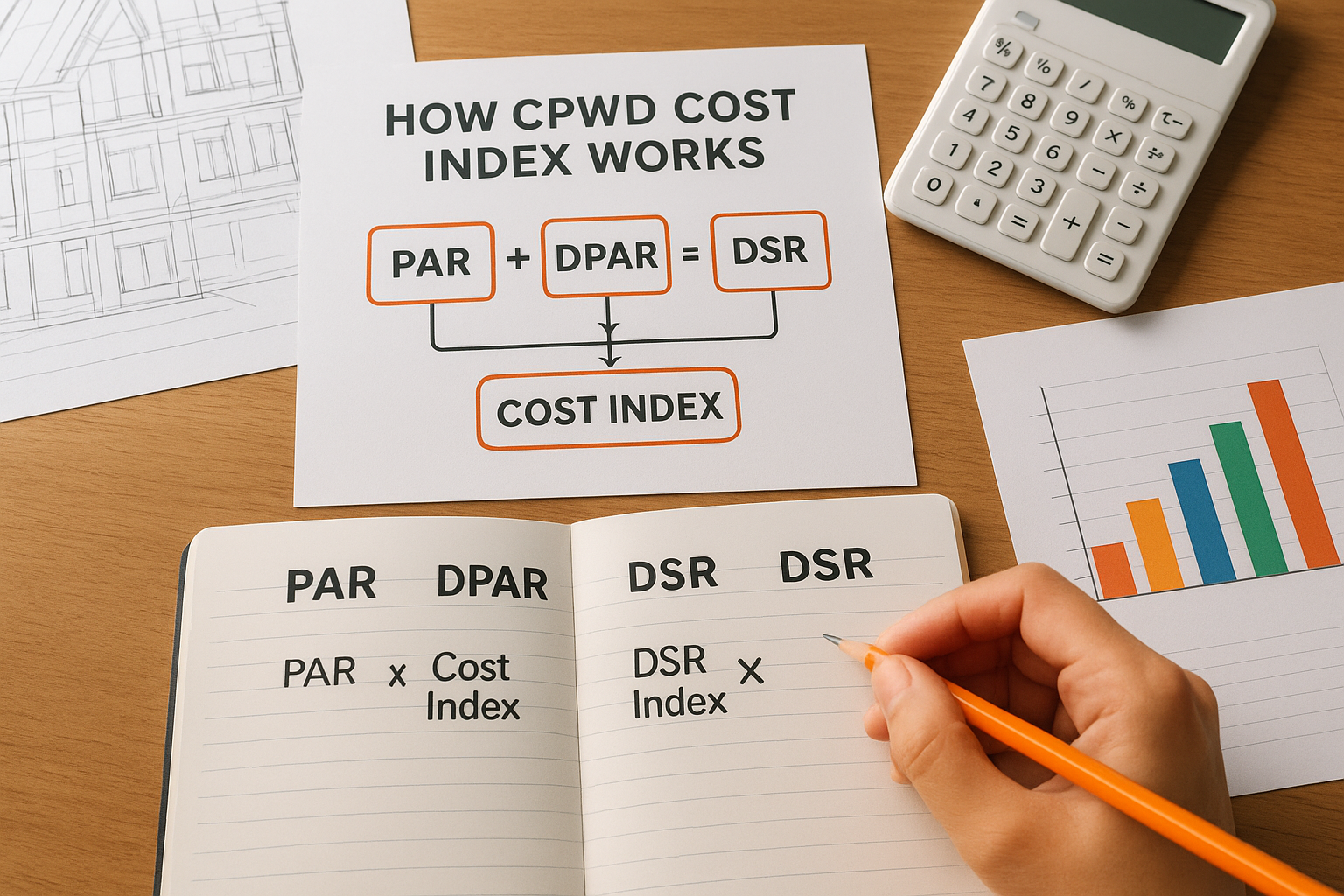
PAR and DPAR: Base rates the index adjusts
PAR gives you a per-square-meter estimate based on building type and finish level. DPAR breaks that figure down further by trade component. Both multiply their base rates by the applicable cost index to account for inflation and regional price differences since the original publication date.
- PAR: Broad building-category rate per square meter
- DPAR: Component-level breakdown of the same base figures
- DSR: Item-wise rates for individual construction activities in Delhi
Applying an outdated cost index to PAR or DPAR figures will produce estimates that approving authorities can reject on technical grounds.
How DSR feeds into the calculation
DSR provides item-level rates for individual construction activities. When you apply the cost index multiplier to DSR line items, you produce rates adjusted for location and current pricing conditions across different states.
Your detailed item-rate tenders depend on this process to make each line item defensible and auditable during technical scrutiny by the approving authority.
How to use CPWD cost index for estimates and billing
The CPWD cost index enters your calculation at the point where you convert a base scheduled rate into a current, location-adjusted figure. The standard approach multiplies your base rate by the applicable index value, then divides by the base year index to produce a current rate that holds up under scrutiny.
Preliminary estimates
For preliminary estimates, take the PAR value for your building type and multiply it by the cost index factor published in the latest circular for your zone. This gives you a defensible per-square-meter rate that approving authorities can verify directly against the published circular.
Always confirm the zone classification for your project location before applying any multiplier, since an incorrect zone increases your exposure during technical evaluation.
Billing and final measurements
During billing, your item-rate quantities from the BOQ need to align with DSR rates adjusted through the current index. When you submit a running account bill, the supporting rate analysis must cite the correct circular number, the applicable index value, and the base DSR edition.
Keeping a structured template that carries the circular reference and index figure for every rate line removes ambiguity and speeds up approvals at each stage of the billing cycle.
Common mistakes and quick verification checklist
Two errors account for the majority of rejected estimates in government construction projects: applying an outdated cost index circular and mismatching the zone classification to the project location. Both mistakes are avoidable if you build a short verification step into your process before submitting any estimate or bill.
Citing a superseded circular during technical evaluation signals poor due diligence to the approving authority and can delay the entire bid.
Mistakes that cause estimate rejections
The most common error is pulling a CPWD cost index figure from an older PDF without checking whether a newer circular has been issued. The second is applying a metro zone multiplier to a project in a remote or hilly classification, which consistently under-prices the estimate. Both errors become visible the moment an approving authority cross-checks your rate analysis against the current published circular.
Verification checklist before submission
Before you finalize any estimate or running bill, run through these checks:
- Circular number and issue date: confirm you have the latest version from cpwd.gov.in
- Zone classification: verify your project location matches the correct regional factor
- Base DSR edition: confirm the edition your item rates reference aligns with your circular
- Project category: match the correct building type to the applicable PAR or DPAR table
- Rate analysis trail: ensure every line item carries the circular reference and index value
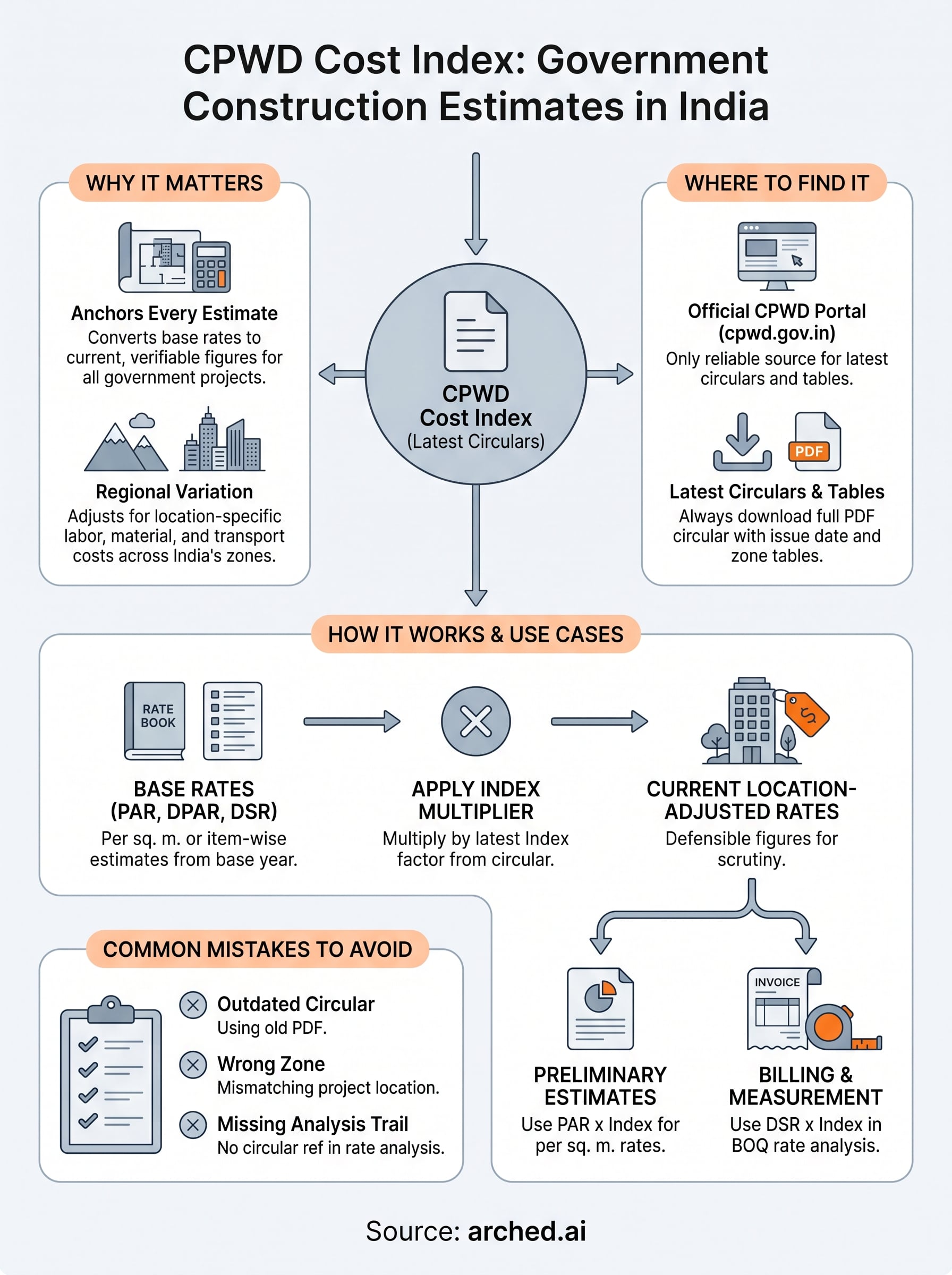
Next steps for accurate pricing
Accurate pricing on government construction projects comes down to consistent process, not occasional checks. Every estimate you submit should trace back to the latest cpwd cost index circular, the correct zone classification, and a rate analysis trail that an approving authority can verify in minutes. If any of those three elements is missing or outdated, your figures are exposed before evaluation even begins.
Start by bookmarking cpwd.gov.in and setting a calendar reminder to check for new circulars each quarter. Build your estimate templates to carry the circular number and index value on every rate line so verification becomes automatic rather than a last-minute scramble.
The index is applied on top of a base schedule, so confirm which one your tender cites: the Schedule of Rates by state directory lists the current edition per state, with searchable rate tables where the schedule has been transcribed.
Tracking these details manually across dozens of active tenders takes real time. Arched automates the document parsing side of this process, extracting BOQ data, flagging cost references, and surfacing qualification criteria so your team focuses on strategy instead of PDF review. See how Arched handles tender document analysis.