World Bank Standard Bidding Documents: Types & How To Use
Master World Bank Standard Bidding Documents to avoid disqualification. Learn to select the right templates and navigate the Bid Data Sheet accurately.
If you've ever bid on a World Bank-funded project in India, road rehabilitation, irrigation infrastructure, urban development, you've almost certainly encountered World Bank Standard Bidding Documents. These are the official templates that borrowing governments must use when procuring works, goods, or services financed by the Bank. They dictate everything from qualification criteria to contract terms, and getting them wrong can disqualify your bid before anyone reads your technical proposal.
The challenge for most contractors and BD teams is that these documents come in multiple versions, each designed for a specific procurement method and contract size. There's one set for large civil works, another for goods, another for design-build, and each carries its own evaluation methodology and compliance requirements. Knowing which document applies to your project, and how to navigate its sections, is a non-negotiable part of winning World Bank-backed contracts.
This is exactly the kind of document complexity that Arched is built to parse. Our platform automatically analyzes tender documents, including those structured around World Bank SBDs, to extract BOQs, flag qualification thresholds, and surface risk clauses that would otherwise take hours to find manually. Whether you're preparing your first multilateral-funded bid or your fiftieth, having a clear understanding of these templates gives you a structural advantage.
This guide breaks down every type of World Bank Standard Bidding Document currently in use, explains when each applies, and walks you through how to use them effectively.
Why World Bank standard bidding documents matter
When the World Bank finances a project, it requires the borrowing government to follow specific procurement rules. Those rules are codified in the Procurement Regulations for IPF Borrowers, and world bank standard bidding documents are the operational tools that translate those regulations into usable templates. For contractors in India's AEC sector, this means that every World Bank-funded tender you encounter follows a predetermined structure and evaluation methodology that is non-negotiable. You cannot negotiate around it, and the procuring entity cannot quietly deviate from it either.
They define the evaluation framework before bids open
The evaluation criteria in a World Bank SBD are not suggestions. Before the procuring entity opens a single envelope, the evaluation committee is bound to assess bids against the exact criteria spelled out in the bidding documents. If your bid doesn't address a specific qualification requirement, such as minimum annual turnover or a required category of similar experience, the evaluator has no discretion to overlook it. Understanding this framework early gives you a significant advantage over competitors who read tender documents at the last minute.
A bid that is technically strong but procedurally incomplete will be rejected before the technical review even begins.
The evaluation framework also determines how price is compared across bidders. Some SBDs use Least Cost Selection, others apply Quality and Cost-Based Selection, and the Works documents include specific formulas for evaluated bid prices when adjustments for nonmaterial deviations are required. Knowing which method applies directly affects how you price and position your submission well before the deadline.
They carry legal and fiduciary weight
World Bank procurement is subject to independent oversight and audit. The Bank's Integrity Vice Presidency can investigate any procurement process financed under its loans or grants, and borrowers who deviate from approved SBDs can face sanctions ranging from a formal reprimand to full project suspension. For you as a contractor, this matters because it means the procuring entity cannot modify evaluation criteria after bids are submitted. The rules are locked into the issued bidding document, and they stay there for the duration of the process.
This legal weight also works in your favor. If you believe a tender has been evaluated unfairly or that the bidding document was altered without a proper addendum, you have a formal basis for complaint through the Bank's procurement grievance mechanisms. Your right to a transparent and rules-bound process is embedded in the structure of these documents, not dependent on the goodwill of any individual procuring officer.
They standardize complex technical requirements
Large infrastructure contracts involve hundreds of technical specifications, sub-contractor requirements, insurance obligations, and payment milestone structures. Without a standardized template, each procuring entity would draft these differently, forcing BD teams to rebuild their compliance checklist from scratch for every single tender. The World Bank SBD framework reduces that burden significantly by using consistent section numbering and clause references across all contracts of the same type.
For Indian contractors bidding on multiple central and state government projects simultaneously, this consistency has real operational value. Once your team understands the structure of a Works SBD, you can apply that institutional knowledge across road rehabilitation projects in Rajasthan, irrigation tenders in Maharashtra, and urban infrastructure bids in Tamil Nadu, provided each is World Bank-financed and follows the same template version. Your compliance preparation scales across bids instead of starting from zero each time.
They signal the contract's risk profile upfront
Beyond compliance, these documents tell you what kind of contract you are actually entering. The general conditions embedded in World Bank SBDs follow internationally recognized principles covering force majeure, dispute resolution through arbitration, and contractor liability limits. Reading the conditions carefully before bid submission lets you assess whether the risk allocation is commercially acceptable for your firm, rather than discovering unfavorable clauses after you have already won.
This upfront visibility is especially relevant for smaller firms in the Indian market that may be bidding on multilateral-funded contracts for the first time. The SBD structure gives you a clear risk map, and identifying problematic clauses early means you can either price for that risk or make an informed decision not to bid at all.
What World Bank standard bidding documents include
Every world bank standard bidding document follows a layered architecture that separates fixed conditions from project-specific data. This layered design means the core legal and procedural text stays consistent across all contracts of the same category, while a dedicated data sheet lets the procuring entity plug in the details specific to that particular tender. Understanding this structure tells you exactly where to look for deadline dates, qualification thresholds, and evaluation formulas without hunting through a hundred pages of boilerplate text.

Invitation for Bids and Instructions to Bidders
The Invitation for Bids (IFB) is the opening page of the document. It summarizes the contract name, funding source, and how to obtain the full bidding package. Immediately after comes the Instructions to Bidders (ITB), which is the procedural rulebook for the entire submission process. The ITB covers how to prepare your bid, what documents to include, how clarifications work, and what happens if you submit late. This section also specifies whether the contract uses a single-envelope or two-envelope submission system, which determines how you separate your technical and financial offers.
Bid Data Sheet and Evaluation Criteria
Your first stop when opening any SBD should be the Bid Data Sheet (BDS). This is where the procuring entity personalizes the template by inserting specific values against each ITB clause: bid validity period, bid security amount, required turnover figures, and similar contract experience thresholds. Alongside the BDS sits the evaluation and qualification criteria section, which spells out exactly how bids will be scored and ranked. Read these two components together, because they define the non-negotiable numbers your submission must satisfy before any evaluator looks at your technical proposal.
If a qualification threshold appears in the BDS but your firm does not meet it, no amount of technical strength in your proposal will save the bid from rejection.
Technical Specifications and Bill of Quantities
The technical specifications define the scope of work in engineering terms, including material standards, workmanship requirements, and testing protocols. For works contracts, the Bill of Quantities (BOQ) accompanies this section and lists every line item you need to price. Errors here, whether missing a line item or entering a unit rate in the wrong column, can trigger arithmetic corrections that shift your evaluated price above competitors. Reading the BOQ alongside the specifications, rather than treating them as separate documents, is the fastest way to catch scope misalignments before submission.
General and Special Conditions of Contract
The General Conditions of Contract (GCC) contain the standard legal terms that govern the relationship between you and the procuring entity, covering payment timelines, performance security requirements, and dispute resolution procedures. The Special Conditions of Contract (SCC) layer project-specific modifications on top of the GCC. Always read the SCC first to identify any clause that overrides the default terms, since those overrides carry the same legal weight as the original conditions.
Types of World Bank SBDs and when to use each
The World Bank publishes several distinct categories of world bank standard bidding documents, each tied to a specific procurement method and contract type. Picking the wrong template is not a minor formatting error. It can invalidate the entire process and force the procuring entity to restart the tender, pushing your revenue timeline back by months. Knowing which document applies to your opportunity is the first decision you make before you write a single line of your bid.
Works SBDs
Works SBDs cover contracts where physical construction or civil infrastructure is the primary deliverable. The Bank publishes two main variants here. The Large Works SBD applies to high-value contracts, typically above the threshold set in the procurement plan, and uses a detailed two-envelope evaluation process. The Smaller Works SBD simplifies the qualification and evaluation structure for lower-value civil contracts where a full two-envelope system would be disproportionately burdensome. If your bid involves road construction, bridge rehabilitation, irrigation channels, or building works funded by the Bank, one of these two documents governs your submission.
Choosing between Large Works and Smaller Works is not a judgment call for the contractor. The procuring entity decides this in the procurement plan, and the issued document tells you exactly which version applies.
A third variant, the Design and Build SBD, applies when the employer wants a single contractor responsible for both detailed design and physical construction. This document shifts a significant portion of the design risk to your firm, which means your technical proposal must include design methodology and preliminary engineering, not just a construction method statement.
Goods SBDs
Goods SBDs govern contracts for the supply of equipment, materials, or other physical products. The standard template covers international competitive bidding for goods above the national threshold, while a simplified version exists for smaller supply contracts. For Indian contractors, these documents appear frequently in power sector, health infrastructure, and water treatment projects financed by the Bank, where procuring entities need turbines, pumps, medical equipment, or IT hardware.
Unlike Works documents, the Goods SBD places greater emphasis on delivery schedules, technical compliance, and after-sales service obligations. Your financial offer must account for customs duties and inland delivery costs, which the document addresses through specific price schedule formats. Missing or incorrectly completing those schedules is one of the most common reasons technically sound goods bids get rejected on procedural grounds.
Consulting and Non-Consulting Services SBDs
Consulting services use a Request for Proposals (RFP) rather than a traditional bidding document. The RFP governs assignments where the firm's expertise and methodology drive the selection, not just price. Non-consulting services, such as routine maintenance contracts or security services, use their own SBD variant, which applies a more price-focused evaluation methodology similar to the goods documents.
How the Works SBD is structured
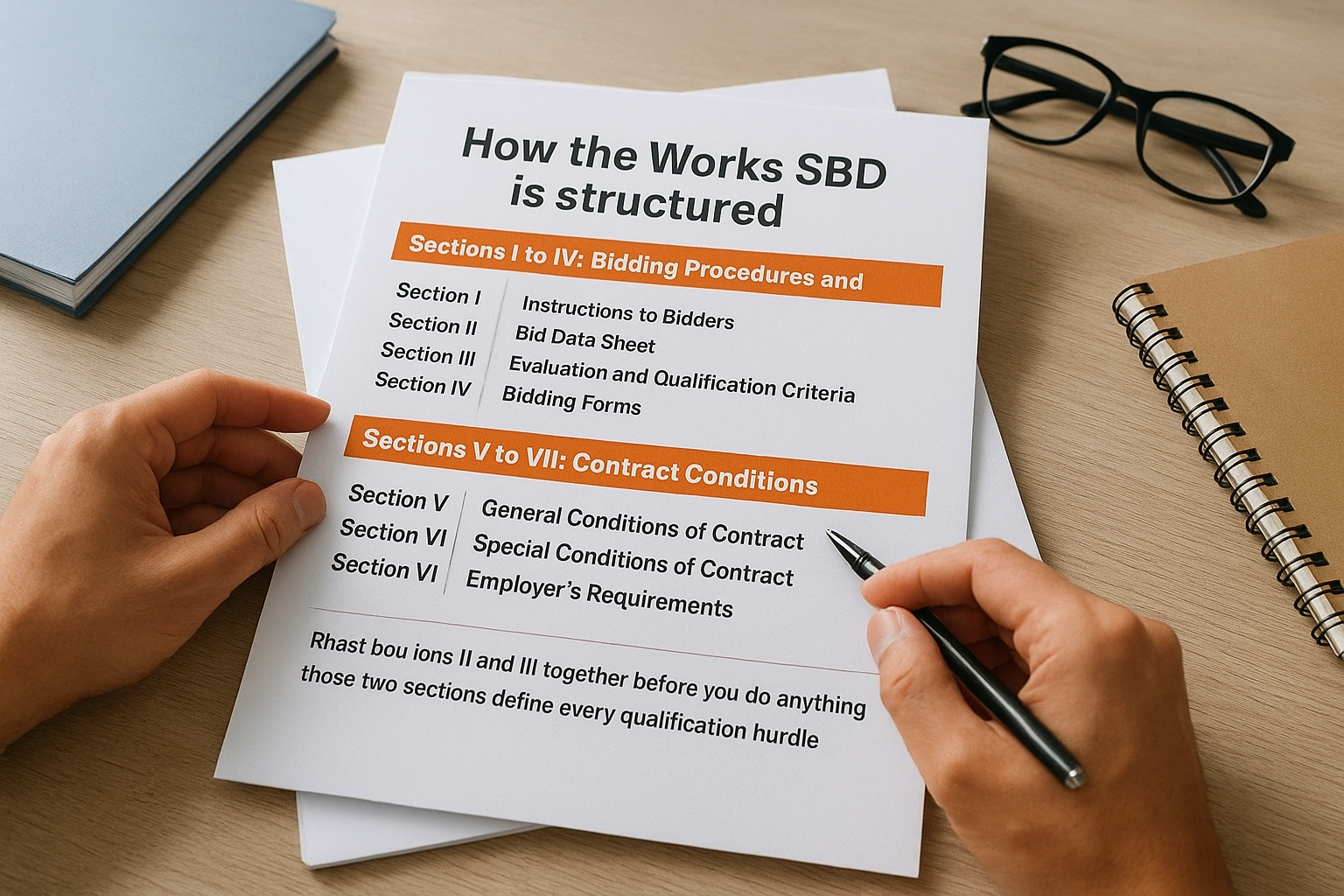
The Large Works world bank standard bidding documents follow a numbered section format that moves logically from bidding procedures through to contract execution. Each section serves a distinct purpose, and the document is intentionally sequenced so that all procedural rules come before technical content. Once you understand the section map, you can navigate any Works SBD quickly without reading it front to back every time you encounter a new tender.
Sections I to IV: Bidding Procedures and Schedules
Sections I through IV cover everything that happens before contract award. Section I is the Instructions to Bidders, which sets the procedural rules for submission. Section II is the Bid Data Sheet, where the procuring entity inserts the project-specific values that override or confirm the default ITB clauses. Every number in the BDS, from bid validity period to minimum turnover threshold, takes precedence over the general text in Section I.
Section III contains the evaluation and qualification criteria, which is the document's most important section for your eligibility assessment. It specifies the financial thresholds, the number of similar contracts required, and any joint venture participation rules. Section IV provides the bidding forms you must complete and submit, including the bid form itself, the bill of quantities, and the bid security format.
Read Sections II and III together before you do anything else, because those two sections define every qualification hurdle your firm must clear.
Sections V to VII: Contract Conditions
Section V contains the General Conditions of Contract, which is the standardized legal framework covering payment, risk allocation, force majeure, and dispute resolution. You cannot negotiate these clauses out of existence. Section VI is the Special Conditions of Contract, where the procuring entity introduces project-specific modifications layered on top of the GCC. Read the SCC immediately after the GCC to catch any clause that shifts liability or changes payment terms from the default position.
Section VII covers the employer's requirements for contract execution, including performance security amounts and insurance obligations. These requirements directly affect your bid pricing because they represent costs you carry from contract award through final completion.
Section VIII: Technical Specifications and BOQ
Section VIII contains the technical specifications and the Bill of Quantities. This is where the engineering scope lives, and it is the section your estimating team will spend the most time in. Each BOQ line item links back to a corresponding specification clause, so pricing the BOQ accurately requires reading both components together rather than treating them as independent documents. Missing a specification requirement at this stage typically results in either a non-compliant technical submission or an underpriced bid, both of which damage your position before evaluation even begins.
How the Goods SBD is structured
The Goods world bank standard bidding documents follow a similar numbered-section format to the Works SBD, but the content priorities shift considerably. Where the Works document centers on construction methodology and site conditions, the Goods SBD focuses on technical compliance, delivery logistics, and after-sales obligations. Once you understand the section map, you can move through any Goods tender efficiently rather than rereading the entire document each time a new opportunity appears.
Sections I to IV: Bid Procedures and Price Schedules
Sections I through IV set the procedural and financial framework for your submission. Section I covers the Instructions to Bidders, laying out the rules for bid preparation and submission. Section II is the Bid Data Sheet, where the procuring entity inserts project-specific values that override the default ITB clauses, including bid validity period, bid security amount, and delivery timeline requirements. These are the numbers that directly determine whether your offer is administratively compliant before anyone reviews your technical documentation.
Section III specifies the evaluation and qualification criteria, which in the Goods SBD focuses heavily on the bidder's financial standing, manufacturing capacity, and past supply experience for similar items. Section IV contains the bidding forms, including the price schedule templates that you must complete in full. These schedules require you to break out costs by unit price, total price, and applicable taxes or customs duties. Leaving any field blank or combining figures that the form requires separately is a procedural error that evaluators have no discretion to overlook.
Complete the price schedules line by line exactly as the form presents them, because any deviation from the required format can result in rejection on administrative grounds before the technical review begins.
Sections V to VII: Technical Requirements and Contract Conditions
Section V contains the General Conditions of Contract, covering the standard legal terms that govern payment timelines, performance security, and the resolution of disputes. Section VI is the Special Conditions of Contract, which layers project-specific modifications on top of the GCC. In Goods contracts, the SCC frequently adjusts delivery milestones and warranty periods, so reading it before you finalize your delivery schedule is essential.
Section VII is where the Goods SBD diverges most sharply from the Works structure. Rather than construction specifications, this section contains the technical specifications and supplier requirements for the goods being procured, including performance standards, testing protocols, and inspection arrangements. Your technical offer must respond directly to each specification stated here. Many Goods bids are disqualified not because the product is unsuitable, but because the technical compliance statement fails to address the specification point by point in the format the document requires.
How to pick the right SBD for your procurement
Selecting the correct world bank standard bidding documents before you start preparing your submission is not a procedural formality. It determines which qualification thresholds apply, which evaluation methodology governs your price, and which contract conditions you must price around. Getting this wrong at the start wastes the preparation work your team puts in downstream.
Check the procurement plan first
Every World Bank-financed project operates under an approved procurement plan, which the borrowing government submits to the Bank before any tender is issued. This plan lists each contract package, its estimated value, the procurement method assigned to it, and the applicable SBD category. Before you analyze a tender in detail, locate the procurement plan for that project on the Bank's Systematic Tracking of Exchanges in Procurement (STEP) system or request it from the procuring entity. The procurement plan removes any ambiguity about which document governs your bid because the procuring entity must follow whatever the approved plan specifies.
If the issued bidding document does not match the procurement method recorded in the approved plan, that discrepancy is grounds for a formal clarification request before the submission deadline.
Match the document to contract value and scope
Once you confirm the procurement method, align it with the contract's primary deliverable and value bracket. Use the Works SBD for any contract where physical construction is the main output, whether that is a road, a bridge, or a water treatment plant. Use the Goods SBD when the contract centers on supply and delivery of equipment or materials, and the consulting RFP when professional expertise and methodology drive the selection. If the contract combines design responsibility with construction, the Design and Build variant applies regardless of value, because it shifts the design liability to your firm in ways the standard Works SBD does not.
Contract value then determines whether you use the large or smaller variant within each category. The threshold between these two sits in the procurement plan and the issued bidding document, not in your own judgment. Applying the large-works template to a contract sized for the smaller-works document, or vice versa, creates a structural mismatch that evaluators will identify immediately.
Verify the template version in use
The Bank updates its SBD templates periodically, and older versions circulate in the market long after revised editions are published. Before you map your compliance checklist to any template, confirm the version date printed on the cover page against the current editions listed on the World Bank's procurement website. Clause numbering and BDS reference points shift between versions, so a checklist built for a 2017 template will point your team to the wrong fields in a 2021 document, introducing errors that compound across every section you prepare.
How to complete the Bid Data Sheet correctly
The Bid Data Sheet is the single document that converts a generic template into a binding procurement instrument, and every field in it carries direct compliance consequences for your bid. When working with world bank standard bidding documents, treat the BDS as your primary compliance checklist rather than a background reference. Read it before any other section, annotate every threshold it specifies, and build your submission structure around what it requires.
Map every BDS field to the ITB clause it references
Each row in the BDS references a specific clause number in the Instructions to Bidders, and the value entered in that row either confirms or overrides the default text in the clause. Your first task is to pull up the ITB and the BDS side by side, then work through every populated field in sequence. Where the BDS inserts a number, that number is the one that governs your bid, not any figure mentioned in the general clause text.
A BDS field left blank by the procuring entity means the default ITB clause applies, so never assume a blank field has no consequence.
Pay particular attention to the bid validity period and bid security amount, both of which appear in the BDS and trigger automatic rejection if your submission falls short. If the BDS specifies a 120-day validity period and your bid security expires on day 118, your bid is non-compliant regardless of how strong the rest of your submission is.
Check qualification thresholds against your firm's actual credentials
The BDS specifies the minimum annual turnover, number of similar contracts, and any sector-specific experience thresholds that your firm must satisfy to pass the qualification stage. Pull your audited financials and project completion certificates before you go any further in your bid preparation. Confirming eligibility at this stage prevents your team from investing weeks of estimating and technical writing into a bid that fails the first screening.
Work through each qualification criterion listed in the BDS and map it to the supporting document you will submit. For turnover, that means identifying which fiscal year's audited accounts you will rely on and verifying the figure clears the stated minimum. For similar contract experience, check that the contract you intend to cite matches the BDS description precisely in terms of nature, complexity, and value, because a contract that is close but not equivalent will not satisfy the criterion.
Build a simple cross-reference table that lists each BDS requirement against the document you are attaching. This discipline catches gaps early, when you still have time to request additional certificates or clarifications from the procuring entity before the submission deadline.
How to tailor requirements without breaking the template
World Bank standard bidding documents give procuring entities two legitimate channels for customization: the Bid Data Sheet and the Special Conditions of Contract. Both channels exist specifically so that project-specific requirements can be inserted without touching the standard legal and procedural text. Your job as a bidder is to understand which channel was used for each modification, so you can respond to the correct version of each requirement rather than the generic clause it sits alongside.
Use the Special Conditions of Contract as the change log
The SCC is the only place where a procuring entity can legally override a GCC clause. When you open a tender, treat the SCC as a formal change log for the entire contract. Read each SCC entry and locate the corresponding GCC clause it modifies before you assess your risk position or finalize your pricing. Some modifications are minor, such as adjusting a notice period from 14 days to 21 days. Others are material, such as shifting liability for design errors or changing the payment milestone structure, and those changes directly affect your cost model.
Never price a bid using the GCC defaults until you have confirmed that the SCC contains no modifications to payment terms, performance security amounts, or retention percentages.
If you identify an SCC modification that appears to contradict the GCC rather than supplement it, raise a formal clarification request through the channel specified in the BDS. The procuring entity is required to respond with an addendum, which then becomes part of the official bidding document. Waiting until after submission to flag a conflict removes your ability to get clarification on record.
Add technical content without touching fixed clauses
Procuring entities sometimes insert project-specific technical requirements into Section VIII, the specifications section, without altering the procedural or legal sections. This is the correct approach, and it means your technical compliance checklist must cover both the standard specification format and any supplementary technical appendices the procuring entity has attached.
When the project adds requirements through appendices, check each one against the bill of quantities line items to confirm that every new technical obligation is priced. Technical appendices that introduce additional testing, specialized materials, or extended warranty obligations all carry cost implications that your estimating team needs to capture before you finalize your price. Leaving an appendix obligation unpriced does not make it optional. The contract will hold you to it regardless of whether your bid acknowledged it.
Build a checklist that cross-references every SCC entry and every technical appendix against your bid submission sections, so your team covers every modification the procuring entity has introduced through the legitimate customization channels available to them.
Common mistakes that cause disqualification
Even well-prepared teams lose bids on procedural grounds when working with world bank standard bidding documents, and the errors that trigger disqualification are almost always avoidable. The evaluation process is sequential: administrative compliance is checked first, qualification is assessed second, and technical and financial reviews come last. A failure at the first stage ends your bid immediately, regardless of how strong your technical proposal or price is.
Submitting incorrect bid security
Bid security errors are among the most common grounds for administrative rejection across all procurement categories. The Bid Data Sheet specifies the exact amount, format, and validity period required. If your bank guarantee expires even one day before the required validity end date, or if the amount falls short of the stated figure, the evaluating committee has no authority to accept it. Confirm every detail of your bid security instrument against the BDS before the document leaves your office.
An evaluator who accepts a deficient bid security is violating the Bank's procurement rules, which means no amount of personal relationship or local goodwill can save a bid with a non-compliant security instrument.
Citing non-qualifying similar experience
Qualification criteria in the BDS specify minimum contract values, nature of work, and the reference period within which the experience must have been completed. Citing a project that is close but does not meet every stated parameter is treated as a failure to demonstrate eligibility. Your experience certificate must reflect a contract that matches the BDS description precisely in value, scope, and completion date, not approximately. Pull the relevant completion certificates early and verify them against the criteria before you commit to bidding.
You also need to confirm that the client issuing the certificate is acceptable under the document's requirements. Experience from internal group companies or informal agreements without formal contracts will not pass scrutiny.
Leaving price schedule fields blank or combined
In Goods bids especially, the price schedule format requires you to itemize costs separately across columns covering unit price, total price, and applicable duties or taxes. Combining figures that the form separates, or leaving any column blank, creates an arithmetically incomplete submission that evaluators will flag as non-compliant. Work through each line of the price schedule exactly as the form presents it, and have a second team member verify every field before final submission.
Ignoring addenda issued before the deadline
Procuring entities issue addenda to correct errors, update specifications, or respond to bidder clarifications. Each addendum becomes part of the official bidding document and must be acknowledged in your submission. Failing to acknowledge an addendum in writing is treated as non-compliance, even if the addendum made no change that affected your bid.
Wrap-up and next step
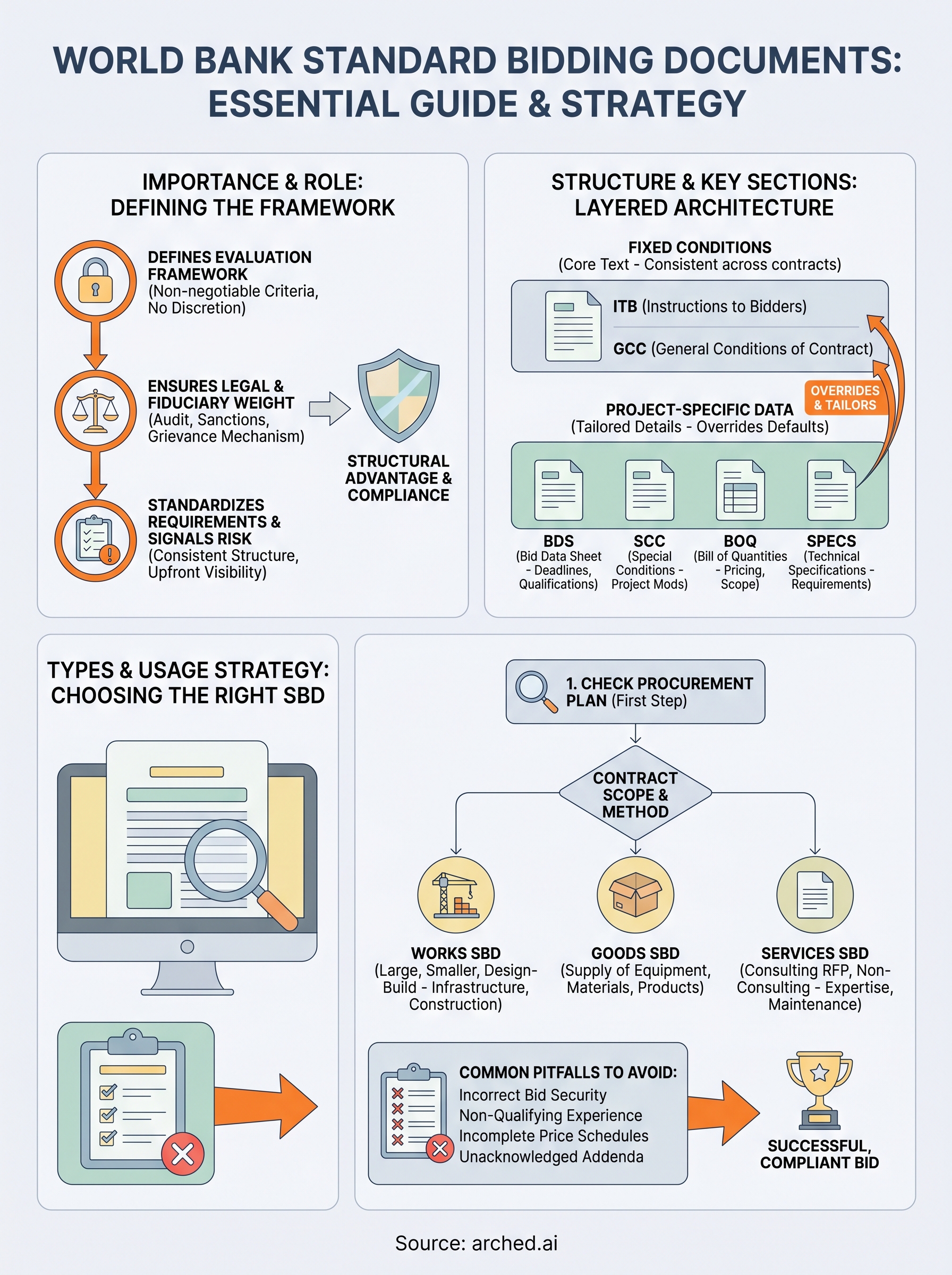
World bank standard bidding documents follow a consistent architecture across every procurement category, and understanding that architecture is what separates bids that clear the first screening from bids that get rejected before any evaluator reads your technical proposal. The rules are fixed, sequential, and non-negotiable: administrative compliance comes first, qualification second, and technical and financial merit last. Every mistake covered in this guide, from deficient bid security to unacknowledged addenda, happens at the first two stages, which means strong engineering capability counts for nothing if your submission fails before it reaches the technical review.
Your next step is to stop reviewing tender documents manually and let a purpose-built tool handle the parsing for you. Arched reads Works and Goods SBDs automatically, extracts BOQ line items, qualification thresholds, and risk clauses, and surfaces the gaps your firm needs to close before the submission deadline. See how Arched works for your BD team and cut your document review time significantly.