SBI Bank Guarantee Form: How To Apply For EMD & Performance
Every government tender you bid on, whether through GeM, CPPP, or a state e-procurement portal, will ask for a bank guarantee at some point. Sometimes it's an EMD (Earnest Money Deposit) guarantee just to participate. Other times, it's a performance guarantee after you've won the contract. Either way, your bank needs a properly filled application form before it issues one, and if you bank with SBI, you'll need the SBI bank guarantee form specific to the type of guarantee required.
Getting this form right matters more than most contractors realize. Errors or mismatches between the guarantee format and the tender's requirements can delay your submission or, worse, get your bid disqualified. That's money, time, and opportunity lost, especially when you're chasing high-value infrastructure contracts where EMD amounts alone can run into lakhs.
This guide walks you through the actual SBI bank guarantee application process for both EMD and performance guarantees. We'll cover where to get the correct forms, what documents SBI requires, the standard formats typically accepted by government departments, and how to avoid common mistakes that slow things down. At Arched, we help contractors prepare bids, but getting that guarantee issued still starts with you and your bank. Let's make sure you get it right the first time.
What an SBI bank guarantee is and when you need one
A bank guarantee (BG) is a written commitment from SBI to pay a government department or project owner a fixed sum if you fail to fulfill your contractual obligations. It's not a loan and it doesn't move money upfront. Instead, SBI stands behind your bid or your contract performance, giving the beneficiary confidence that they won't be left exposed. Government procurement rules in India under GFR (General Financial Rules) and most state procurement guidelines treat a valid bank guarantee as mandatory, which is why you can't skip this step.
Without a valid BG from an approved scheduled bank, your tender submission is typically treated as non-responsive and rejected outright.
EMD guarantee vs. performance guarantee
Both guarantee types appear regularly in government contracts, but they serve different purposes and carry different financial stakes. Knowing which one applies at which stage saves you from submitting the wrong format.
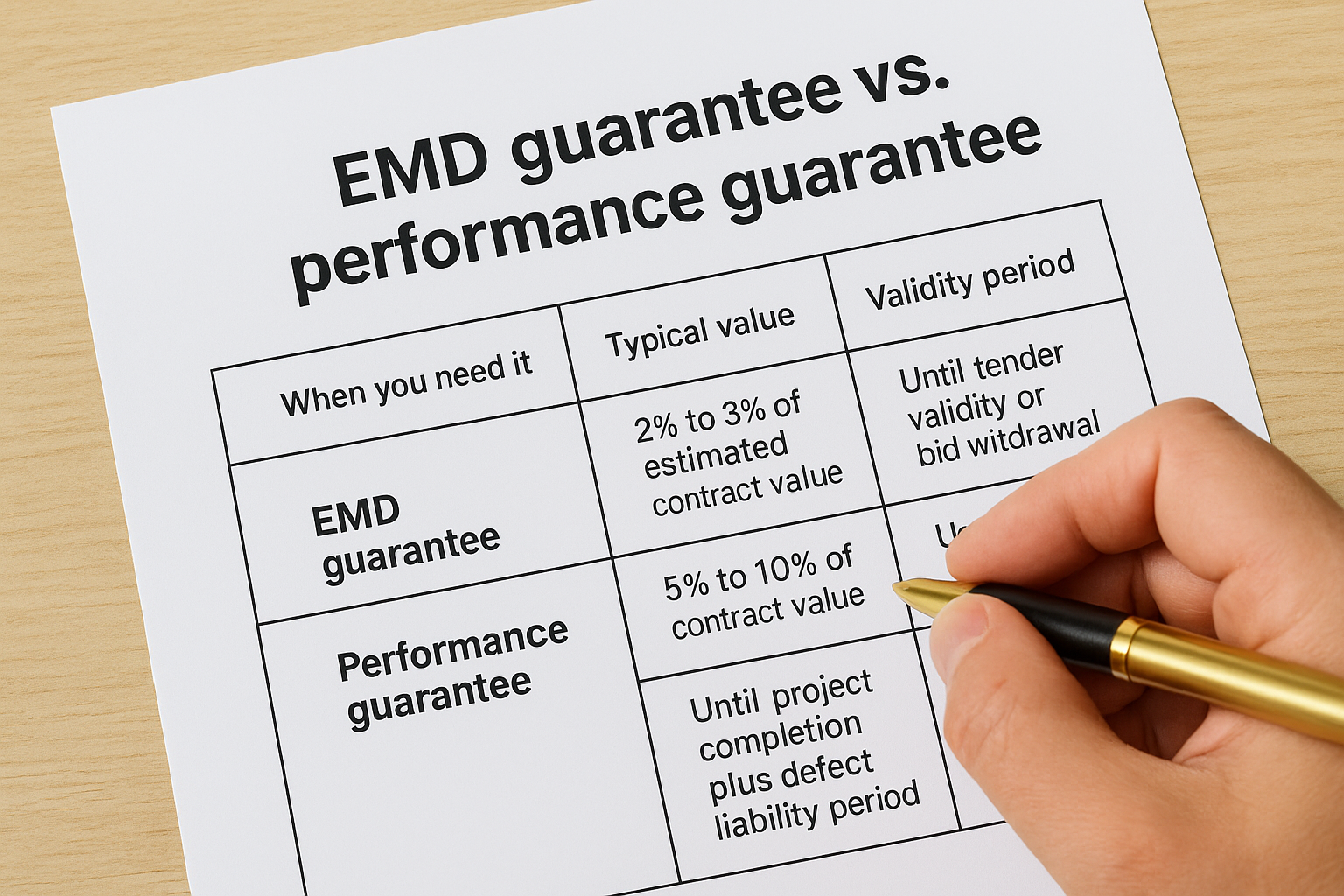
| Type | When you need it | Typical value | Validity period |
|---|---|---|---|
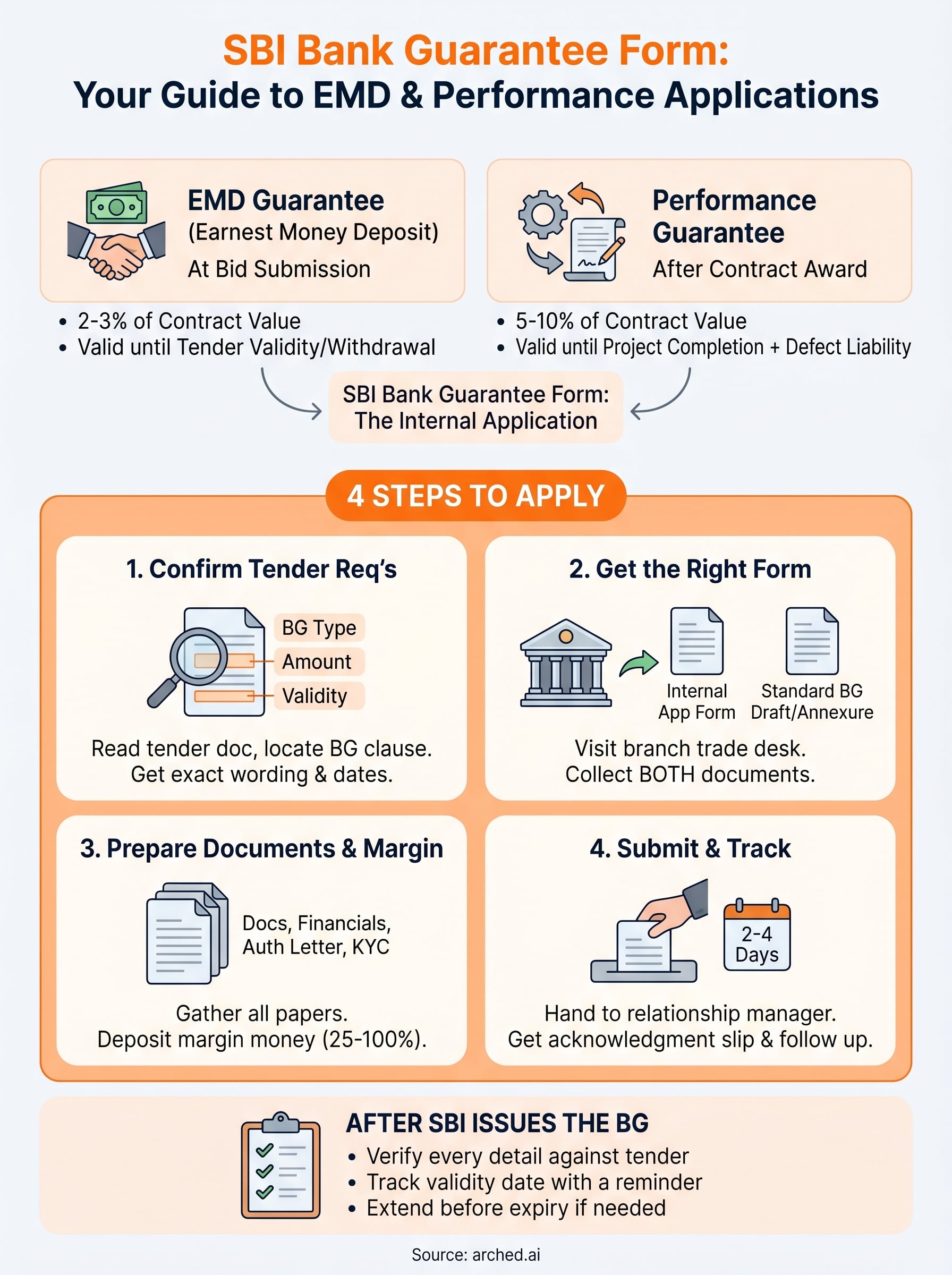
| EMD guarantee | At bid submission | 2% to 3% of estimated contract value | Until tender validity or bid withdrawal |
| Performance guarantee | After contract award | 5% to 10% of contract value | Until project completion plus defect liability period |
Some tenders also require a mobilization advance guarantee if the employer releases funds before work begins, though EMD and performance are by far the most common.
Where the SBI bank guarantee form fits in
The SBI bank guarantee form is the internal application document you complete to instruct SBI to issue the guarantee on your behalf. It captures the beneficiary name, guarantee amount, validity dates, and the exact wording the government department demands. Your SBI branch will not process the request until this form is correctly filled, your account has sufficient margin money or collateral pledged, and all supporting documents are in order.
Step 1. Confirm the BG type and tender requirements
Before you fill out the SBI bank guarantee form, open the tender document and locate the BG clause. Government tenders specify the guarantee type, amount, validity period, and required wording in the bid data sheet or special conditions of contract. Arriving at your SBI branch without this information risks delays and, in the worst case, a missed submission deadline.
Read the tender document before visiting the branch
Pull out these four details before you speak to your SBI relationship manager:
- BG type: EMD, performance, mobilization advance, or retention money
- Amount: Fixed figure or percentage of bid price (e.g., 2.5% of estimated project cost)
- Validity: Exact end date, including any claim period beyond project completion
- Format: Whether the department mandates prescribed wording or accepts a standard bank draft
If the tender includes a prescribed BG format, print it and carry it to your branch. SBI will draft the guarantee text to match, and the beneficiary will reject any wording that deviates from their template.
Verify the issuing bank eligibility
Many central and state government tenders restrict guarantees to scheduled commercial banks listed by RBI, or to public sector banks only. SBI qualifies under both categories, but confirm this in the tender conditions before proceeding, since some departments also require the BG to come from a branch within a specific city or jurisdiction.
Step 2. Get the right SBI BG form and standard format
SBI does not publish a universal downloadable BG application form on its public website. To get the correct SBI bank guarantee form, visit your home branch or the branch where your current account is held and request the form from the trade finance or loans desk. Some large corporate branches with dedicated relationship managers will email you the form directly, which saves a trip.
Always collect the form from the branch that will actually issue the guarantee, since different branches occasionally use slightly different internal versions.
Two documents you need to collect
You'll leave the branch with two things: the internal application form SBI uses to process your request, and a standard BG draft format that SBI's back office relies on when no prescribed wording exists in the tender. If the tender already supplies a prescribed format, your branch will use that instead of SBI's standard draft text.
When the tender prescribes its own format
Many government departments, including PWD, NHAI, and state irrigation boards, attach their own BG wording as an annexure in the tender document. In this case, print that annexure, highlight the fill-in fields such as amount, validity date, and beneficiary name, and hand it directly to your SBI relationship manager alongside the application form.
Step 3. Prepare documents, margin, and wording details
Once you know the BG type and have the correct SBI bank guarantee form in hand, gather everything SBI needs before walking into the branch. Arriving with incomplete paperwork delays issuance by days, which is a real risk when tender submission deadlines are fixed.
Documents SBI typically requires
Your SBI relationship manager will ask for a standard set of documents alongside the completed application form. Collect these before your branch visit:
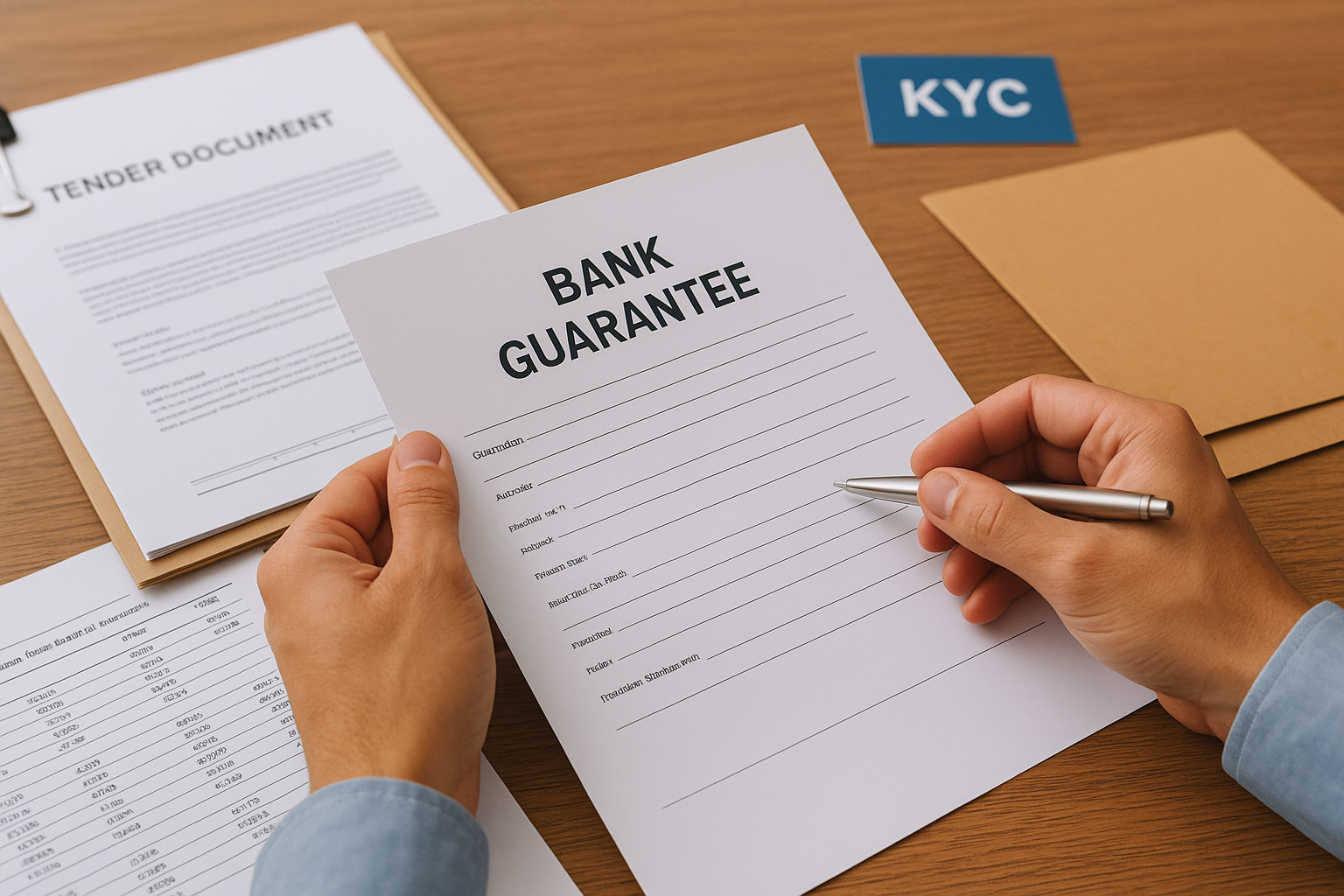
- Copy of the tender document (the relevant pages showing the BG clause and prescribed format)
- Audited financial statements for the last two to three years
- Board resolution or authorization letter permitting the signatory to apply for the BG
- KYC documents: PAN, GST registration, and address proof
Margin money and wording accuracy
SBI requires you to deposit margin money as security, typically 25% to 100% of the BG value depending on your credit limit and relationship with the branch. If your firm already holds a cash credit or term loan facility with SBI, the bank may accept collateral instead of a cash deposit.
Double-check every figure in the wording, including the guarantee amount in words and digits and the exact validity end date, before signing the application form.
Wording errors are the most common reason SBI reissues a guarantee, which wastes days and costs additional processing fees on top of your original stamp duty.
Step 4. Submit the application and track issuance
Once your documents are complete and your margin money is deposited, hand the signed SBI bank guarantee form along with all supporting papers to the trade finance desk at your branch. The officer will verify your documents, confirm the wording matches the tender requirements, and log the request in SBI's internal system before passing it to the back office for drafting.
What happens at the branch counter
The branch officer will run through a checklist before accepting your application. Expect them to verify these items on the spot:
- Signed and dated application form with company stamp
- Margin deposit receipt or confirmation of available credit limit
- Tender document pages showing the BG clause
- Board resolution or authorization letter
How to follow up on issuance status
SBI typically issues a bank guarantee within two to four working days for straightforward applications. If your tender submission deadline falls within that window, inform your relationship manager at the time of submission and request priority processing.
Ask for a written acknowledgment slip when you submit the application; it records the date and serves as your reference if issuance gets delayed.
Follow up with a direct call to your relationship manager rather than the general branch number, since they can check the back-office queue and flag urgent cases.
What to do after SBI issues the bank guarantee
Once SBI hands over the physical guarantee document, your job is not finished. Before you dispatch it to the tendering authority, verify every detail on the printed guarantee against both your original SBI bank guarantee form and the tender's BG clause. A single digit error in the validity date or the guarantee amount can lead to outright rejection.
Verify the guarantee before submission
Check the printed text against the tender's prescribed format line by line. Confirm that the beneficiary's name and address exactly match what the tender specifies, and that the guarantee amount in both figures and words is correct. If anything is off, return the document to your branch immediately for a corrected reissue.
Never submit a BG with even a minor discrepancy; tendering authorities reject incorrectly worded guarantees without giving you a chance to correct them on the spot.
Track validity and renewal dates
Set a calendar reminder at least 30 days before the BG expiry date so you have enough time to request an extension if the tender validity or project timeline extends. Missing the renewal window forces you to apply for a fresh guarantee, which costs additional stamp duty and processing time.
Next steps
Getting the SBI bank guarantee form right is one piece of a larger bidding process. You still need to identify which tenders are worth pursuing, confirm eligibility before you invest time in the BG application, and track submission deadlines across multiple portals simultaneously. Doing all of that manually across GeM, CPPP, and state e-procurement systems is where most BD teams lose hours every week.
Once the guarantee is arranged, the bid still needs a priced estimate. If you would like help, send us the project and Arched will deliver a reviewed BOQ on your deadline.
Have a package your team can’t get to? Send it to us. Our engineers check and sign off everything we deliver.