PPP Knowledge Lab: Key Tools, Country Data And Legal Guides
Public-Private Partnerships drive some of the largest infrastructure projects in India, from highways and metro systems to water treatment plants and smart cities. But navigating PPP frameworks requires more than ambition; it demands a solid understanding of procurement structures, risk allocation, and legal precedents. That's exactly where the PPP Knowledge Lab comes in. Maintained by the World Bank Group, it's one of the most comprehensive open-access repositories for PPP legal guides, country-specific data, and sector benchmarks available today.
For infrastructure firms and BD teams tracking government contracts, understanding PPP structures isn't optional, it's a competitive edge. At Arched, we prepare estimates and BOQs for AEC companies bidding on public contracts in India. The PPP Knowledge Lab complements that effort by giving firms the legal and strategic context behind the opportunities they're bidding on.
This article breaks down what the PPP Knowledge Lab offers, how its tools and datasets are organized, and how contractors and consultants operating in India's public procurement space can put it to practical use.
Why PPP Knowledge Lab matters for PPP decisions
When you're evaluating whether to pursue a PPP contract, the financial stakes are high and the documentation is dense. Government procurement decisions in India often hinge on understanding how risk is shared between public and private entities, what contractual structures are standard, and where comparable projects have succeeded or stalled. Without a reliable reference, your team can spend days piecing together answers from fragmented sources.
A single reference point for complex frameworks
The PPP Knowledge Lab consolidates legal guides, sector notes, and country data into one searchable platform. This matters because PPP structures vary significantly by sector and jurisdiction. A road project under NHAI follows a different concession model than a water treatment plant under a municipal authority, and the distinctions affect bid preparation, risk pricing, and contract negotiations in ways that are not always obvious from the tender notice alone.
Firms that understand the contractual framework before they bid are in a far stronger position to price risk accurately and draft compliant technical proposals.
Data that supports faster, better decisions
Your team's ability to benchmark contract terms and financial structures against global and regional precedents directly improves the quality of your bids. The platform lets you review how similar projects were structured in other countries, which qualifications were typically required, and what common failure points looked like. This kind of comparative analysis is difficult to replicate through general searches or fragmented government circulars.
For BD managers working under tight timelines, having structured reference material reduces the research burden significantly. Instead of reading through multiple policy documents, you can locate sector-specific guidance and move straight to applying it to your current opportunity.
What you can find inside PPP Knowledge Lab
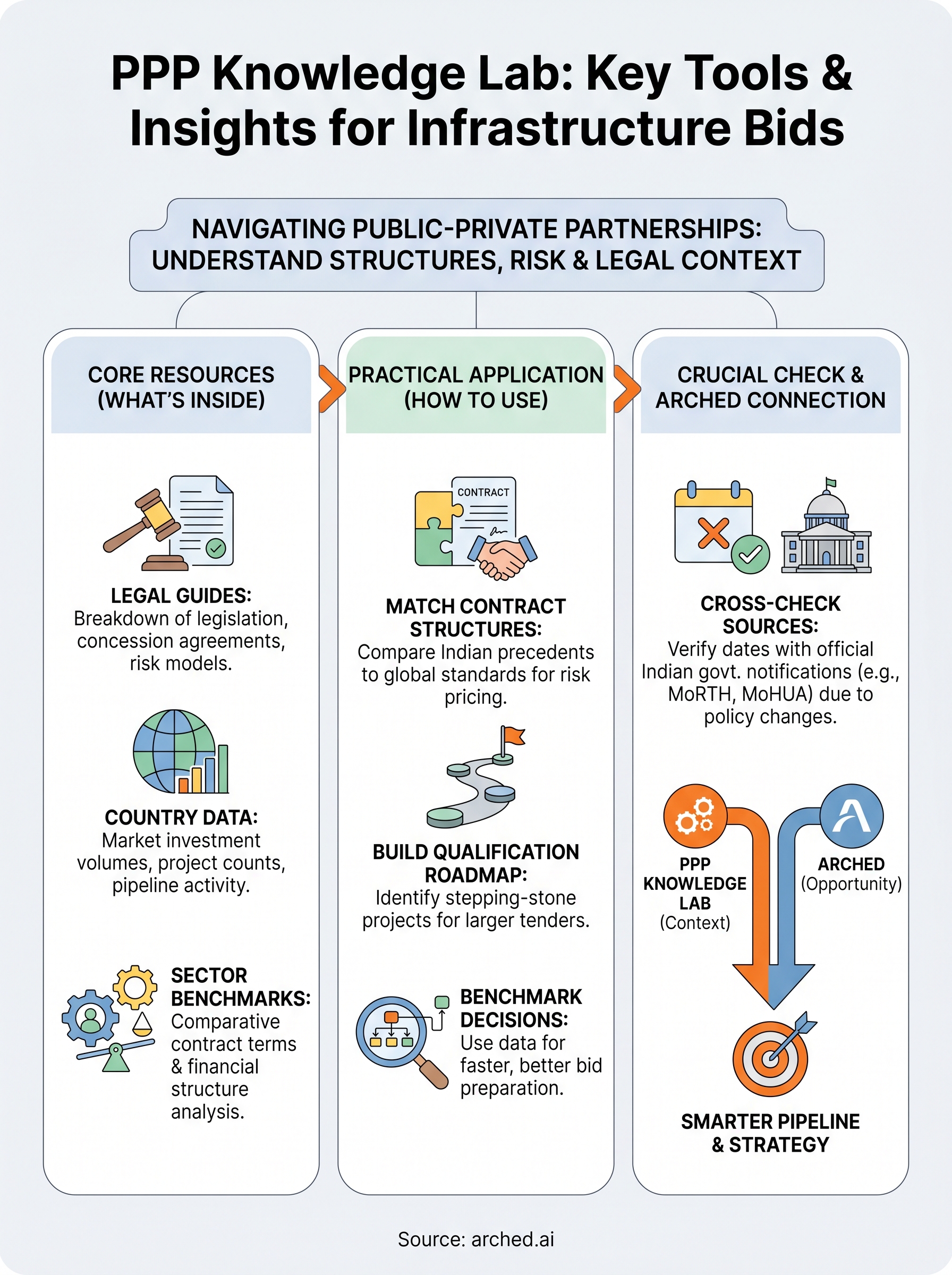
The PPP Knowledge Lab organizes its resources into several distinct areas, each targeting a specific decision point in the PPP lifecycle. Rather than a static library, it functions as a structured knowledge base covering procurement phases from preparation through contract management.
Legal guides and sector notes
The legal guides break down PPP legislation and regulatory frameworks for dozens of countries, explaining how concession agreements are typically structured, what enabling legislation looks like, and which risk allocation models are most common. For Indian contractors, these guides help you understand international contract standards that increasingly influence domestic PPP tenders, particularly in sectors like transport and urban infrastructure.
Knowing the legal baseline before you review a tender notice helps you spot non-standard clauses that could increase your exposure.
Country data and procurement benchmarks
This section gives you quantitative data on PPP markets, including investment volumes, project counts by sector, and historical pipeline activity. You can filter by country or sector to see where public infrastructure spending is concentrated. For BD teams assessing market entry or bid prioritization, this data provides a factual foundation that goes well beyond what individual tender notices reveal. It also lets you benchmark India's procurement activity against comparable emerging markets.

How to navigate the site and get answers fast
The PPP Knowledge Lab site can feel overwhelming if you land on it without a plan. Your fastest path to useful information starts with knowing which question you're trying to answer before you start clicking around. Are you looking for legal framework guidance, country data, or sector-specific benchmarks? Each of these lives in a distinct part of the site.
Use the search bar with specific terms
Your search results improve significantly when you enter specific sector terms or country names rather than broad phrases. Searching "road concession India" or "water PPP legal framework" returns far more targeted results than searching "PPP projects." If you get too many results, narrow by document type using the filters available on the results page.
Specific search terms cut your research time significantly compared to browsing category by category.
Filter by country and sector
The country and sector filter tools let you isolate the data most relevant to your current bid. Select India under the country filter to pull legislation summaries, project data, and procurement benchmarks specific to your market, then layer on a sector filter to sharpen the results further.
How to use it for a PPP project in India
India's PPP pipeline spans roads, ports, urban infrastructure, and energy, each governed by sector-specific frameworks that shape what qualifications and structures are viable. Before you submit a bid on any public project, the PPP Knowledge Lab gives you the context to understand what the contracting authority expects and how comparable projects have been structured.
Match contract structures to Indian precedents
Indian PPP contracts often follow concession models familiar in transport and urban sectors, but the specific risk-sharing terms can vary by awarding authority. Use the legal guides to compare how qualification criteria and payment mechanisms are typically structured in India versus regional benchmarks, then apply those findings directly to your bid strategy.

Understanding the standard risk allocation before reading a tender notice helps you flag non-standard clauses faster.
Build your qualification roadmap
If your firm lacks specific credentials or financial thresholds required for a larger PPP contract, the country data and sector notes help you identify what stepping-stone projects to target first. Map the typical qualification requirements for your target contract size, then work backward to determine which smaller tenders build the right experience profile.
Your BD team can then use this roadmap to prioritize bids that build toward larger contract eligibility over successive tender cycles.
Common pitfalls and how to cross-check sources
The PPP Knowledge Lab is a strong reference point, but it has limitations you need to account for. Some country-specific data and legal guides lag behind recent legislative changes, particularly in fast-moving markets like India where procurement regulations update frequently. Treating any single source as your sole reference point is a risk your team cannot afford on a high-value bid.
Always verify legal framework details against the most recent notifications from the relevant Indian government ministry or awarding authority.
Check dates and verify against official sources
Before applying any legal or regulatory guidance from the platform to an active bid, check when the document was last updated. Indian PPP frameworks, particularly in urban infrastructure and transport sectors, have seen significant policy changes in recent years. Cross-reference the platform's guidance against current notifications from ministries such as MoRTH or MoHUA to confirm accuracy before use.
Global and regional benchmarks are useful for framing your thinking, but do not substitute India-specific procurement rules with data drawn from other markets. Validate every qualification threshold and contract term against the actual tender documents and applicable Indian legislation before finalizing your bid strategy.
Next steps
The PPP Knowledge Lab gives you a strong foundation for understanding the legal frameworks, country data, and sector benchmarks behind India's public infrastructure pipeline. Your next move is to apply that knowledge directly to the tenders you're actively pursuing. Start by bookmarking the legal guides most relevant to your target sectors, and build a habit of cross-referencing platform data against official government notifications before each major bid submission.
Research alone does not win contracts. Knowing the contractual structure matters, but your bid also needs a detailed, defensible estimate behind it. If your team is stretched across too many bids, send us the project and Arched will deliver an engineer-reviewed estimate and BOQ on your deadline.
Have a package your team can’t get to? Send it to us. Our engineers check and sign off everything we deliver.