What Are PPP Projects? Meaning, Models & Examples In India
India's infrastructure ambitions, highways, metro rail, airports, water treatment plants, run on a simple premise: the government can't build it all alone. That's where PPP projects come in. A Public-Private Partnership is a contractual arrangement where a government agency and a private company share the responsibility (and risk) of delivering public infrastructure or services.
For contractors and infrastructure firms chasing growth, PPP projects represent some of the highest-value opportunities in the Indian procurement ecosystem. But they also come with layered qualification criteria, complex concession agreements, and long gestation periods that demand serious strategic planning. Understanding how these models work isn't optional, it's the difference between bidding smart and bidding blind.
This article breaks down what PPP projects mean, the major models used in India, real-world examples, and how these partnerships shape the opportunities that land on procurement portals every day.
What makes a project a PPP
Not every government contract qualifies as a PPP. The term gets used loosely, but a genuine PPP has specific structural features that separate it from a standard procurement contract or an outright government build. At its core, a PPP involves shared responsibility across the full project lifecycle, which typically includes financing, construction, and operations, not just construction alone. The private partner isn't simply a vendor completing a scope of work; they carry real financial exposure tied to the project's performance over a defined concession period.
The core elements of a PPP agreement
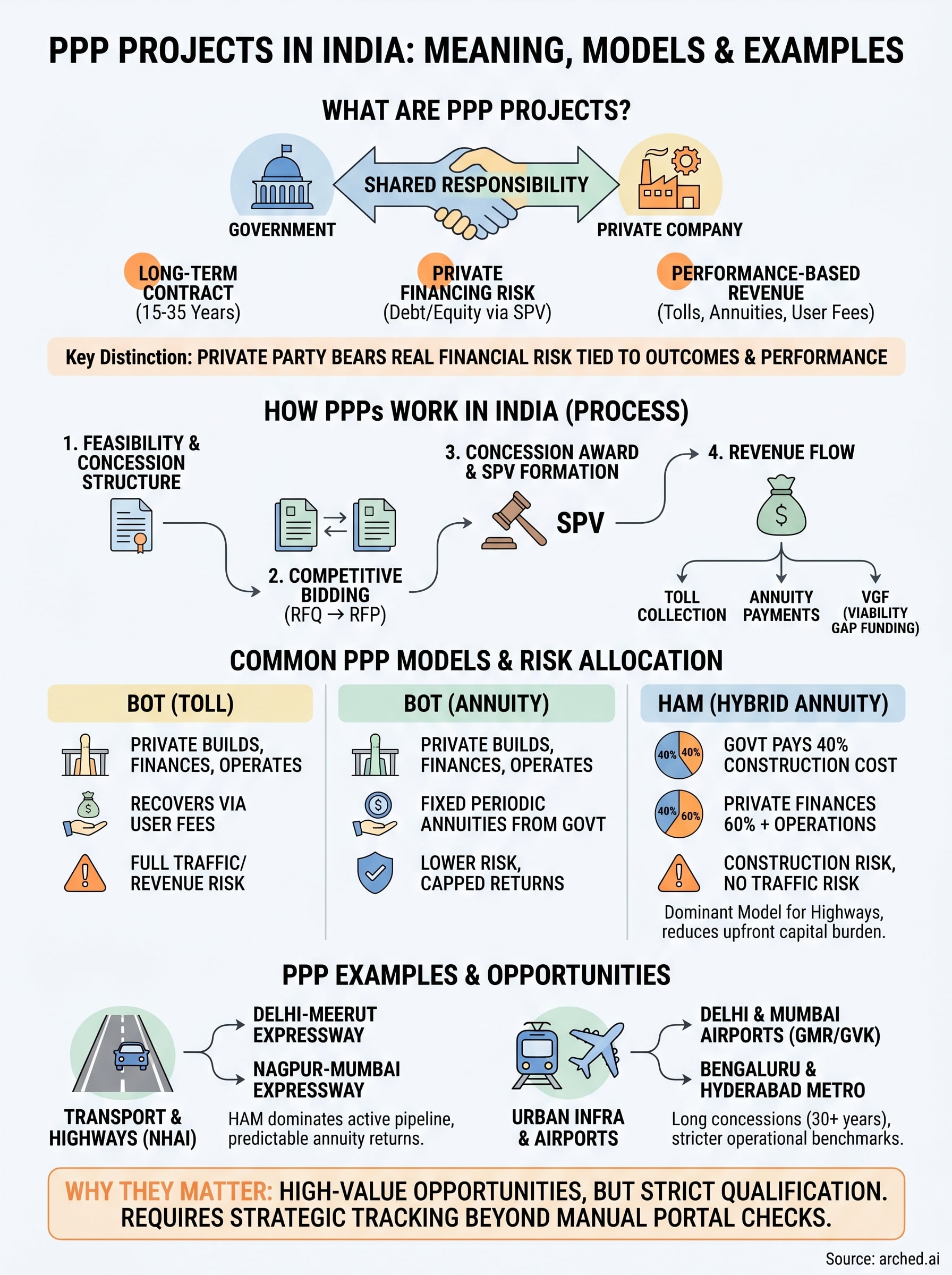
Three defining elements show up in virtually every PPP structure across India. First, there's a long-term contractual arrangement, usually spanning 15 to 35 years, that governs how both parties share obligations. Second, the private party takes on project financing risk, either by raising debt through a Special Purpose Vehicle (SPV) or by committing equity directly. Third, performance-based revenue mechanisms, such as toll collection or annuity payments, tie the private partner's returns to actual service delivery. If they don't perform, they don't get paid at the same rate.
The key distinction in any PPP is risk transfer: the private party must bear meaningful financial consequences tied to outcomes, not just project outputs.
Here is a quick breakdown of what separates a PPP from a standard EPC (Engineering, Procurement, and Construction) contract:
| Feature | Standard EPC Contract | PPP |
|---|---|---|
| Private party role | Builder only | Builder, financier, operator |
| Revenue source | Government payment on completion | Tolls, annuities, or user fees |
| Risk borne by private party | Construction risk only | Construction + financial + operational |
| Contract duration | 1 to 5 years typically | 15 to 35 years |
What separates PPP from regular government contracts
If you're asking what are PPP projects at a structural level, the simplest answer is this: accountability extends well beyond handover. In a regular tender, your firm builds the asset, hands it over, and the government takes responsibility from that point forward. In a PPP, your firm operates the asset long after construction ends, which means revenue depends on sustained performance metrics like traffic volume, uptime, or quality benchmarks. That ongoing accountability is exactly what makes PPP bids more complex to evaluate and more demanding to win.
Why PPP projects matter in India
India's National Infrastructure Pipeline (NIP) targets ₹111 lakh crore in infrastructure investment through 2025, and the government cannot fund that scale from public budgets alone. PPP projects fill that gap by pulling private capital and operational expertise into sectors where public agencies lack the capacity to deliver at speed. Understanding what are PPP projects, and why they dominate infrastructure procurement, directly shapes where your firm should focus its business development effort.
The scale of India's infrastructure gap
India adds thousands of kilometers of roads, dozens of metro corridors, and new airport terminals each year, all of which require long-term financing structures the government cannot absorb independently. PPP frameworks give private firms a formal mechanism to participate in these large-scale projects while the government retains regulatory control. The result is a procurement pipeline that consistently generates some of the highest-value tenders across the AEC sector.
When the government cannot fund infrastructure outright, PPP contracts become the primary vehicle for large-scale project delivery, and that directly expands the opportunity set for well-qualified private firms.
What this means for your business
PPP projects are relevant to your firm because contract values are significantly larger than standard government tenders, often running into hundreds of crores. Winning even one concession contract can anchor your revenue pipeline for a decade or more. The catch is that qualification criteria are stricter, concession documents are dense, and eligibility thresholds around net worth, technical capacity, and past project value are non-negotiable. Firms that track PPP opportunities systematically gain a real edge over those that rely on manual portal checks.
How PPP projects work in India
Understanding what are PPP projects at a conceptual level is useful, but knowing how they move from policy to procurement helps you position your firm at the right stage. In India, PPP projects follow a structured government-led process that begins well before a tender hits any portal. The central or state authority identifies an infrastructure gap, mandates a feasibility study, and then selects a concession structure before inviting private bids.
From feasibility to concession award
The government appoints a transaction adviser to prepare the Detailed Project Report (DPR) and draft the concession documents. Once approved, the project moves to competitive bidding, typically through a Request for Qualification (RFQ) followed by a Request for Proposal (RFP). Shortlisted firms then submit financial bids, and the authority awards the concession based on criteria like lowest grant requirement, highest premium, or lowest user charge, depending on the model selected.
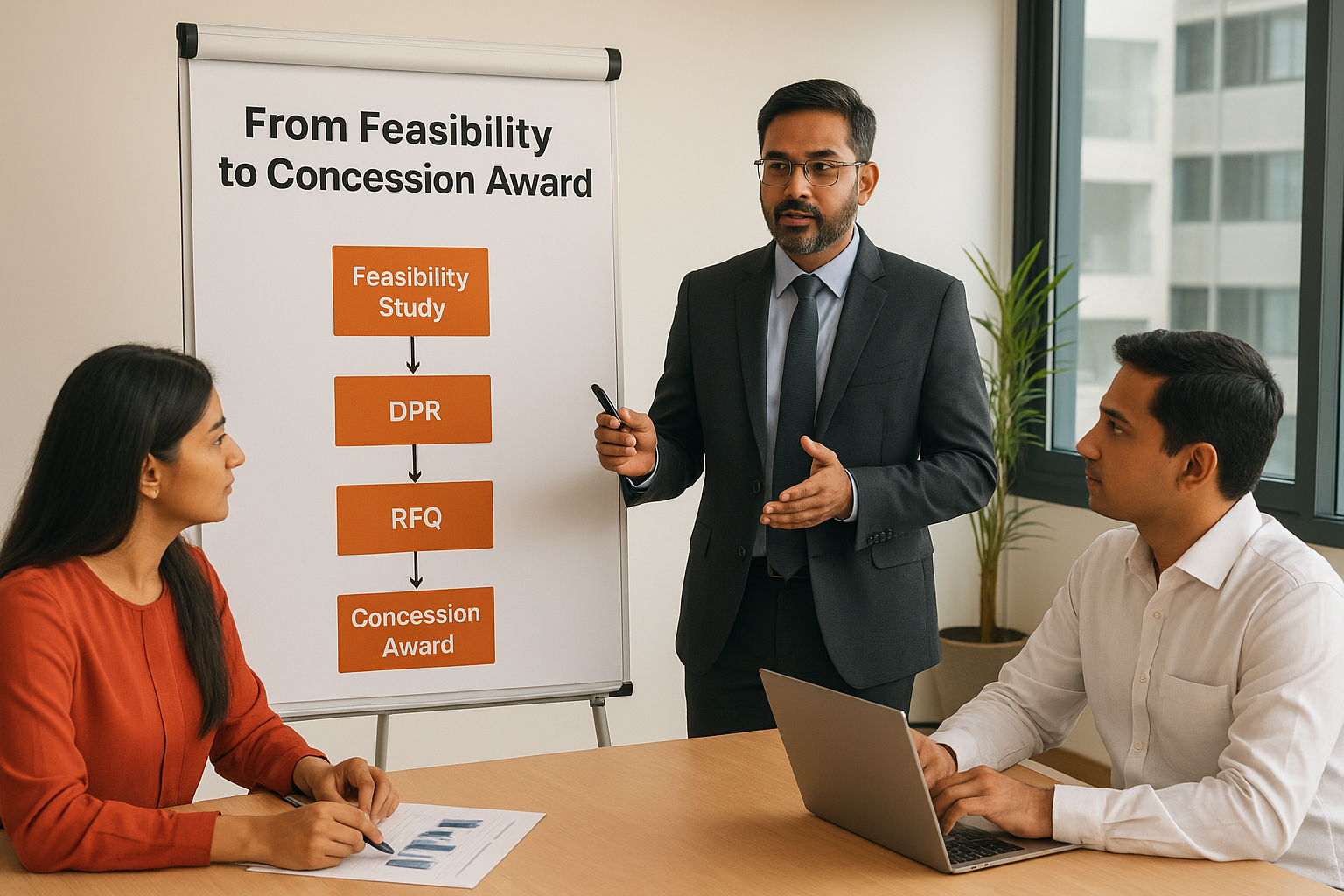
The RFQ stage is where many firms get eliminated, as qualification thresholds around net worth, technical capacity, and sector experience are strict and non-negotiable.
How revenue flows to the private partner
Once the authority awards the concession, your firm forms a Special Purpose Vehicle (SPV) to ring-fence project finances from your parent company's balance sheet. Revenue then flows through toll collection, annuity payments, or Viability Gap Funding (VGF) depending on the model in place. The government releases VGF tranches only after your firm hits defined construction milestones, which keeps both parties accountable throughout the full project lifecycle. Which revenue mechanism you get is a function of the contract model — the comparison of EPC, HAM, BOT and TOT sets out who funds construction and when cash actually reaches your firm under each.
Common PPP models and risk allocation
India uses several distinct PPP structures, and the model chosen determines how risk is split between the government and your firm. Knowing the difference before you bid is critical because qualification thresholds, capital requirements, and revenue mechanisms vary significantly across each structure.
BOT Toll and BOT Annuity
Under a Build-Operate-Transfer (BOT) Toll arrangement, your firm finances and builds the asset, then recovers costs through user fees over the concession period. You carry full traffic and revenue risk. BOT Annuity shifts that risk back to the government: the authority pays your firm fixed periodic annuities regardless of actual usage, making cash flows more predictable but returns capped.
Hybrid Annuity Model (HAM)
HAM sits between the two BOT variants and has become India's preferred highway PPP model since 2016. The government pays 40% of project cost during construction as milestone-linked installments, and your firm finances the remaining 60%. Post-construction, the authority makes semi-annual annuity payments covering your debt and equity over 15 years. Your firm carries construction risk but not traffic risk.
HAM reduces the private sector's upfront capital burden significantly, which is why it now dominates NHAI's highway pipeline.
When you're evaluating what are ppp projects worth bidding on, model selection directly determines your capital exposure and return timeline, making it the most important filter before you commit resources to bid preparation.
PPP project examples across Indian sectors
Real-world examples make the structural theory concrete. Across India, PPP projects span sectors from highways to urban transit, and each one illustrates how risk allocation and revenue models play out differently depending on the asset type and the procuring authority.
Transport and highways
NHAI's highway program is the largest source of PPP activity in India. The Delhi-Meerut Expressway and the Nagpur-Mumbai Super Communication Expressway both moved through structured PPP concessions, with private consortiums forming SPVs to manage financing and construction. The Hybrid Annuity Model now dominates NHAI's active pipeline, giving firms predictable annuity-based returns without the full burden of traffic risk. If your firm holds the qualifying net worth and sector experience, NHAI tenders represent the single highest-value opportunity category in the AEC space.
Highway PPP concessions under NHAI consistently produce contract values in the range of hundreds of crores, making them the benchmark opportunity for well-capitalized infrastructure firms.
Urban infrastructure and airports
The Delhi and Mumbai airport modernizations under GMR and GVK are India's most referenced airport PPP examples, demonstrating how long concession periods of 30-plus years create sustained revenue streams tied to aeronautical and commercial throughput. Metro rail projects in cities like Bengaluru and Hyderabad have also used PPP structures, with the government retaining equity stakes while private operators manage specific lines or system components. These urban concessions typically carry stricter operational performance benchmarks than highway projects, which raises the entry bar considerably.
Final takeaway
If you've worked through this article, you now have a clear picture of what are PPP projects, how they're structured, and why they dominate India's infrastructure procurement landscape. PPP contracts reward firms that prepare strategically, not those that stumble across opportunities by refreshing portals manually. The qualification thresholds are strict, the concession documents are dense, and the competition is well-capitalized.
Your firm's ability to track the right opportunities at the right stage determines whether you land in the bid or miss the window entirely. That means monitoring RFQ releases, understanding which model applies to each tender, and knowing your eligibility gaps before you invest resources in a bid.
Once you decide to bid, Arched can prepare the estimate: send us the project and we deliver a priced BOQ reviewed by an engineer. See how our estimating service works.
Have a package your team can’t get to? Send it to us. Our engineers check and sign off everything we deliver.