11 Types Of Contracts In Construction (India) Explained
Master the 11 types of contracts in construction used in India. Compare EPC, Lump Sum, and Item Rate models to manage risk and optimize your bidding strategy.
Every government tender document in India specifies a contract structure, and picking the wrong one (or misunderstanding what you're signing up for) can wreck your margins before a single brick is laid. Understanding the types of contracts in construction isn't academic; it's the difference between a project that builds your firm's credentials and one that bleeds money for 18 months straight.
Yet most BD teams and bid managers treat the contract type as an afterthought, buried somewhere on page 40 of a tender PDF. They focus on the scope and the price, skip past the payment mechanism, and then wonder why cash flow dried up mid-project. Whether it's a lump sum agreement on a highway widening job or a cost-plus arrangement for a complex irrigation scheme, the contract type shapes your entire risk exposure, from how variations are handled to who absorbs material price escalations.
This guide breaks down 11 contract types commonly used across Indian construction projects, covering how each one works, where it fits, and what to watch out for. At Arched, our platform parses thousands of tender documents across 500+ government portals, and contract structure is one of the first things we flag during document analysis. That context shaped this article, so expect practical, India-specific insight rather than generic textbook definitions.
1. Lump sum contract
A lump sum contract sets a fixed total price for a defined scope of work before the project begins. The contractor agrees to complete the entire job for that single agreed amount, regardless of what it actually costs to deliver. This is one of the most familiar types of contracts in construction, and it's the default structure on a large number of central and state government tenders across India.

What it is
In a lump sum contract, the owner hands over complete drawings and specifications upfront, and the contractor prices the entire scope as one bundled figure. There's no itemized breakdown shared with the client after signing; the risk of cost overruns sits squarely on the contractor's shoulders.
How pricing and payment work
Payment typically happens in milestone-based installments tied to physical progress, such as 10% on mobilization and 30% on completion of substructure. Running account (RA) bills are submitted at regular intervals, and the client's engineer certifies the work before releasing funds. A retention amount, usually 5-10% of each bill, is held back until the defect liability period closes.
Pros and cons
The biggest upside for clients is cost certainty; they know the number from day one. For contractors, a well-priced lump sum can deliver strong margins if execution is tight. On the downside, scope creep and ambiguous drawings are your worst enemy here, because any extra work not explicitly covered means you absorb the cost directly.
If drawings change after signing, push for a formal variation order before starting that work, not after.
Best fit in India
This structure works well for NHAI road projects and MES building works, along with urban infrastructure contracts where detailed drawings are finalized before tendering. CPWD also uses lump sum agreements extensively for civil and finishing works.
Risks and clauses to watch
Watch for poorly defined scope boundaries in contract annexures and vague "deemed to include" language, which lets the client argue additional work was always covered. Also check the price escalation clause; many lump sum contracts in India are fully fixed-price with no indexation, which hurts badly on multi-year projects during material price spikes.
Typical documents and approvals
You'll typically handle a General Conditions of Contract (GCC), an Integrity Pact, and performance security of 3-5% of contract value. For CPWD work, the standard agreement document is CPWD Form 7 or Form 8, accompanied by a milestone-linked payment schedule.
2. Item rate contract
An item rate contract is one of the most widely used types of contracts in construction in India, particularly across state PWD and central government departments. Unlike a lump sum deal, here the contractor prices each individual item of work separately, using a schedule of rates, and payment adjusts based on the actual quantities measured on site.

What it is
In this structure, the tender document includes a detailed Bill of Quantities (BOQ) listing every work item with an estimated quantity. Your job is to quote a unit rate for each item, and the final contract value shifts as actual measurements are taken during execution.
How pricing and payment work
Payment flows through monthly RA bills where the engineer measures completed quantities and multiplies them by your quoted rates. The final contract value is settled at completion once all quantities are reconciled against the original estimates.
Pros and cons
You carry less scope risk here because payment tracks real work done. The downside is that quantity variations can cut your revenue sharply if high-value items come in below estimate, and clients can reduce scope without owing you much compensation.
Always check whether the contract caps quantity variation at 25%, which is standard under most Indian GCC conditions.
Best fit in India
State PWD road and building works favor this model, as do irrigation department contracts and municipal infrastructure tenders where final quantities are genuinely uncertain at the time of bidding.
Risks and clauses to watch
Watch for low-estimate items in the BOQ that you priced aggressively; if quantities drop, margins collapse fast. Scrutinize the re-measurement clause to confirm who controls final quantity certification.
Typical documents and approvals
Standard documents include the PWD Schedule of Rates, a signed agreement with the GCC, and performance security of 3-5% of the estimated contract value.
3. Percentage rate contract
Among the types of contracts in construction used across India, the percentage rate contract is the simplest to bid on. Instead of quoting unit rates for individual items, you submit one percentage above or below the government's published Schedule of Rates (SOR) as your entire bid.
What it is
The government prepares a complete BOQ with quantities and rates already filled in from the official SOR. Your bid is a single percentage deviation from that total, such as "4% above SOR" or "2% below SOR."
How pricing and payment work
Payment flows through monthly RA bills where the engineer measures completed quantities and values each item at the SOR rate adjusted by your quoted percentage. The final bill reconciles all quantities and closes the account at project completion.
Pros and cons
Bidding is fast because you skip detailed unit rate buildup for each item. The risk is that SOR rates frequently lag behind actual market prices, sometimes by two to three years, so quoting below SOR on a rising-cost project cuts into your margins immediately.
Before finalizing your percentage, compare current material and labour costs against the SOR base year to measure how much buffer you actually carry.
Best fit in India
State PWD departments and municipal bodies rely on this structure for routine repair, maintenance, and smaller civil works where the scope is well-defined and SOR coverage is complete.
Risks and clauses to watch
Always check the SOR revision date before bidding, since older schedules can undervalue key line items significantly. Confirm whether the contract includes a price variation clause if the project runs beyond 12 months.
Typical documents and approvals
Standard documents include the applicable State SOR, a signed agreement with the GCC, and performance security based on the estimated contract value at the SOR percentage.
4. Labour contract
A labour contract separates human effort from materials, making the contractor responsible for supplying only the workforce, supervision, and basic tools. The owner sources and pays for all materials directly. This is one of the more specialized types of contracts in construction, used when a client wants tight control over material quality and procurement.
What it is
The contractor provides workers and supervisory staff for a defined scope of work, while the owner handles procurement of cement, steel, aggregates, and other inputs independently.
How pricing and payment work
Payment is based on labour hours deployed or a fixed rate per unit of work completed, such as per cubic meter of concrete poured or per square meter of brickwork laid. RA bills are submitted weekly or fortnightly, supported by muster rolls and attendance records.
Pros and cons
Clients gain full control over material sourcing and quality standards, which reduces the risk of substandard inputs. For contractors, margins are thin because labour productivity risk sits entirely with you, and any idle time due to material delays hits your bottom line directly.
Clarify in writing who bears idle labour costs when the client's material supply chain delays the work.
Best fit in India
PMAY housing projects and finishing works in large civil contracts commonly use labour arrangements, as do government repair and renovation works where the client already holds material inventory.
Risks and clauses to watch
Watch for unclear productivity benchmarks and payment disputes over muster roll verification. Confirm the idle time compensation clause before signing.
Typical documents and approvals
You'll need a signed labour agreement, Provident Fund and ESI registration proof, and attendance records certified by the site engineer.
5. Time and materials contract
A time and materials (T&M) contract pays you for the actual hours worked and the actual materials consumed, with the owner reimbursing both at pre-agreed rates plus a markup. Among the types of contracts in construction used in India, this structure is less common in public procurement but appears regularly in specialized renovation, emergency repair, and retrofitting work where the full scope simply cannot be defined before work starts.
What it is
Under a T&M agreement, you submit detailed timesheets and material invoices to the client at agreed intervals. The owner pays your labour at a negotiated rate per trade and reimburses material costs, typically with a markup of 10-15% to cover procurement overhead.
How pricing and payment work
Billing runs on a weekly or fortnightly cycle, supported by verified timesheets and material receipts. Most T&M contracts set an estimated ceiling amount to limit total exposure, though final payment adjusts to actual quantities logged on site.
Pros and cons
You carry very little scope risk because every hour and every rupee of material is recoverable. The trade-off is heavy documentation overhead; poor timesheet discipline leads directly to payment disputes and delayed certification.
Set up a digital timesheet process from day one, because manual muster rolls create billing gaps that are difficult to recover later.
Best fit in India
Specialized MEP contractors and heritage restoration firms use T&M arrangements most frequently, along with emergency civil repair contracts issued by urban local bodies where speed matters more than upfront scope clarity.
Risks and clauses to watch
Confirm the ceiling price clause and its revision mechanism before signing. Without a clear process to revise the ceiling when scope grows, you risk completing work the client refuses to pay beyond the original cap.
Typical documents and approvals
Standard paperwork includes a signed T&M agreement with rate schedules for each trade category, daily site logs certified by the client's representative, and material receipt vouchers supporting every billing claim.
6. Cost-plus contract
A cost-plus contract reimburses the contractor for all verified project expenses and adds a predetermined fee on top for profit and overhead. Unlike fixed-price types of contracts in construction, this structure places the financial risk of cost uncertainty on the owner rather than the contractor.
What it is
The contractor tracks and submits every direct cost, including labour, materials, equipment hire, and subcontractor fees, and the client pays that total plus a fee structured as either a fixed amount or a percentage of costs.
How pricing and payment work
Billing runs on a monthly cycle supported by verified invoices and site records. The client's representative audits costs before releasing payment, and the profit fee is applied at the same interval.
Pros and cons
You carry minimal cost risk because actual expenditure is fully recoverable. The downside is that rigorous record-keeping and invoice audit trails are non-negotiable, and documentation gaps create payment delays.
Maintain a dedicated cost ledger from day one, because retroactively reconstructing expense records under client scrutiny damages trust and delays certification.
Best fit in India
Disaster reconstruction projects and complex retrofitting works issued by NDMA or state agencies commonly use this structure when the scope cannot be defined before work begins.
Risks and clauses to watch
Confirm exactly which cost categories are reimbursable before signing. Vague definitions of "direct costs" create disputes on larger reimbursement claims.
Typical documents and approvals
You'll need a signed cost-plus agreement with defined reimbursable cost categories, monthly certified cost statements, and supporting invoices and muster rolls for every billing cycle.
7. Guaranteed maximum price contract
A guaranteed maximum price (GMP) contract is one of the types of contracts in construction that sets a hard ceiling on what the owner will pay while still reimbursing actual costs up to that cap. Any overrun beyond the GMP sits entirely with the contractor.
What it is
Under a GMP arrangement, both parties agree on a maximum payable figure upfront, and the contractor delivers the project within that cap. If actual costs fall below the ceiling, resulting savings are split between both parties at a pre-agreed ratio.
How pricing and payment work
Payment tracks actual verified costs on a monthly cycle until the GMP ceiling is reached. Once that threshold approaches, the contractor absorbs any additional expenditure directly.
Pros and cons
Owners get cost certainty with a built-in savings incentive, and contractors earn more than a fixed fee when execution is tight. The downside is that poorly estimated GMP ceilings expose the contractor on projects where scope is still fluid at contract award.
Negotiate the GMP figure only after preliminary design is at least 30% complete, because earlier caps consistently underprice risk.
Best fit in India
Large PPP-adjacent building projects and private-sector infrastructure contracts favor this structure when owners want a firm spending cap but the detailed scope is still evolving.
Risks and clauses to watch
Confirm the savings-sharing ratio and the scope change mechanism in writing before signing. Undocumented scope additions push costs past the GMP without triggering a formal revision, leaving your firm absorbing the overrun directly.
Typical documents and approvals
Standard paperwork includes a signed GMP agreement with defined reimbursable cost categories, a schedule of values, and monthly certified cost statements backed by verified invoices and site records.
8. Design-build contract
A design-build contract bundles design and construction under a single contract with one firm responsible for delivering both. This differs from the traditional approach, where an owner hires an architect separately and then tenders construction to a different contractor. Among the types of contracts in construction, design-build reduces coordination friction but significantly raises your delivery responsibility.
What it is
The owner provides a performance brief rather than finished drawings, and your firm develops the design, gets approvals, and builds the project. A single point of accountability means no blame-shifting between designer and builder when problems arise.
How pricing and payment work
Payment typically follows a milestone-based schedule tied to design completion, statutory approvals, and construction progress. Most design-build contracts carry a lump sum price finalized after the concept design stage.
Pros and cons
You control the design-construction interface, which speeds delivery and reduces coordination disputes. The downside is that design liability rests entirely with your firm, including errors that surface during construction.
Nail down the owner's requirements document before finalizing your price, because scope ambiguity at this stage directly inflates your risk.
Best fit in India
NHAI hybrid annuity model projects and smart city infrastructure tenders increasingly use design-build arrangements where the government wants faster delivery with fewer coordination layers.
Risks and clauses to watch
Confirm the employer's requirements document is detailed enough to price accurately. Vague performance specifications create scope disputes at the worst possible point: mid-construction.
Typical documents and approvals
Standard paperwork includes a signed design-build agreement, employer's requirements, performance security, and statutory design approval records from the relevant authority.
9. Turnkey contract
A turnkey contract holds the contractor responsible for delivering a fully operational facility, not just a completed structure. You hand over the keys when the project is ready to run, which means design, construction, commissioning, and testing all fall within your scope. Among the types of contracts in construction used across Indian infrastructure, turnkey arrangements are common in power plants, water treatment facilities, and large public buildings where the owner wants a finished, functioning asset from a single source.
What it is
Under a turnkey contract, the owner defines the desired output and performance standards, and your firm handles everything required to reach that outcome. Unlike design-build, turnkey extends your responsibility through commissioning and handover, meaning the facility must actually work at the specified capacity before your obligation ends.
How pricing and payment work
Payment follows a milestone-based schedule linked to design completion, construction progress, commissioning, and final acceptance testing. Most turnkey contracts fix the price at the outset, so cost overruns during commissioning sit entirely with your firm.
Confirm that commissioning acceptance criteria are specific and measurable before finalizing your price, because vague performance benchmarks create handover disputes that delay final payment.
Pros and cons
You control the full delivery chain, which removes coordination gaps between design and construction teams. The downside is that commissioning failures at the end of a long project can delay final payment significantly while your team resolves technical issues on a fully built asset.
Best fit in India
JICA-funded water infrastructure projects and NTPC power facilities frequently use turnkey structures, as do smart city command centers and state-level sewage treatment plants where operational readiness is the primary delivery benchmark.
Risks and clauses to watch
Confirm the performance acceptance test protocol in the contract documents before signing. Ambiguous test criteria let clients reject commissioning results on technical grounds and withhold final payment indefinitely.
Typical documents and approvals
Standard paperwork includes a signed turnkey agreement with detailed output specifications, a commissioning protocol document, performance security, and statutory completion certificates from the relevant regulatory authority.
10. EPC contract
An EPC (Engineering, Procurement, and Construction) contract bundles all three delivery phases under a single firm, making it one of the most comprehensive types of contracts in construction used across Indian infrastructure. Your firm is responsible for detailed engineering, procuring all materials and equipment, and completing full construction before handing over the facility.

What it is
Under an EPC contract, the owner defines output specifications and performance requirements, and your firm manages everything from design development through to commissioning. There is no separation of responsibility between the engineering team and the construction team; both sit under your contract.
How pricing and payment work
Payment follows a lump sum fixed-price structure tied to milestones such as detailed design completion, major equipment delivery, and civil progress stages. Advance mobilization payments of 10-15% are standard on large EPC packages to cover procurement lead times.
Pros and cons
Owners gain a single point of accountability and full cost certainty from day one. Your exposure is significant because both procurement price spikes and engineering errors land directly on your balance sheet.
Lock down long-lead equipment pricing before finalizing your EPC bid, because procurement cost swings drive the largest overruns on these contracts.
Best fit in India
NTPC power projects and NHAI expressway packages regularly use EPC structures, along with metro rail civil packages and large water treatment contracts under national urban missions.
Risks and clauses to watch
Confirm owner-supply item boundaries and interface scope definitions early, because undefined handover points between your engineering and procurement phases create costly gaps mid-delivery.
Typical documents and approvals
Standard documents include a signed EPC agreement, detailed technical specifications, performance security of 5-10% of contract value, and statutory clearances from the relevant regulatory authority.
11. PPP concession agreement
A PPP (Public-Private Partnership) concession agreement sits at the most complex end of the types of contracts in construction. The government grants a private entity the right to finance, build, and operate an asset for a fixed concession period, typically 15-30 years, after which the asset transfers back to the public authority.
What it is
Under this structure, the concessionaire does not receive direct payment from the government for construction. Instead, you recover your investment through user fees, annuity payments, or a hybrid of both over the life of the concession.
How pricing and payment work
Revenue flows either through toll collection directly from end users or through fixed semi-annual annuity payments from the government authority, as in NHAI's Hybrid Annuity Model. Equity and debt financing must be arranged by your consortium before financial close.
Pros and cons
Long-term revenue visibility makes PPP projects attractive for large infrastructure groups with access to project finance. The downside is that traffic or revenue shortfalls during the concession period land entirely on your balance sheet with limited government protection.
Stress-test your traffic revenue projections against at least three downside scenarios before committing to a concession bid.
Best fit in India
NHAI highway corridors and state toll road authorities are the most active PPP concession markets in India, alongside urban metro feeder infrastructure and port connectivity projects.
Risks and clauses to watch
Confirm the force majeure and termination payment provisions in the concession agreement, because inadequate compensation on early termination can wipe out your entire equity investment.
Typical documents and approvals
Standard documents include the Model Concession Agreement, a detailed project report, lender's engineer appointment, and financial close certificate from the lending consortium.
Key Takeaways
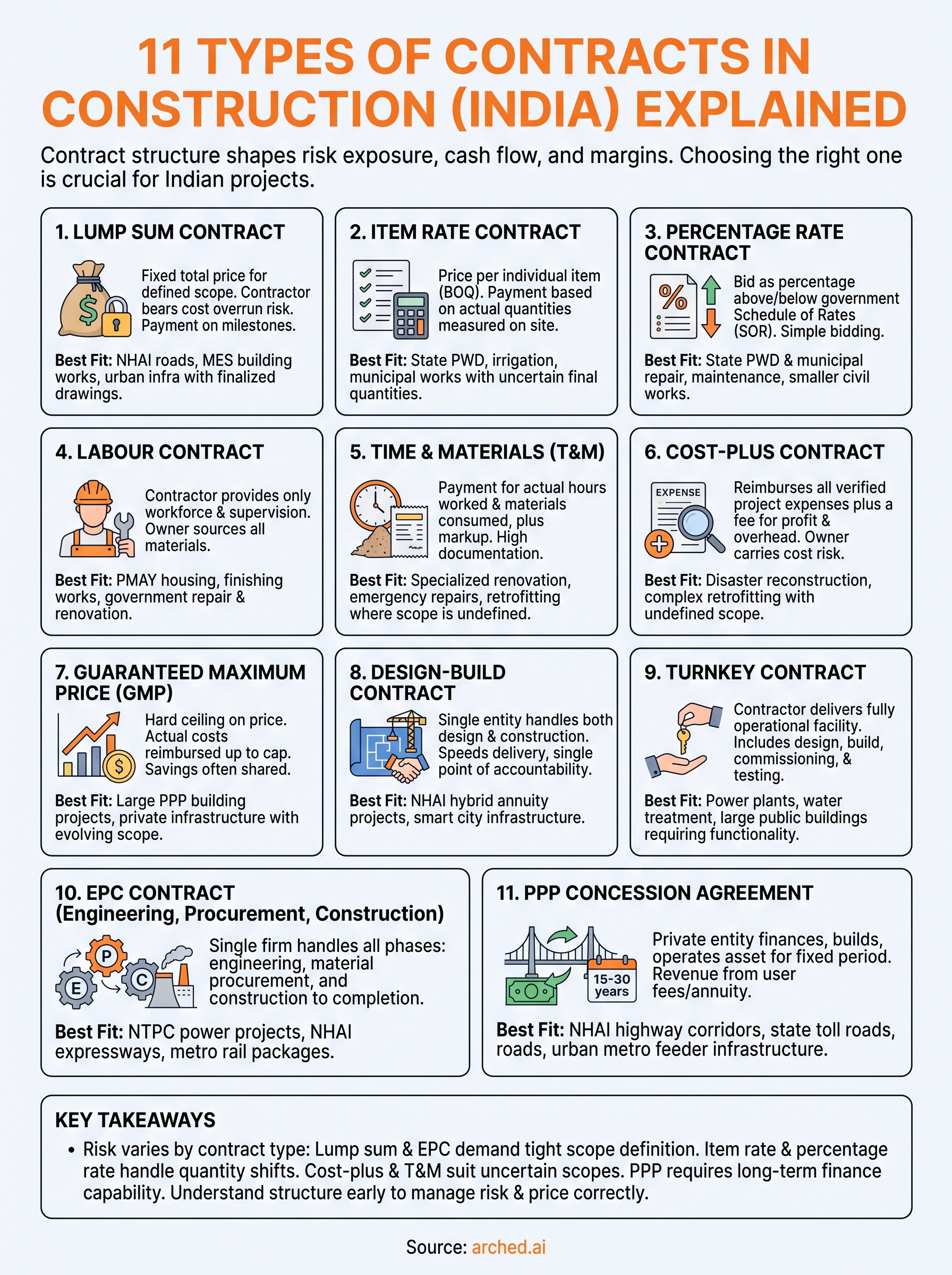
Each of the types of contracts in construction covered here distributes risk differently, and the structure your client or tender authority chooses shapes your cash flow, liability, and margin before you write a single method statement. Lump sum and EPC contracts demand tight scope definition upfront. Item rate and percentage rate contracts protect you when quantities shift. Cost-plus and T&M arrangements suit genuinely uncertain scopes but require airtight documentation discipline. PPP concession agreements are in a different league entirely, requiring project finance capability alongside construction expertise.
Your strongest move is reading the contract structure and key clauses as early as possible in the bid evaluation process, not after you've committed resources to a proposal. The sooner you identify mismatches between your firm's credentials and the contract risk profile, the more time you have to price correctly or walk away. If you want to speed up that analysis across hundreds of tenders simultaneously, explore what Arched can do for your BD pipeline.