What Is Defect Liability Period in Construction? Vs Warranty
Understand what is defect liability period in construction. Learn to manage post-handover repairs, handle warranties, and secure your retention money.
Every government construction contract in India, whether sourced through GeM, CPPP, or a state e-procurement portal, contains a clause that kicks in after the project is handed over. If you've ever wondered what is defect liability period, it's the contractual window during which the contractor remains responsible for fixing defects that surface after completion, at their own cost. Miss its implications during bid evaluation, and you're staring at unexpected expenses that eat straight into margins.
The defect liability period (DLP) is often confused with a warranty, but the two serve different purposes and carry different legal weight. Understanding this distinction matters when you're reviewing tender documents for risk clauses buried in annexures, exactly the kind of detail that platforms like Arched parse automatically when analyzing government tenders across 500+ procurement portals.
This article breaks down how the DLP works in construction contracts, what durations are standard across Indian public works projects, what responsibilities fall on the contractor, and where the line between a DLP and a warranty actually sits. Whether you're a bid manager evaluating a new opportunity or a project lead closing out a contract, this is the reference you need.
Why the defect liability period exists
Construction projects don't reveal all their flaws at handover. Workmanship issues, material failures, and design-execution mismatches often take months to surface, especially after a structure faces real loads, monsoon cycles, or heavy operational use. The defect liability period exists precisely because handover certificates are not quality guarantees. They confirm that a project meets visible completion criteria, not that it will perform without fault for the next several years.
Indian public works contracts, particularly those governed by CPWD specifications or state PWD conditions, recognized this gap decades ago. The DLP became a standard mechanism to hold contractors accountable for latent defects without forcing clients to chase legal remedies through courts the moment an issue appears. It creates a straightforward obligation: if a defect surfaces within the agreed window, the contractor fixes it, no negotiation required.
The gap between completion and real-world performance
A building or infrastructure asset behaves differently under service conditions than it does during inspection. Thermal expansion, settlement, and moisture penetration work on materials over time in ways that no pre-handover test fully replicates. A road that looks sound after construction may show surface cracking after one full monsoon season. A retaining wall may hold perfectly at handover but develop drainage-related failures six months later.
The DLP is the contractual mechanism that bridges the gap between formal project completion and proven, real-world performance.
This is why understanding what is defect liability period matters long before you sign a contract. The clause forces both parties to think ahead: the contractor builds with post-handover accountability in mind, and the client holds a clear, enforceable path to remedy if something goes wrong. For you as a bid manager reviewing tender documents, this clause signals how much financial and operational exposure the contract carries beyond the completion date.
Who bears the risk during the DLP
During the DLP, the contractor carries the full cost of investigating, accessing, and repairing any defect that falls within the clause's scope. This isn't a shared arrangement. If the client identifies a qualifying defect and notifies the contractor within the period, the contractor mobilizes resources and completes the repair at their own expense. Failure to do so typically gives the client the right to engage a third party and recover costs from the contractor's retention money or bank guarantee.
This structure places significant financial risk on the contractor's side of the ledger. A firm that prices a bid without factoring in potential DLP obligations leaves itself exposed. In high-value government infrastructure projects, where retention amounts often sit at 5% to 10% of contract value, the DLP period determines exactly how long that money stays locked up and under whose control it remains.
How defect liability period works in contracts
Most tender documents embed the DLP clause within the general conditions of contract, often referencing the standard terms set by the National Building Code or the relevant PWD schedule. The clause specifies three things: when the period starts, how long it runs, and what the contractor must do if a defect is notified during that window.
When the clock starts
The DLP typically begins on the date of practical completion, which is the date the client issues a completion certificate confirming the work meets contractual requirements. Some contracts, particularly those following FIDIC or MES conditions, use the term "taking-over certificate" instead, but the trigger is the same: formal client acceptance of the completed works.
If your project covers multiple sections delivered in phases, each section can carry its own DLP start date. This is a detail that often gets missed during bid reviews. A phased DLP multiplies the overlap periods your firm must manage simultaneously, extending your post-project financial exposure well beyond what a single completion date would suggest.
Always check whether the contract defines one DLP start date or section-specific start dates before you price the risk.
How retention money ties to the DLP
Retention money is the financial lever that enforces DLP obligations. Under standard Indian government contracts, the client holds back a percentage of each running account bill, typically 5% of the certified value, and releases it only after the DLP expires without outstanding defect notices.
Your firm's retention funds stay locked inside the client's account for the entire DLP duration. If defects arise and you fail to repair them within the notice period, the client draws against the retention or performance bank guarantee to fund third-party repairs. This is why understanding what is defect liability period in contract terms goes beyond legal formality; it directly determines your cash flow timeline after project handover.
What counts as a defect during the DLP
Not every post-handover complaint qualifies as a defect under the DLP. Most government contracts define a defect as any fault, shrinkage, or failure that results from materials or workmanship not conforming to the contract specifications. If the work matches what the tender documents required, the client cannot invoke the DLP simply because they dislike the outcome. Understanding this boundary is central to grasping what is defect liability period in practice, not just in theory.
Workmanship and material failures
The clearest category covers defects that trace directly back to how the work was executed or what materials were used. Cracks in structural concrete that exceed specified tolerances, waterproofing failures on roofs or basements, and premature surface deterioration on road pavements all fall here. These are failures you produced, and the DLP holds you responsible for correcting them at your own cost.
If the defect traces back to your materials or methods, the DLP applies regardless of when it becomes visible.
A useful way to confirm whether a defect falls within scope is to check it against the approved material lists and contract drawings. If the failure results from a deviation from those documents, the obligation to repair sits firmly with you, and the client has full grounds to issue a formal defect notice.
What falls outside the contractor's liability
Some post-handover failures do not qualify as DLP defects. Damage caused by the client's operational misuse, modifications made by third parties after handover, and failures resulting from design errors introduced by the employer's team all sit outside your scope. Similarly, normal wear and tear from standard operational use does not trigger a DLP obligation.
This distinction matters when a client raises a defect notice. Before you mobilize repair crews, review whether the failure stems from your work or from something the client introduced post-completion. Accepting liability for defects outside your scope sets a dangerous precedent and drains retention funds that you have already earned.
Defect liability period vs warranty and maintenance
The terms DLP, warranty, and maintenance period often appear in the same contract section, and many bid managers treat them as interchangeable. They are not. Each serves a distinct purpose and places different obligations on different parties. Understanding what is defect liability period and how it differs from a warranty shapes how you price risk before you submit a bid.
What a warranty covers that the DLP doesn't
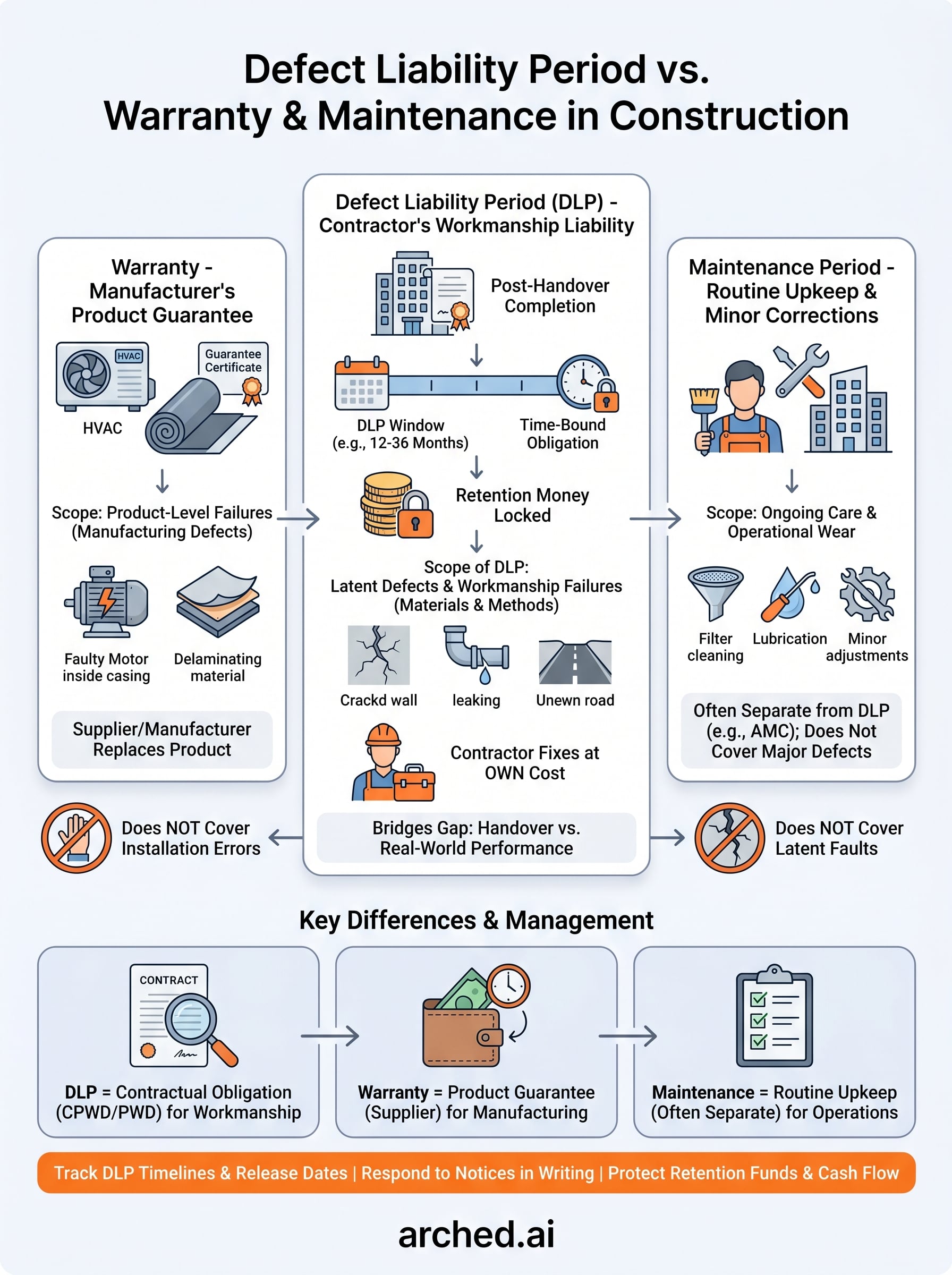
A warranty is a manufacturer's or supplier's guarantee attached to a specific product or component, such as a waterproofing membrane, an HVAC system, or structural steel fabrication. It runs from the date of installation or handover and covers product-level failures that stem from manufacturing defects, not workmanship errors. If a certified membrane fails within its five-year warranty window, the supplier bears the cost of replacement, not you.
The DLP covers your workmanship; a warranty covers the product itself. These are separate obligations with separate remedies.
The DLP, by contrast, is contractually imposed by the client and covers the totality of how you built the structure. It pulls in workmanship, coordination, and material application together. A warranty from a supplier does not discharge your DLP obligation if your installation method caused the failure, even if the product itself is factory-certified.
Where maintenance periods fit in
A maintenance period, sometimes called a defects notification period in FIDIC contracts, overlaps closely with the DLP in function but differs in scope. During a maintenance period, your obligation typically covers routine upkeep and minor corrections, not structural or latent defect repairs of the kind the DLP addresses.
Some Indian government contracts bundle maintenance obligations directly into the DLP clause, expecting you to maintain the asset alongside repairing defects. Others separate them cleanly, with a dedicated Annual Maintenance Contract (AMC) taking over once the DLP closes. Before you price either obligation, check the contract conditions carefully to confirm whether your post-handover exposure covers defect repair only, maintenance only, or both running simultaneously. That distinction shifts your cost calculations significantly.
How to manage DLP in Indian government works
Understanding what is defect liability period in theory is one thing. Managing it across multiple active government contracts simultaneously is the real operational challenge. Indian public works contracts under CPWD, state PWDs, and MES often run DLP periods of 12 to 36 months, meaning your firm can carry several overlapping DLP obligations at any given time. Treating DLP management as a post-project afterthought rather than a live contract management task exposes your retention funds and bank guarantees to unnecessary risk.
Track DLP timelines and retention release dates
Your finance and project teams need a dedicated tracking system for every active DLP period, mapped against each contract's retention release schedule. For each project, log the practical completion date, the DLP expiry date, and the exact retention amount held. Without this, your firm loses visibility over when cash becomes available and misses the window to formally request retention release once the DLP closes.
Many firms discover retention release delays only when they check bank statements months after a DLP has expired. A shared tracker updated weekly prevents this entirely. For larger bid portfolios, purpose-built contract management tools give you automated alerts tied to DLP milestones so nothing slips through.
Respond to defect notices in writing
When a client issues a defect notice during the DLP, your first step is always written acknowledgment, not a verbal agreement. Confirm receipt, state your intended inspection date, and log the full communication trail. This protects you if a dispute arises over whether a defect falls within your scope or whether the client exceeded the notice timeline stipulated in the contract.
Treating every defect notice as a formal document event, not a casual site conversation, keeps your contractual position clean throughout the DLP.
If you inspect a defect and find it falls outside your scope, respond in writing within the contract's specified reply period. Silence is routinely treated as acceptance of liability under Indian government contract conditions, a position that is very difficult to reverse once the client has already engaged third-party repair crews.
Final takeaways
Understanding what is defect liability period is not a legal formality you can skim over during bid review. The DLP determines how long your firm carries post-handover financial exposure, how much retention money stays locked up, and what repair obligations you accept the moment you sign a contract. Every clause around duration, notice timelines, and defect scope directly affects your cash flow and project profitability long after your team leaves the site.
Your strongest protection against DLP risk is preparation before the contract starts, not damage control after a defect notice lands. Read the DLP clause carefully, confirm whether maintenance obligations run alongside it, and build retention release dates into your financial tracking from day one. Responding to every defect notice in writing keeps your contractual position clean and defensible.
If you want to spot DLP risk clauses before you commit to a bid, explore what Arched can do for your tendering process.