What Is a Work Completion Certificate? Meaning, Format & Use
Understand what is work completion certificate, the correct format, and how to use it for Indian tenders. Secure your eligibility and bid with confidence.
A work completion certificate is one of the most consequential documents in government contracting, and one of the most overlooked until it's urgently needed. It serves as formal proof that a contractor has successfully finished a project to the client's satisfaction, and in India's public procurement ecosystem, it directly determines what you can bid on next.
Every major tender on GeM, CPPP, or state e-procurement portals asks for proof of past performance. Without a properly issued completion certificate, your firm's track record essentially doesn't exist on paper, no matter how many projects you've delivered. This is exactly why Arched's platform flags credential gaps during tender matching: a missing or poorly formatted certificate can disqualify you from contracts worth crores.
This article breaks down what a work completion certificate actually contains, when and why you need one, who issues it, and how to format it correctly. You'll also find ready-to-use templates in Word and PDF so you can request or draft one without starting from scratch.
What a work completion certificate includes
When you examine what is work completion certificate documentation in practice, it's more than a simple sign-off form. It's a structured document that captures the full identity of a project, from the contract number and scope of work to the final handover date and payment status. Government clients in India expect specific fields to appear in a consistent order, and any missing element can make the certificate unusable for future tender submissions.
Project and contract details
The first section of the certificate establishes the basics: the contract number, project title, and the names of both the client and the contractor. You'll also find the contract value here, along with the commencement date and the agreed completion date. These fields let a tender evaluation committee quickly verify that your firm handled a project of the right scale, type, and complexity to qualify for the new contract you're pursuing.
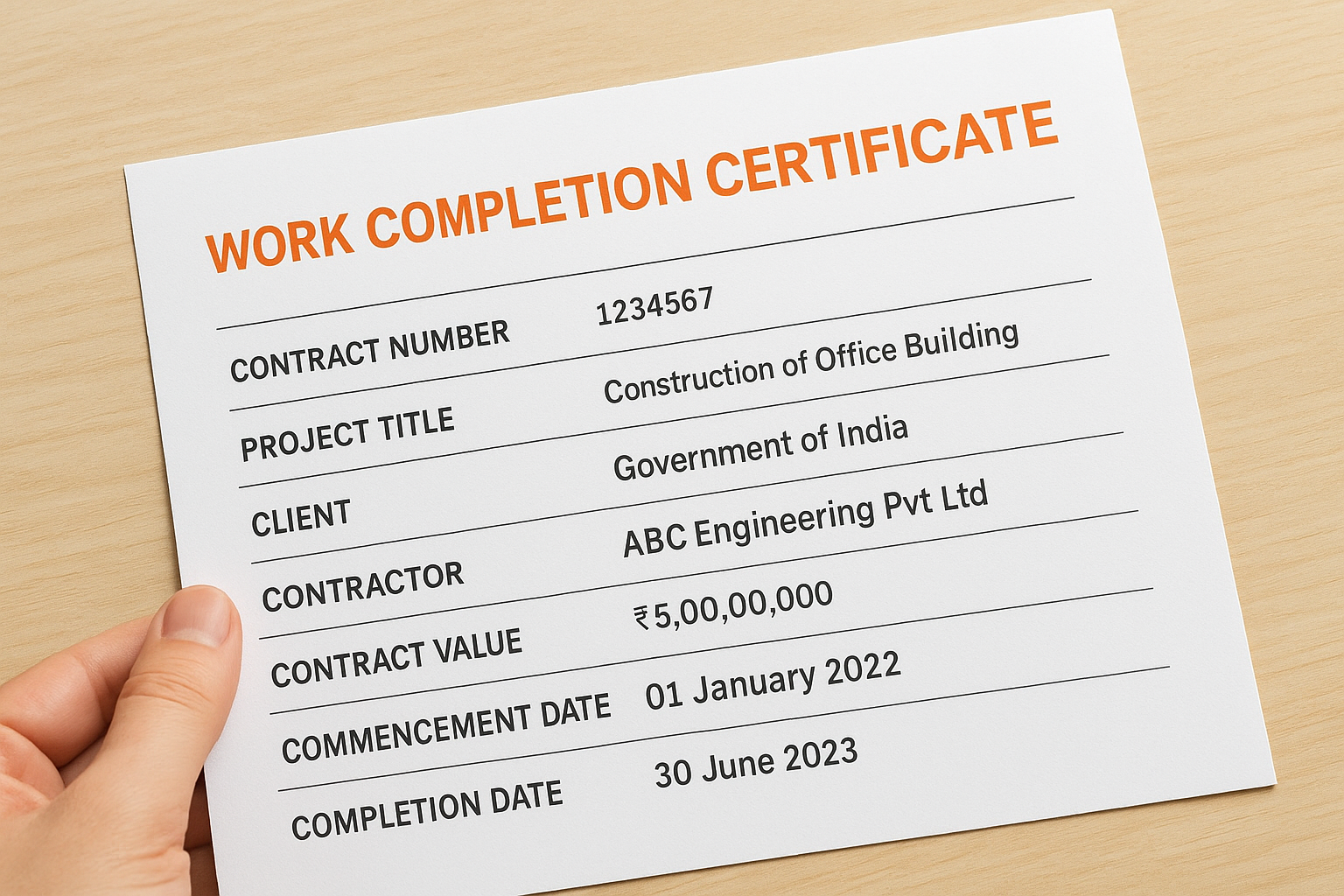
A certificate that omits the contract value or the project category is practically worthless for government tender pre-qualification in India.
Performance and quality statements
Below the project details, the certificate includes a clear statement confirming that the work was completed as per the contract scope and met the required technical standards. This is where the issuing authority confirms there are no outstanding defects or pending obligations. Some certificates go further and rate the contractor's performance, timeliness, and quality of workmanship on a qualitative scale.
Many state PWD departments and central agencies like CPWD require this performance assessment section to be explicitly present. Without it, evaluators may reject the certificate during shortlisting, even if the project scope and value are clearly stated.
Signatures and authorization
The final and most critical part is the authorization block. It must carry the signature, name, and designation of the issuing officer, along with the official seal or stamp of the client organization. A certificate signed by someone without the authority to issue it, such as a site engineer rather than an Executive Engineer or equivalent, will likely be challenged during document scrutiny.
You should also confirm that the date of issue appears clearly and that it falls after the actual project handover date. Tender evaluators frequently cross-check this against the completion date listed in the body of the certificate, so any inconsistency creates a red flag that could cost you the bid.
Why a work completion certificate matters
Understanding what is work completion certificate documentation does for your business goes far beyond a simple formality. Every tender authority in India treats this certificate as hard evidence of your capacity, and without it, your firm's track record on paper starts at zero regardless of your actual delivery record.
It determines your eligibility for future tenders
Government tenders routinely require proof of similar work experience, typically demanding that you demonstrate you've completed one or more projects above a specified value within the last five to seven years. The work completion certificate is the only document that satisfies this requirement. A missing, incomplete, or improperly signed certificate disqualifies your bid outright, even when your team has the technical skills to deliver.
Tender evaluation committees in India do not accept verbal references or internal project records in place of a formally issued completion certificate.
Your certificate also directly affects your firm's eligibility band, meaning the size and complexity of contracts you can pursue. Firms that collect well-structured certificates consistently move into higher-value tender categories over time.
It protects you in payment disputes
Beyond eligibility, the certificate serves as legal proof of contract fulfillment. If a client withholds final payment or raises a dispute about scope after handover, a properly issued certificate becomes your strongest supporting document. It records that both parties acknowledged the work as complete and acceptable.
Retaining signed copies of every certificate in an organized system protects your firm from retrospective claims and speeds up the resolution of billing disagreements. This matters most on government projects, where payment cycles run long and disputes can drag on for months.
Who issues it and when to use it in India
Understanding what is work completion certificate authority in India means recognizing that the issuing party varies by project type and sector. The client organization, meaning the body that awarded and funded the contract, always issues the certificate. This is not a document your own firm produces unilaterally. It requires the client's formal acknowledgment that the work is done and acceptable.
Who has the authority to issue it
In public sector projects across India, the designated authority is typically an Executive Engineer, Project Director, or a senior officer of equivalent rank within the client department. For central government projects under CPWD or the Ministry of Road Transport and Highways, the authority hierarchy is clearly defined in the contract terms. For state government projects under PWD, irrigation departments, or urban local bodies, the competent authority designation varies by state, so you should confirm this before handover to avoid receiving a certificate signed at the wrong level.
A certificate signed by a junior site-level officer rather than the authorized departmental head carries no weight during tender pre-qualification in India.
Private clients and PSUs such as ONGC, NTPC, or NMDC also follow internal authorization protocols, and most of them require the certificate to carry both the engineer-in-charge signature and a senior management countersignature.
When to submit it during the bid process
You submit the work completion certificate at the technical bid stage, not after financial evaluation. Most tender documents on portals like CPPP and GeM specify that experience certificates must accompany your bid packet during document upload. Waiting until the evaluation stage to arrange missing certificates almost always results in disqualification, so collecting and organizing these documents immediately after every project handover should be a fixed step in your firm's process.

How to create and sign a work completion certificate
Since the client issues the certificate, your role in understanding what is work completion certificate creation is primarily about initiating the process correctly and ensuring the output meets tender requirements. In most cases, you draft the document yourself, present it to the client for review, and request that their authorized officer signs and stamps it. Clients almost never produce these documents on their own initiative.
Draft the document with complete project data
Start by pulling all project details from your contract agreement: the contract number, project title, contract value, scope of work, commencement date, and actual completion date. Include a clear performance statement confirming the work was delivered per the agreed specifications and that no outstanding obligations remain. Avoid vague phrasing like "work satisfactorily completed" without any specifics, since evaluators want a document they can verify against public records.
Key fields to include in every draft:
- Contract number and project title
- Client organization name and contractor name
- Contract value and full project scope
- Commencement date and actual completion date
- Performance statement and authorized signature block
A draft you prepare yourself signals professionalism to the client and significantly reduces the time it takes to receive a signed certificate.
Follow the correct authorization process
Once your draft is ready, submit it formally in writing to the client's designated authority, typically the Executive Engineer or Project Director assigned to your contract. Attach a short covering letter referencing the project name, contract number, and the date of final handover.
Follow up within two weeks if you receive no response. Collecting the certificate while the project is fresh in the client's memory is far easier than chasing it months later when staff may have rotated or records are harder to retrieve.
Work completion certificate format and samples
Understanding what is work completion certificate structure in practice means having a reliable format you can adapt for any project type. Most government clients in India accept a one-page format for smaller contracts, while larger infrastructure projects may require a two-page document with a detailed scope summary. Using a consistent template across all your projects reduces errors and makes document collection a predictable step rather than a last-minute chase.
Keep a blank master template on file so you can fill it in immediately after every project handover, while project details are still fresh.
Standard format template
The fields below represent the minimum acceptable structure for a work completion certificate that will hold up during government tender pre-qualification in India. You can copy this directly into Microsoft Word and save a signed PDF version once the authorized officer stamps it.
| Field | Details to include |
|---|---|
| Certificate title | "Work Completion Certificate" |
| Contract number | As per the original agreement |
| Project title | Full name of the project |
| Client name | Issuing organization |
| Contractor name | Your firm's registered name |
| Contract value | In INR, figures and words |
| Scope of work | Brief description of work performed |
| Commencement date | As per contract |
| Actual completion date | Date of physical handover |
| Performance statement | Confirm work meets contract specifications |
| Authorized signature | Name, designation, official seal, date |
Word and PDF versions
Save your template in two formats: an editable Word file for drafting and a locked PDF for final submission. Standard word-processor table formatting is what most government clients find easiest to review and countersign.
Once the authorized officer signs and stamps the document, scan it immediately and store the PDF in a dedicated credentials folder organized by project year and contract value. This habit means you can locate and submit any certificate within minutes when a tender deadline hits.
Key takeaways
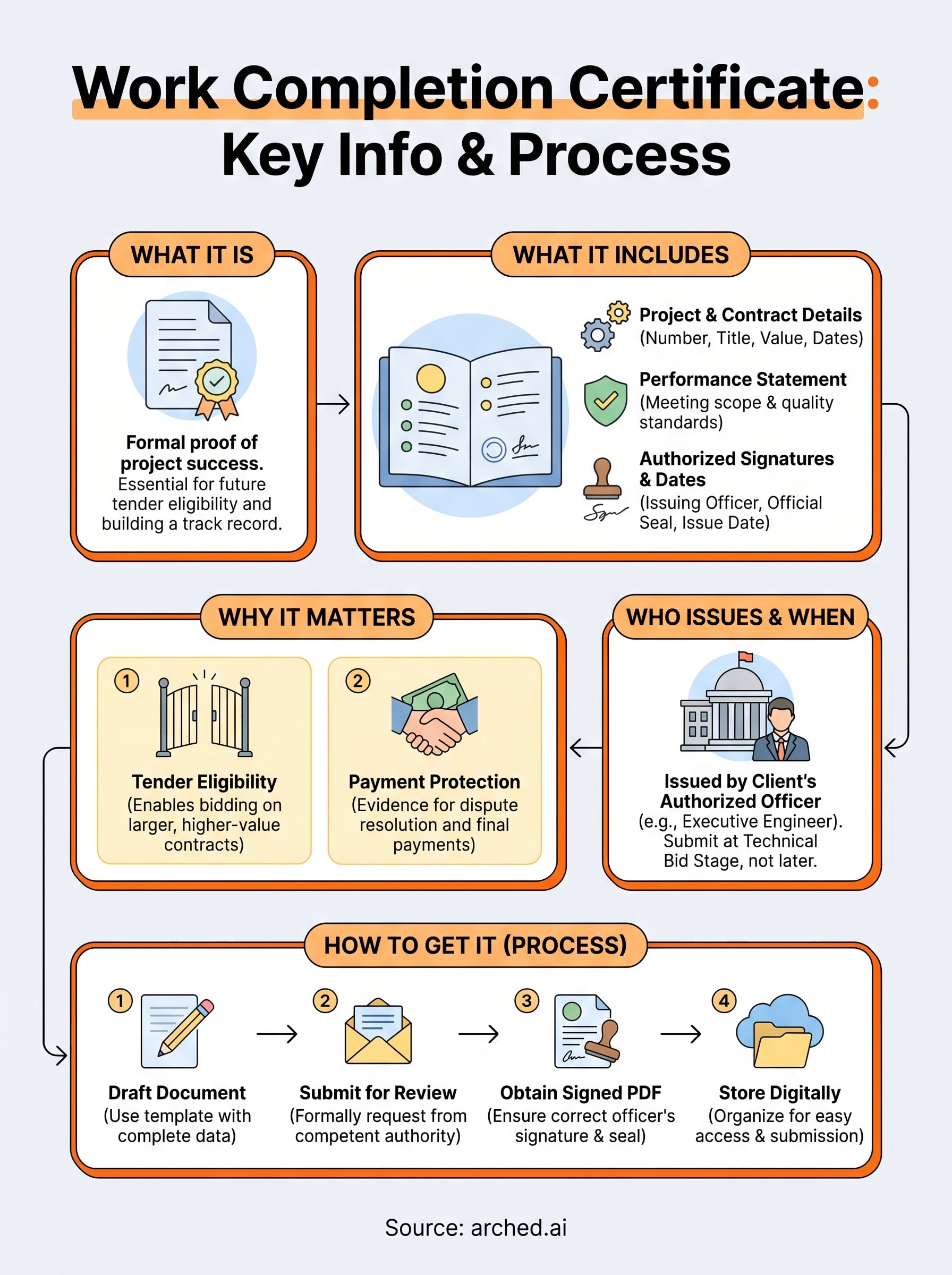
A work completion certificate is your firm's primary proof of past performance in India's government contracting system. Understanding what is work completion certificate documentation means recognizing that every field matters: a missing contract value or an unauthorized signatory can disqualify your bid outright. Collect these certificates immediately after every project handover, not when a deadline forces you to scramble.
Your long-term eligibility depends on building a well-organized library of properly signed certificates. Each certificate you collect opens access to higher-value contract tiers, and each gap in your credentials closes doors. Draft the document yourself, submit it to the correct authorized officer, and store a signed PDF and an editable Word backup of every project.
Arched's platform is built to map your credential gaps and match tenders to your actual eligibility, so you stop missing contracts due to documentation oversights. See how Arched can support your bid strategy.