Digital Signature for Government Tenders: Class 3 DSC Guide
If you've ever tried to submit a bid on GeM, CPPP, or any state e-procurement portal, you've hit the same wall: no DSC, no submission. A digital signature certificate is the electronic credential that proves your identity and lets you legally sign documents online, and in Indian government contracting, it's non-negotiable. Without one, your firm simply cannot participate in e-tendering.
A DSC does more than unlock portal access. It binds your identity to every document you sign electronically, ensuring that the bid you submit can't be tampered with or disputed. For infrastructure firms and contractors chasing public sector work, it's the first real checkpoint in the procurement process, one that comes before you ever evaluate a tender's BOQ or eligibility criteria.
Nothing else in a government bid matters if your DSC isn't sorted. This guide breaks down exactly what a digital signature certificate is, how the technology behind it works, the different types available in India, and step-by-step how to get one so you can move from paperwork to actual bidding.
Why digital signature certificates matter in India
India's Information Technology Act, 2000 gave digital signatures the same legal standing as handwritten ones. That single legislative move changed the procurement landscape permanently. If you're asking what is a digital signature certificate and whether it actually carries legal weight in India, the answer is yes, and the government has built its entire e-procurement infrastructure around that fact.
The IT Act and legal enforceability
Section 3 of the IT Act, 2000 establishes the legal validity of digital signatures across India. When you sign a document using a DSC, that signature is legally enforceable in a court of law, just like ink on paper. The Controller of Certifying Authorities (CCA), operating under the Ministry of Electronics and Information Technology (MeitY), oversees the entire DSC ecosystem and licenses the Certifying Authorities allowed to issue them.
A DSC is not just a technical access tool; it is a legally recognized identity credential backed by national legislation.
This framework means that any tampering with a digitally signed document is immediately detectable and legally actionable. For firms bidding on government contracts, this gives both the buyer and the bidder verified confidence that documents submitted are authentic and unaltered from the moment of signing.
Why e-procurement portals require a DSC
India's major government procurement platforms, including GeM, CPPP, and state-level e-tender portals, all mandate DSC-based authentication before you can submit a bid. This is not a policy preference; it is a technical and legal requirement built directly into how these portals function. Your login credentials alone are not enough to file a submission.
The scale of India's public procurement makes this requirement critical. Hundreds of thousands of tenders are processed annually across infrastructure, defense, health, and urban development sectors. Without a standardized authentication mechanism like a DSC, the system would be open to fraud, identity theft, and document manipulation at enormous scale.
For AEC firms specifically, every portal your BD team monitors, from IREPS to state road and irrigation departments, requires a valid DSC to submit bids or upload qualification documents. Missing a DSC renewal deadline can lock your firm out of active tenders mid-cycle, and in high-value infrastructure bids, that means direct revenue loss. Getting this foundation right is not optional; it is the first operational requirement before any serious tendering strategy can begin.
How a digital signature certificate works
Understanding what is a digital signature certificate means understanding the cryptography underneath it. A DSC relies on Public Key Infrastructure (PKI), a two-key system where one key encrypts data and a mathematically linked key decrypts it. When a Certifying Authority issues your DSC, it binds your identity to a unique key pair, one public and one private, stored on a USB token.
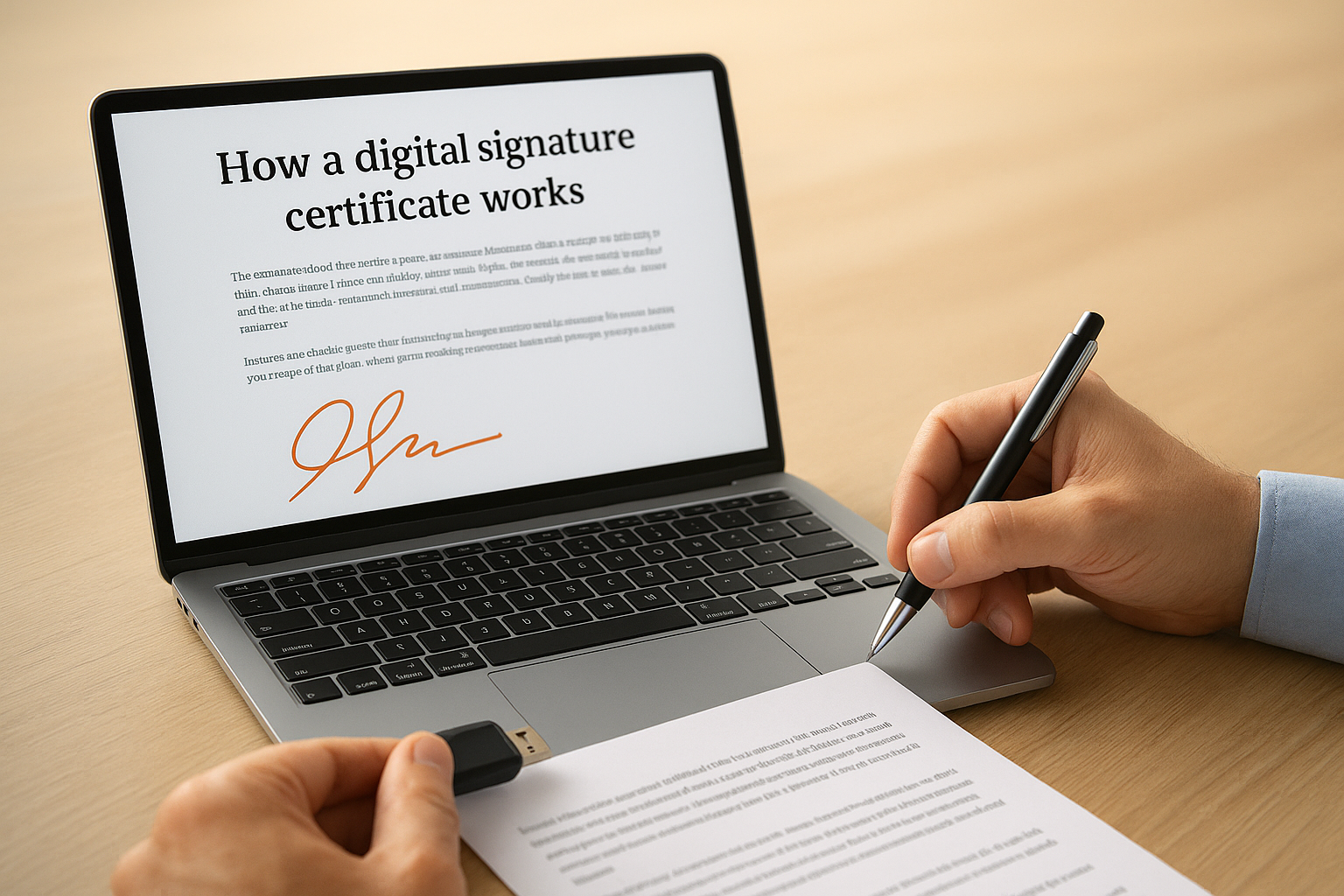
Public and private key cryptography
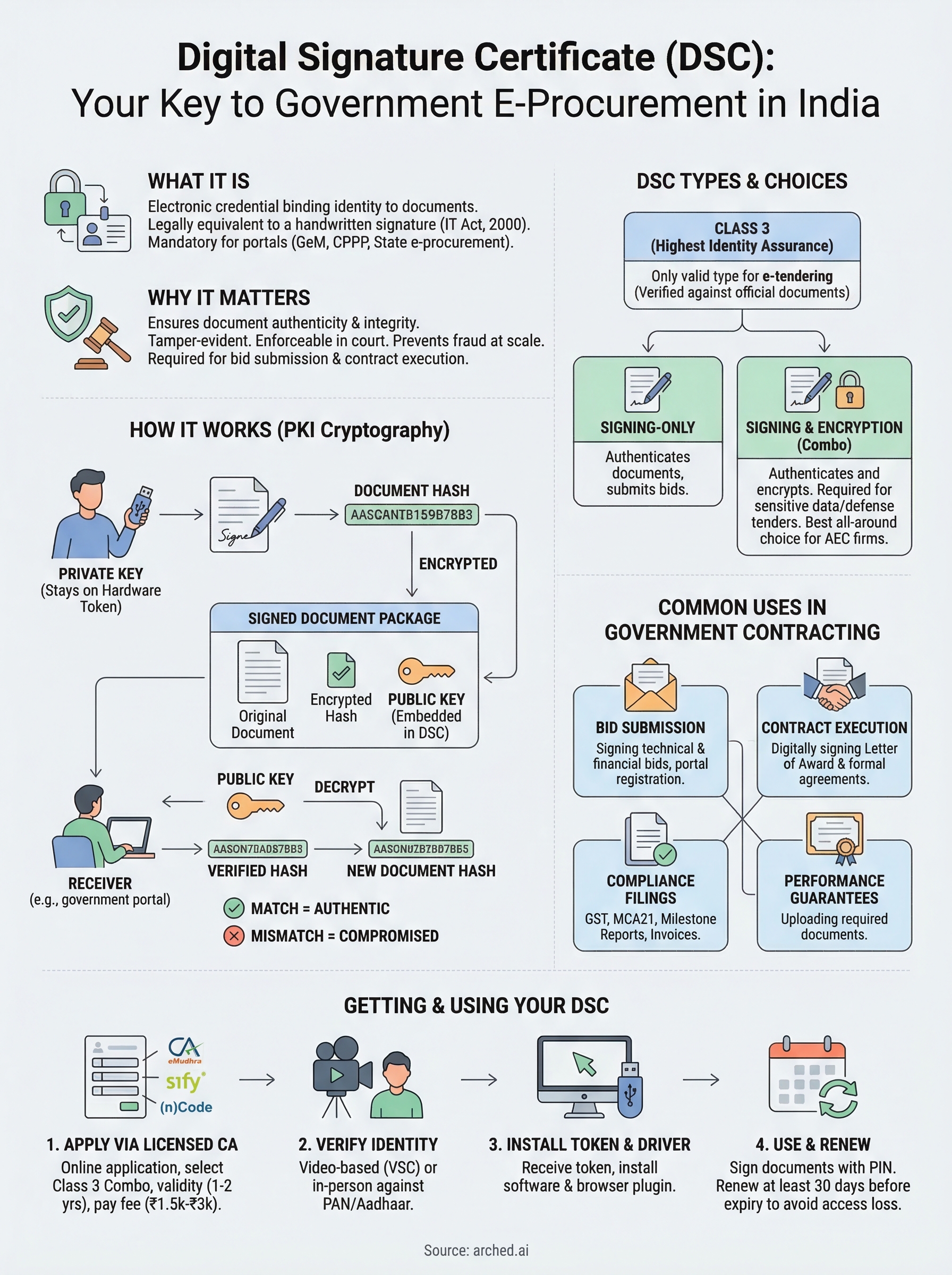
Your private key stays on your hardware token and never leaves it. Your public key is embedded in your DSC and shared openly. When you sign a document, your private key generates a unique cryptographic hash for that exact file. Anyone receiving the document uses your public key to verify that hash, which confirms both who signed it and that nothing in the document changed after signing.
If even a single character in the document is altered after signing, the hash verification fails instantly, making tampering impossible to hide.
What happens when you sign a document
The signing process takes seconds but runs several operations in sequence. Your token generates a hash of the document, encrypts it with your private key, and attaches it to the file along with your DSC. The receiving portal or party then decrypts that hash using your public key and compares it to a freshly generated hash of the same document. A match confirms authenticity. A mismatch flags the document as compromised. For government portals processing hundreds of bid submissions daily, this automated verification is what makes large-scale, tamper-proof procurement possible.
Types of DSCs and how to choose the right one
India's Controller of Certifying Authorities simplified the DSC landscape in 2021 by discontinuing Class 1 and Class 2 certificates. If you're asking what is a digital signature certificate and which type applies to you as a contractor, the answer is straightforward: Class 3 is now the only class valid for government e-procurement, covering identity verification against official government databases before issuance.
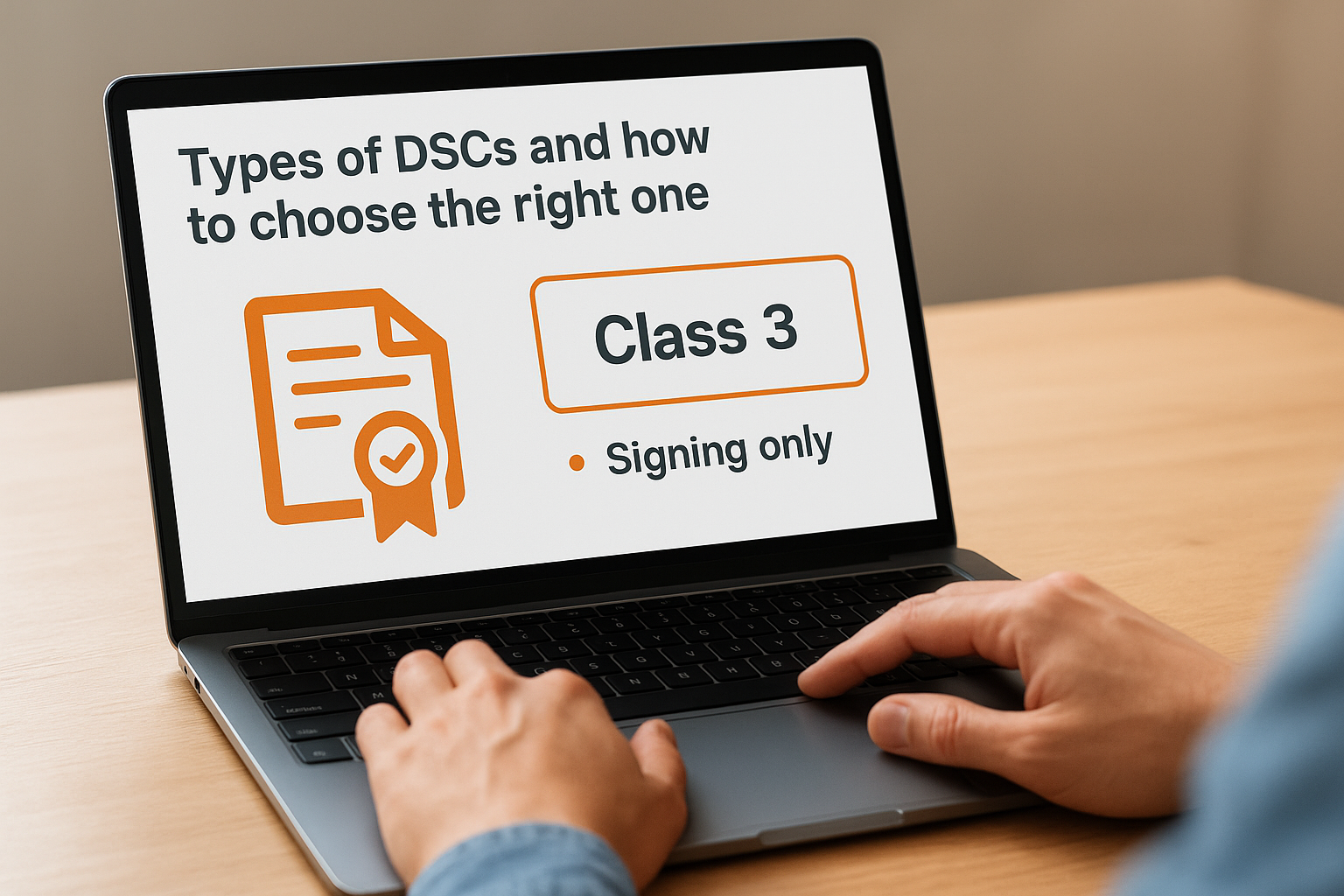
Class 3: the only option for e-tendering
Class 3 DSCs carry the highest level of identity assurance available under the Indian PKI framework. To obtain one, your identity gets verified in person or through a video-based process against government-issued documents like your PAN, Aadhaar, or passport. Every portal your firm will use, whether GeM, CPPP, or any state e-tender system, requires Class 3 specifically. There is no workaround or lower-class substitute accepted in active procurement.
Attempting to use an outdated Class 2 certificate on a live portal will result in an authentication failure, which can block your bid submission entirely.
Signing-only vs. signing and encryption
Within Class 3, you choose between two functional variants. A signing-only DSC lets you authenticate documents and submit bids but does not encrypt file content. A signing and encryption (combo) DSC adds a second key pair that encrypts your bid documents during transmission, which several portals, particularly defense and infrastructure procurement systems, require to protect commercially sensitive data. For most AEC firms bidding across multiple portal types, a combo DSC is the safer default choice since it covers both requirements without needing a second certificate.
Common uses for DSCs in government contracting
Once you understand what is a digital signature certificate and get one issued, you'll use it across nearly every stage of the procurement cycle. Government contracting in India is end-to-end digital, and your DSC is the credential that authenticates your firm at each touchpoint, from the moment you register on a portal to the point you execute a contract.
Bid submission and portal registration
Every portal registration requires you to authenticate with your DSC before your firm profile goes live. When you submit a bid, your DSC signs the entire bid package, including the technical and financial envelopes, so the portal can confirm the documents came from your firm and remained unaltered in transit. Portals like GeM and CPPP reject any submission where DSC authentication fails, regardless of how complete the bid documents are.
Missing a DSC renewal before a live submission deadline is one of the most avoidable reasons firms lose competitive tenders.
Contract execution and compliance filings
Your DSC's role does not stop at bid submission. Once you win a contract, the Letter of Award and formal contract documents are executed digitally using the same certificate. Many government agencies also require DSC-authenticated uploads for milestone completion reports, invoice submissions, and performance guarantee documents throughout project execution. For firms bidding on central government work through MeitY-governed platforms, your DSC also authenticates compliance filings tied to GST and MCA21. Keeping your certificate valid and renewed well before its expiry date ensures your firm stays operational across every document-intensive phase of a government contract, not just the initial bid.
How to get, install, and use a DSC step by step
Once you understand what is a digital signature certificate and confirm you need a Class 3 DSC, getting one is a clear, sequential process. Three Certifying Authorities dominate the Indian market: eMudhra, Sify, and (n)Code Solutions. All three are licensed by the CCA and accepted across every government portal your firm will use for e-tendering.
Apply through a licensed Certifying Authority
Visit the official website of your chosen CA and select the Class 3 combo DSC option for e-tendering. Fill in your firm details, the applicant's name, and your preferred validity period, typically one or two years. Pay the issuance fee online at this stage, which generally ranges from ₹1,500 to ₹3,000 depending on the CA and the validity term you select.
Complete identity verification
After submitting your application, you'll go through video-based verification (VSC) or in-person verification against your PAN and Aadhaar. The CA's representative confirms your identity live on the call, then processes your certificate.
Most CAs complete issuance within one to three business days after successful verification, so apply well ahead of any active tender deadline.
Install the token driver and sign documents
Your DSC arrives on a USB hardware token. Install the driver software from the CA's website, plug in the token, and activate the required DSC browser plugin. On any portal like GeM or CPPP, navigate to the DSC login option, select your certificate from the token, enter your PIN to authorize the signature, and the document is signed instantly. Renew your certificate at least 30 days before expiry to avoid losing portal access during an active bid cycle.
Next steps
Now that you understand what is a digital signature certificate and how it fits into Indian government procurement, the path forward is straightforward. Get your Class 3 combo DSC issued through a licensed CA like eMudhra, Sify, or (n)Code Solutions, install the token driver, and verify that your certificate authenticates correctly on the portals your firm actively uses. Set a calendar reminder 30 days before your DSC expiry date so you never lose portal access during an active bid cycle.
Your DSC is the entry point, but winning government contracts consistently takes more than just access. Pricing the bid is where most teams lose their hours. If you need an estimate for your next tender, Arched can prepare it: send us the project and we deliver a priced BOQ reviewed by an engineer.
Have a package your team can’t get to? Send it to us. Our engineers check and sign off everything we deliver.