Contract Lifecycle Management Workflow: Stages And Steps
Learn how a contract lifecycle management workflow automates compliance and reduces risk in government bidding. Master the stages from drafting to renewal.
A single government infrastructure contract can involve dozens of documents, multiple approval stages, and compliance requirements that shift between portals. Without a structured contract lifecycle management workflow, firms end up reacting to deadlines instead of managing them, and that's where bids slip through the cracks and revenue gets left on the table.
For AEC firms and government contractors in India, this problem compounds fast. You're tracking opportunities across GeM, CPPP, IREPS, and state e-procurement portals simultaneously. Each contract moves through distinct phases, initiation, authoring, negotiation, execution, compliance, renewal, and a breakdown at any stage can stall your pipeline or disqualify you from future bids. At Arched, we built our platform around this reality: helping firms not just discover tenders, but manage the strategic path from opportunity identification to contract close using AI-driven document parsing, gap analysis, and real-time monitoring across 500+ portals.
This article breaks down every stage of the CLM workflow, step by step. You'll learn what happens at each phase, where most firms lose time or introduce risk, and how automation can cut through the manual grind of tracking obligations and deadlines. Whether you're formalizing your process for the first time or looking to tighten an existing system, this guide gives you the full picture.
What a contract lifecycle management workflow is
A contract lifecycle management workflow is a structured sequence of steps that governs every stage a contract passes through, from the initial request to final expiry or renewal. Think of it as the operating system for your contracting activity. Instead of relying on scattered emails, manual reminders, and individual memory, the workflow defines who does what, when, and in what order, so nothing critical gets missed regardless of how many contracts you're running simultaneously.
In government contracting, specifically in India's AEC sector, the word "workflow" carries extra weight. A single road development or urban infrastructure project can require multiple contract documents and sequential approval chains involving technical committees, finance departments, and project directors, plus compliance checkpoints tied to GeM or CPPP submission rules. The workflow holds all of that together. Without it, your team spends more time tracking contract status than actually winning work.
The core components of a CLM workflow
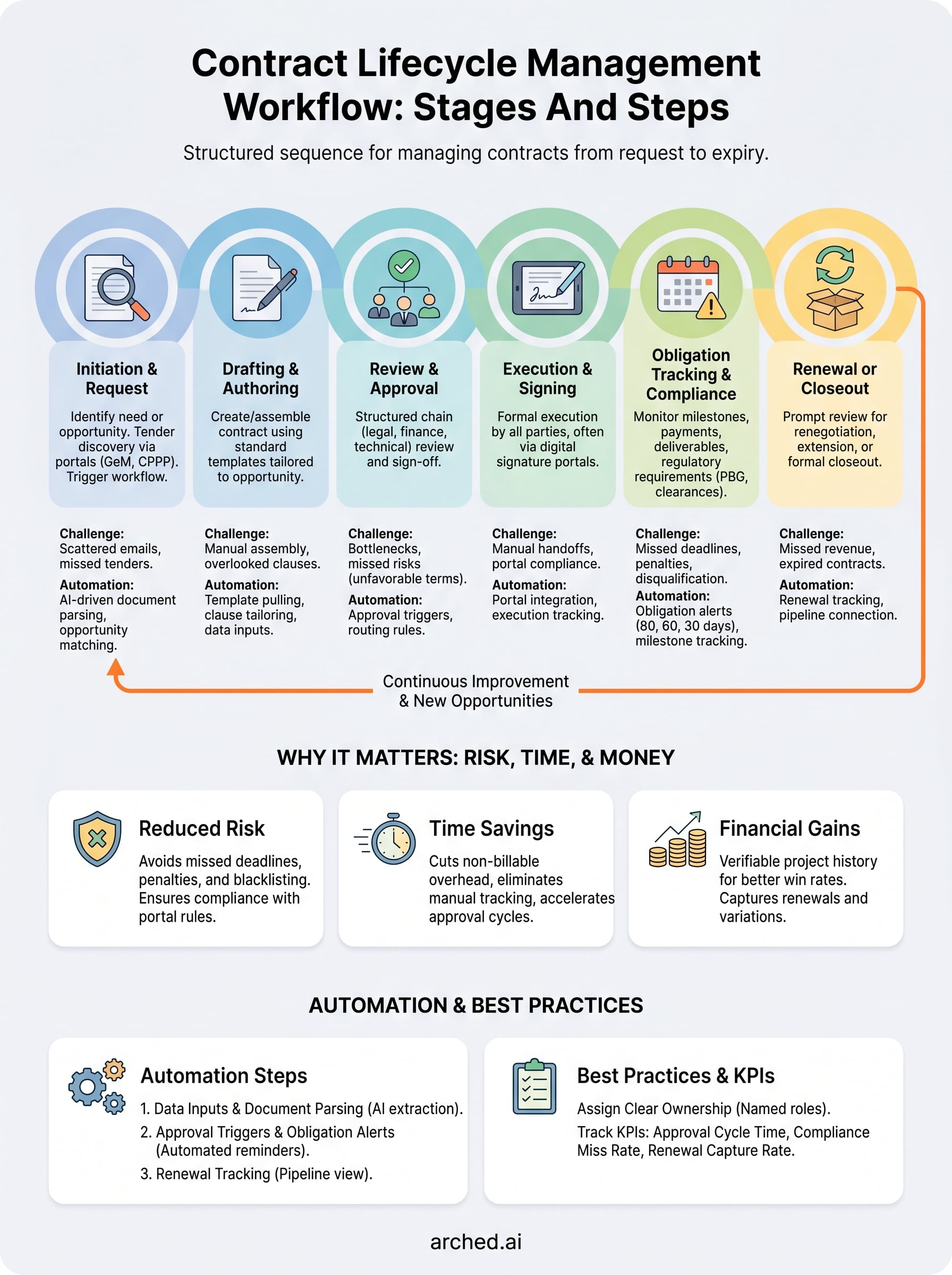
Every CLM workflow, regardless of industry, shares a common architecture. At its core, it connects people, processes, and documents across a defined timeline, where each component plays a specific role in moving the contract forward without creating bottlenecks:
- Request and initiation: Someone identifies a need or opportunity and formally triggers the contract process, whether that's a BD manager flagging a tender or a project lead requesting a subcontract.
- Drafting and authoring: Relevant team members create or assemble the contract document, pulling from standard templates and tailoring clauses to the specific opportunity.
- Review and approval: Legal, finance, and technical stakeholders review the draft, flag risks, and sign off through a defined approval chain.
- Execution and signing: All parties execute the contract, either physically or through a recognized digital signature mechanism.
- Obligation tracking and compliance: The workflow actively monitors milestones, payment schedules, deliverables, and regulatory requirements throughout the contract's active period.
- Renewal or closeout: As the contract approaches its end date, the workflow prompts review, renegotiation, or formal closeout procedures.
When any one of these components is missing or poorly defined, the entire chain breaks down, and your firm absorbs the cost in missed deadlines, penalties, or disqualification from future bids.
How a CLM workflow differs from contract management
Contract management and a CLM workflow are related but not the same thing. Contract management refers broadly to the activity of overseeing contracts. A CLM workflow is the specific, structured process that makes contract management actually function at scale. The distinction matters because many firms believe they're managing contracts when they're only storing them.
Keeping PDFs in a shared folder is not contract management. Tracking renewal dates in a spreadsheet is not a workflow. A true CLM workflow assigns ownership at every stage and sets automated triggers for review deadlines, maintaining an auditable trail of every action taken on every document. For AEC firms in India competing across hundreds of government tenders per year, that distinction separates a reactive operation from one that consistently wins.
Your firm's maturity in this area also affects how you qualify for future tenders. Many high-value government contracts in India require documented project history and verifiable compliance records to satisfy eligibility criteria. A functioning CLM workflow ensures those records exist, stay accurate, and are accessible when you need to demonstrate them inside a bid submission. That's not a nice-to-have; it's a direct factor in whether you clear the qualification threshold on a high-crore opportunity.
Why a CLM workflow matters for risk, time, and money
A broken contracting process doesn't announce itself with a single failure. It shows up in missed renewal windows, overlooked compliance clauses, and penalty fees that your team never saw coming. For government contractors in India, these gaps carry serious consequences because public procurement rules leave little room for administrative errors on active contracts.
Without a structured contract lifecycle management workflow, your firm doesn't just lose time. It absorbs compounding risk across every active contract in your pipeline.
Where risk concentrates in unmanaged contracts
Government tenders in India frequently include compliance obligations tied to specific milestones, such as performance bank guarantees, environmental clearances, and labor compliance certificates that expire on fixed dates. When no one owns the tracking of those dates, your firm defaults on obligations it didn't realize were still active. That default can trigger financial penalties, contract termination, or blacklisting from portals like GeM, which directly limits your ability to bid on future work.
Each tender document also contains clauses that carry different risk profiles. Without a structured review stage, your team signs contracts with unfavorable payment terms or ambiguous dispute resolution clauses that turn into costly problems months after execution when no one remembers the original negotiation.
How time gets lost across manual processes
BD managers at most AEC firms spend significant hours each week refreshing portals, cross-checking tender eligibility, and chasing internal approvals. Each of those activities adds non-billable overhead without moving any bid forward. When you add up the hours spent tracking contract status across multiple portals and internal systems, the cumulative cost in lost productivity becomes difficult to ignore.
A well-designed workflow reduces that drag by assigning clear ownership at each stage and triggering automated reminders before deadlines arrive. Your team stops hunting for information and starts acting on it.
The direct financial case for a tighter workflow
Firms that track contract performance data systematically tend to win more work because they can demonstrate verifiable project history and compliance records to satisfy eligibility criteria on high-value tenders. That documentation trail is often what separates a qualified bid from a disqualified one on high-crore opportunities. Contracts also contain renewal windows and variation order opportunities that go unnoticed when no one flags them before they close. A functioning workflow captures that revenue instead of letting it expire quietly.
CLM workflow stages from request to renewal
Every contract lifecycle management workflow moves through a predictable set of stages, but the details inside each stage vary depending on contract type, value, and the portals involved. Understanding what happens at each phase helps you spot where your current process leaks time or introduces compliance risk before it becomes a penalty.
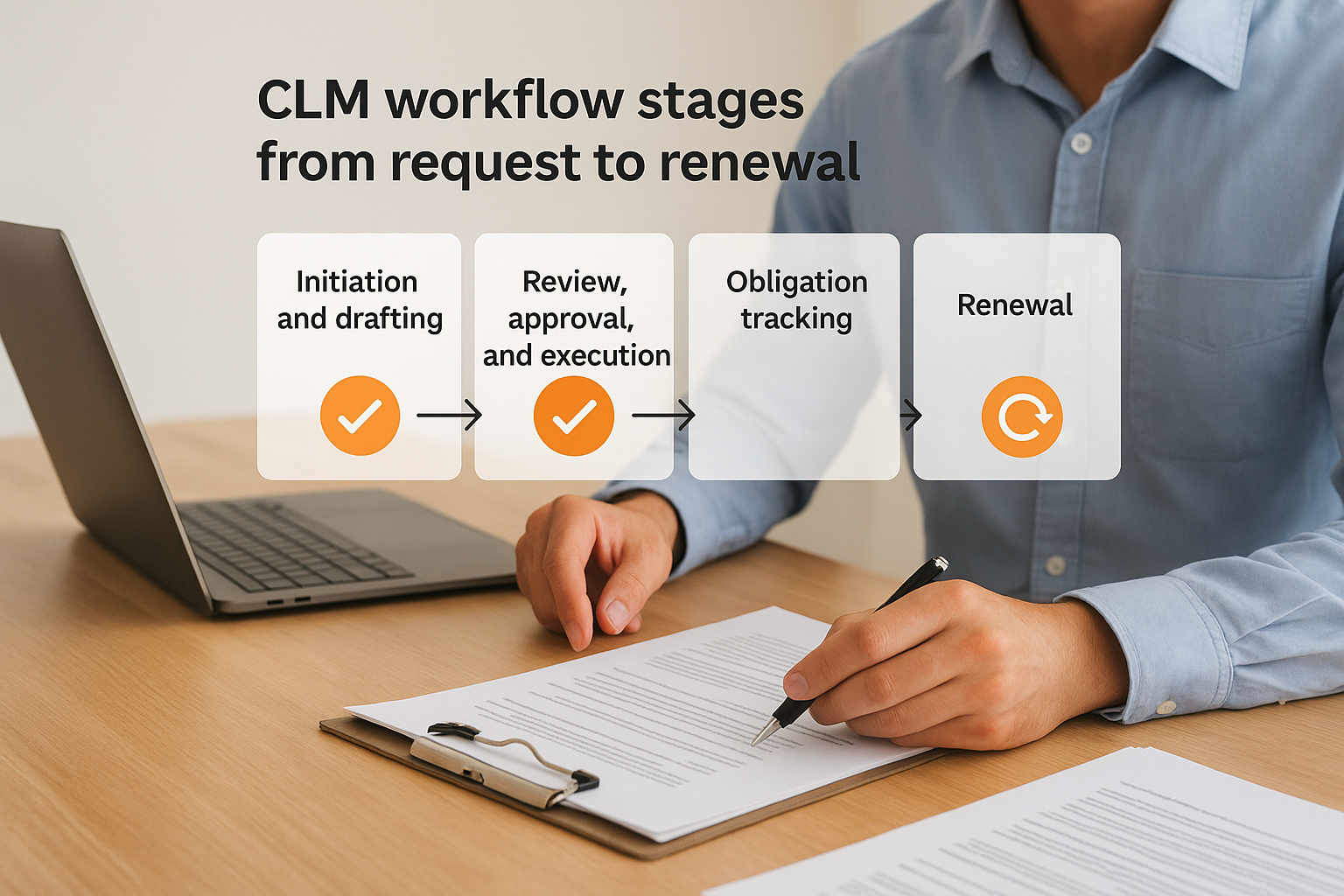
Initiation and drafting
The workflow starts when someone formally identifies a contract need. For government contractors in India, that trigger is typically a matched tender opportunity your team decides to pursue after evaluating eligibility against the notice requirements. At this stage, you assign ownership, define internal submission deadlines, and pull the relevant tender documents for analysis.
Drafting follows directly. Your team assembles the bid or contract document using standard templates tailored to the specific opportunity, incorporating clauses that reflect the qualification criteria and scope detailed in the notice. A common error here is treating drafting as a single person's task rather than a structured, collaborative step that brings in legal and technical input from the start.
Review, approval, and execution
Once the draft exists, it moves through a structured review and approval chain involving legal, finance, and technical stakeholders. Each reviewer focuses on different risk categories: legal checks for dispute resolution terms and penalty clauses, finance reviews payment schedules and bank guarantee requirements, and technical teams confirm the scope aligns with your firm's actual delivery capacity.
Compressing or skipping this stage is where firms absorb their highest contract risk, because a clause missed in review becomes a direct liability during execution.
After all approvals are confirmed, the contract moves to formal execution and signing. In Indian public procurement, this often involves specific formats recognized by GeM or state e-procurement portals, so your execution process needs to align with the relevant portal's technical requirements rather than applying generic procedures.
Obligation tracking and renewal
Active contracts generate ongoing compliance obligations from the moment they are signed. Performance bank guarantees, milestone progress reports, labor compliance certificates, and environmental clearances each carry independent deadlines that your team must actively track throughout the full contract period.
Renewal sits at the far end of the workflow but demands early attention to avoid missing windows that carry real revenue value. A well-run workflow flags renewal opportunities at least 60 to 90 days before expiry, giving your team enough lead time to renegotiate terms, confirm eligibility for extensions, or initiate formal closeout procedures if the contract has fully run its course.
How to automate a CLM workflow step by step
Automating your contract lifecycle management workflow doesn't require replacing your entire process at once. The practical approach is to identify the highest-friction stages first and introduce automation there before expanding across the full chain. For AEC firms managing government tenders in India, the biggest gains typically come from automating portal monitoring, document parsing, and deadline tracking, three activities that currently consume most of a BD team's working hours.
Start with data inputs and document parsing
The first step is connecting your tender discovery process to a centralized system that reads incoming documents automatically rather than relying on manual downloads and individual review. When a relevant notice surfaces across GeM, CPPP, or a state e-procurement portal, your system should immediately parse the document to extract key eligibility criteria, BOQ line items, and deadline dates without requiring a team member to read the full PDF first.
Once the system captures structured data from each tender document, it can map those requirements against your firm's existing credentials and flag qualification gaps before your team invests time in a bid that won't clear the threshold on a high-value opportunity.
Automating document parsing at the intake stage can cut the time your team spends on initial eligibility screening significantly, freeing that capacity for higher-value bid work.
Build approval triggers and obligation alerts
After the intake stage, automation shifts to managing the approval chain and tracking active obligations. Set up rule-based triggers that route draft contracts to the right reviewer automatically based on contract type, value threshold, or portal origin. This removes the email-based handoff that typically causes delays between drafting and final sign-off.

On the obligations side, configure automated alerts tied to specific milestone dates within each active contract. Performance bank guarantee renewals, compliance certificate submissions, and progress report deadlines all need advance notification, typically at 90, 60, and 30 days out. Rather than maintaining a manual calendar, let the system push those alerts directly to the responsible team member.
Connect renewal tracking to your pipeline view
Renewal automation closes the loop on the full workflow. Your system should flag approaching contract expiry windows and simultaneously surface comparable new opportunities from your monitored portals that align with your firm's current credentials. That direct connection between renewal tracking and new opportunity discovery means your pipeline stays active without requiring a separate manual review cycle each time a contract nears its end date.
CLM workflow best practices, roles, and KPIs
A well-structured contract lifecycle management workflow only performs as well as the people running it and the metrics tracking its health. Without clear role assignments and defined performance indicators, even a fully automated system will drift toward the same bottlenecks your manual process had. The practices below apply directly to government contractors in India managing multiple concurrent tenders and active contracts across state and national procurement portals.
The gap between firms that consistently win high-value government contracts and those that struggle often comes down to how clearly defined their internal contracting roles are.
Assign clear ownership at every stage
Each stage of your workflow needs a named owner with defined responsibilities rather than a shared inbox or a team-level assignment that nobody acts on. Ambiguous ownership is the primary reason compliance deadlines get missed and approval chains stall. Assign one person to intake, one to review coordination, and one to obligation tracking so that accountability is never in question when a deadline approaches.
Here are the core roles your workflow needs:
- BD Manager: Identifies and qualifies incoming opportunities, triggers the workflow at intake
- Bid Coordinator: Manages drafting, internal review scheduling, and submission timelines
- Legal Reviewer: Flags penalty clauses, dispute terms, and unusual risk in tender documents
- Finance Lead: Reviews payment schedules, bank guarantee requirements, and contract value thresholds
- Compliance Owner: Tracks active obligations, milestone certifications, and renewal windows
Track KPIs that reflect real workflow performance
Measuring your workflow's performance requires specific, observable metrics rather than vague assessments of how things feel. The KPIs below give you a clear signal on where your process moves efficiently and where it needs adjustment.
| KPI | What it measures | Target benchmark |
|---|---|---|
| Tender-to-bid conversion rate | Share of evaluated tenders resulting in submitted bids | Firm-specific, trend upward |
| Approval cycle time | Days from draft completion to final sign-off | Under 5 working days |
| Compliance miss rate | Missed obligation deadlines per quarter | Zero |
| Renewal capture rate | Contracts renewed or extended before expiry | Above 85% |
| Bid qualification accuracy | Bids submitted that clear eligibility threshold | Above 90% |
Reviewing these metrics monthly gives your team a concrete basis for improving specific process steps rather than reacting only after a deadline has already passed. For firms operating in high-value infrastructure sectors like road development or urban water systems, a single missed compliance deadline can disqualify your firm from follow-on contract opportunities, which makes these KPIs directly tied to future revenue.
Where to go from here
A structured contract lifecycle management workflow gives your firm the operational discipline to track every tender, obligation, and renewal window without relying on manual checklists or individual memory. The stages covered here, from initiation through compliance tracking and renewal, represent what a functioning system looks like when roles, automation, and defined metrics all work together.
Putting that structure into practice is where the real gains happen. Arched monitors 500+ procurement portals simultaneously, parses tender documents automatically, and flags qualification gaps before your team invests time in bids you can't win. That means less overhead spent on manual portal refreshing and more capacity directed toward bids that actually fit your firm's credentials and growth targets.
Explore how Arched works and see how your firm can move from reactive bidding to a managed contracting operation that captures every viable opportunity your current process is missing.