6 Structural Optimization Software Tools for Modern Design
6 Structural Optimization Software Tools for Modern Design
Every infrastructure project, whether it's an NHAI bridge in Himachal or a metro viaduct in Pune, starts with a structural design that has to balance strength, material cost, and buildability. Structural optimization software takes that balancing act out of manual iteration and puts it into algorithms that can evaluate thousands of design variations in the time it takes an engineer to sketch one. The result: lighter structures, lower material costs, and designs that actually perform better under load.
For contractors bidding on government infrastructure tenders in India, this matters more than it might seem. Tenders increasingly specify performance-based criteria, and the difference between a competitive bid and an over-engineered one often comes down to how well your design team can optimize material quantities without compromising structural adequacy. Once you've identified a tender worth pursuing, the engineering tools you use to develop your technical proposal are just as critical to winning the job.
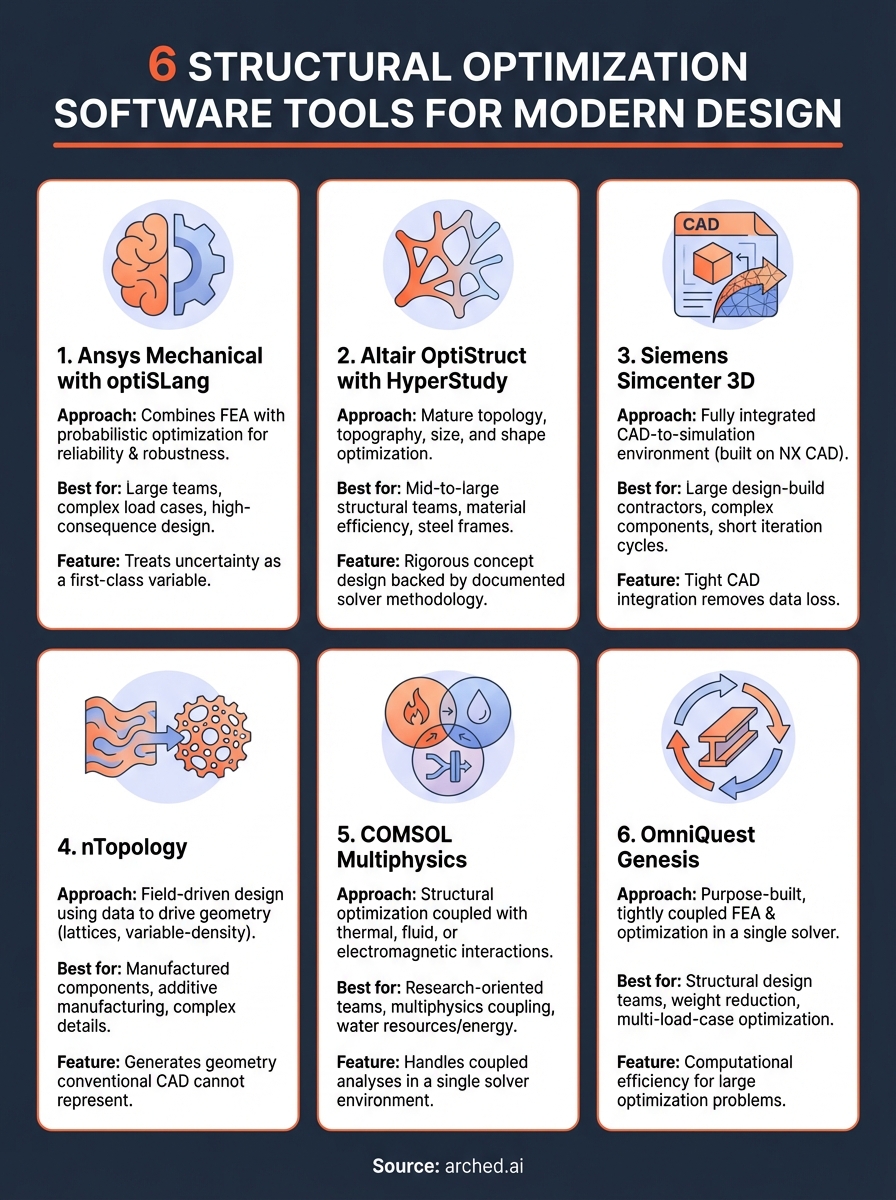
This article covers six structural optimization software tools worth evaluating in 2026, spanning topology optimization, finite element analysis, and performance-driven design. Whether you're a preconstruction team sizing up a bridge tender or a design cell working on building structures, these platforms represent the current state of what's available, what each does best, and where they fit in a modern engineering workflow.
1. Ansys Mechanical with optiSLang
Ansys Mechanical is one of the most widely deployed finite element analysis (FEA) platforms in the industry, and when you combine it with optiSLang, Ansys's probabilistic optimization engine, you get a workflow that goes well beyond standard stress checks. The combined platform lets you run design space exploration, sensitivity analysis, and optimization loops across structural, thermal, and dynamic load cases simultaneously.
How it approaches structural optimization
Ansys Mechanical handles the core structural simulation side: meshing, applying boundary conditions, running static and dynamic analyses, and producing stress and deformation results. optiSLang connects to that simulation environment and drives parametric optimization, varying geometric inputs, material properties, or design variables across thousands of design evaluations to identify configurations that minimize mass, maximize stiffness, or hit target safety factors. The two tools work together through Ansys Workbench, where you define the optimization objective and constraints, and optiSLang manages the design-of-experiments runs automatically.
What makes this combination particularly powerful is that optiSLang treats uncertainty as a first-class variable, meaning you can optimize for reliability and robustness, not just nominal performance.
Topology optimization is also available through Ansys Mechanical's built-in module, which lets you define a design space and let the solver determine where material is structurally necessary. This is useful for concept-stage design of bridges, structural members, and support components where you want to reduce material before detailed engineering begins.
Best fit teams and use cases
This platform suits large engineering teams and design-build contractors who are already running simulation workflows and want optimization tightly integrated with their existing analysis environment. If your team regularly handles complex load combinations such as seismic, wind, and live loads on bridge or building structures, the ability to run probabilistic optimization within the same FEA environment as your primary solver reduces friction significantly. Both aerospace and heavy civil structural teams use this combination regularly for high-consequence design work.
Pricing and licensing notes
Ansys licenses through annual subscription or perpetual license arrangements negotiated directly with Ansys or through authorized resellers. Pricing is not publicly listed, and costs vary significantly based on the modules you include, the number of solver cores, and whether you need HPC licensing for large-scale runs. Academic and startup pricing tiers exist, but for commercial infrastructure work, expect enterprise-level costs. Request a quote and trial through the Ansys website directly.
2. Altair OptiStruct with HyperStudy
Altair OptiStruct has a longer history in topology optimization than most platforms on this list, and that depth shows in how it handles structural design problems. Paired with HyperStudy, Altair's multi-disciplinary design exploration tool, it gives you a complete pipeline from concept optimization through to design validation.
How it approaches structural optimization
OptiStruct treats topology, topography, size, and shape optimization as distinct but connected workflows. You define the design domain, load cases, and constraints, then let the solver redistribute material until it finds the structurally efficient form. For civil and structural applications, this means you can run concept-stage bridge deck or support frame optimization before committing to detailed dimensions. HyperStudy adds design-of-experiments and response surface modeling on top, so you can explore how parameter changes affect structural performance across your full design space.
OptiStruct's lattice optimization capabilities are advanced, but its core FEA-driven topology tools are equally mature for conventional construction applications.
This combination is one of the more capable structural optimization software platforms for teams that want rigorous concept design backed by documented solver methodology.
Best fit teams and use cases
OptiStruct fits mid-to-large structural design teams working on both conventional and advanced fabrication projects. It suits contractors and consultants handling bridge components, steel frame buildings, and industrial structures where material efficiency directly affects bid competitiveness.
Pricing and licensing notes
Altair uses a unit-based licensing model called Altair Units, which lets you access multiple products from a shared pool rather than buying per-tool licenses. This gives your team flexibility across the Altair suite without being locked into a single application. Contact Altair directly for pricing specific to your team size and usage requirements.
3. Siemens Simcenter 3D
Siemens Simcenter 3D is a full-scale simulation environment built on the NX CAD platform, which means your geometry, analysis, and optimization workflows all live in a single integrated environment. For structural engineers, this tight CAD-to-simulation connection removes a significant source of data loss and rework that you typically encounter when transferring models between separate tools.
How it approaches structural optimization
Simcenter 3D handles topology optimization, size optimization, and shape optimization natively within its FEA solver environment. You define your load cases, constraints, and design objective directly inside the same environment where you built the geometry, and the solver iterates through material distributions or parameter variations until it converges on an optimized configuration. The platform also supports multi-discipline optimization, letting you combine structural, thermal, and dynamic load cases in a single optimization run rather than solving each separately and reconciling results manually.
This single-environment approach is particularly valuable when your design team needs a short iteration cycle between geometry changes and structural verification.
Best fit teams and use cases
Simcenter 3D is a strong fit for large design-build contractors and engineering consultancies that are already working within the Siemens NX ecosystem. Teams developing complex bridge components, prefabricated structural elements, or performance-critical civil structures will benefit most from the tight CAD integration. It's also well-suited to preconstruction teams that need to run rapid design comparisons to support bid development on technically demanding tenders where this type of structural optimization software directly influences material cost estimates.
Pricing and licensing notes
Siemens licenses Simcenter 3D through its NX licensing framework, with modular options depending on the simulation capabilities you need. Pricing is available through Siemens Digital Industries Software sales channels and authorized resellers; contact Siemens directly for a quote based on your team's specific module requirements.
4. nTopology
nTopology takes a fundamentally different approach than most platforms on this list. Instead of running optimization on a traditional mesh-based FEA model, it uses a field-driven design system where geometry is defined by mathematical fields that can be continuously modified by structural performance data. This means your team can create complex lattice structures, variable-density infills, and performance-graded geometries that conventional CAD tools simply cannot represent or export reliably.
How it approaches structural optimization
nTopology connects directly to simulation outputs from external solvers like Ansys or Abaqus and uses those results to drive geometry generation. You feed in your stress or strain field data, and nTopology uses it to vary wall thicknesses, lattice densities, or surface geometries continuously across the full design volume. This approach treats structural optimization software as a geometry engine that responds to physics, rather than a traditional solver iterating on an existing mesh definition.
This field-based workflow is particularly well-suited to additive manufacturing applications, where the fabrication process can actually produce the complex internal geometries the optimization generates.
Best fit teams and use cases
nTopology suits design teams working on manufactured structural components rather than large-scale civil infrastructure. Steel fabricators, specialty contractors producing complex connection details or high-performance prefabricated elements, and engineering teams developing performance-critical components for bridges or industrial structures will find the most practical value here. If your work regularly involves components that need to be as light as possible while remaining structurally verified, this platform offers a workflow built around that requirement.
Pricing and licensing notes
nTopology offers annual subscription licensing through its website, with tiers structured around team size and the specific feature modules your work requires. The platform also provides a free trial period for new users, letting your team evaluate the field-driven workflow before committing to a commercial license. Contact nTopology sales directly for current commercial pricing details.
5. COMSOL Multiphysics
COMSOL Multiphysics is known primarily as a multiphysics simulation platform, but its structural mechanics module makes it a capable option for teams that need to couple structural performance with other physical phenomena. If your structural design involves significant thermal, fluid, or electromagnetic interactions, COMSOL handles those coupled analyses in a single solver environment rather than requiring you to transfer results between separate tools.
How it approaches structural optimization
The platform handles structural optimization through its Structural Mechanics Module combined with the Optimization Module, which adds parametric and topology optimization capabilities directly inside the simulation environment. You define design variables, set up your load cases and boundary conditions, and configure an objective function like minimizing compliance or matching a target displacement. The solver then iterates through parameter variations while solving the full coupled physics at each step, making it particularly useful when your structural problem cannot be isolated from thermal or fluid effects.
COMSOL's value as structural optimization software is the ability to optimize structural performance while simultaneously accounting for non-structural physics that would otherwise require manual approximation.
Best fit teams and use cases
COMSOL fits research-oriented engineering teams and consultancies working on structures where multiphysics coupling matters more than pure structural performance alone. It suits teams in water resources, industrial structures, or energy infrastructure where loads involve heat transfer or fluid pressure alongside mechanical stress.
Pricing and licensing notes
Licensing follows a modular structure, where you purchase the core platform and add the specific modules your work requires. Pricing is available through direct contact with COMSOL sales or an authorized distributor, with options for both named-user and floating licenses depending on how your team shares tool access.
6. OmniQuest Genesis
OmniQuest Genesis, developed by Vanderplaats Research & Development, is a purpose-built structural optimization software that combines FEA simulation and optimization in a single solver rather than treating them as separate processes connected by a workflow. That architecture means the solver exchanges data between the structural analysis and the optimization algorithm continuously, which reduces the computational overhead that comes with loosely coupled tool combinations.
How it approaches structural optimization
Genesis handles topology, topography, sizing, and shape optimization natively, covering the full range of design variable types most structural engineers need across concept and detailed design stages. You define your design domain, load cases, and performance constraints, then configure an objective like minimizing structural weight or maximizing stiffness within a displacement limit. The solver runs the FEA and optimization loop together, updating the design at each iteration based on sensitivities computed directly from the structural analysis.
This tightly coupled solve approach gives Genesis a computational efficiency advantage on large optimization problems where external data transfer between separate tools becomes a bottleneck.
Best fit teams and use cases
Genesis suits structural design teams working on steel or concrete structures where weight reduction or material efficiency is a primary design driver. It fits well for contractors and consultants who want a dedicated optimization solver without the broader simulation suite overhead that comes with larger platforms. Teams handling bridge components, truss systems, or framed structures with complex load combinations will find its multi-load-case optimization handling particularly practical.
Pricing and licensing notes
VR&D offers Genesis through direct licensing arrangements, with options for both commercial and academic use. Your team should contact VR&D directly for current pricing and trial access details, as costs depend on the specific optimization modules and solver scale your projects require.
Where to go from here
The six platforms above cover the main approaches to structural optimization software available in 2026, from tightly coupled FEA-optimization solvers like Genesis to field-driven geometry engines like nTopology. Your choice depends on what your team actually needs: whether that's probabilistic robustness analysis, multiphysics coupling, or straightforward topology optimization for concept-stage bridge and structural work. Most vendors offer trial access, so you can evaluate the workflow fit before committing to a license.
For contractors working on government infrastructure in India, winning a tender starts well before your design team opens any simulation tool. You need to find the right opportunities and confirm your credentials actually qualify before you invest engineering hours into a technical proposal. If the estimate is what slows your team down, Arched can take it off your plate: send us the tender and we deliver a priced BOQ, reviewed by an engineer. See how our estimating service works.
Have a package your team can’t get to? Send it to us. Our engineers check and sign off everything we deliver.