AASHTO LRFD Bridge Design Specifications: Latest Guide
AASHTO LRFD Bridge Design Specifications: Latest Guide
The AASHTO LRFD Bridge Design Specifications serve as the governing standard for highway bridge design across the United States. Every structural engineer working on bridge infrastructure projects references this document, whether they're designing a simple overpass or a complex multi-span structure. Understanding these specifications isn't optional; it's foundational to compliant, safe bridge engineering.
If you're here looking for the latest edition, specific code provisions, or updates to design requirements, you're in the right place. This guide breaks down what the specifications cover, what changed in recent editions, and how to access the current version for your projects. We'll also address common questions about load factors, resistance factors, and the key sections engineers reference most frequently.
This article gives you the complete picture of what those specifications contain and how they shape modern bridge design.
Why the AASHTO LRFD specs matter
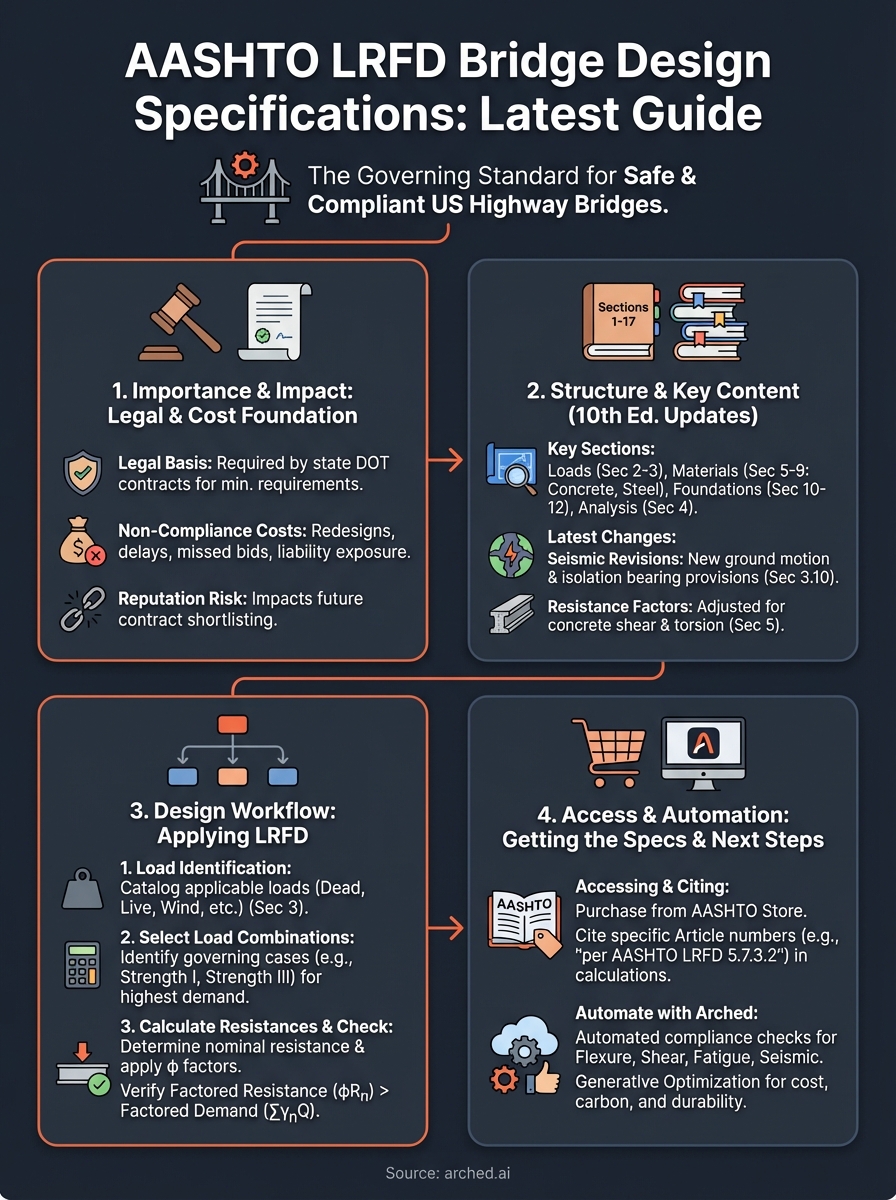
The AASHTO LRFD bridge design specifications form the legal basis for every publicly funded bridge project in the United States. When a state Department of Transportation issues a contract, they require full compliance with these standards. Your design calculations, material selections, and load combinations must trace directly back to specific code provisions. Without this documentation, your project won't pass review, and your firm assumes significant liability exposure.
The legal and regulatory foundation
State DOTs enforce these specifications through contract language and design approval processes. You can't substitute your own judgment or use international standards as alternatives. The specifications define minimum requirements for strength, serviceability, and constructability that protect public safety. They also establish the load and resistance factor design philosophy that replaced older allowable stress methods, giving you a more rational framework for handling uncertainty in both loads and material properties.
When your calculations reference specific AASHTO articles and equations, you create a defensible design that withstands third-party review and potential legal scrutiny.
The cost of non-compliance
Design errors that violate these specifications don't just delay approval. They trigger costly redesign cycles, missed bid deadlines, and potential project cancellations. Your client loses competitive positioning when your design package comes back marked up with code violations. Contractors expect to bid on compliant plan sets that won't require change orders due to structural deficiencies discovered during construction. Insurance carriers and bonding companies also evaluate your firm's track record with code compliance when setting rates and coverage limits.
Beyond the immediate project impact, repeat violations damage your firm's reputation with state agencies. DOTs maintain records of consultants who submit non-compliant work, and this history influences future shortlisting decisions for major contracts.
What the specs cover and how they are organized
The AASHTO LRFD bridge design specifications organize 17 major sections that cover every aspect of highway bridge design, from initial planning through final construction details. You'll find comprehensive guidance on loads, analysis methods, material properties, foundation design, and structural components. Each section builds on the fundamental principles established in the opening chapters, creating a logical progression from theory to application.
The section-based structure
Section 1 establishes general design and location features, while Sections 2 and 3 define loads and load factors that drive your entire design. Material-specific sections (5 through 9) cover concrete, steel, wood, and aluminum components with detailed resistance equations and detailing requirements. Sections 10 through 12 address foundation systems, including shallow footings, deep foundations, and buried structures. The remaining sections handle specialized topics like joints, railings, and seismic design.
Each section references other chapters where needed, so you'll navigate between sections frequently as you verify different limit states.
Key sections you'll reference most
Most bridge engineers spend their time in Section 4 (structural analysis), Section 5 (concrete structures), and Section 6 (steel structures). These chapters contain the resistance factor tables, flexural strength equations, and shear design procedures you apply daily. Section 3's load combination tables become second nature once you've run through a few design cycles.
What changed in the latest edition
The 10th Edition of the AASHTO LRFD bridge design specifications introduced significant updates that affect how you calculate resistance factors and evaluate seismic performance. Published in 2020 with subsequent interims, this version reflects research findings from NCHRP projects and feedback from practicing engineers who identified ambiguities in earlier editions. You'll find revised load factors, updated material properties, and clearer guidance on complex analysis scenarios.
Seismic design revisions
The latest edition completely rewrote Section 3.10 to incorporate new ground motion procedures and refined displacement-based design methods. Your seismic analysis now requires more detailed soil-structure interaction modeling for critical bridges. The specifications added explicit provisions for isolation bearings and energy dissipation systems that weren't fully addressed in previous versions.
These changes directly impact how you design bridge piers and abutments in high-seismic zones, requiring updated analysis workflows.
Resistance factor adjustments
Section 5 modified resistance factors for concrete shear and torsion based on updated research. You'll apply different phi factors depending on the calculation method you use. The specifications also clarified tension-controlled sections versus compression-controlled sections, eliminating previous interpretation conflicts that caused inconsistent designs across different firms and regions.
How to apply LRFD in a bridge design workflow
Your design workflow starts with load identification and moves through factored resistance verification at every limit state. You begin by cataloging all applicable loads from Section 3, then select the governing load combinations that produce the highest demand on each structural element. This systematic approach ensures you check every critical scenario the AASHTO LRFD bridge design specifications require.
The load combination selection process
Section 3.4 defines strength limit states (Strength I through V) and service limit states that you apply based on project-specific conditions. You evaluate which combinations control your design by calculating factored loads for each case. Permanent loads like dead load get multiplied by load factors (typically 1.25 or 1.5), while live loads combine with dynamic allowance factors. Your analysis software should automate these combinations, but you verify the governing cases manually to catch calculation errors.

You'll find that Strength I controls most typical bridge superstructure designs, while Strength III governs when wind becomes critical.
Calculating factored resistances
After determining factored demands, you calculate nominal resistances using material-specific sections (5, 6, or 7) and apply the appropriate resistance factor (phi). Your factored resistance must exceed the factored demand at every location you check.
How to get and reference the official specs
You purchase the official AASHTO LRFD bridge design specifications directly from the American Association of State Highway and Transportation Officials through their online bookstore. The specifications come in both printed and digital formats, with the PDF version offering searchable text that speeds up your reference workflow. Individual state DOTs also maintain internal copies and may provide access to contracted consultants through their design manual systems.
Where to purchase the specifications
The current 10th Edition with all interim updates costs approximately $450 for AASHTO members and $600 for non-members when purchased through Amazon or the AASHTO store. Your firm needs at least one licensed copy per office location according to copyright requirements. Many engineers purchase personal copies to annotate with project-specific notes and calculation shortcuts.
You cannot legally use photocopied versions or share digital files outside your organization's licensed user count.
Citing provisions in your calculations
Your calculation sheets must reference specific article numbers when applying resistance equations or load factors. Format citations as "per AASHTO LRFD Article 5.7.3.2" to create an audit trail that reviewers can follow. Include the edition and year on your title sheet so future engineers know which version governed your original design decisions.
Next steps for your bridge designs
You now understand how the AASHTO LRFD bridge design specifications structure every aspect of compliant bridge engineering. Your next project starts with identifying the applicable load combinations from Section 3, selecting resistance equations from your material-specific chapters, and documenting every calculation with proper article citations. This process requires careful attention to detail and systematic verification of multiple limit states across your entire structure.
Have a package your team can’t get to? Send it to us. Our engineers check and sign off everything we deliver.