5 AISC Design Guide Essentials: Topics, Editions, How To Use
5 AISC Design Guide Essentials: Topics, Editions, How To Use
The AISC Design Guide series is the go-to technical resource for structural engineers working with steel, and for good reason. These publications translate complex code requirements into practical, project-ready guidance that saves hours of interpretation and calculation.
Whether you're designing steel connections for a highway bridge or evaluating fatigue criteria on a major infrastructure project, knowing which guide applies (and which edition is current) can make or break your workflow.
This article covers the five essential things you need to know about AISC Design Guides: the core topics they address, current editions worth owning, and how to actually use them in your day-to-day engineering work. Let's get into it.
1. Design Guide 1: Base plate and anchor rod design
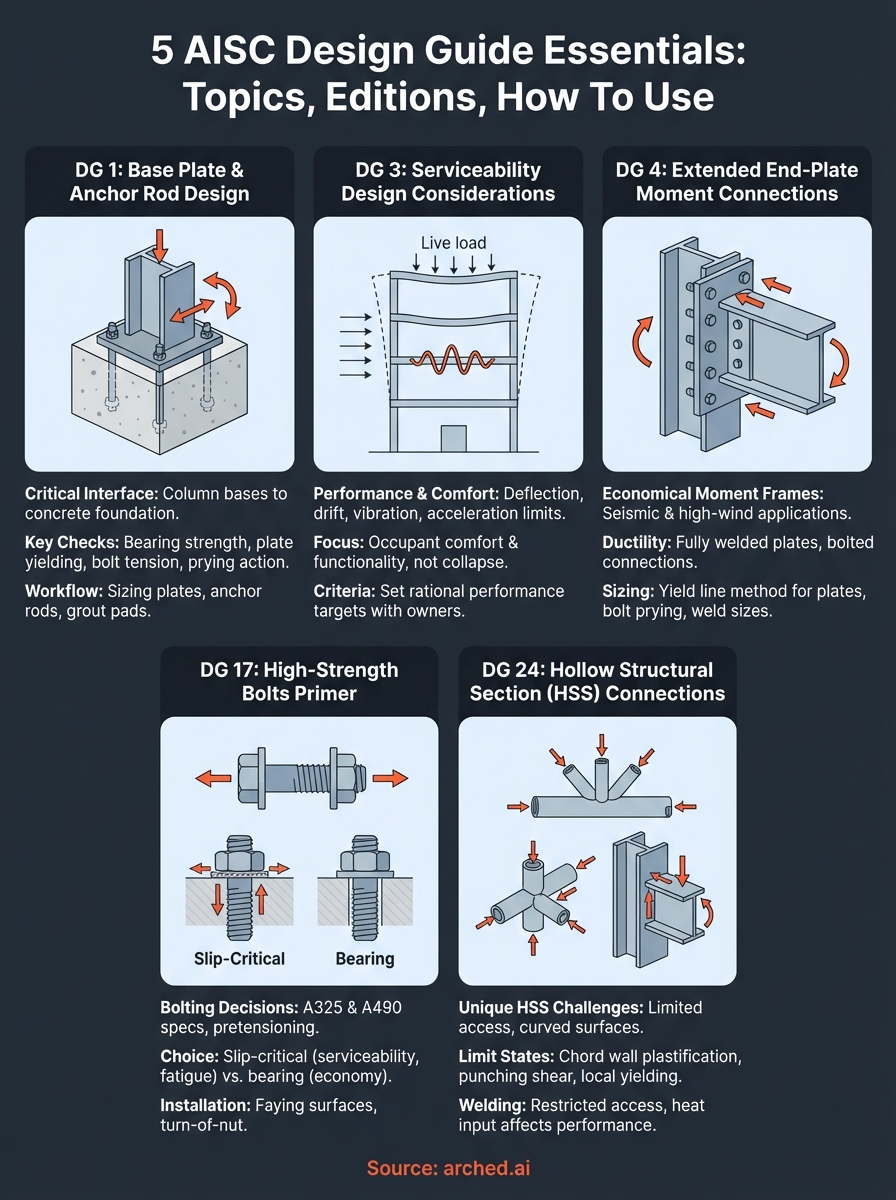
Design Guide 1 remains one of the most referenced publications in the AISC library because base plates and anchor rods form the critical interface between steel superstructure and concrete foundation. You use this guide whenever you need to design column base connections, whether for rigid frames, braced frames, or moment-resisting systems that transfer axial loads, shear, bending, and combinations of all three into footings or piers.
What this guide covers and when it applies
This guide walks you through the complete design workflow for base plates, anchor rods, and grout pads under both gravity and lateral loads. You apply it when designing column bases that resist compression, tension, shear, or combined loading conditions. It covers thick base plates, moment base plates, and lightly loaded configurations where bearing on grout controls. The guide also addresses practical questions like edge distances, embedment depths, and when you need to use stiffeners or haunches.
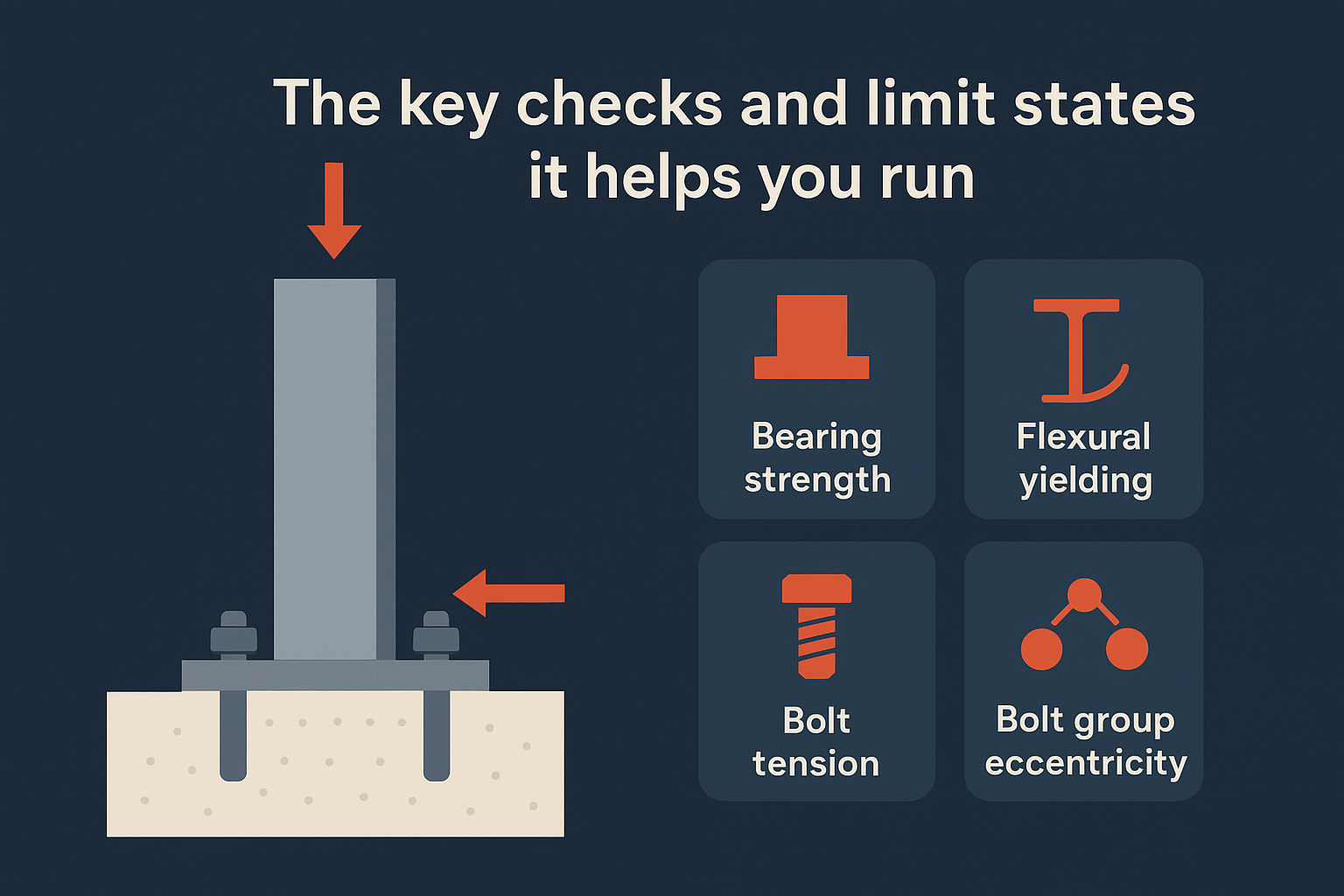
The key checks and limit states it helps you run
You'll work through bearing strength on concrete, flexural yielding of the base plate, bolt tension capacity, and bolt group eccentricity effects using this guide. It provides step-by-step procedures for calculating required plate thickness, determining anchor rod size and layout, and checking combined bending and axial stress states. The guide also shows you how to model the plate's behavior using cantilever and one-way bending assumptions that align with strength-based design methods.
"Base plate design is fundamentally about force distribution between discrete anchors and continuous bearing, and this guide gives you the tools to balance both."
Common design traps in base plates and anchors
Engineers often underestimate prying action in thick plates or overestimate the contribution of grout when plates are thin and flexible. Another frequent mistake involves ignoring the actual concrete breakout capacity of anchor rods or using inappropriate edge distances that violate ACI 318 provisions. You also need to watch for poor load path assumptions that treat a flexible plate as rigid, leading to unconservative results in tension zones.
Edition notes and how it aligns with AISC 360-22 and the 16th Edition Manual
The second edition of this AISC design guide, published in 2006 and still current, aligns with AISC 360-10 and earlier editions. While AISC 360-22 introduced updated provisions, the fundamental design principles in this guide remain applicable. You should cross-reference Section J8 of the 16th Edition Manual for the latest base plate tables and anchor rod design provisions that reflect current code requirements.
How to get the guide and choose digital vs print
You can purchase this guide directly from the AISC website in both print and digital PDF formats. Digital versions allow instant download and searchability, which helps when you're cross-referencing between sections during a design check. Print copies work better if you prefer markup and side-by-side comparison with plan sheets.
Related AISC resources to pair with it
Pair this guide with Design Guide 7 (Industrial Buildings) if you're working on mill buildings or crane structures where base plate loads can be unusually large. Also reference the Steel Construction Manual Part 14 for anchor rod material properties and Part 9 for connection design fundamentals that apply to base plate detailing.
2. Design Guide 3: Serviceability design considerations for steel buildings
Design Guide 3 addresses the performance criteria that keep buildings functional and comfortable, not just structurally safe. You reach for this guide when you need to establish deflection limits, evaluate floor vibration complaints, or justify drift criteria to an owner who expects their glazing system to stay intact during wind events.
What this guide covers and what it does not
This AISC design guide focuses on serviceability limit states that affect building occupant comfort and long-term functionality. You'll find guidance on floor deflections under live load, lateral drift under wind and seismic events, acceleration limits for human comfort, and vibration serviceability for rhythmic activities. The guide does not provide strength design procedures or prescriptive code minimums, but it does give you the framework to set rational performance targets based on building use.
Deflection, drift, acceleration, and vibration topics you can't ignore
You need to address live load deflection criteria that vary by occupancy, span-to-depth ratios that prevent visual sag, and drift limits that protect cladding and partitions. The guide walks through frequency-based vibration checks for office floors, footfall-induced motion in open-web joists, and acceleration thresholds that prevent occupant discomfort in residential and healthcare settings.
"Serviceability failures don't collapse buildings, but they generate callbacks, tenant complaints, and expensive retrofits that strength calculations never catch."
How to set serviceability criteria with owners and architects
Start the conversation early by identifying cladding system tolerances, partition flexibility, and equipment sensitivity to vibration or deflection. You'll use the guide's tables to propose realistic limits that balance performance with cost, then document these criteria in your basis of design before you run the first analysis.
Edition notes and how it aligns with AISC 360-22 and the 16th Edition Manual
The second edition of this guide, published in 2003, remains current and aligns with the serviceability philosophy in AISC 360-22 Chapter L. Cross-reference the 16th Edition Manual for updated deflection tables and drift limits that reflect modern code provisions.
How to get the guide and choose digital vs print
Purchase this guide from the AISC website in PDF or hardcopy format. Digital versions let you extract tables directly into specifications, while print copies work better during owner coordination meetings.
Related AISC resources to pair with it
Pair this guide with Design Guide 11 (Floor Vibrations) for deeper analysis of walking-induced motion and with the Steel Construction Manual Appendix 1 for standard serviceability load cases.
3. Design Guide 4: Extended end-plate moment connections
Design Guide 4 serves as your primary reference for designing one of the most efficient and economical moment connection types in steel construction. You apply this guide when you need fully welded end plates that transfer bending moments through bolted connections, particularly in seismic or high-wind applications where ductility and rotation capacity matter.
What this guide covers and the connection families it addresses
This guide focuses on four-bolt and eight-bolt extended configurations where the end plate extends beyond the beam flanges to develop moment capacity. You'll find procedures for both stiffened and unstiffened versions, flush and extended arrangements, and connections that work with wide-flange beams and columns. The guide addresses both wind and seismic applications, though seismic detailing requires additional prequalification per AISC 358.
How to use it to size plates, bolts, welds, and stiffeners
You'll work through the yield line method to calculate required plate thickness, then size high-strength bolts in tension using prying action calculations. The guide provides step-by-step procedures for determining weld sizes at the beam flanges and web, evaluating column flange strength, and checking whether you need continuity plates or doubler plates to prevent local yielding.
What drives failures in practice and how to avoid them
Undersized plates that allow excessive prying forces on bolts represent the most common failure mode. You also see problems when designers ignore column panel zone shear or fail to account for the combined effects of axial load and moment in the connection. Inadequate weld access holes and poor fit-up tolerances create field installation issues that compromise performance.
"Extended end plates concentrate forces at discrete bolt locations, so your plate thickness calculation directly controls whether the connection performs as intended or develops premature yielding."
Edition notes and how it aligns with AISC 360-22 and the 16th Edition Manual
The third edition of this aisc design guide, published in 2016, aligns with AISC 360-16 and remains current under AISC 360-22. Cross-reference Part 9 of the 16th Edition Manual for updated bolt and weld design provisions that reflect the latest code requirements.
How to get the guide and choose digital vs print
Purchase this guide from the AISC website in PDF or print format. Digital versions allow you to extract design tables directly into calculation sheets, while print copies work better for markup during connection reviews.
Related AISC resources to pair with it
Pair this guide with Design Guide 29 (Vertical Bracing Connections) if your moment frames include braced bays and with AISC 358 for prequalified seismic moment connections that require special detailing beyond what this guide covers.
4. Design Guide 17: High-strength bolts primer
Design Guide 17 serves as your comprehensive reference for making informed decisions about structural bolting in steel construction. You apply this guide when you need to select bolt types, specify pretension requirements, or determine whether a connection demands slip-critical performance versus standard bearing behavior.
What this guide covers for structural bolting decisions
This guide walks you through bolt grades, installation methods, and connection behavior under service and ultimate loads. You'll find detailed coverage of A325 and A490 bolt specifications, proper hole sizes and tolerances, and the mechanical principles that govern bolt group strength. The guide addresses both shear and tension applications, including combined loading scenarios that appear in moment connections and bracing systems.
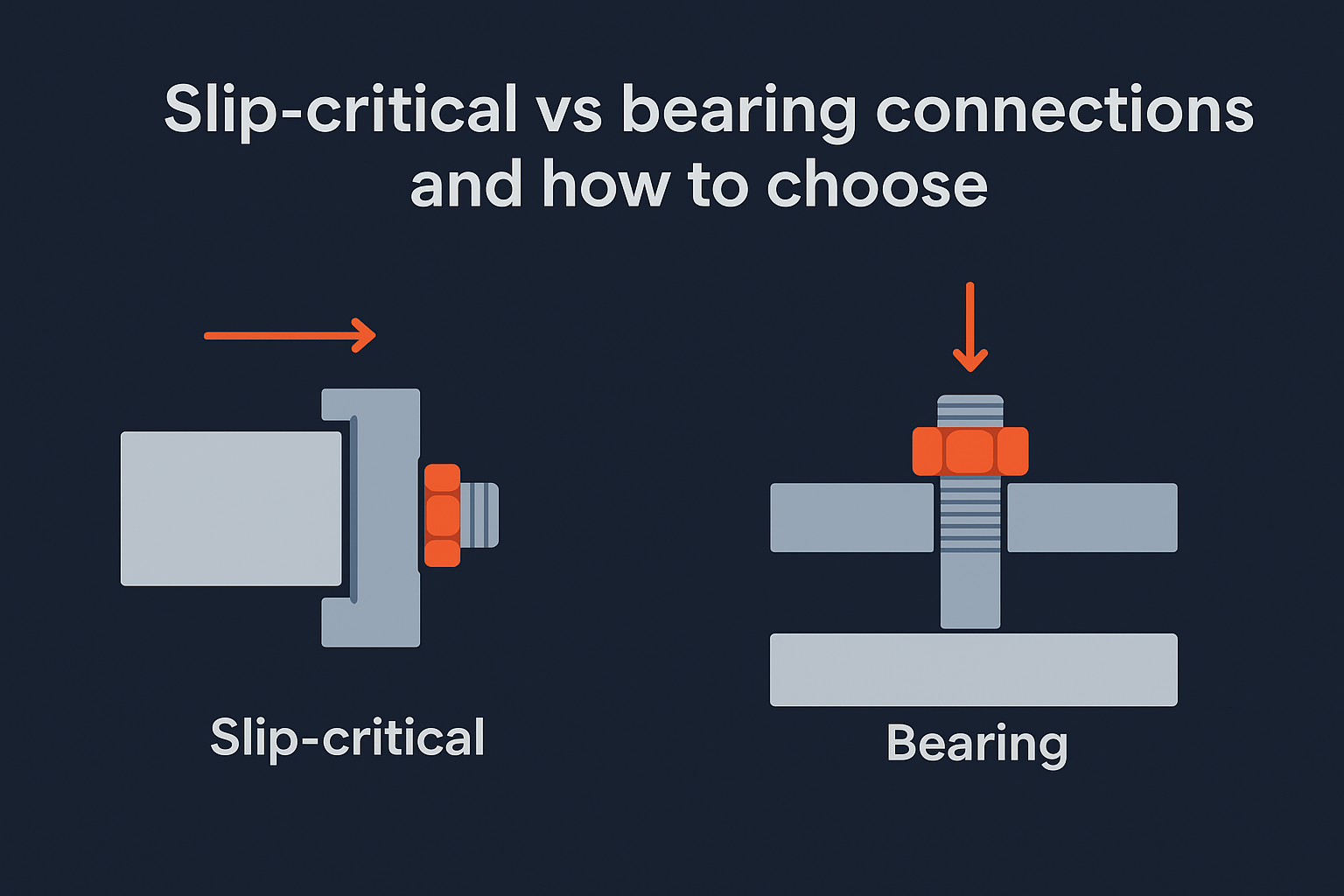
Slip-critical vs bearing connections and how to choose
You choose slip-critical connections when service-level slip would compromise structural integrity, damage cladding, or create unacceptable movement in oversized holes. Bearing connections allow controlled slip at higher loads and offer greater economy when movement doesn't affect performance. The guide provides decision trees based on connection type, loading pattern, and faying surface condition that help you justify your approach to reviewers.
Pretensioning, installation, and inspection details designers often miss
Designers frequently underspecify faying surface preparation, ignore the effect of galvanizing on slip resistance, or fail to detail turn-of-nut requirements that field crews actually need. You also see problems when specifications don't address thread inclusion in the shear plane or when inspection protocols lack clear acceptance criteria for bolt tension verification.
"Proper bolt installation depends on details you specify in the contract documents, not just the connection design calculations you stamp."
How it ties into RCSC, AISC 360-22, and the 16th Edition Manual
This second edition aisc design guide, published in 2013, aligns with the Research Council on Structural Connections specifications that form the basis for AISC 360-22 Chapter J3. Cross-reference Part 9 of the 16th Edition Manual for updated bolt design tables and Section J3.8 for current pretension requirements.
How to get the guide and choose digital vs print
Purchase this guide from the AISC website in PDF or hardcopy format. Digital versions allow quick searches during specification reviews, while print copies work better for field reference during construction observation.
Related AISC resources to pair with it
Pair this guide with Design Guide 4 (Extended End-Plate Connections) for moment connection bolting and the Steel Construction Manual Part 7 for standard bolt specifications and material properties.
5. Design Guide 24: Hollow structural section connections
Design Guide 24 addresses the unique challenges of connecting tubular members where access to connection zones remains limited and traditional connection assumptions break down. You apply this guide when designing HSS-to-HSS connections, HSS-to-wide-flange connections, or any configuration where closed sections require special consideration for load transfer and fabrication.
What this guide covers and why HSS connections need special treatment
This aisc design guide provides comprehensive procedures for branch-to-chord connections in trusses, moment connections between HSS columns and beams, and bracing connections that rely on gusset plates welded to tube surfaces. HSS members require different treatment because you can't access the interior for bolting, welding occurs on curved or flat surfaces with thickness limitations, and local yielding or punching shear in the chord wall often controls capacity rather than the connected member itself.
The main HSS limit states and where designers misjudge strength
You need to check chord wall plastification, local yielding at branch faces, shear punching through the chord wall, and chord sidewall buckling under compression branches. Engineers frequently overestimate connection capacity by ignoring the effective width of the chord that participates in load transfer or by treating the tube wall as infinitely stiff when it's actually flexible enough to redistribute forces.
"HSS connection strength depends on how the tube wall deforms under concentrated loads, not just the yield strength of the connected members."
Welding and mechanical fastening realities for closed sections
You face practical limits on weld access and heat input that affect connection performance and fabrication cost. Full-penetration welds to HSS require careful joint preparation and often internal backing or consumable inserts you can't inspect after welding. Mechanical fasteners work only through slotted or drilled connections that reduce the effective section and require careful detailing to prevent local distress.
Edition notes, what changed in the second edition, and AISC 360-22 alignment
The second edition of this guide, published in 2010, introduced updated limit state equations and expanded coverage of rectangular HSS connections. Current provisions align with AISC 360-22 Chapter K, which governs concentrated forces on HSS members and provides the design equations this guide illustrates through worked examples.
How to get the guide and choose digital vs print
Purchase this guide from the AISC website in PDF or hardcopy format. Digital versions let you zoom in on connection details and extract tables, while print copies work better for shop drawing reviews where you need side-by-side comparison.
Related AISC resources to pair with it
Pair this guide with Design Guide 29 (Vertical Bracing Connections) for HSS bracing systems and the Steel Construction Manual Part 9 for HSS material properties and standard connection configurations.
Where to go next
You now have the five most frequently referenced AISC Design Guides in your toolkit, covering everything from base plate detailing to HSS connection behavior that bridge projects demand. These publications translate code provisions into practical workflows that save hours on every project, but manually cross-referencing between guides, the Steel Construction Manual, and AISC 360-22 still consumes time you'd rather spend on design optimization and value engineering opportunities.
Have a package your team can’t get to? Send it to us. Our engineers check and sign off everything we deliver.