QCBS Vs QBS Vs L1: Scoring And Selection In Govt Tenders
Understand the scoring logic of qcbs vs qbs vs l1 in government tenders. Learn how to align your technical and financial bids to increase your win rate.
Every government tender in India follows a specific evaluation method that determines who wins the contract. Whether a department scores bids purely on price, weighs technical capability alongside cost, or ignores price entirely in favor of expertise, that single decision shapes who stands a chance. Understanding QCBS vs QBS vs L1 is not optional knowledge for anyone serious about winning public procurement contracts.
Yet most BD teams and bid managers still treat all tenders the same way, applying identical effort regardless of how the evaluation actually works. That's a strategic mistake. A bid optimized for an L1 tender will fall flat in a QCBS evaluation, and vice versa. Knowing the scoring mechanism before you commit resources is what separates firms that win consistently from those that burn effort on low-probability bids.
This article breaks down all three evaluation methods, their scoring logic, where each one applies, and how to adjust your bid strategy accordingly. At Arched, our platform parses tender documents to extract evaluation criteria automatically, so firms using our AI-powered command center already see this information flagged upfront. But whether you use Arched or not, grasping these three methodologies will sharpen every bid decision you make.
What QCBS, QBS, and L1 mean in tenders
These three terms represent fundamentally different frameworks that government agencies use to evaluate competing bids. Each one reflects a deliberate policy choice about what matters most in selecting a vendor: technical quality, price, or a weighted combination of both. Understanding the distinction between QCBS vs QBS vs L1 is the first step in reading any tender document intelligently, and it determines how you should allocate your time and resources before you even start writing a proposal.
QCBS: Quality and Cost-Based Selection
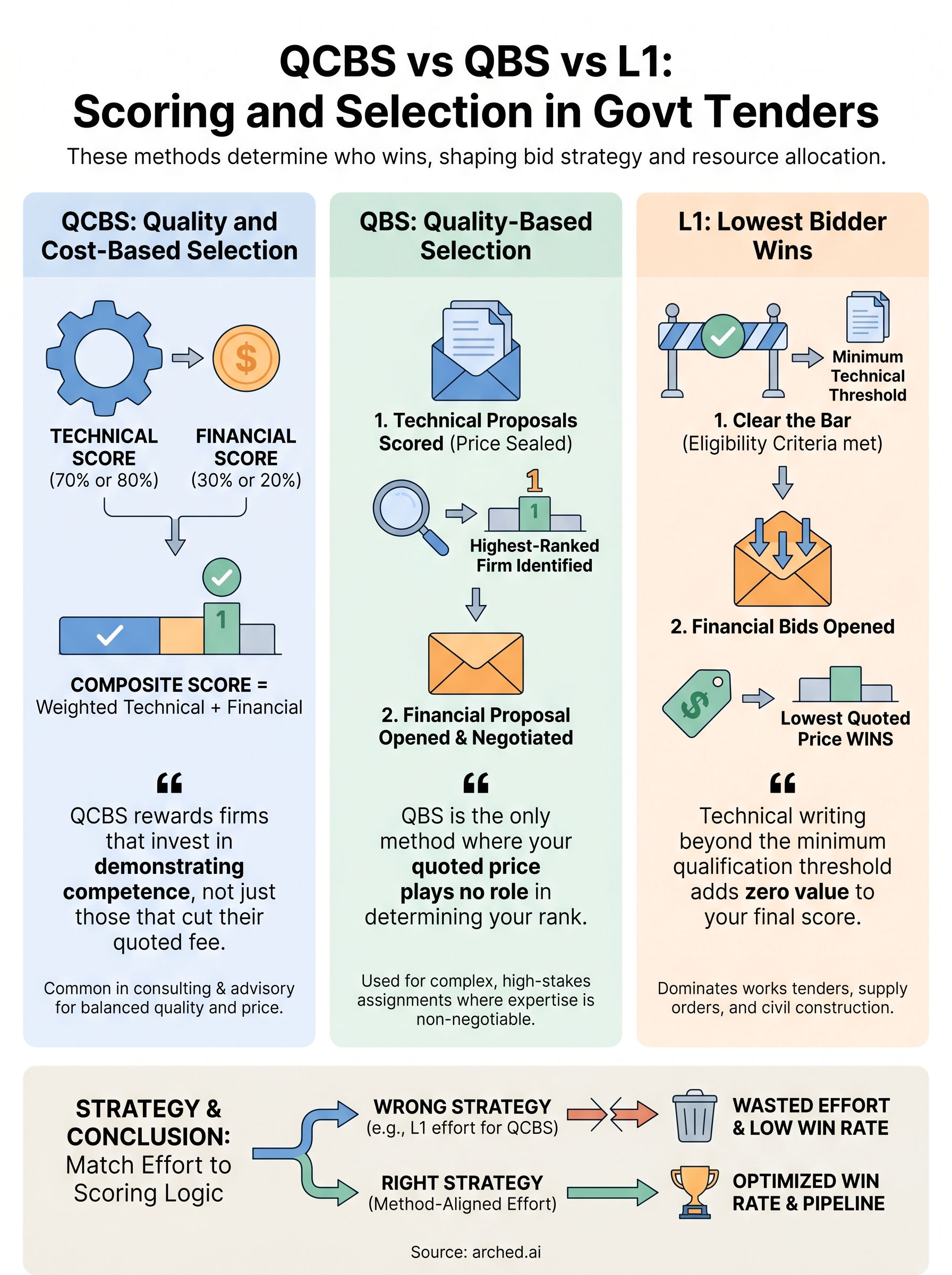
Quality and Cost-Based Selection (QCBS) is a dual-criteria method where evaluators score both your technical proposal and your financial bid, then combine those scores using a pre-defined ratio. The most common split you will encounter in Indian government tenders is 70:30 or 80:20, where the higher number represents the technical component. This method appears regularly in consulting and advisory assignments where the agency wants competent execution, not just the cheapest option available. Multilateral bodies such as the World Bank and the Asian Development Bank mandate QCBS for externally funded projects in India.
QCBS rewards firms that invest in demonstrating competence, not just those that cut their quoted fee.
QBS: Quality-Based Selection
Quality-Based Selection (QBS) removes price from the equation entirely during the evaluation stage. In a QBS process, the agency scores all technical proposals first, identifies the highest-ranked firm, and only then opens financial negotiations with that single bidder. Your financial proposal stays sealed until the technical ranking is final. QBS surfaces most often in complex, high-stakes assignments where expertise is non-negotiable, such as urban master planning, specialized infrastructure studies, or environmental impact assessments.
L1: Lowest Bidder Wins
L1 (Lowest Bidder) selection is the most prevalent evaluation method across Indian public procurement. Once a firm clears the minimum technical qualification threshold, the contract goes to whoever quotes the lowest price. You either meet the eligibility criteria or you do not, and after that hurdle, only your quoted figure matters. L1 dominates civil construction contracts, works tenders, and supply orders on portals including GeM, CPPP, and most state e-procurement systems.
Why the evaluation method changes who wins
The evaluation method is not just administrative paperwork. It directly determines which type of firm the agency wants to attract, and by extension, which bid strategy gives you the best odds. When you treat a QCBS tender like an L1 tender, you compete on the wrong dimension entirely. When you treat an L1 tender like QBS, you invest time in technical writing that the evaluator will never score.
Different methods reward different strengths
In an L1 environment, your competitive advantage is cost efficiency. Firms with lower overheads, better supply chain pricing, or more willingness to compress margins win more often. Technical writing beyond the minimum qualification threshold adds zero value to your final score, regardless of how impressive your portfolio is.
QCBS and QBS shift that dynamic completely. Your past project experience, your team's qualifications, and the depth of your methodology section all feed directly into your rank. A firm that submits a well-structured technical proposal can outscore a cheaper competitor even when the price gap is significant.
In qcbs vs qbs vs l1, knowing which game you are playing before you write a single page is the difference between a winning bid and wasted effort.
This matters most for resource allocation. A serious technical proposal for a QCBS bid can take weeks of focused preparation. Applying that same effort to an L1 works tender returns nothing extra. Matching your bid investment to the actual evaluation logic is how high-performing BD teams protect their time and steadily improve their win rate over a full tender cycle.
How QCBS scoring works with clear math
QCBS combines a technical score and a financial score into a single composite number using a fixed ratio that the tender document specifies before bids open. The most common split in Indian government tenders is 70:30, meaning technical quality accounts for 70 points and cost accounts for 30 points out of a total of 100.

Breaking down the technical score
Your technical proposal is evaluated against pre-defined criteria such as firm experience, key personnel qualifications, and your proposed methodology. Each criterion carries a maximum point value, and evaluators assign scores based on how well your submission satisfies each requirement. Only firms that cross the minimum technical qualifying threshold, often set at 70 or 75 out of 100, advance to the financial evaluation stage.
Calculating the financial score
The financial score rewards the lowest bidder relative to other qualified firms. The formula works like this:
Financial Score = (Lowest Bid Among Qualified Firms / Your Bid) × 30
So if the lowest bid is ₹50 lakh and your bid is ₹60 lakh, your financial score is (50/60) × 30 = 25 out of 30.
In qcbs vs qbs vs l1, QCBS rewards firms that price competitively without sacrificing technical strength, since neither dimension alone guarantees the win.
Your composite score is then your weighted technical score plus your financial score. The firm with the highest combined total wins, which means a strong technical proposal can directly offset a slightly higher quoted price.
How QBS and L1 selection works step by step
Where QCBS combines both dimensions into a weighted formula, QBS and L1 follow sequential processes that keep evaluation stages clearly separate. Knowing how each step unfolds lets you plan your submission correctly and avoid spending effort on elements the evaluator will not score.
QBS: Technical Score First, Price Negotiated After
In a QBS process, the agency evaluates all technical proposals without seeing any financial information at that stage. Once scoring is complete, it identifies the top-ranked firm and opens only that firm's financial proposal. The remaining financial envelopes stay sealed and are returned to the other bidders without being opened.
The steps typically run in this order:
- Submit technical and financial proposals in two separate sealed envelopes
- Agency scores all technical proposals against published criteria
- Agency announces the highest-ranked firm before opening any financial envelope
- Agency opens that firm's financial proposal and begins fee negotiation
- Contract is awarded once both parties reach agreement on scope and cost
In qcbs vs qbs vs l1, QBS is the only method where your quoted price plays no role in determining your rank.
L1: Clear the Bar, Then Quote the Lowest
L1 selection works through two distinct gates. First, the agency checks whether each bidder meets the minimum technical eligibility criteria, such as turnover thresholds, past project values, and mandatory certifications. Firms that fail this gate are disqualified immediately.
After eligibility is confirmed, the agency opens all financial bids. The lowest quoted price wins, and technical strength beyond the minimum threshold carries no additional weight in the final decision.
Common confusions in Indian tenders
Even experienced BD managers mix up evaluation rules when reading tender documents quickly. The terminology shifts across different agencies, and some portals use non-standard phrasing that obscures which method the department actually intends to apply. Knowing where these confusions typically appear saves you from structuring your submission around the wrong logic.
Mistaking Technical Eligibility for Technical Scoring
Many firms assume that because a tender asks for project experience, turnover, and certifications, it must be scoring those elements the way a QCBS process does. In reality, most Indian works tenders on portals like CPPP and state e-procurement systems are pure L1, and those criteria are eligibility gates, not point-earning opportunities. Once you clear the threshold, your technical strength adds nothing to your rank. Spending days polishing a methodology section for an L1 tender is a direct waste of bid resources.
In qcbs vs qbs vs l1, confirming the evaluation method in the tender document before you plan your effort is the single most important step in your bid process.
Assuming Every Consulting Tender Uses QBS
Consulting assignments in India do not automatically follow QBS. Many advisory and design contracts use QCBS with ratios specified in the tender. Some use a modified financial weightage, where cost carries as little as 10 percent of the total score. You need to locate the evaluation matrix in the tender document directly, usually in the Instructions to Consultants section, and read the exact weightage before deciding how to balance your technical effort against your pricing strategy.
Wrap up and choose the right bid approach
Understanding qcbs vs qbs vs l1 comes down to one habit: read the evaluation section of every tender document before you plan a single hour of bid work. Each method rewards a different strength, and applying the wrong strategy costs you time, money, and winnable contracts. QCBS rewards balanced technical quality and competitive pricing. QBS rewards pure expertise with no price competition at all. L1 rewards cost efficiency once you clear the eligibility threshold, nothing more.
Your bid team's effectiveness multiplies when you match your effort to the actual scoring logic rather than treating every tender the same way. Most firms skip this step and wonder why their win rate stays flat. Knowing the method is the foundation, but acting on it consistently is what builds a strong pipeline over time. If you want a platform that flags the evaluation method and eligibility criteria automatically, explore what Arched can do for your team.