Bid Financial Scoring: Formulas, Weightage, And Examples
You've cleared the technical evaluation. Your proposal scored well. But the contract still went to someone else, because their bid financial scoring edged yours out by a fraction. This happens more often than most contractors admit. In Indian public procurement, especially on platforms like GeM and CPPP, the financial score frequently decides who wins and who doesn't, even when technical capabilities are nearly identical.
Financial scoring isn't just about quoting the lowest price. It involves specific formulas, QCBS, least cost, combined scoring with 70:30 or 80:20 weightage, that vary by procuring authority and project type. Understanding how these formulas work gives you a real advantage when deciding what number to put on paper. Get the math wrong, and you either lose the bid or win it at a margin that hurts you.
This article breaks down the most common financial scoring methodologies used in Indian government tenders, walks through the actual formulas with worked examples, and explains how weightage splits between technical and financial scores affect your final ranking.
What bid financial scoring includes
Bid financial scoring covers more than a single quoted price. Procuring authorities in India look at a structured set of financial elements pulled from your commercial bid, and each element feeds into a formula that converts your quoted amount into a comparative score relative to other bidders. The exact components vary based on the project type, the procuring body, and the methodology specified in the tender document, but the core principle stays constant: your financial score is not judged against a fixed benchmark. It is judged against the field.
The core components evaluated
Most Indian government tenders pull the following financial elements when calculating your score:
- Quoted contract price: The total lump sum or unit rate figure you submit in your financial bid
- Taxes and duties: GST, applicable levies, and duties, which evaluators may include or exclude depending on the specific tender clause
- Provisional sums and contingencies: Fixed amounts the procuring authority pre-sets, not figures you control
- Price adjustment clauses: Escalation provisions that apply to long-duration infrastructure contracts
The score you receive depends on how your quoted price compares to the lowest valid bid in the pool, not to any pre-set internal figure.
Your quoted contract price carries the most weight in the calculation. Taxes and provisional sums are typically standardized across all bidders, so they rarely shift relative scores, but misquoting or omitting them can trigger a bid rejection before scoring begins.
How procuring authorities structure the score
Each procuring authority embeds its chosen financial evaluation formula directly in the tender document, usually under a section labeled "Evaluation Criteria" or "Bid Evaluation Methodology." You need to find this section before you finalize any price. Authorities follow guidelines from bodies like the Central Vigilance Commission or their own internal procurement manuals, which specify which formula applies to which contract category.
Works contracts typically use a lowest-cost formula, while consulting assignments use Quality and Cost Based Selection (QCBS), where your financial score combines with a technical score through a weighted ratio.
Why financial scoring matters in tender awards
Most contractors focus on winning the technical evaluation, then treat the price submission as a secondary step. That approach costs contracts. Bid financial scoring directly determines your final ranking in the majority of Indian government tenders, and in many works contracts, it determines the winner outright. Understanding this scoring mechanism shifts how you approach pricing strategy from the start.
In least-cost selection tenders, a technically qualified firm with the lowest valid financial score wins regardless of any other distinction.
It shapes your pricing strategy before you submit
Your quoted price does not exist in isolation. Every figure you submit gets measured against competing bids through a formula that rewards specific positioning within the bidder pool. Submitting too high pushes your financial score down sharply. Submitting too low risks a rejection or an unviable margin. Knowing the formula in advance lets you model where your price needs to land to maximize your combined score.
It shifts the outcome in combined scoring methods
When a tender uses QCBS with a 70:30 or 80:20 split, your technical score alone cannot carry the result. A bidder with a slightly lower technical score can overtake you if their financial score is significantly stronger. The final ranking reflects both components together, which means ignoring the financial calculation is a structural mistake.
Common financial scoring formulas and examples
Two formulas dominate Indian public procurement for bid financial scoring: least-cost selection and the QCBS financial score. Both reward lower pricing relative to the field, but they apply to different contract categories. Works contracts typically use least-cost, while consulting and advisory assignments use QCBS. Knowing which formula your tender specifies before you finalize a price changes how you position your number against the competition.
Least-cost selection formula
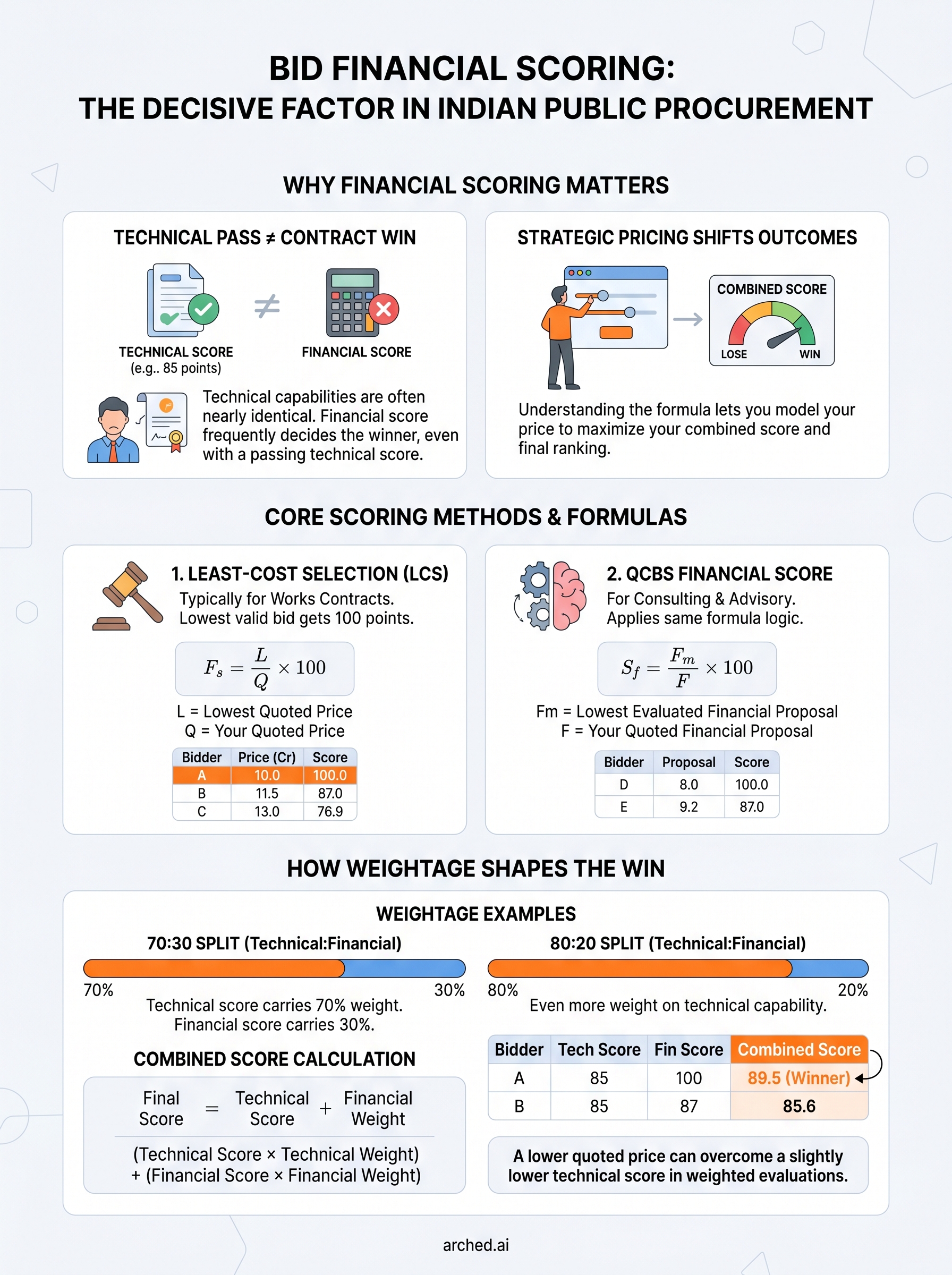
In least-cost tenders, your financial score equals 100 points only if you submit the lowest valid bid in the pool. Every other bidder receives a proportional score using this formula: Fs = (L / Q) × 100, where L is the lowest quoted price submitted and Q is your quoted price.

| Bidder | Quoted Price (INR Crore) | Financial Score |
|---|---|---|
| A | 10.0 | 100.0 |
| B | 11.5 | 87.0 |
| C | 13.0 | 76.9 |
QCBS financial score formula
QCBS tenders apply the same core formula: Sf = (Fm / F) × 100, where Fm is the lowest evaluated financial proposal and F is your quoted figure. Evaluators then combine this financial score with your technical score through the specified weightage ratio to produce a final ranking.
A narrow price gap between two bidders can shift the combined score enough to change the contract award entirely.
How to apply weightage like 70:30 with tech scores
Once you have both your technical score and your financial score, combining them through the specified weightage ratio produces your final ranking. A 70:30 split means technical scores carry 70% of the total and financial scores carry 30%. An 80:20 split shifts even more weight toward technical capability. The tender document specifies which ratio applies, so locate that clause before you model any pricing scenarios.
Calculating the combined score step by step
Apply the combined formula as follows: Final Score = (Technical Score × Technical Weight) + (Financial Score × Financial Weight). The example below shows how two bidders with identical technical scores but different quotes finish at different positions.
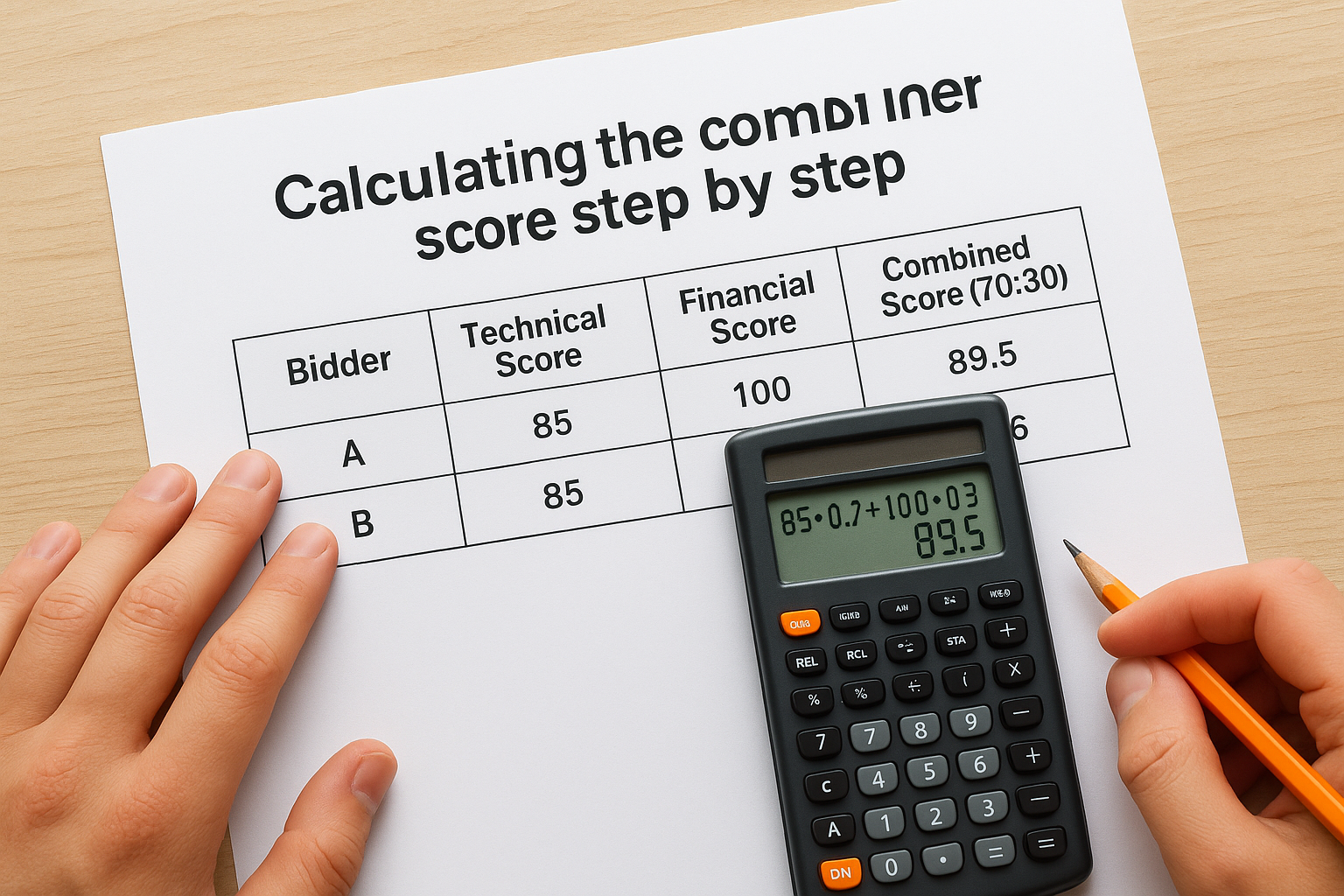
| Bidder | Technical Score | Financial Score | Combined Score (70:30) |
|---|---|---|---|
| A | 85 | 100 | 89.5 |
| B | 85 | 87 | 85.6 |
A three-point gap in financial score translates directly into a measurable difference in the final ranking, even when technical scores are equal.
Bidder A wins because their lower quoted price generated a higher financial score, despite both firms matching on technical merit. Running this calculation before submission tells you exactly how much pricing flexibility you actually have.
Common pitfalls and how evaluators avoid bias
Even well-structured bid financial scoring processes break down when evaluators skip verification steps or apply formulas inconsistently across bidders. These errors often go unnoticed until a losing bidder raises a formal grievance, which delays contract award and creates real legal exposure for the procuring authority.
Arithmetic errors that shift rankings
Calculation mistakes in financial score computation are more common than most bid teams expect. An evaluator who applies the wrong baseline figure, using the second-lowest bid instead of the lowest valid bid, shifts every bidder's score simultaneously and distorts the entire ranking.
A single input error in the baseline price field can reverse the contract award entirely.
Procuring authorities counter this by requiring independent recalculation by a second evaluator before scores are finalized and disclosed to any bidder.
Inconsistent treatment of taxes and contingencies
Tax inclusion or exclusion varies across bid documents, and evaluators sometimes apply different treatment to different bidders within the same pool. Your quoted price may include GST while a competitor excludes it, making direct comparison inaccurate without prior normalization. Standardizing the financial basis across all submitted bids before running any formula is the step evaluators skip most often, and it consistently produces the most damaging ranking errors. Auditors flagging procurement irregularities trace a significant share of disputes back to this single inconsistency.
Next steps for your next tender
You now have the formulas, the weightage logic, and the pitfall list. The real work is applying this before you finalize any price. Start by locating the evaluation methodology section in your next tender document before you build your cost model. Identify whether the procuring authority uses least-cost selection or QCBS, confirm the technical-to-financial weightage ratio, and check how taxes are treated. Run the bid financial scoring formula with realistic competitor price assumptions to see where your quote needs to land to maximize your combined score.
If pricing is where your team is stretched, Arched can build the estimate for you: send the drawings and we deliver a priced BOQ with rate build-ups, reviewed by an engineer, so the number you put on paper is one you can defend. See how our estimating service works.
Have a package your team can’t get to? Send it to us. Our engineers check and sign off everything we deliver.