Bid Technical Scoring: Methods, Criteria & Formulas Used
Every government tender you chase in India, whether on GeM, CPPP, or a state e-procurement portal, runs your proposal through some form of bid technical scoring before price even enters the picture. It's the mechanism that separates qualified firms from everyone else, and it directly determines whether your bid moves forward or gets rejected outright. Yet most contractors treat it as a black box: submit the documents, hope for a good number, and move on to the next opportunity without understanding what actually drove the score.
That's a problem, because technical scores follow specific, published methodologies. Evaluation committees use weighted criteria, point-based systems, and mathematical formulas that are often spelled out in the tender document itself. Understanding these isn't optional, it's the difference between a bid that barely clears the threshold and one that maximizes every available point.
This article breaks down how bid technical scoring actually works: the common methods used across Indian public procurement, the criteria evaluators weigh most heavily, and the formulas that convert your experience, methodology, and credentials into a number. Whether you're a BD manager prepping a highway tender or a consultant bidding on urban infrastructure, you'll walk away with a clear framework for how your next technical proposal will be assessed, and how to structure it accordingly.
Why bid technical scoring matters in tenders
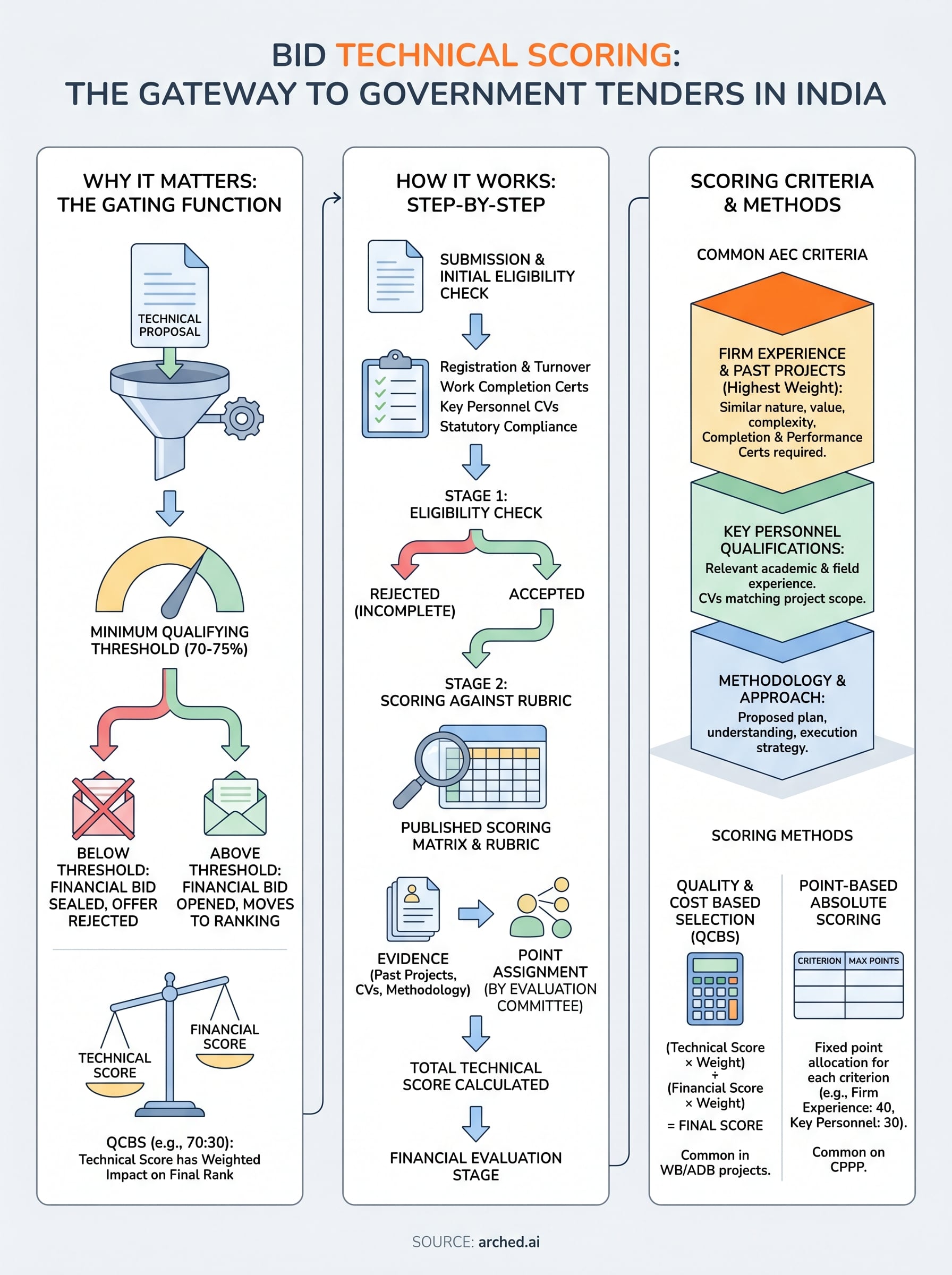
In most Indian government tenders, your technical proposal gets evaluated before the financial envelope is even opened. The technical evaluation stage acts as a filter, and only firms that clear a minimum qualifying score move forward to price comparison. Understanding how bid technical scoring works means you're not just trying to submit something complete; you're trying to hit specific numeric thresholds that evaluators have already defined in the tender document.
The gating function: clearing the minimum threshold
Most public procurement tenders in India, particularly those on CPPP and state e-procurement portals, set a minimum qualifying technical score between 70% and 75%. If your submission falls below that cutoff, your financial bid stays sealed and your offer gets rejected entirely. This makes the technical evaluation the single most important stage for many tenders, because no price advantage, however significant, can compensate for a disqualification here.
Your financial bid is irrelevant if your technical score doesn't clear the minimum threshold first.
The criteria driving that threshold typically cover team qualifications, past project experience, and your proposed methodology. Each carries a point allocation, and evaluators measure your submission against a pre-defined scoring rubric that procuring authorities publish inside the tender document itself.
How the score shapes your final ranking
When tenders use Quality and Cost Based Selection (QCBS), your technical score contributes a weighted percentage to the final combined score. A common split is 70:30 or 80:20 in favor of technical marks. That structure means a firm with a strong technical score can finish ahead of a lower-priced competitor if the point difference is large enough.
Your technical performance also signals credibility to the procuring authority. Consistently high technical scores build a demonstrable track record that influences future bid evaluations, especially in repeat procurement cycles where evaluators reference prior submissions from the same firm.
How technical bid scoring works step by step
Bid technical scoring follows a structured sequence that procuring authorities define before they receive a single proposal. Knowing that sequence lets you prepare each component of your submission to match exactly what evaluators measure, rather than guessing after the fact.
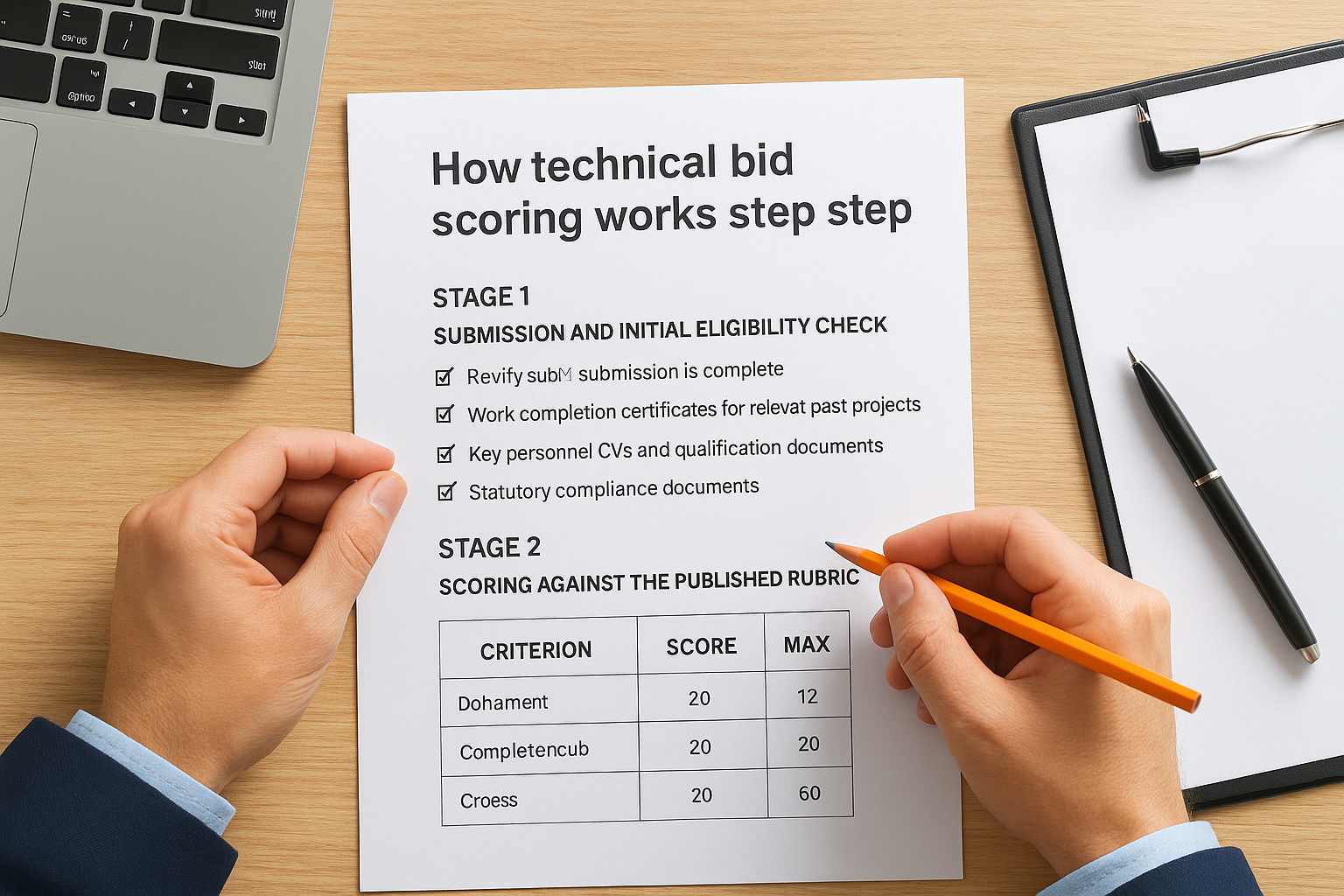
Stage 1: Submission and initial eligibility check
Evaluators first verify that your submission is complete and that you meet the basic eligibility conditions stated in the tender notice. Missing a single mandatory document at this stage can result in rejection before any scoring begins. Treat the checklist in the tender document as a hard requirement. The items typically checked at this stage include:
- Registration and turnover certificates
- Work completion certificates for relevant past projects
- Key personnel CVs and qualification documents
- Statutory compliance documents
Stage 2: Scoring against the published rubric
Once your bid clears the initial screen, evaluators move through each weighted criterion and assign points based on the evidence you've submitted. They compare your documentation directly against the scoring matrix that the procuring authority published inside the tender. A panel typically scores each member independently, then averages the results to reduce individual bias.
The rubric is already written before you submit. Your job is to make sure your evidence maps directly to every point on it.
After scoring, your total technical mark gets checked against the minimum qualifying threshold, and only firms that clear it move on to the financial evaluation stage.
Common technical evaluation criteria in AEC bids
Across Indian public procurement, AEC tenders use a consistent set of criteria that evaluators measure your submission against during bid technical scoring. These criteria appear in the evaluation matrix inside the tender document, and each carries a specific point allocation and maximum score. Knowing which criteria matter most lets you prioritize your preparation time before you submit.
Firm experience and past project credentials
Your completed project history is typically the highest-weighted criterion in any AEC technical evaluation. Evaluators look for projects that are similar in nature, value, and complexity to the one being procured. A road project tender, for example, will specify a minimum contract value threshold and require you to demonstrate you've completed comparable work within a defined period, usually the last five to seven years.
Submitting a project that partially meets the similarity criteria scores fewer points than one that matches the scope exactly.
The evidence you submit here must include work completion certificates issued by the client and, in many cases, performance certificates as well.
Key personnel qualifications
Team composition and individual credentials form the second major scoring block. Evaluators assign points based on the academic qualifications and relevant field experience of your proposed team members, particularly the Project Manager and key technical staff.
Your personnel CVs need to directly reference projects with matching scope and value, not just list generic experience, to capture the full points available for each role.
Scoring methods, weightings, and formulas explained
Indian public procurement uses several distinct scoring methods, and the tender document tells you which one applies to your bid. Each method handles the relationship between technical marks and financial marks differently, which directly shapes how you allocate preparation time before submitting.
Quality and Cost Based Selection
QCBS is the most widely used method for consulting and AEC assignments under World Bank and ADB-funded projects in India. Your technical score combines with your financial score using a pre-defined ratio, typically 70:30 or 80:20. The formula is:

Final Score = (Technical Score × Technical Weight) + (Financial Score × Financial Weight)
In a 70:30 QCBS split, a firm scoring 85 on technical evaluation with a higher price can still outrank a firm scoring 70 with the lowest price.
The financial score for each bidder is calculated as: (Lowest Bid / Your Bid) × 100 × Financial Weight. This structure rewards competitive pricing but only after your technical proposal clears the minimum qualifying threshold first.
Point-based absolute scoring
Many domestic tenders on CPPP and state portals use a fixed point allocation system instead of QCBS. Each criterion in the bid technical scoring matrix carries a maximum point value, and evaluators assign marks based directly on the evidence you submit. This table shows a typical structure:
| Criterion | Max Points |
|---|---|
| Firm experience | 40 |
| Key personnel | 30 |
| Methodology | 20 |
| Local presence | 10 |
How to improve your technical score before you bid
Improving your bid technical scoring outcome starts before you write a single word. The tender document contains the scoring matrix, point allocations, and evidence requirements that evaluators will use. Reading that section first tells you exactly where points are available and which criteria carry the most weight.
Read the scoring matrix before you write anything
Most firms start writing immediately and reference the evaluation criteria only when checking completeness at the end. That order produces generic submissions that miss specific point triggers. Instead, extract the scoring matrix first and treat each criterion as a separate deliverable with its own evidence requirement and point target.
Map your available evidence against each scoring criterion before you begin drafting, not after.
Match your evidence to exact criteria language
Evaluators score what you submit against the specific language in the rubric, not your interpretation of it. If the tender asks for projects of a minimum contract value in a particular sector, your completion certificates must reference both the value and the sector clearly. Submitting a certificate that implies eligibility without stating it directly often scores partial points.
Your CVs follow the same logic. Each key personnel profile should reference specific projects with scope, value, and role details that map directly to what the tender's personnel scoring section asks for. Generic CVs listing total years of experience rarely capture full marks.
Final takeaways and next step
Bid technical scoring is not a mystery. Procuring authorities publish the evaluation matrix, point allocations, and evidence requirements inside every tender document, and firms that read that section first consistently outperform those that treat submission as a documentation exercise. Your technical score determines whether your financial proposal gets opened at all, which makes it the most consequential part of your bid preparation.
The firms that score highest do three things consistently: they extract the scoring rubric before writing anything, they match their evidence to the exact language evaluators use, and they identify gaps in their credentials early enough to address them on future bids rather than discovering them after a rejection.
If preparing the estimate and BOQ is squeezing your time before the technical submission, Arched can take it off your plate: send the drawings and we deliver a priced BOQ with rate build-ups, reviewed by an engineer. See how our estimating service works.
Have a package your team can’t get to? Send it to us. Our engineers check and sign off everything we deliver.