Tender Opening Procedure In India: Technical vs Financial
Learn the tender opening procedure in India, including technical vs financial bid evaluations. Follow GFR 2017 rules to avoid early disqualification.
Every government contract in India passes through a structured gate before any work begins: the tender opening procedure in India. Whether you're bidding on a highway project through CPPP or supplying materials via GeM, understanding exactly how bids are unsealed, and in what order, determines whether your proposal even gets evaluated. Get the process wrong, and a technically strong bid can be disqualified before the financial envelope is ever opened.
The procedure splits into two distinct stages: the technical bid opening and the financial bid opening. Each follows specific rules under the GFR and CVC guidelines, with eProcurement platforms adding their own layer of process controls. For BD managers and bid teams handling multiple submissions across state and central portals, knowing these steps cold isn't optional, it's the difference between a pipeline that converts and one that leaks.
This guide breaks down the complete tender opening process stage by stage, covering technical vs. financial bid evaluation, timelines, common disqualification triggers, and what happens on the ground (or screen) when bids are opened. At Arched, we parse thousands of tender documents across 500+ portals to help firms like yours spot eligibility risks before submission day, so consider this your operational primer on what happens after you hit "submit."
What tender opening means in India
In India, tender opening is the formal, regulated act of unsealing submitted bids on a pre-announced date and time, in the presence of authorized personnel and, in most cases, the bidders themselves or their representatives. This is not a simple administrative step. The General Financial Rules (GFR) 2017 and CVC guidelines treat the opening event as a transparency checkpoint, where every envelope is accounted for, every submission is logged, and any procedural deviation can invalidate the entire process. For infrastructure firms competing on CPPP, GeM, or state e-procurement portals, understanding this step is as critical as preparing the bid itself.
The two-envelope (or two-cover) system
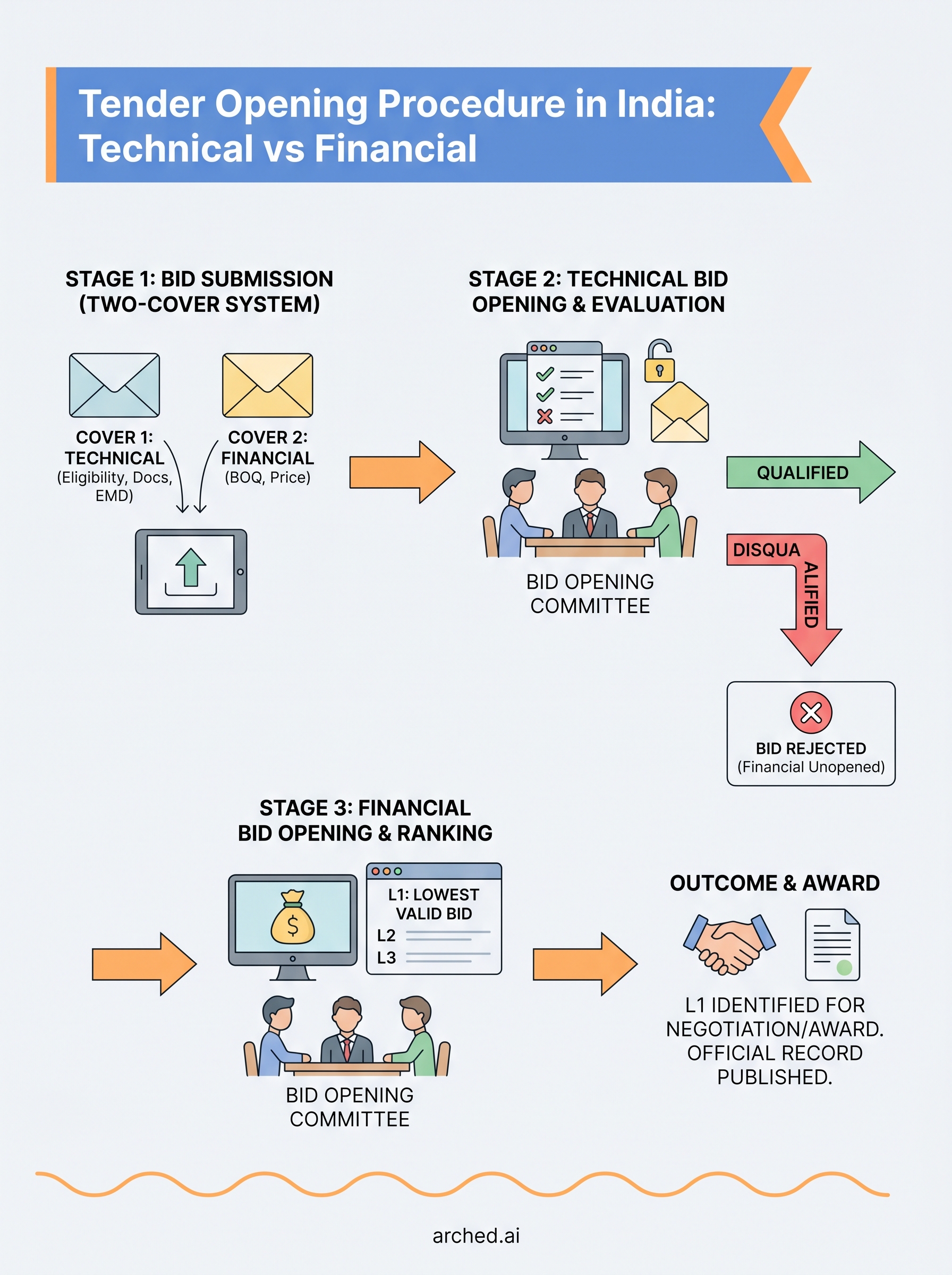
The most common format you will encounter in the tender opening procedure in India is the two-cover system. Under this structure, your bid travels in two separate submissions: the first cover holds your technical and eligibility documents, and the second holds your financial quote (BOQ and pricing). Authorities open Cover 1 first and evaluate it independently before Cover 2 is touched. This separation prevents price from influencing the technical assessment, a safeguard that protects both procurement integrity and your firm's chances of fair evaluation.

The financial envelope is only opened for bidders who pass technical scrutiny. If your Cover 1 is rejected, your price is returned unopened.
The table below shows how this maps across common procurement platforms:
| Platform | Cover 1 (Technical) | Cover 2 (Financial) |
|---|---|---|
| CPPP / Central portals | Eligibility, EMD, certifications | BOQ, price schedule |
| GeM | Compliance documents | Quoted unit price |
| State e-Portals (e.g., MSTC) | Technical bid, drawings | L1 price comparison |
How eProcurement changed the opening process
Before eProcurement became standard, physical bid opening happened in a designated room with witnesses signing each envelope. Today, most central and state tenders use electronic bid opening, where the system decrypts submissions at the exact scheduled time, removing human handling from the unsealing step entirely. Bidders receive automatic notifications, and the opened data appears on-screen to all registered participants simultaneously.
This shift matters practically for your team. You no longer need to send a representative to a government office to witness the opening. Instead, you monitor the portal directly, and the digital audit trail created during opening becomes part of the official procurement record, which is relevant if you ever need to file a grievance or challenge an evaluation outcome later.
Before opening day: rules, roles, and readiness
The tender opening procedure in India runs on a defined set of pre-conditions. Before any bid is decrypted or unsealed, the procuring authority must confirm that the Bid Opening Committee (BOC) is constituted and present, that the opening date and time match what was published in the tender notice, and that the system or room is ready to receive bidders or their representatives. Skipping any of these steps gives bidders legal grounds to challenge the process.
Who holds authority over the opening
Under GFR 2017 Rule 175, the bid opening must be conducted by at least two authorized officers. These officers sign the bid opening statement, record the number of bids received, and note any bids that arrived late or were rejected at the gate. On eProcurement platforms, the system logs officer credentials digitally, but the accountability still rests with named officials, not the platform itself.
If a bid is received after the submission deadline, GFR rules require it to be returned unopened, regardless of the reason for the delay.
What you should verify before opening day
Your preparation as a bidder directly affects whether your submission survives the opening event. Run through these checks at least 48 hours before the deadline:
- EMD submitted in the correct format (bank guarantee, DD, or online payment as specified)
- Cover 1 documents complete: certificates, registration, experience statements, and drawings where required
- Submission acknowledged by the portal with a system-generated receipt number
- No pending clarifications or corrigendum updates that change the document list
Confirming these items removes the most common reasons bids get flagged the moment a tender opens.
Technical bid opening: what happens and what gets recorded
When Cover 1 opens, the procuring authority begins a sequential review of every document you submitted under the technical envelope. The Bid Opening Committee checks each submission against the checklist published in the tender notice, marking documents present, absent, or deficient. In eProcurement systems, this review happens on-screen simultaneously for all logged-in participants, and the system timestamp locks the official record of what was received and when.
What the committee reviews in Cover 1
The technical review is a compliance check, not a quality assessment. Officers confirm that your EMD is valid, your registration certificates match the required category, your experience statements cover the minimum project value and type, and any mandated drawings or joint venture agreements are attached. Missing even one mandatory document at this stage removes your bid from further consideration, regardless of how strong your pricing or track record might be.
Common documents checked during Cover 1 opening:
- EMD instrument: Bank guarantee, DD, or online payment receipt
- Registration certificate: Contractor class, GSTIN, PAN
- Experience statements: Minimum qualifying projects as specified in the NIT
- Joint venture agreement: Required if bidding as a consortium
A deficient technical bid cannot be corrected after opening. Whatever you submitted before the deadline is the final record.
What gets recorded in the opening statement
The tender opening procedure in India requires the committee to produce a Bid Opening Statement listing every bidder's name, the documents found in their Cover 1, and any noted deficiencies. On platforms like CPPP, this document is published digitally and forms the official procurement record. Download and retain this statement immediately after opening, because it is your primary reference if you need to challenge a disqualification or file a grievance later.
| Field | What gets recorded |
|---|---|
| Bidder name and registration number | Confirmed from submission metadata |
| EMD details | Amount, instrument type, validity date |
| Document checklist | Present, Absent, or Deficient |
| Committee signatures | Names and designations of officers |
Financial bid opening: how prices get revealed and compared
Cover 2 only opens after the procuring authority publishes the technical evaluation results and confirms which bidders qualified. On eProcurement platforms, the system enforces this sequence automatically: the financial envelope remains encrypted until an authorized officer triggers the next phase. If you passed technical scrutiny, you will receive a portal notification before the scheduled financial opening date, which is typically announced separately in the original tender notice or via a corrigendum.
When Cover 2 gets unlocked
The Bid Opening Committee reconvenes on the financial opening date and decrypts all qualifying bidders' price submissions simultaneously. In the tender opening procedure in India, this simultaneous reveal is a deliberate safeguard: no bidder's price is visible to the committee before opening, which prevents last-minute manipulation. Your submitted BOQ rates and total quoted price appear on-screen and are recorded in a Financial Bid Opening Statement, similar in format to the Cover 1 record.
If you were disqualified at the technical stage, your Cover 2 is never opened and the submitted price data is not entered into the procurement record.
How the L1 comparison works
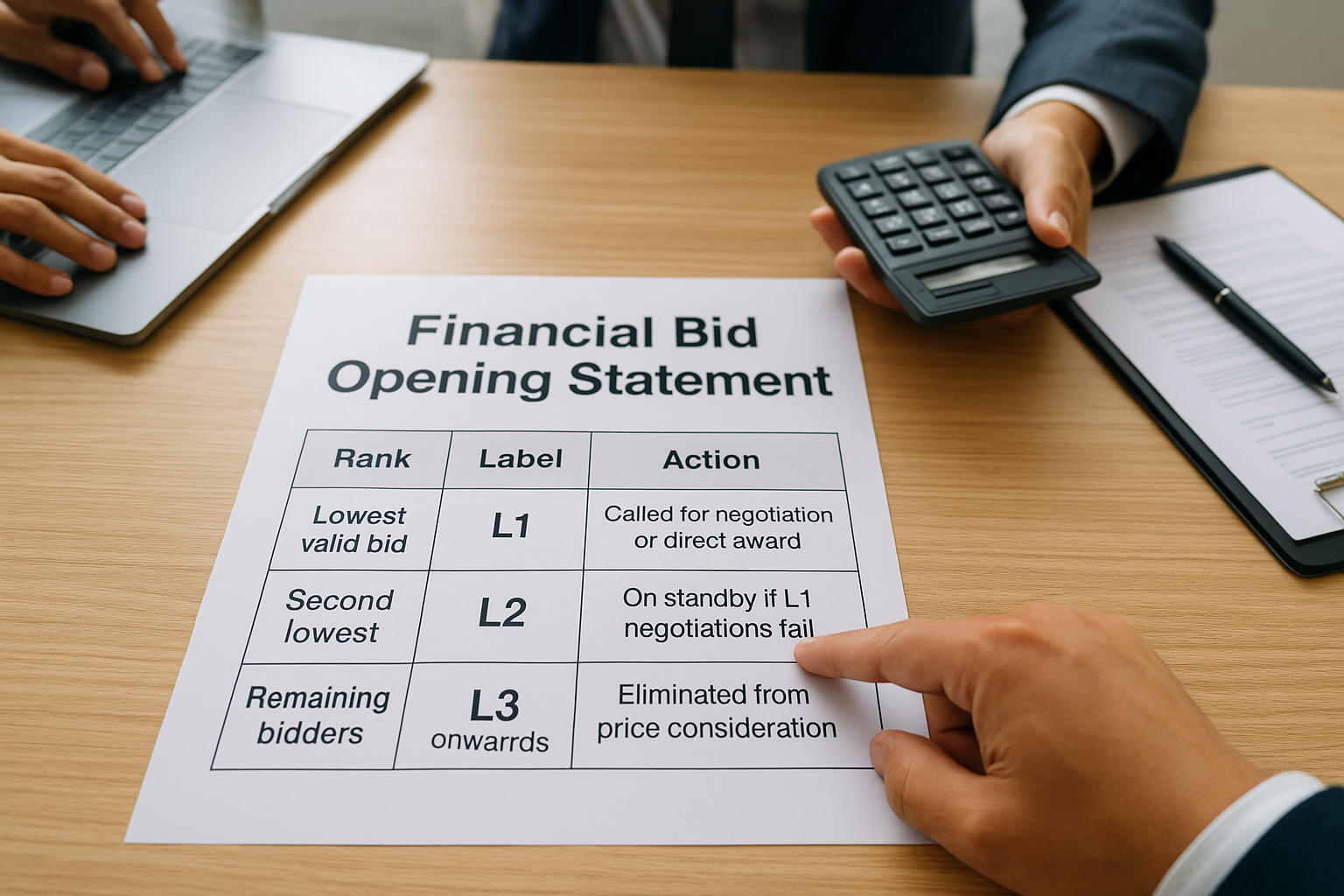
After decryption, the system or committee ranks all valid financial bids from lowest to highest total quoted price. The lowest bidder is designated L1, the next is L2, and so on. Evaluation follows this ranking structure:
| Rank | Label | Action |
|---|---|---|
| Lowest valid bid | L1 | Called for negotiation or direct award |
| Second lowest | L2 | On standby if L1 negotiations fail |
| Remaining bidders | L3 onwards | Eliminated from price consideration |
Your total quoted figure, not individual line items, determines your rank. Always cross-check your BOQ arithmetic before submission because a calculation error in the total directly affects your L-ranking, not just one line.
After opening: evaluation outcomes, clarifications, and challenges
Once both covers are opened and recorded, the procuring authority moves into the evaluation phase, where the committee reviews technical compliance scores and L1 pricing in detail. This phase is not instant. On most central and state portals, the formal evaluation period runs anywhere from two to eight weeks depending on the project value and the number of qualifying bidders. Monitor the portal actively during this window because procurement authorities may raise clarification requests that require a response within a tight deadline.
Responding to clarification requests
Authorities issue clarification requests when a submitted document is ambiguous or incomplete but not disqualifying outright. You will receive a portal notification, and your team must respond within the specified window, usually three to five working days. Your response goes into the official procurement record and influences the final evaluation decision.
A missed clarification deadline is treated the same as non-submission. Set calendar reminders the moment you receive the request.
How to challenge a disqualification
If the Bid Opening Statement shows your technical bid as deficient and you believe the assessment is incorrect, you have a formal recourse path under the GFR 2017 grievance provisions. File your challenge with the procuring authority first, citing the specific document reference and the relevant clause in the tender notice. Most state portals also carry a grievance portal link in the dashboard. Keep your submission receipt and the opening statement on hand as evidence.
| Challenge step | Action required |
|---|---|
| Review opening statement | Download and compare against your submission receipt |
| Identify the disputed clause | Reference the NIT clause number directly |
| Submit written representation | Address to the designated grievance officer |
| Escalate if unresolved | Approach the CVC or relevant ministry with documentation |
Quick recap and next step
The tender opening procedure in India follows a strict two-stage sequence: Cover 1 (technical) opens first, and only bidders who clear that evaluation see their Cover 2 (financial) decrypted. Every stage from pre-opening checks to L1 ranking runs on documented, time-stamped records that become part of the official procurement file. Your submission receipt, the opening statement, and any clarification correspondence are the documents that protect you if a dispute arises.
Knowing the process is one part of the equation. The harder part is reaching opening day with a complete, compliant bid that survives Cover 1 scrutiny without gaps. That means catching eligibility shortfalls and missing credentials before submission, not after the opening statement is published. Arched reads tender documents across 500+ portals, flags qualification risks specific to your firm, and maps out exactly what each opportunity requires. See how Arched handles tender document analysis and stop losing bids to preventable disqualifications.