Tender Eligibility Criteria: How To Qualify for Govt Bids
Every government tender comes with a gate you have to pass through before your bid even gets read. That gate is the tender eligibility criteria, the set of technical, financial, and legal requirements that determine whether your firm qualifies to participate. Miss a single requirement, and your bid gets rejected outright, regardless of how competitive your pricing or execution plan might be.
For infrastructure and AEC firms bidding on projects through GeM, CPPP, or state e-procurement portals, these criteria can vary significantly from one tender to the next. Some demand minimum annual turnover thresholds; others require specific certifications, prior project experience of a certain scale, or EMD deposits that lock up working capital. Understanding exactly what qualifies you, and what disqualifies you, is the difference between a productive pipeline and wasted effort.
This article breaks down every component of government tender eligibility in India, from financial benchmarks to technical qualifications to legal standing. You'll learn how to evaluate your firm's readiness before committing resources to a bid.
What tender eligibility criteria include
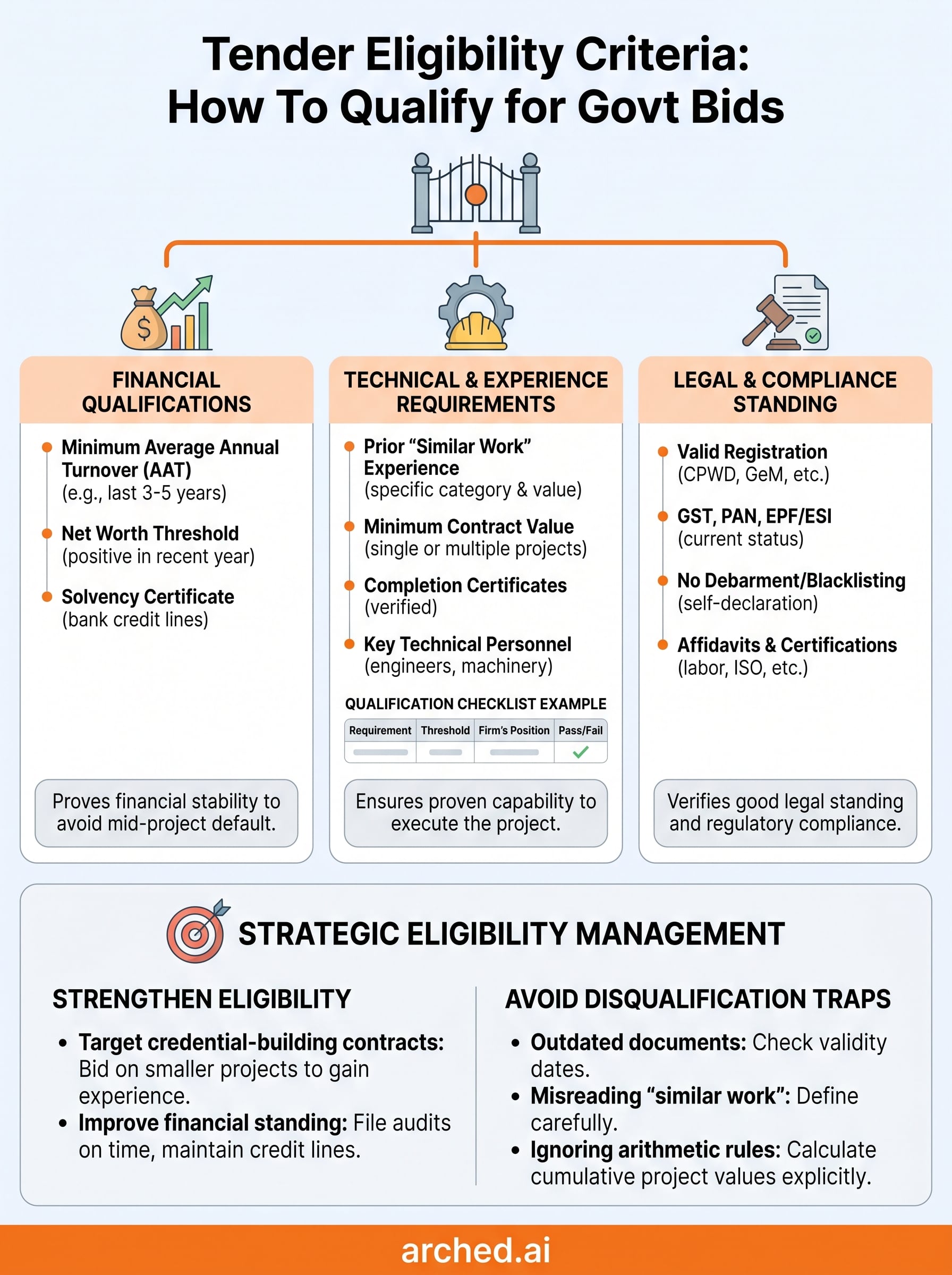
Government tenders in India typically bundle their requirements into three broad categories: financial capacity, technical track record, and legal standing. Each category contains specific thresholds your firm must meet before the evaluation committee even opens your price bid. The exact combination depends on the contracting authority, the sector, and the project value, but the core structure stays consistent across most public procurement frameworks.
Financial qualifications
The most commonly cited financial requirement is minimum average annual turnover (AAT), usually calculated over the last three to five audited financial years. A road widening contract worth ₹50 crore might require an AAT of ₹25 crore or more. Some tenders also set a net worth threshold or demand that the bidder show positive net worth in the most recent financial year. Beyond turnover, many notices require a solvency certificate from your bank, confirming that the firm has sufficient credit lines to execute the project.
Procurement authorities set these thresholds to reduce the risk of financial default mid-project. If your latest balance sheets do not meet the stated figures, your bid gets disqualified at the pre-qualification stage, regardless of your pricing.
A firm with strong execution capability but thin balance sheets will be screened out on financials alone, making early financial planning as critical as operational readiness.
Technical and experience requirements
Prior project experience is the most detailed section of most tender eligibility criteria. Authorities typically require that you have completed at least one "similar work" of a specified value within the last five to ten years. "Similar work" is defined differently in every notice, so read that definition carefully. A bridge tender may accept only bridge construction contracts, not general civil works. An irrigation tender might count only earthwork or canal lining projects.

Beyond the category of work, minimum value thresholds for individual completed contracts are common. Some tenders require one single project worth at least 40% of the tender value, while others accept multiple smaller projects that collectively reach 60-80% of the tender value. You need completion certificates, work orders, and payment certificates from the client to prove this experience. Missing or incomplete documentation is one of the most frequent rejection reasons.
Many specialized tenders also list technical personnel requirements, such as a minimum number of graduate engineers with specific years of experience or key plant and machinery that must be available for deployment.
Legal and compliance standing
Your firm must be properly registered and in good legal standing to bid. This means holding a valid registration with the relevant authority, such as CPWD, state PWD, or an approved contractor classification on GeM. For many tenders, you also need a current GST registration, PAN card, and an EPF/ESI registration for your workforce.
Authorities also check for debarment and blacklisting status. If your firm has been blacklisted by any government authority, a self-declaration is required in most bids, and false declarations carry serious legal consequences. Some portals cross-check debarment lists automatically.
Additional compliance documents often include an affidavit of non-conviction, labor law compliance certificates, and, for larger contracts, an ISO certification or quality management system accreditation. Keep all of these documents current, because most tender notices require them to be valid at the time of bid submission, not just at contract award.
Why eligibility criteria matter in govt procurement
Tender eligibility criteria exist because governments need to reduce the risk of handing public contracts to firms that cannot deliver. When a ₹100 crore road project stalls because the contractor runs out of funds or lacks the technical depth to handle field-level problems, the cost falls on the public. Procurement frameworks across GeM, CPPP, and state PWD portals embed eligibility thresholds to screen for execution capability before any price comparison begins.
They protect the contracting authority
Government departments operate under strict accountability frameworks where project failure draws financial and political consequences. Setting minimum financial and technical thresholds shifts the screening process to the pre-qualification stage, which means evaluators spend their time comparing capable firms rather than sorting through unqualified submissions. For large infrastructure projects, this screening is built directly into the two-envelope or three-envelope bid structure, where technical and financial eligibility must be cleared before the price envelope is opened at all.
Eligibility thresholds are not bureaucratic hurdles, they are a risk management tool designed to protect public funds from being locked in failed contracts.
Procurement guidelines issued under the General Financial Rules (GFR) 2017 reinforce this principle by requiring contracting authorities to define pre-qualification criteria that are proportionate to the scale and complexity of the work. This means the thresholds you encounter are deliberate, and there is no mechanism to appeal a disqualification based on them once a bid is submitted.
They shape your bid strategy
Treating eligibility requirements as a strategic filter is one of the most practical ways to improve your win rate. If a tender requires a completed similar project worth ₹30 crore and your largest finished project is ₹18 crore, you are ineligible regardless of how competitive your pricing is. Submitting anyway wastes your BD team's time, depletes working capital tied to EMD, and produces no useful outcome.
Firms that consistently review eligibility criteria before committing to a bid build a pipeline of genuinely winnable opportunities rather than a high-volume list of long shots. That focus also surfaces useful information: it shows you exactly which credentials and project values you need to accumulate to qualify for the next tier of contracts.
How to check if you qualify before you bid
Checking eligibility before you invest time in a bid is a straightforward process if you approach it systematically. Every tender notice contains a pre-qualification section or an eligibility criteria clause that lists every requirement your firm must satisfy. Read that section before you read anything else in the document, including the scope of work or the BOQ. Starting there tells you within minutes whether the opportunity is worth further analysis.
Build a qualification checklist from the tender document
Pull every stated requirement from the tender eligibility criteria section and convert it into a binary checklist: either your firm meets the threshold or it does not. Common items to extract include the minimum annual turnover figure, the required value of a single similar completed project, the list of mandatory certifications, and the validity dates for compliance documents. Do not rely on memory or past assumptions. Build the checklist fresh for each tender, because thresholds differ significantly between contracting authorities and project types.

Here is a simple structure you can apply directly:
| Requirement | Threshold Stated | Your Firm's Position | Pass / Fail |
|---|---|---|---|
| Average Annual Turnover | ₹X crore (last 3 yrs) | ₹Y crore | |
| Similar Work (single project) | ₹X crore (last 10 yrs) | Largest: ₹Y crore | |
| GST Registration | Valid | Valid / Expired | |
| Solvency Certificate | Required | Available / Not available | |
| Key Technical Personnel | Graduate engineer, X yrs exp | Count on rolls |
A failed checklist run before submission saves far more time and capital than a disqualified bid after submission.
Match your credentials against each requirement
Once your checklist is complete, pull your supporting documents and verify that each one aligns with the exact wording in the notice. Pay close attention to date ranges for completed projects, because many tenders specify that work must have been completed within the last five or ten years. A project completed outside that window does not count, even if the contract value qualifies.
Verify that completion certificates sit on client letterhead, carry a date of actual completion, and state the final contract value clearly. If any document is missing or ambiguous, treat that line item as a disqualification and reassess whether submitting a bid is worth the EMD deposit and preparation time it will consume.
How to strengthen your eligibility over time
Meeting tender eligibility criteria today is only part of the equation. The firms that consistently win high-value government contracts treat eligibility as a long-term capability building process, not a one-time compliance check. If you currently fall short on turnover thresholds or lack a completed project of the required value, a structured plan to close those gaps moves you into qualifying range far faster than waiting for growth to happen on its own.
Target contracts that build your credentials
The most direct way to raise your eligibility profile is to bid on smaller, adjacent contracts that directly contribute to your qualifying experience. If the ₹80 crore bridge tender you want requires a single completed similar project worth ₹32 crore, your immediate target should be contracts in the ₹35-45 crore range that match the same work category. Completing those contracts gives you both the turnover contribution and the documented similar-work experience required for the next tier.
Building a deliberate sequence means tracking which work categories appear most frequently in the tenders you want to qualify for, then mapping your bid activity to those categories over the next one to two years. Each contract you complete becomes a credential, and each credential opens a tier of opportunities you could not access before. Keep completion certificates, payment records, and work orders organized from day one, because you will need them to prove eligibility years later.
Treat every contract you execute as a qualification asset, not just a revenue event, and your eligibility for larger work compounds over time.
Improve your financial standing in parallel
Annual turnover thresholds and net worth requirements tighten as contract values increase, so financial strengthening needs to run alongside project execution. File your audited financial statements on time every year, because late filing creates documentation gaps that can disqualify you on technical grounds even when your actual numbers are strong. Work proactively with your bank to maintain and upgrade your solvency certificate and available credit facility, since many high-value tenders require both as part of pre-qualification.
Retained earnings policy and legitimate fixed asset revaluation are two levers your auditor can help you apply to improve net worth over time. Neither produces overnight results, but both build the financial credibility that unlocks contracts in the ₹50 crore-plus range within a two to three year window.
Common disqualification traps and how to avoid them
Many firms that actually qualify on paper still get rejected because of process and documentation failures. Tender eligibility criteria are applied strictly at the time of submission, not generously after the fact. Knowing where bids most commonly fail gives you a specific checklist to run before every submission and helps you avoid losing the EMD deposit and preparation time on a bid you should have won.
Submitting outdated or incomplete documents
Validity dates on solvency certificates, GST registrations, and contractor registration certificates are a frequent rejection trigger. Most tender notices require these documents to be valid at the date of submission, not the date of contract award. Check every expiry date in your document folder at the start of each bid cycle rather than assuming last quarter's pack is still current.
Completion certificates that lack a date of actual completion or omit the final certified contract value are another consistent rejection reason. Evaluation committees follow a checklist and will not infer missing information from other documents in your submission. If your certificate is ambiguous, contact the original client and request a corrected version before the bid deadline.
Disqualification from a documentation gap is entirely preventable, while disqualification from a genuine eligibility shortfall is not.
Misreading the similar work definition
The definition of "similar work" sits inside the tender document, and it varies substantially between contracting authorities. A clause that reads "similar nature of work" in one tender may mean civil construction broadly. In another, it may mean only a specific sub-type, such as pre-stressed concrete bridge construction or lined canal earthwork. Read that definition clause word by word, not at a glance.
Firms also misapply the project value threshold by using the original contract value rather than the final certified value. Some contracts grow through variations and amendments; others shrink. The figure that counts for qualification is always the value certified by the client on the completion certificate, not the figure on the original work order.
Ignoring arithmetic requirements for multiple projects
Some tenders accept multiple smaller completed projects to meet the experience threshold, but they apply specific rules: for example, two projects each worth at least 30% of the tender value, collectively summing to 80% or more. Running that arithmetic check explicitly, rather than assuming the total looks right, catches failures before submission rather than after.
Where to go from here
Tender eligibility criteria are not paperwork formalities. They are the actual gate between your firm and a government contract, and treating them as a structured checklist rather than a last-minute scan is what separates teams that win consistently from those that burn effort on unwinnable bids. You now have a complete picture of what each requirement type covers, how to self-assess your readiness before committing resources, how to build eligibility over time, and where documentation failures typically occur.
The next step is applying that knowledge at scale. Manually checking eligibility across dozens of tenders every week is time-consuming and error-prone. Once you decide to bid, Arched can take the estimate off your plate: send us the tender documents and we deliver a priced BOQ, reviewed by an engineer, so your team can concentrate on the qualification and submission side. See how our estimating service works.
Have a package your team can’t get to? Send it to us. Our engineers check and sign off everything we deliver.