How To Calculate Bid Validity Period In Tenders (Examples)
Learn how to calculate bid validity period with Indian tender examples. Master day counting and bank guarantee alignment to avoid disqualification.
Every tender document specifies a bid validity period, the window during which your quoted price and terms remain legally binding. Get the dates wrong, and your bid gets rejected before anyone even evaluates it. Understanding how to calculate bid validity period correctly is one of those fundamentals that separates firms who win contracts from firms who waste months on disqualified submissions.
The calculation itself isn't complicated, but it trips people up because different procuring authorities use different starting points. Some count from the bid submission deadline, others from the date of bid opening. Indian government tenders on platforms like GeM, CPPP, and state e-procurement portals each have their own conventions, and the specifics are often buried deep inside lengthy tender documents, exactly the kind of detail that Arched's document parsing engine is built to extract automatically.
This article breaks down the exact method to calculate bid validity dates, walks through real examples from Indian public procurement, and covers what happens when a procuring authority requests an extension. By the end, you'll know how to pin down the precise start date, end date, and duration for any tender, and how to avoid the common mistakes that cost contractors otherwise winnable bids.
Why bid validity period matters
The bid validity period is not just administrative fine print. It's a legal commitment from your firm to the procuring authority that your quoted price, scope, and conditions remain firm for a defined window. If your bid lapses before a contract gets awarded, the procuring authority can reject your offer outright, even if you submitted the lowest bid. That rejection doesn't come with a second chance.
What happens when your bid lapses early
When a procuring authority evaluates hundreds of bids, evaluation and negotiation cycles routinely stretch weeks beyond the original timeline. Delays happen for legitimate reasons: government approvals take time, technical queries need resolution, and financial scrutiny adds days. If your bid validity period expires mid-evaluation, you're legally out of the running. The procuring authority cannot award a contract to a bid that has expired, regardless of how competitive your numbers were.
A bid that expires during evaluation is treated the same as a bid that was never submitted.
Knowing how to calculate bid validity period accurately matters at the submission stage, not after the fact. You need to confirm not just the start and end dates, but also whether your bid security instrument or bank guarantee covers the same window. If the security expires before the bid validity does, you create a gap that gives the authority grounds to disqualify you without ever reaching the commercial evaluation.
How validity affects your pricing risk
Every day your bid stays valid is a day your quoted price remains legally binding. In sectors like construction, civil works, and infrastructure, material costs for items like steel, cement, and fuel shift constantly. A bid validity period of 180 days means you're committing to your BOQ prices for six months. If input costs spike by 15% in month three, you bear that risk alone because your offer is still on the table.
Smart firms factor this directly into their bid pricing strategy. Longer validity periods typically attract conservative pricing buffers, while shorter windows allow tighter, more competitive numbers. Understanding the validity window before you finalize your rates is as important as calculating the rates themselves. The duration is always specified in the tender document, and reading it carefully before you build your cost sheet prevents expensive surprises later.
What dates define the validity window
Two dates anchor the validity window: the start date and the end date. Procuring authorities define both inside the tender document, but they don't always state them in the same place or in plain language. Before you understand how to calculate bid validity period correctly, you need to identify which specific event triggers the clock, because different authorities use different reference points.
The start date: submission deadline or bid opening
Most Indian government tenders, including those issued through CPPP and state e-procurement portals, start the validity period from the bid submission deadline, also called the last date of bid receipt. Some authorities, particularly those following older procurement frameworks, count from the date of bid opening instead. The two dates are usually close together but they are not the same, and assuming the wrong one can shorten your valid window by several days without you realizing it.

Always check the tender's general conditions of contract section to confirm which event the procuring authority uses as the start date.
The end date and how the number is expressed
Once you know the start date, the end date follows from the validity duration stated in the tender, typically expressed as a number of calendar days. A tender might state "bid validity: 90 days from the date of bid opening." Calendar days mean every day counts, including weekends and public holidays. You do not strip out non-working days the way you might for a contractual performance schedule. This matters when you calculate the exact expiry date, because miscounting by even a few days creates a compliance gap that gives a procuring authority grounds to reject your submission outright.
How to calculate bid validity period step by step
Knowing how to calculate bid validity period comes down to three actions: find the clause, identify the trigger event, and count forward in calendar days. Each step takes minutes when you know exactly where to look, but skipping any one of them leads to miscalculations that cost you the bid.
Step 1: Locate the validity clause in the tender document
Open the tender document and go directly to the General Conditions of Contract (GCC) or the Instructions to Bidders (ITB) section. The bid validity clause is almost always in one of these two sections. It will state both the duration in days and the reference event, which is either the bid submission deadline or the bid opening date. Read the exact wording rather than scanning for a number, because confirming the reference event is what the entire calculation depends on.
Step 2: Identify the trigger date and count forward
Once you confirm the reference event, note the exact calendar date from the tender schedule. If the trigger is the bid submission deadline and that date falls on June 1, your count starts on June 1. Add the number of days stated in the tender to reach your expiry date. Count every calendar day, including weekends and public holidays, with no exceptions.
Day 1 is the trigger date itself in most Indian procurement frameworks, so a 90-day validity starting June 1 expires on August 29, not August 30.
Cross-check the expiry date against your bid security instrument to confirm both windows align. Misalignment between the two creates a disqualification risk that is entirely avoidable with one quick verification before you submit.
Examples for Indian tenders with worked dates
Worked examples make the calculation concrete. The two scenarios below reflect formats you'll regularly encounter on CPPP and state e-procurement portals across India.
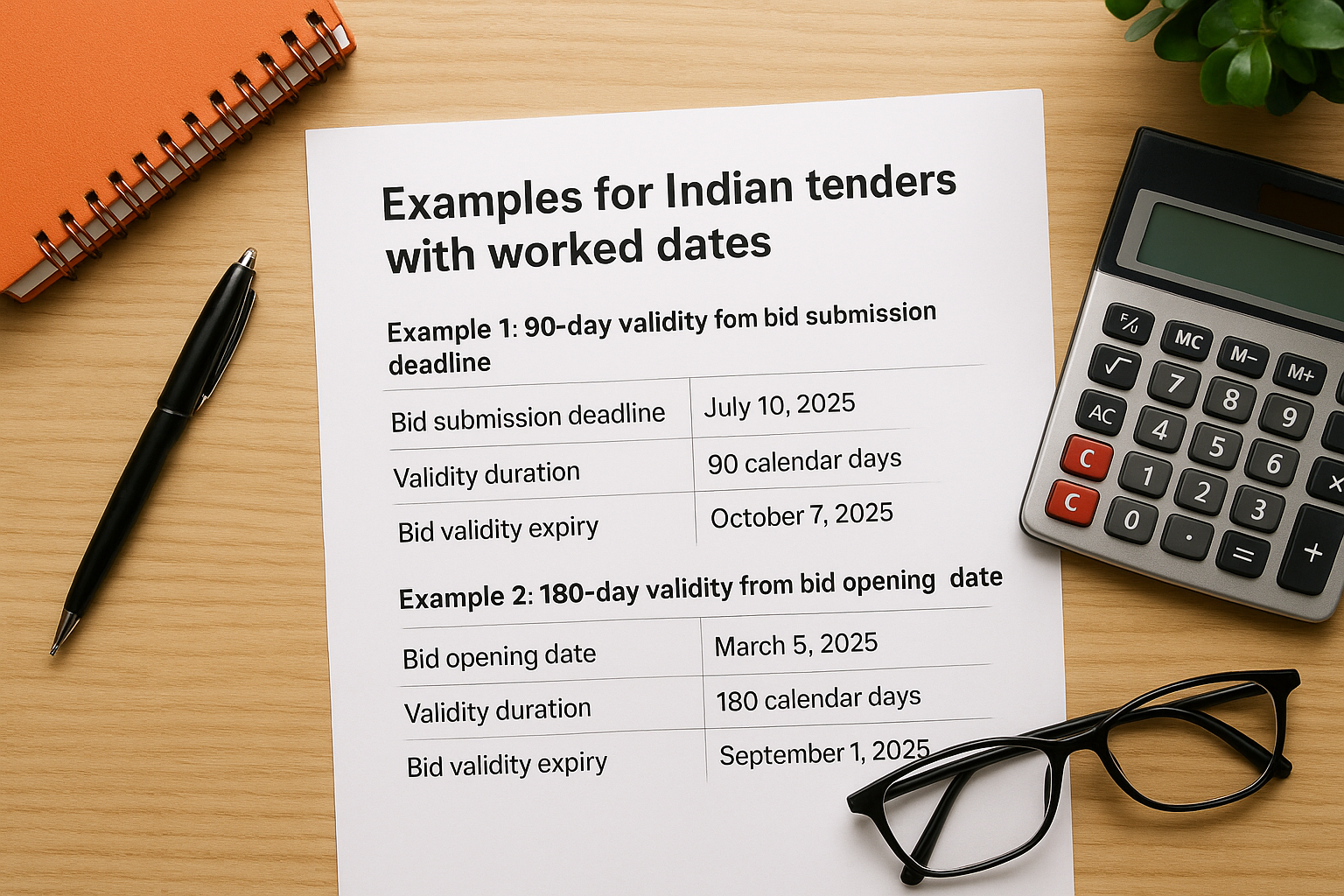
Example 1: 90-day validity from bid submission deadline
A road widening tender published on CPPP specifies a bid submission deadline of July 10, 2025, with a validity period of 90 calendar days from the last date of bid receipt. Day 1 is July 10, so you count forward 89 more days to reach the expiry date.
| Reference point | Date |
|---|---|
| Bid submission deadline (Day 1) | July 10, 2025 |
| Validity duration | 90 calendar days |
| Bid validity expiry | October 7, 2025 |
Your bid security instrument must remain valid at least until October 7, 2025, or the procuring authority can reject your bid on technical grounds before evaluation even begins.
Example 2: 180-day validity from bid opening date
An irrigation project tender on a state e-procurement portal lists a bid opening date of March 5, 2025 and specifies 180 calendar days from the date of bid opening as the validity window. Day 1 is March 5.
| Reference point | Date |
|---|---|
| Bid opening date (Day 1) | March 5, 2025 |
| Validity duration | 180 calendar days |
| Bid validity expiry | September 1, 2025 |
A 180-day window means your quoted rates stay legally binding through six months of potential cost fluctuation, so build your pricing buffer accordingly before you submit.
Double-check your bank guarantee expiry against this date before submission. A guarantee that lapses even one day before the bid validity expiry creates a disqualification gap you cannot fix after submission closes.
Bid validity extensions and bid security alignment
Procuring authorities don't always finish evaluation before your bid validity period expires. When delays push the timeline past your original expiry date, the authority sends a formal request asking you to extend your bid validity for a specified number of additional days. Knowing how to calculate bid validity period doesn't stop at the original submission - you need to handle extensions correctly too, or you risk losing a contract you were on track to win.
When a procuring authority requests an extension
The extension request arrives in writing, typically through the same e-procurement portal where you submitted your original bid. It states a new validity end date and gives you a deadline to confirm. You are not obligated to accept, but refusing an extension usually removes you from the evaluation process. If the procuring authority's timeline has stretched due to technical scrutiny or approval delays, declining means walking away entirely.
Accept or decline in writing before the deadline stated in the request - silence is not treated as acceptance in most Indian procurement frameworks.
Aligning your bid security with the extended period
This is where many firms create an avoidable problem. When you accept a validity extension, your bid security instrument must also be extended to cover the new end date. A bank guarantee or demand draft that expires on the original validity date leaves a gap the moment the extension takes effect.
Contact your bank or surety provider before you formally confirm the extension. Confirm the revised instrument is issued and submitted to the procuring authority within the timeframe specified in the extension request. Failing to align both documents simultaneously gives the authority grounds to disqualify your bid even after you've accepted the extension in writing.
Quick recap and next step
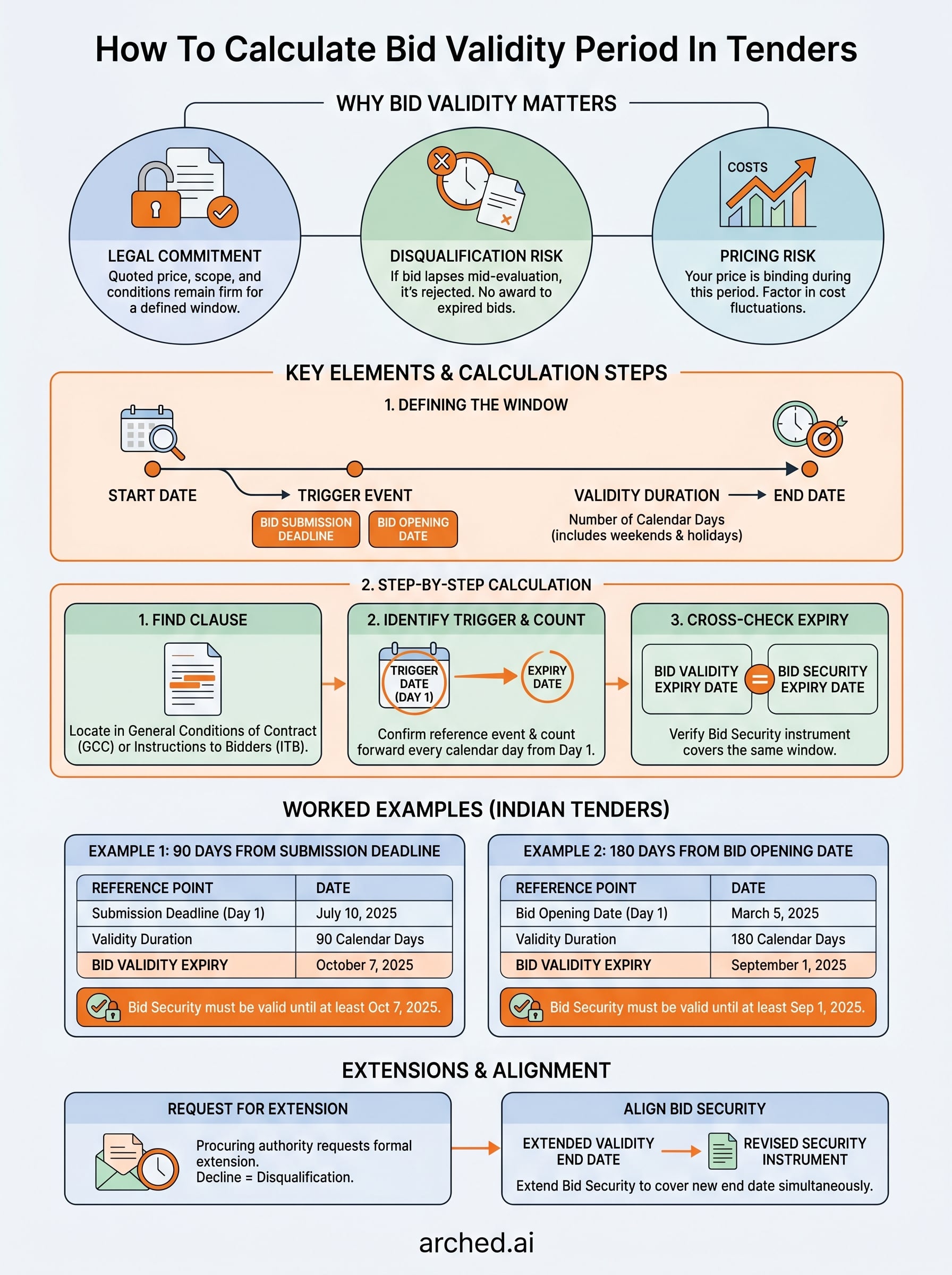
Knowing how to calculate bid validity period correctly comes down to three things: confirm the trigger event stated in the tender, count forward in calendar days from that date, and verify your bid security instrument covers the same window. Extensions follow the same logic but require you to act on both documents simultaneously. Getting any one of these steps wrong puts your submission at risk before evaluation even begins.
Every tender buries these details inside long PDFs across dozens of portals, and reading each one manually takes hours your team cannot spare. Arched's document parsing engine reads tender documents automatically, extracts key dates and qualification criteria, and flags validity and security mismatches before submission. Your team focuses on strategy, not document hunting.
If your firm bids on Indian government contracts and wants to stop missing details that cost you otherwise winnable tenders, see what Arched can do for your pipeline.