Bid Management Roles And Responsibilities In AEC Tenders
A single government tender in India's AEC sector can involve hundreds of pages of technical documents, strict eligibility criteria, and submission deadlines that leave little room for error. The person responsible for holding all of this together, the bid manager, carries a role that's often misunderstood or loosely defined. If you're trying to pin down the exact bid management roles and responsibilities in this context, you're likely building a team, hiring for a position, or figuring out where you fit in the process. Either way, clarity on this role directly affects win rates.
Most AEC firms operating in Indian public procurement juggle tenders across GeM, CPPP, IREPS, and dozens of state portals simultaneously. That volume makes the bid manager's scope far broader than just "filling out forms." It includes eligibility analysis, document parsing, competitor tracking, and strategic pipeline decisions.
This article breaks down the core responsibilities, required skills, and organizational expectations tied to bid management in AEC government contracting, so you can define the role properly and staff it with the right person, or grow into it yourself with a clear understanding of what the job actually demands.
Why bid management matters in AEC government tenders
AEC government contracting in India operates at a scale that makes informal tender tracking genuinely risky. Missed eligibility criteria or late submission of required documents on a large infrastructure contract don't just mean losing one opportunity - they can stall a firm's revenue pipeline for an entire quarter. That's why structured bid management roles and responsibilities exist: to bring consistency and accountability to a process that carries real financial weight.
A single disqualified bid due to a missing credential can cost a firm months of pipeline recovery time, not just one lost contract.
The cost of unstructured bid processes
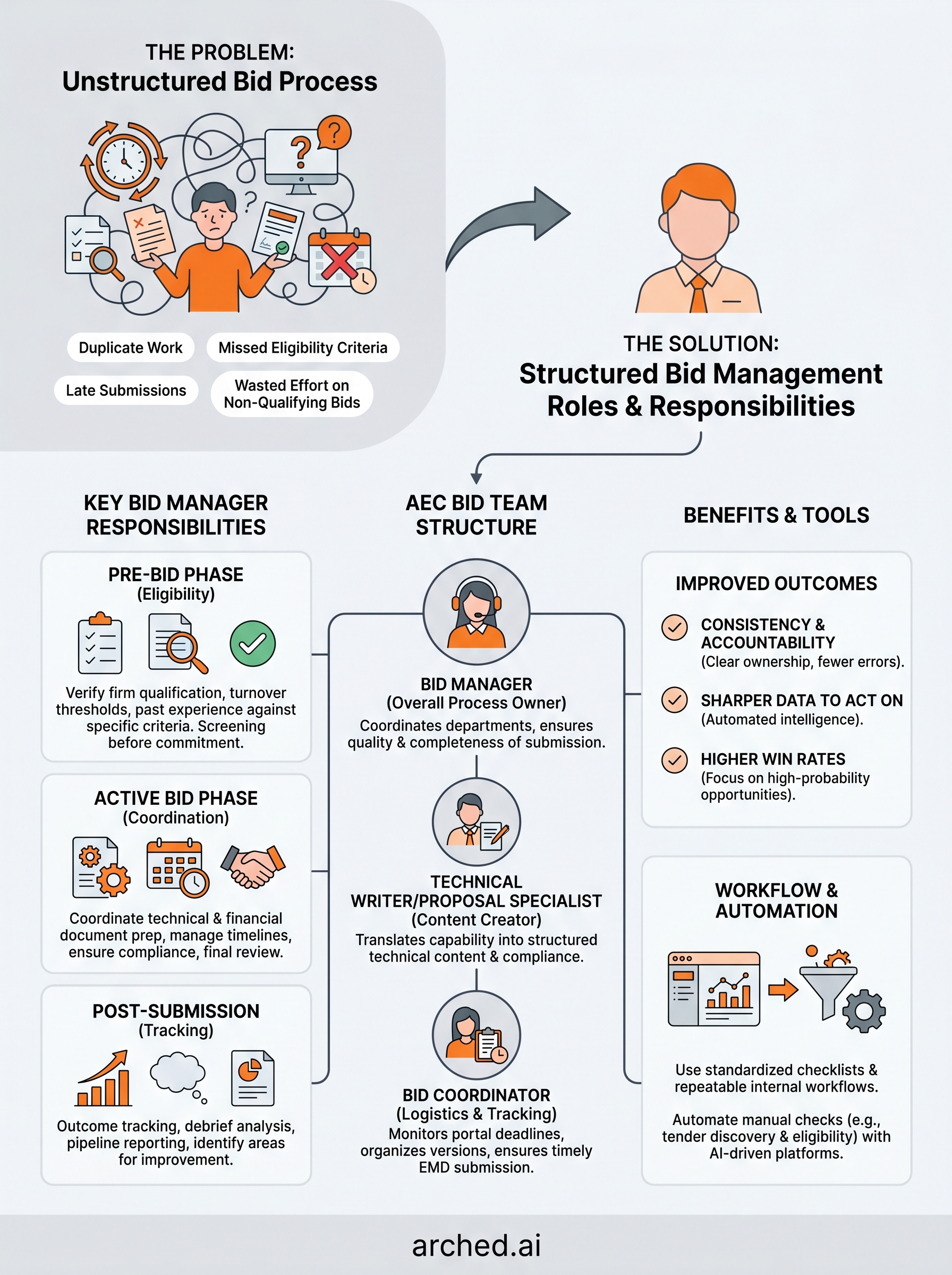
When no one owns the bid management function clearly, duplicate work and eligibility misses become routine. One team member might be checking CPPP while another monitors state portals, with no shared system tracking which tenders are genuinely worth pursuing. The result is wasted hours on non-qualifying opportunities and missed deadlines on tenders that actually fit your firm's credentials and turnover thresholds. AEC firms working across road, bridge, irrigation, and urban infrastructure regularly face documents that run 200+ pages, each with distinct qualification variables.
Common points of failure in unstructured bid teams:
- No clear ownership over portal monitoring, leading to missed tender windows
- Eligibility checked too late, after significant writing effort is already invested
- Inconsistent document formats across submissions to different procuring authorities
The regulatory reality of AEC government tenders
Unlike commercial procurement, government AEC tenders follow fixed regulatory frameworks governed by bodies like CPWD, NHAI, and state PWDs. These frameworks specify exact document sequencing, EMD submission rules, and credential verification steps. Missing any single requirement results in outright disqualification, not a reduced score. Your firm's win rate depends directly on how well someone processes eligibility data before your team commits hours to writing a bid.
Firms that treat bid management as secondary routinely spend significant effort on tenders they were never going to win. Structured ownership of the eligibility screening and document preparation workflow shifts time toward high-probability opportunities instead.
Core bid manager responsibilities across the bid lifecycle
The bid lifecycle in AEC government tenders moves through distinct phases, and the bid manager owns accountability at each one. Understanding these phases helps you map bid management roles and responsibilities accurately, whether you're hiring, evaluating performance, or structuring your team's workflow.
Pre-bid eligibility and opportunity screening
Before your team writes a single word, the bid manager must verify that your firm actually qualifies for the tender. This means checking turnover thresholds, past project experience requirements, and certifications against the specific criteria listed in the notice. Skipping this step wastes hours on bids your firm cannot legally submit.
Eligibility screening before commitment is the single most resource-protective step in the entire bid lifecycle.
Typical eligibility variables the bid manager validates at this stage:
- Annual turnover relative to contract value
- Similar work completed within the procuring authority's required timeframe
- Registration with statutory bodies or sector-specific certifications
Document preparation and submission ownership
Once eligibility is confirmed, the bid manager coordinates technical and financial document preparation across internal teams, ensuring correct formatting, EMD submission, and portal-specific requirements are all met. On platforms like CPPP or state e-procurement systems, submission errors or missing attachments trigger automatic disqualification with no appeal window. The bid manager holds final accountability for checking every document package before the submission deadline closes.
Who does what on a bid team in AEC tenders
In most AEC firms, bid management roles and responsibilities don't sit with a single person. Depending on your firm's bid volume and sector spread, the function splits across multiple roles, each with a distinct scope. Understanding who owns what prevents the gaps and overlap that slow down submissions and create last-minute errors.

Clear role ownership is what separates a team that consistently hits deadlines from one that scrambles in the final hours before submission.
The bid manager
The bid manager owns the overall process: from eligibility screening and timeline management to final document review before submission. This role coordinates across departments and holds accountability for the quality and completeness of every submission package sent to procuring authorities.
The technical writer or proposal specialist
Your technical content - methodology statements, past project write-ups, and compliance sections - typically falls to a proposal specialist or senior engineer. This person translates your firm's actual delivery capability into the structured format procuring authorities require, and their work directly affects how evaluators score your technical bid.
The bid coordinator
The bid coordinator handles logistics and tracking: monitoring portal deadlines, organizing document versions, and ensuring EMD submissions reach the right authority on time. On high-volume teams bidding across multiple state portals simultaneously, this role prevents the operational errors that trigger disqualification before evaluators even read your submission.
Skills, tools, and workflows that make bids predictable
Predictable bid outcomes don't come from working harder during submission week. They come from structured habits and repeatable workflows built into how your team handles every stage, from first alert to final upload. Firms with clear bid management roles and responsibilities treat the skills behind this function as a professional discipline, not a background task someone picks up on the fly.
Consistency in process is what separates teams with steady win rates from teams that scramble every time a deadline approaches.
Core skills every bid manager needs
Your bid manager needs a specific mix of analytical and coordination skills to operate effectively in the AEC government contracting environment. Eligibility interpretation requires close reading of technical and legal clauses. Timeline management requires the ability to work backward from submission deadlines and assign tasks with enough lead time for review.
Key skills your bid manager must demonstrate:
- Reading and interpreting complex regulatory frameworks, such as CPWD and NHAI qualification criteria
- Cross-functional coordination across technical, finance, and legal teams under deadline pressure
- Structured document management to track versions, portal requirements, and submission checklists
Workflow discipline over individual effort
Beyond skills, repeatable internal workflows drive consistent output. Your team should use a standardized eligibility checklist before committing to any tender, and a submission review protocol that a second person completes before every upload, regardless of how routine the bid appears.
How to write a clear bid manager job description
A vague job description attracts the wrong applicants and sets up your new hire for confusion from day one. When you define bid management roles and responsibilities in writing, the goal is to give candidates an accurate picture of what they'll own, not a generic list of tasks pulled from a template.
Define the scope before listing duties
Start by specifying which portals and sectors your firm operates in and the bid volume the person will handle monthly. A bid manager working across CPPP, IREPS, and three state portals simultaneously needs different capacity than someone managing five tenders per quarter. That context shapes every responsibility that follows.
Your job description should reflect your actual bid environment, not an idealized version of it.
Structure the responsibilities section clearly
Group responsibilities by lifecycle phase rather than by frequency. Eligibility screening, document coordination, and submission review are distinct functions, and listing them together under a single bullet point obscures who actually owns what. Use a short structured list for each phase so candidates immediately understand the scope.
Required responsibilities to include by phase:
- Pre-bid: eligibility validation, portal monitoring, and go/no-go decisions
- Active bid: technical document coordination, timeline ownership, and compliance checks
- Post-submission: outcome tracking, debrief analysis, and pipeline reporting
Specify the reporting line clearly and name the tools your team already uses so candidates self-select based on genuine fit.
Key takeaways
Bid management roles and responsibilities in AEC government tenders are not interchangeable tasks you assign based on availability. They form a structured function where eligibility screening, document coordination, and submission accountability each require clear ownership by a specific person or role. When your firm defines these boundaries properly, you stop losing bids to preventable errors and start directing effort toward tenders your credentials actually support.
Your bid manager, technical writers, and coordinators each carry distinct scope across the lifecycle, and that separation is what keeps high-volume bidding from collapsing under deadline pressure. Structured workflows and repeatable checklists matter more than individual effort during submission week.
If estimate and BOQ preparation is eating into your bid team's time, Arched can take it off your plate: we deliver a priced, engineer-reviewed BOQ for your tender. See how our estimating service works.
Have a package your team can’t get to? Send it to us. Our engineers check and sign off everything we deliver.