QCBS In Government Tenders: Formula, Scoring, And Rules
Learn the qcbs formula and scoring rules for Indian government tenders. Understand technical weightage and how to optimize your bid strategy to win.
When a government department evaluates your proposal, the method they choose to score it determines whether your technical strengths actually matter, or whether the lowest price wins by default. QCBS, or Quality and Cost Based Selection, is the procurement method that gives weight to both. It's used across major Indian public sector projects, from highway construction under NHAI to urban infrastructure contracts floated through state PWDs, and understanding how it works is the difference between bidding strategically and bidding blind.
Yet most firms treat QCBS tenders the same way they treat any other bid. They skim the RFP, check the deadline, and submit a price. That approach leaves money on the table because QCBS scoring has a specific formula, and the ratio between technical and financial weightage changes from tender to tender. Knowing how that ratio affects your combined score gives you a concrete edge over competitors who never bother to run the numbers. It also helps you decide whether a particular tender is worth pursuing at all, a decision that platforms like Arched help automate by parsing tender documents and flagging evaluation criteria before you commit hours to a bid.
This article breaks down everything you need to know about QCBS: what it is, how the scoring formula works, where it's mandated, and how it compares to other selection methods like LCS and QBS. Whether you're a BD manager filtering through opportunities or a bid team assembling a proposal, this is the reference guide you'll want bookmarked.
What QCBS means in Indian government tenders
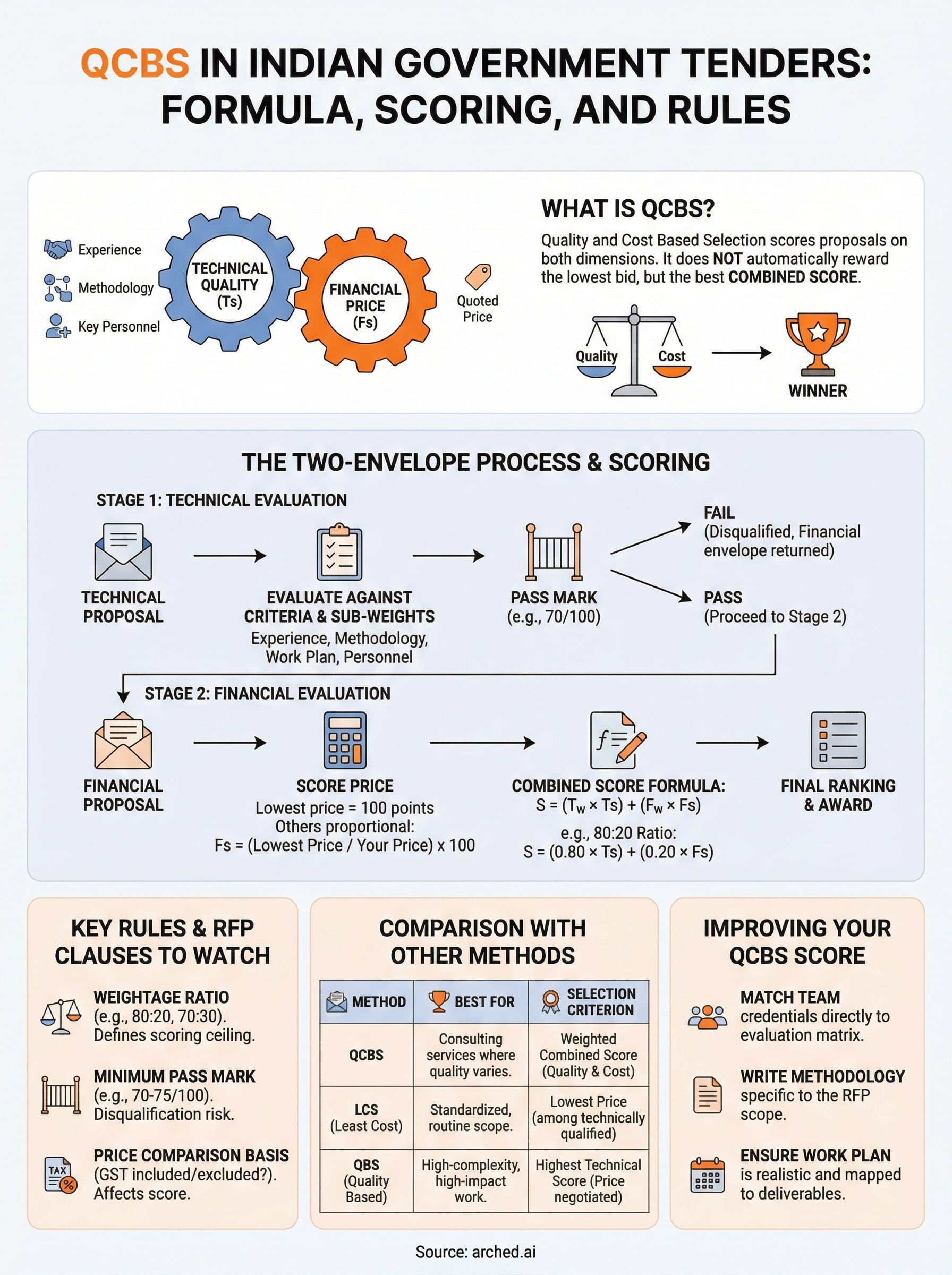
Quality and Cost Based Selection is a procurement method where the contracting authority evaluates consultants and firms on two separate dimensions: the technical quality of their proposal and the price they quote. Each dimension carries a pre-assigned weightage, and the combination of the two scores determines the winner. Unlike a pure lowest-price selection, QCBS rewards firms that demonstrate stronger experience, better methodology, or more qualified key personnel, as long as they remain competitive on price.
QCBS does not automatically reward the cheapest bid. It rewards the best combined score, which means a firm quoting 15% above the lowest price can still win if its technical score is high enough.
In India, QCBS applies most frequently to consulting services contracts rather than civil works. You will encounter it in projects funded by multilateral agencies like the World Bank and the Asian Development Bank, where their respective procurement frameworks mandate it. You will also see it in domestically funded projects where the contracting authority follows the General Financial Rules (GFR) 2017 and guidelines issued by the Central Vigilance Commission. State PWDs, urban local bodies, and central ministries all use QCBS when the contract involves intellectual output, advisory services, or design work where quality genuinely matters to project outcomes.
How QCBS fits into India's procurement landscape
The Ministry of Finance and Central Vigilance Commission guidance draws a clear distinction between contracts where quality can be standardized and contracts where it cannot. Civil works like road paving or building construction typically use item-rate or percentage-rate tenders, where price is the primary differentiator. Consulting and technical service contracts involve judgment, methodology, and expertise that cannot be commoditized, so a purely price-driven selection would systematically favor under-resourced firms over qualified ones.
QCBS sits in that second category. When a state government commissions a feasibility study for an irrigation project, a transaction advisory for a PPP highway, or a structural audit of public infrastructure, it uses QCBS to ensure that the firm it hires has the credentials and technical depth to deliver. The procurement notice will specify the exact weightage split between technical and financial scores, which is the first number you should locate in any QCBS RFP.
The two core components of a QCBS score
Technical score (Ts) measures the quality of your firm's proposal across criteria like relevant experience, methodology, work plan, and the qualifications of your key personnel. The contracting authority assigns sub-weights to each criterion and evaluates proposals against them before opening the financial envelopes.
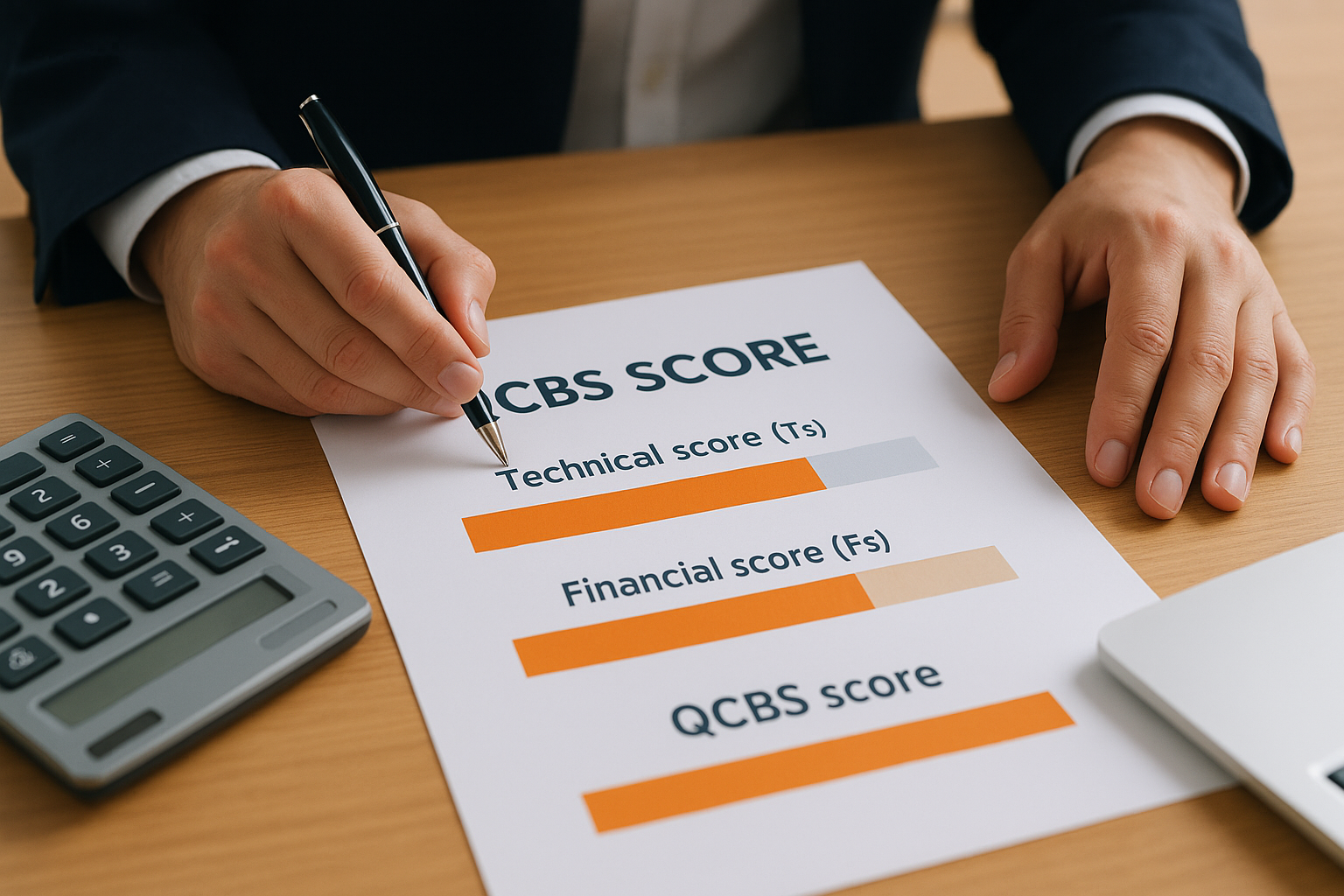
Financial score (Fs) measures how your quoted price compares to the lowest financial proposal received. The standard formula most Indian authorities use assigns 100 points to the lowest quoted price and calculates all other financial scores proportionally. Your combined score is then calculated by applying the stated weightage split. For example, in an 80:20 ratio, your final score equals 0.80 multiplied by your technical score plus 0.20 multiplied by your financial score. A 70:30 split places more weight on price, while a 90:10 split makes technical quality the near-exclusive deciding factor.
The weightage split printed in the RFP shapes your entire bid strategy. A high technical weightage means you should invest in assembling a stronger team and writing a more detailed methodology, because price matters less. A lower technical weightage, like 60:40, signals that cost competitiveness will play a bigger role, and you need to price sharply while still clearing the minimum technical pass mark.
When buyers choose QCBS and when they should not
QCBS suits contracts where the quality of the deliverable varies significantly depending on who delivers it. When a contracting authority cannot simply write a specification and expect every bidder to produce the same output, price alone becomes a poor selection criterion. The GFR 2017 and World Bank Procurement Regulations both point toward QCBS when the scope involves complex or specialized advisory work, where methodology and team expertise directly determine project success.
Contracts where QCBS is the right fit
Consulting assignments are the clearest case. A Detailed Project Report (DPR) for a new metro corridor, an environmental and social impact assessment, or a Project Management Consultancy (PMC) for a large infrastructure scheme all involve professional judgment that varies by firm. Contracting authorities also apply QCBS to transaction advisory mandates, legal and financial structuring for PPP projects, and urban planning assignments. In each case, the quality of the work product justifies giving technical criteria significant weight in evaluation.
World Bank and ADB-funded projects typically mandate QCBS for most consulting contracts above a defined threshold, as stated in their respective procurement frameworks. State and central government departments following CVC guidelines apply it similarly, particularly for assignments where a weak technical submission would result in a flawed study or an undeliverable design that creates cost overruns downstream.
Contracts where QCBS is the wrong choice
Not every contract needs a quality-cost tradeoff. When the scope is fully defined and standardized, and any technically qualified firm could deliver the same output, QCBS adds unnecessary complexity to the evaluation process. Routine surveys, standard-format audits, and fixed-methodology assignments with clear templates are better suited to Least Cost Selection (LCS), where the lowest price among shortlisted firms wins.
Applying QCBS to a contract that should use LCS inflates evaluation time without improving outcome quality, and it can expose the contracting authority to challenge if the rationale is not documented clearly.
Contracting authorities also avoid QCBS when budget predictability is the primary concern and the scope allows for tight specification upfront. In those cases, using a minimum technical threshold to shortlist firms and then selecting on price achieves the same protective function without the complexity of a combined scoring formula. Understanding which method applies before you submit a bid stops you from pricing and structuring your proposal incorrectly for the procurement environment you are actually competing in.
QCBS stages and the two-envelope process
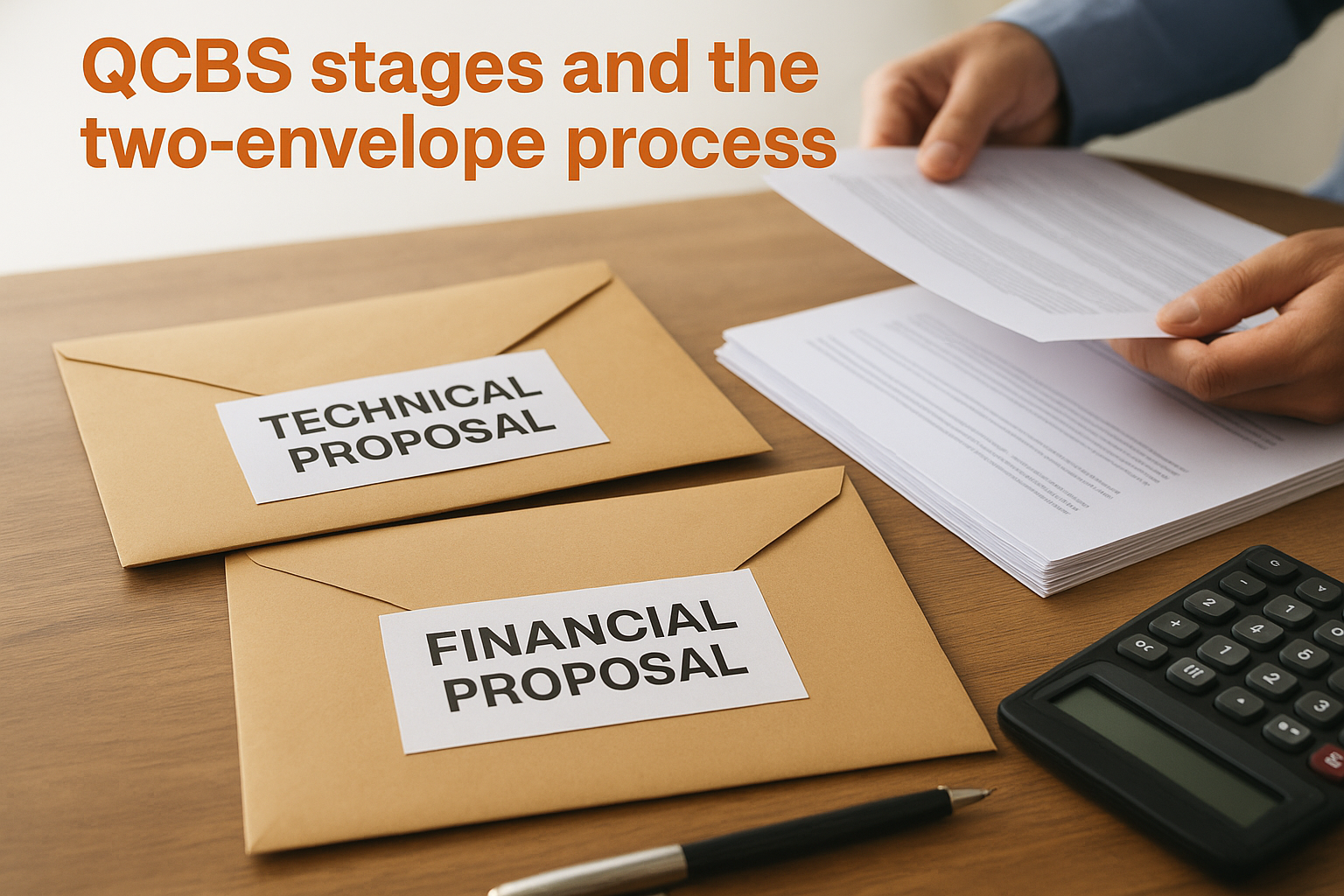
Every QCBS procurement follows a structured sequence designed to prevent your financial offer from influencing the technical evaluators. The contracting authority separates the process into two distinct stages, each with its own submission, evaluation, and scoring step. You submit both technical and financial proposals simultaneously, but sealed in separate envelopes. The financial envelope stays locked until the technical evaluation is fully complete and scores are officially recorded.
Stage one: technical submission and evaluation
When you submit your bid, your technical proposal goes into the first envelope. This includes your firm's relevant experience, proposed methodology, work plan, team composition, and CVs of key personnel. The evaluation committee scores every proposal against the criteria and sub-weights published in the RFP, without any knowledge of what any firm has quoted financially. This separation is what keeps the process fair and legally defensible.
Once the committee finishes scoring all technical proposals, the contracting authority publishes the technical scores and identifies which firms have cleared the minimum qualifying mark. Firms that fall below the pass mark, typically set at 70 or 75 out of 100 depending on the tender, are disqualified at this point. Their financial envelopes are returned unopened.
Only firms that pass the technical threshold move to the financial stage. Submitting a financial envelope does not guarantee it will ever be opened.
Stage two: financial envelope opening and scoring
After publishing technical results, the contracting authority opens the financial envelopes of all qualifying firms in a public session. This transparency protects both the buyers and the bidders, since every qualifying firm can verify the prices on record. The lowest quoted price receives a financial score of 100, and all other prices are scored relative to it using the formula: Fs = (Lowest price / Your price) x 100.
Your final combined score then applies the stated weightage split to your two individual scores. If the tender uses an 80:20 ratio, your final score equals (0.80 x your technical score) plus (0.20 x your financial score). The firm with the highest combined score wins the contract, regardless of whether it submitted the lowest price or the highest technical score individually. Understanding this sequence tells you exactly where to invest your preparation time before you commit to a bid.
Technical evaluation criteria and pass marks
The technical score in a QCBS evaluation is not a single judgment call. Contracting authorities break it into sub-criteria, each carrying a defined weight, and your total technical score is the sum of what you earn across all of them. Knowing those sub-criteria in advance lets you allocate your proposal-writing effort where it will generate the most points, rather than spending equal time on criteria that carry only 5% of the weight.
Common scoring criteria in QCBS proposals
Most QCBS tenders in India follow a consistent structure for technical evaluation, though the exact weights shift based on the nature of the assignment. The four areas that appear most often are firm experience, proposed methodology, work plan and staffing schedule, and key personnel qualifications. Experience and key personnel together typically account for 60 to 80 percent of the total technical score, which means the CVs you submit and the projects you cite carry more weight than how well you format your work plan.
Below is the typical breakdown you will find in an RFP from a central ministry or multilateral-funded project:
| Criterion | Typical Weight Range |
|---|---|
| Firm's relevant experience | 10–20% |
| Methodology and approach | 20–30% |
| Work plan and resource schedule | 10–15% |
| Key personnel qualifications | 30–40% |
| Training and knowledge transfer (if applicable) | 5–10% |
Your key personnel CVs often decide whether you pass the technical threshold, so matching team credentials directly to the RFP's stated requirements is non-negotiable.
The minimum pass mark and what happens if you miss it
Most Indian QCBS tenders set the minimum qualifying technical score at 70 or 75 out of 100. The exact threshold appears in the RFP's evaluation section, and you must locate it before you commit to bidding. Falling below that threshold eliminates you from the procurement entirely. Your financial envelope is returned unopened, and you receive no combined score regardless of how competitive your price might have been.
Evaluators score each sub-criterion independently, so a weak score in one area can drag your total below the pass mark even if you perform well elsewhere. If your firm's experience section earns 50% of available marks because your cited projects do not closely match the assignment scope, no amount of strong methodology writing covers that gap. Read the evaluation matrix in the RFP carefully and map each sub-criterion to the strongest evidence you can submit.
Financial evaluation and price scoring formula
The financial stage of a QCBS evaluation only begins after the contracting authority has locked in all technical scores and disqualified any firms that missed the pass mark. At that point, the financial envelopes are opened publicly, and every qualifying firm's quoted price enters a single formula that converts raw rupee figures into comparable scores between 0 and 100.
How the price score is calculated
The formula contracting authorities use is straightforward: Fs = (Lowest quoted price / Your quoted price) x 100. The firm that quotes the lowest price receives a financial score of 100. Every other qualifying firm receives a score proportional to how far above that lowest price it sits. If the lowest quote is ₹50 lakh and you quoted ₹60 lakh, your financial score is (50/60) x 100, which equals 83.3.
A 20% price premium over the lowest bid does not eliminate you from contention. In an 80:20 weighted tender, that 16.7-point financial score difference translates to only 3.34 points in your final combined score.
This is the calculation you should run during bid preparation, not after submission. Estimating where your price is likely to sit relative to the competition tells you how many combined-score points you are effectively trading away by quoting higher, and whether your technical score is strong enough to cover that gap.
What gets included in the quoted price
The financial proposal is not just your professional fees. Most Indian QCBS tenders require you to quote a lump-sum price that covers staff costs, reimbursable expenses, travel, taxes, and any other direct costs associated with delivering the scope. The RFP's financial proposal form specifies exactly which cost components to include, and omitting a line item can cause the contracting authority to disqualify your financial submission or adjust your quoted total.
Read the instructions to consultants section of the RFP before you build your cost sheet. Some tenders ask for prices exclusive of GST, with the tax applied separately at the evaluation stage. Others ask for an all-inclusive total. Submitting in the wrong format creates ambiguity that evaluators resolve against you, not in your favor. Confirm the format, confirm which reimbursables are capped by the client, and build your financial proposal to match the structure the RFP prescribes, not the cost format your firm uses internally.
Final combined score formula with worked example
The combined score formula is the point where all your preparation either pays off or exposes gaps you did not address. Once the contracting authority has locked in both your technical score and your financial score, it applies a single calculation to produce the final ranking figure that determines who wins the contract. Running this calculation yourself, during bid preparation, is one of the most practical things you can do before you submit.
The formula itself
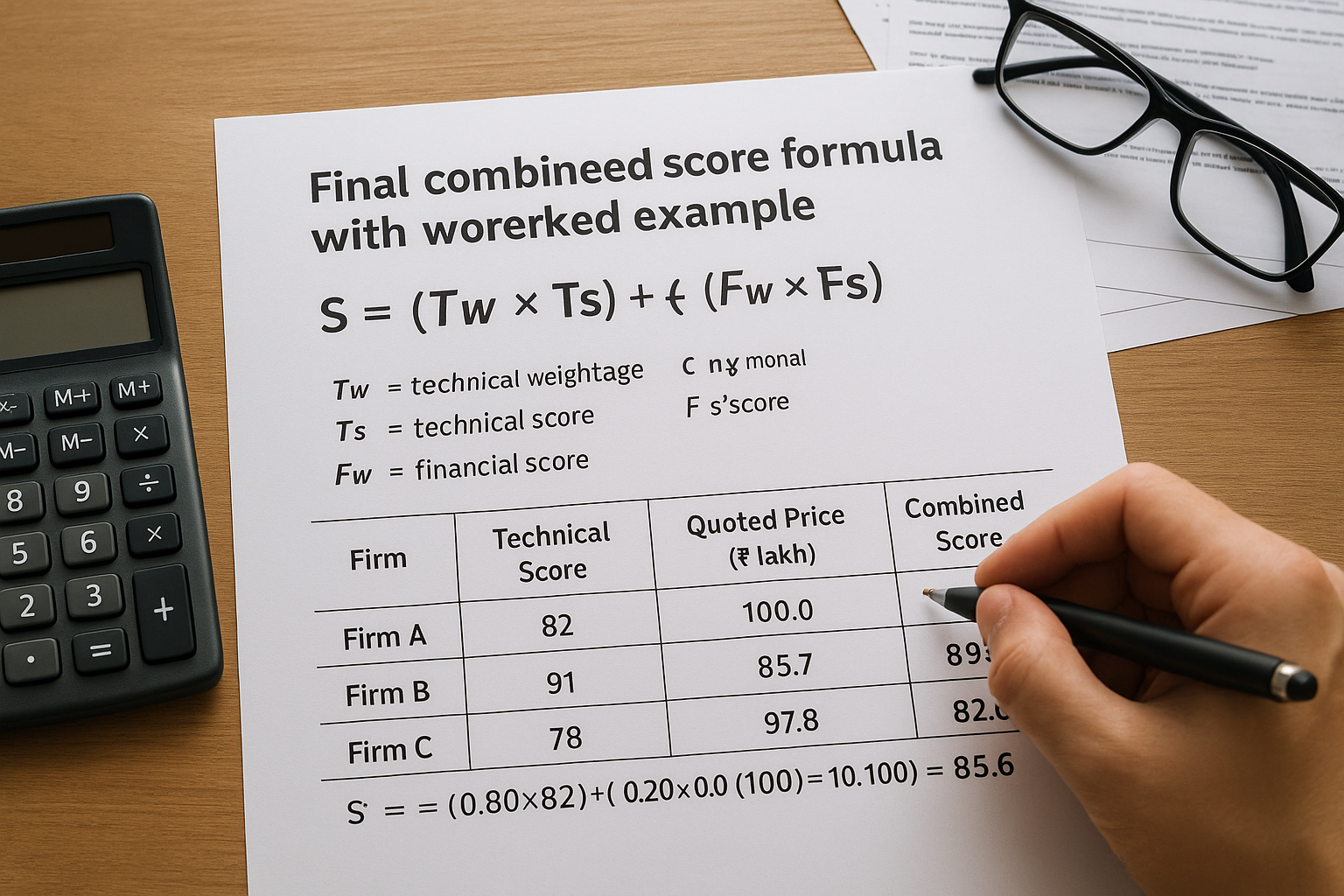
The standard QCBS combined score formula is: S = (Tw × Ts) + (Fw × Fs), where S is your final combined score, Tw is the technical weightage stated in the RFP, Ts is your technical score out of 100, Fw is the financial weightage, and Fs is your calculated financial score out of 100. The two weightages always add up to 1.0, so an 80:20 split means Tw equals 0.80 and Fw equals 0.20.
You should run this formula for multiple price scenarios before you finalize your financial proposal, because it shows you exactly how much combined-score ground you lose by quoting higher.
A worked example with three competing firms
Assume a central ministry issues an RFP for a project management consultancy with an 80:20 technical-to-financial ratio and a minimum technical pass mark of 70. Three firms qualify technically and their envelopes are opened.
| Firm | Technical Score | Quoted Price (₹ lakh) | Financial Score | Combined Score |
|---|---|---|---|---|
| Firm A | 82 | 90 | 100.0 | (0.80×82)+(0.20×100) = 85.6 |
| Firm B | 91 | 105 | 85.7 | (0.80×91)+(0.20×85.7) = 89.9 |
| Firm C | 78 | 92 | 97.8 | (0.80×78)+(0.20×97.8) = 82.0 |
Firm B wins despite quoting the highest price of the three. Its superior technical score of 91 generates enough combined-score advantage that the financial penalty from quoting ₹15 lakh above the lowest bid only costs it 2.86 points in the final calculation. Firm A, which quoted the lowest price and earned a perfect financial score of 100, still finishes second because its technical score trails by nine points.
What this tells you about bid strategy
This example confirms that investing in your technical proposal quality delivers a higher return in an 80:20 weighted tender than trimming your price. Every additional technical point you earn is multiplied by 0.80, while every financial point is multiplied by only 0.20. If your firm's experience and team credentials are genuinely strong, price-cutting to win is often the wrong strategy when the technical weightage is this high.
QCBS vs QBS vs LCS and other methods
Indian procurement regulations recognize several selection methods, and contracting authorities choose between them based on how much quality variation matters for a given assignment. Understanding where QCBS sits among these options tells you why a particular tender uses the method it does, and what that means for how you should structure your response.

Quality Based Selection
Quality Based Selection, or QBS, removes price from the equation entirely. The contracting authority evaluates only technical proposals, identifies the highest-scoring firm, and then negotiates the contract price with that firm directly. If negotiations fail, it moves to the next-ranked firm. QBS applies when the assignment is so complex, specialized, or high-impact that selecting on any price dimension risks compromising the outcome. Brain surgery on a public infrastructure project, such as a specialized structural assessment of a critical dam or a complex financial restructuring advisory, is where QBS logic makes sense. You will encounter it most often in World Bank-funded assignments classified as high complexity.
QBS is not a license for the winning firm to quote any price. Negotiations follow clear reference points, and the authority can walk away if the fee is unreasonable.
Side by side, the two methods differ on four things that change how you bid:
| Criteria | QCBS | QBS |
|---|---|---|
| Financial bid scored? | Yes, weighted contribution | No, used only in negotiation |
| Minimum technical threshold? | Typically 75/100 | No minimum; highest score wins |
| Common use | Standard consulting assignments | Highly specialized or complex work |
| Fee strategy | Price competitively within quality range | Focus on justifying scope and rates |
Least Cost Selection
Least Cost Selection (LCS) — almost always called L1 in Indian tender practice, after the lowest-quoting bidder's rank — flips the approach. The contracting authority sets a minimum technical pass mark, shortlists every firm that clears it, and then awards the contract to the one quoting the lowest financial proposal. Quality is treated as a binary filter rather than a scored dimension. LCS works well when the scope is tightly defined and any qualified firm would produce essentially the same output. Routine surveys, standard reporting assignments, and fixed-format studies with clear templates are typical LCS candidates. If your firm clears the technical bar, winning comes down entirely to price.
Fixed Budget Selection and Single Source
Fixed Budget Selection publishes the available budget upfront and asks firms to compete by proposing the highest-quality scope for that fixed amount. This method suits assignments where the contracting authority has a hard spending ceiling and needs to maximize technical output within it. Single Source Selection, by contrast, bypasses competition entirely and is reserved for emergency situations, contract extensions, or cases where only one firm has the specific credentials required. Both methods appear infrequently compared to QCBS and LCS, and you are unlikely to encounter them in standard open-tender procurements.
| Method | Price Criterion | Technical Criterion | Typical Use Case |
|---|---|---|---|
| QCBS | Weighted score | Weighted score | Most consulting assignments |
| QBS | Negotiated | Highest score wins | High-complexity, high-impact work |
| LCS (L1) | Lowest price wins | Pass/fail threshold | Standardized, routine scope |
| Fixed Budget | Fixed | Highest quality for budget | Hard spending ceiling exists |
| Single Source | Negotiated | N/A | Emergency or sole-qualified firm |
Key rules and tender clauses to watch in India
Every QCBS tender in India contains clauses that change how the evaluation plays out in practice, and most bidders skim past them. Before you write a single line of your technical proposal, you need to locate three specific pieces of information in the RFP: the weightage split, the minimum qualifying technical score, and the price comparison basis. These three figures control your entire scoring outcome, and they vary from one procurement to the next.
Missing a single clause about how GST is handled in price comparison can shift your financial score by several points and change your final ranking.
The weightage ratio and minimum pass mark
The RFP's evaluation section always states the technical-to-financial weightage ratio explicitly. Indian government tenders commonly use splits of 80:20, 70:30, or 90:10 depending on the complexity of the assignment. Multilateral-funded projects under World Bank guidelines tend to favor 80:20 or higher technical weights for complex consulting assignments. You must record this ratio before you build your bid strategy, because it determines whether your effort should go into strengthening the team or sharpening the price.
The minimum technical pass mark appears in the same section and typically falls between 70 and 75 out of 100. Some state-level tenders set it as low as 65, while certain central ministry procurements push it to 80. Confirm the exact figure, then map your proposal against each sub-criterion to estimate your likely score before submission.
Clauses that affect how your price is compared
Indian tenders differ on whether GST is included or excluded when computing financial scores. Some RFPs ask you to quote an all-inclusive lump sum, while others apply taxes after computing the financial score using the base fee. If you include GST in your quoted total when the RFP excludes it from the comparison, your financial score drops against competitors who read the clause correctly.
Watch also for clauses that cap reimbursable expenses separately from professional fees. When a contracting authority scores only the professional fee component and reimburses travel and per diem at actuals, including those costs in your lump-sum quote inflates your comparable price without adding any technical value. Read the financial proposal form and the instructions to consultants together, not just the summary terms, because the two documents sometimes specify different things about what your quoted price must cover.
How to improve your QCBS score as a bidder
Your QCBS score is not determined on submission day. It is determined weeks earlier, when you decide which team to deploy, how to structure your technical proposal, and whether your experience citations actually match what the evaluation matrix rewards. Most firms lose points on criteria they could have scored higher on, not because their credentials are weak but because they never mapped their proposal directly to the sub-criteria before writing it.
Match your team to the evaluation matrix
Key personnel qualifications typically carry 30 to 40 percent of the total technical score, making your team selection the single highest-leverage decision in any QCBS bid. Before you assign roles, pull the evaluation criteria table from the RFP and list the specific qualifications and project types each key personnel slot requires. Then match your available staff to those requirements directly, not to whoever your firm normally deploys for similar work.
If the RFP awards points specifically for a team member with experience on ADB-funded assignments, a CV listing only World Bank project history may score lower than you expect.
When reviewing CVs, check three things against the stated evaluation criteria:
- Whether the RFP scores years of experience, number of similar projects completed, or both
- Whether each CV references projects with scope descriptions and contract values that fall within the thresholds the RFP specifies
- Whether irrelevant experience in a CV is diluting the evaluator's attention from the credentials that actually earn marks
Write methodology that addresses the actual scope
Methodology sections lose marks when they read as generic firm capability statements rather than direct responses to the specific assignment in front of the evaluator. Most RFPs break methodology into sub-criteria with individual weights, so structure your methodology document to match that breakdown exactly. If the RFP scores your stakeholder engagement approach separately from your technical analysis approach, write separate sub-sections for each rather than blending them into a single narrative.
Your work plan and resource schedule reinforce the methodology score when they show clear task sequencing, realistic timelines, and named personnel mapped against each deliverable. A schedule that references the scope items listed in the RFP by name tells evaluators that your team has read and understood the assignment in detail, which is the baseline test they are running. Firms that reuse generic templates from previous bids signal the opposite, and experienced evaluation committees recognize it quickly.
Next steps for your next QCBS bid
Winning a QCBS bid comes down to preparation you complete before the RFP deadline, not adjustments you make after submission. Start by locating the weightage ratio and minimum pass mark in every RFP you review, because those two numbers define your scoring ceiling and your disqualification risk simultaneously. Map your team credentials directly against the evaluation matrix, price your financial proposal after running the combined score formula for multiple scenarios, and read every financial clause carefully to confirm you are quoting on the correct basis.
Your firm does not need to manually check hundreds of portals to find the right QCBS opportunities. Arched parses tender documents automatically, extracts evaluation criteria, flags qualification requirements, and matches opportunities to your firm's actual credentials so you spend time only on bids worth entering. See what Arched can do for your bid pipeline and stop missing high-probability contracts buried in portals you never had time to check.