QCBS vs QBS: Key Differences in Government Tenders Explained
Understand qcbs qbs differences in Indian government tenders. Learn how to align your technical and financial proposals to maximize your win rates.
When a government agency needs to hire consultants for a complex infrastructure project, think a feasibility study for a new expressway or a detailed project report for an urban metro line, it rarely picks the lowest bidder. Instead, it evaluates proposals using structured selection methods, and two of the most common are QCBS and QBS. Understanding the difference between these two methods isn't academic; it directly affects how you score, how you price, and whether you win.
Quality and Cost Based Selection (QCBS) weighs both your technical proposal and your financial bid. Quality Based Selection (QBS) evaluates technical merit first and only opens the financial envelope of the top-ranked firm. Each method changes the game in terms of bid strategy and competitive positioning. Misreading which one applies to a tender can lead to underpricing a complex assignment or overinvesting in a proposal where cost carries significant weight.
This is exactly the kind of nuance that Arched is built to surface. Our platform parses tender documents across 500+ government portals, GeM, CPPP, state e-procurement sites, and more, and flags evaluation criteria like QCBS or QBS so your BD team can adjust strategy before drafting a single page. Instead of spending hours reading through RFP PDFs, you get structured, actionable intelligence in seconds.
This article breaks down both selection methods in detail: what they are, when procuring agencies use each one, how scoring works, and what the practical differences mean for firms bidding on government consulting contracts in India.
Why evaluation method matters in Indian tenders
The evaluation method in a tender is not a formality buried in an appendix. It's the scoring logic that decides which firm wins, and it shapes every decision you make before submitting a bid. If you treat a QCBS tender like a pure quality competition, you may price yourself out. If you treat a QBS process like a cost race, you waste time refining a fee that shouldn't even be in the picture at the shortlisting stage. Getting this wrong costs real money in wasted preparation time, misallocated effort, and lost contracts.
How Indian procurement frameworks apply QCBS and QBS
India's central ministries and state agencies follow different procurement frameworks depending on the funding source and the nature of the assignment. Projects financed by multilateral development banks, including the World Bank, the Asian Development Bank, and the Asian Infrastructure Investment Bank, specify evaluation methodology explicitly in the Request for Proposals (RFP), almost always drawing from the World Bank's Procurement Regulations for IPF Borrowers. Domestically funded assignments governed by the General Financial Rules (GFR) 2017 or state-specific procurement rules follow similar principles, though terminology and weightings can vary by agency.
When the funding source is a multilateral bank, the evaluation methodology is non-negotiable. The procuring agency cannot deviate from the method stated in the RFP.
For consulting assignments in sectors like transport, urban infrastructure, water resources, and irrigation, which represent a large share of high-value tenders on CPPP and state portals, QCBS is the default method for most assignments. QBS appears less frequently, reserved for highly complex or specialized engagements where the agency prioritizes deep expertise over minimizing consultancy fees.
The strategic cost of misreading an evaluation framework
When your BD team misidentifies the evaluation method, the downstream effects compound quickly. In a QCBS evaluation, a weak technical score cannot be recovered by undercutting on price. In a QBS process, spending time sharpening your financial bid before the technical score is even evaluated is a direct misallocation of resources. Both mistakes consume effort that could have gone into proposals with a higher win probability.
Understanding where qcbs qbs applies across your active pipeline lets you allocate proposal writing effort based on actual scoring logic rather than assumptions. Firms that track evaluation criteria systematically across portals win more often because they align preparation intensity with the method that genuinely determines the outcome, not the one they assumed applied.
How QCBS works in government tenders
In a QCBS process, the procuring agency evaluates your proposal in two stages: technical quality first, then financial cost. The agency sets a predetermined weighting before opening any envelopes, and that ratio determines how much each component contributes to your final combined score. You cannot change or negotiate the weighting after submission; it is fixed in the RFP.
The technical-financial split
Most Indian consulting tenders under multilateral bank financing use a technical-to-financial ratio of 80:20, meaning technical quality carries four times the weight of your fee. Some assignments use 70:30 or 90:10, depending on the complexity and the funding agency's guidelines. Agencies evaluate your technical proposal against criteria like the experience of key staff, methodology, and firm track record before the financial envelope is opened.
The financial envelope of firms who score below the minimum qualifying technical threshold (typically 75 out of 100) is never opened.
| Weighting Type | Technical Weight | Financial Weight | Typical Assignment Type |
|---|---|---|---|
| 80:20 | 80% | 20% | Standard consulting assignments |
| 90:10 | 90% | 10% | Highly complex, specialized work |
| 70:30 | 70% | 30% | Routine studies with cost sensitivity |
How your final score is calculated
Once the agency scores all qualifying technical proposals, it opens the financial envelopes and normalizes the bids by dividing the lowest offered price by your quoted price. The result is multiplied by the financial weight and added to your weighted technical score. This means a strong technical proposal absorbs a higher fee, but pricing significantly above competitors still pulls your combined score down. For firms navigating qcbs qbs decisions across multiple tenders, understanding this formula directly shapes how you set your fee.

How QBS works in consulting procurements
Quality Based Selection removes cost from the initial competition entirely. Under QBS, the procuring agency evaluates all submitted technical proposals, scores them against defined criteria, and ranks firms solely on technical merit. Only the top-ranked firm receives an invitation to negotiate a contract. No other firm's financial proposal is opened at any stage of the process.
In QBS, your fee becomes a subject of negotiation, not a competitive variable scored against other bidders.
The technical evaluation stage
In a QBS process, your technical proposal carries 100% of the competitive weight. The agency scores submissions on criteria such as the qualifications of proposed key personnel, the firm's relevant project experience, the quality of the technical approach and methodology, and the overall work plan. Agencies assign these criteria individual weights within the technical scoring matrix, and the firm achieving the highest aggregate technical score advances to the negotiation stage. Firms ranked second or lower do not participate in fee discussions unless negotiations with the top-ranked firm collapse.
What happens after technical ranking
Once the agency identifies the highest-scoring firm, it opens that firm's financial proposal and uses it as the starting point for negotiation. The goal is to agree on a contract value that reflects the scope of work and industry-standard rates for the level of expertise involved. If negotiations fail, the agency moves to the second-ranked firm and repeats the process.
For firms tracking qcbs qbs evaluation types across their pipeline, QBS signals a clear instruction: invest your preparation effort entirely in demonstrating technical depth, staff credentials, and methodological rigor. Competing on price at the proposal stage is irrelevant because the agency will never use your quoted fee to rank you against competitors.
QCBS vs QBS: key differences and use cases
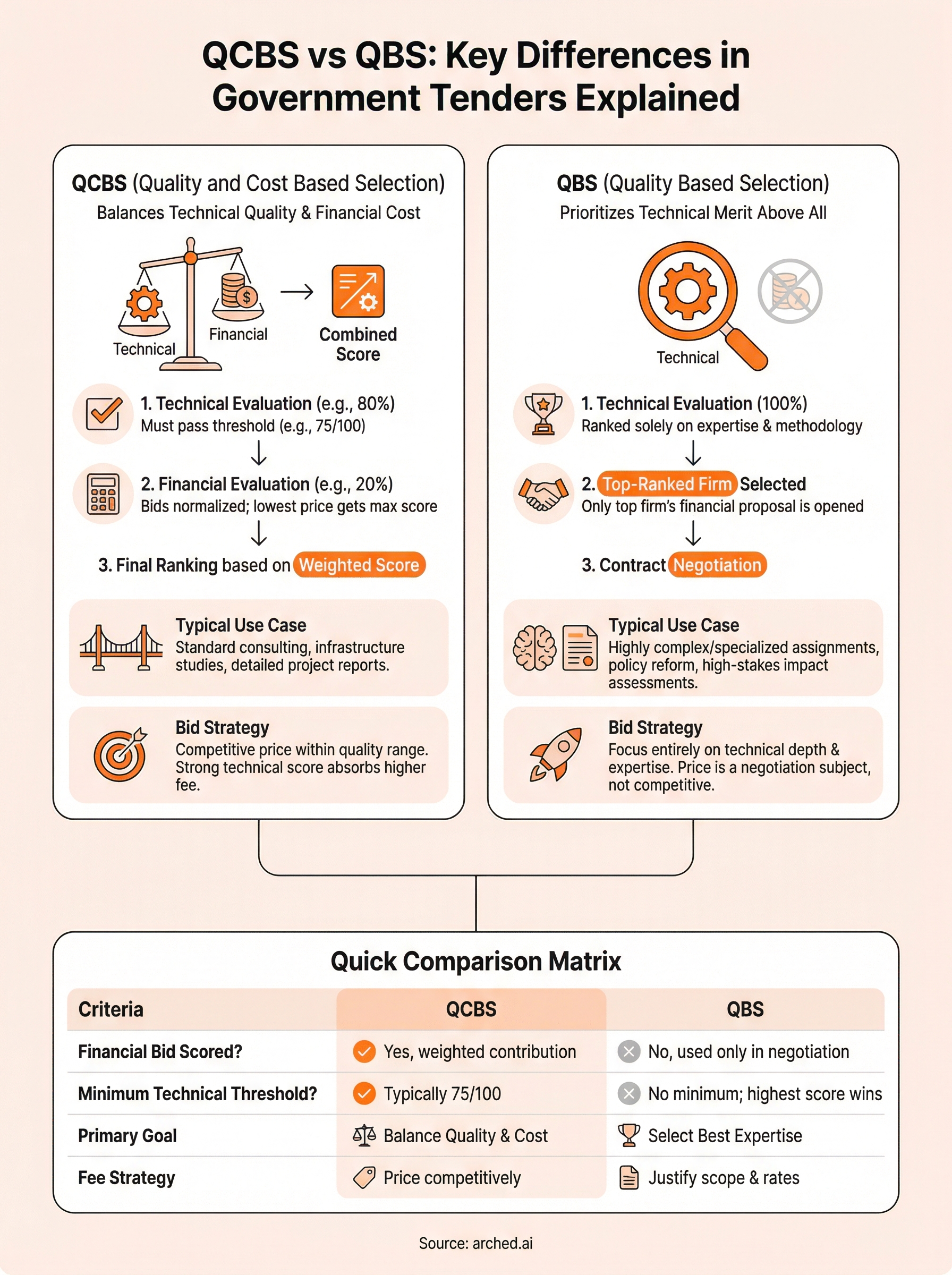
The clearest way to separate these two methods is by asking what the agency is optimizing for. QCBS balances quality against cost, making it the right tool when the agency wants strong technical work but still needs to justify the fee to oversight bodies. QBS eliminates cost as a variable, signaling that the agency views the assignment as too specialized or sensitive to compromise on expertise for a lower price. Knowing this distinction shapes your entire bid strategy before you write a single paragraph.
Where each method applies
Agencies select QCBS for the majority of standard consulting assignments, including feasibility studies, detailed project reports, and supervision contracts across infrastructure sectors. QBS appears in assignments where the output has a direct bearing on high-stakes decisions, such as policy reform studies, complex financial structuring work, or environmental and social impact assessments that carry regulatory consequences.
If the tender document does not specify the evaluation method clearly, review the funding agency's procurement guidelines or request a formal clarification before preparing your proposal.
A side-by-side look at the two qcbs qbs approaches makes the practical differences clear:
| Criteria | QCBS | QBS |
|---|---|---|
| Financial bid scored? | Yes, weighted contribution | No, used only in negotiation |
| Minimum technical threshold? | Typically 75/100 | No minimum; highest score wins |
| Common use | Standard consulting assignments | Highly specialized or complex work |
| Fee strategy | Price competitively within quality range | Focus on justifying scope and rates |
What this means for your pipeline
Your BD team should flag the evaluation method as early as possible when screening tenders. Treating every opportunity identically wastes preparation time on factors that carry no weight under that specific method.
Assigning a QCBS or QBS label to each active tender in your pipeline lets you calibrate proposal effort precisely. A QBS tender justifies deeper investment in staff CVs and methodology, while a QCBS tender requires you to balance technical depth with a competitive fee that holds up under the normalized scoring formula.
How to write a strong proposal for QCBS and QBS
The evaluation method determines your writing priorities, not the other way around. Before you assign a single team member to draft a proposal, confirm whether the tender uses QCBS or QBS. That single data point tells you where to concentrate effort and what the agency will actually score. Treating both methods the same way is one of the most common reasons technically capable firms produce proposals that underperform.
Structuring your technical proposal
For both qcbs qbs methods, the technical section carries the majority of scoring weight. Your methodology needs to address the specific scope of work directly, not recycle language from previous proposals. Key personnel CVs must highlight project experience that maps to the evaluation criteria listed in the RFP, including years of relevant experience, specific assignment types, and measurable outcomes from past engagements. Reviewers score CVs against defined attributes, so generic profiles reduce your technical score regardless of the team's actual capability.
Write each section of your technical proposal as a direct response to the evaluation criteria, not as a general capability statement.
Build your work plan around the agency's stated deliverables and timeline. Identify risks proactively and explain mitigation steps in your methodology section, because evaluation committees score methodological rigor as a separate criterion in most RFPs.
Setting your fee in a QCBS submission
In a QCBS tender, your quoted fee feeds directly into the normalized scoring formula. Price too high and the mathematical penalty offsets your technical advantage. Price unrealistically low and you signal either poor scope understanding or delivery risk. Calculate your fee from a detailed input-based breakdown covering staff time, reimbursables, and overhead, then cross-check the final number against what the normalized scoring formula would yield at typical competitor price ranges. A defensible, well-structured financial proposal strengthens your overall position.
Next steps
Understanding qcbs qbs distinctions gives your bid team a real competitive edge, but applying that knowledge across dozens of active tenders is where the process breaks down for most firms. Manual document review slows your team down, and missing the evaluation method buried in an RFP annex is a common and costly mistake.
Arched solves this at scale. The platform automatically parses tender documents across 500+ government portals and extracts evaluation methodology, qualification criteria, and scoring weights so your team knows exactly what it is competing on before drafting begins. You stop guessing and start allocating preparation effort to the tenders where your profile actually fits the scoring logic.
If your firm bids on government consulting contracts in India and you want to stop losing time to the wrong opportunities, the right place to start is seeing what Arched surfaces for your specific credentials. Explore the Arched platform and find out what you have been missing.