How To Write A Tender Proposal: Step-By-Step For India
Learn how to write a tender proposal for Indian government contracts. Master the two-envelope system, meet technical criteria, and avoid disqualification.
Most government tenders in India aren't won by the lowest bidder, they're won by the firm that demonstrates the clearest understanding of what the buyer actually needs. Yet every week, qualified contractors lose out on crores worth of work because their proposals read like copy-paste templates. Knowing how to write a tender proposal that speaks directly to evaluation criteria is the single most controllable factor in your win rate.
A strong tender proposal does more than check compliance boxes. It tells a story of capability, relevance, and reliability, backed by documentation that leaves zero room for disqualification. Whether you're bidding through GeM, CPPP, or a state e-procurement portal, the structure and strategy behind your submission matter just as much as your technical qualifications and pricing.
This guide breaks down the entire process, from reading the tender notice correctly to formatting your final submission, so you can put together proposals that actually score well. Every step is grounded in how Indian public procurement evaluation works in practice, not theory borrowed from international frameworks. We built Arched to help contractors find the right tenders and understand eligibility requirements through AI-driven document analysis. This article picks up where that discovery ends: the moment you sit down to write the bid itself.
What a tender proposal needs in India
Indian public procurement follows structured evaluation frameworks that vary by authority, but most tenders on CPPP, GeM, and state portals share a common set of requirements. Before you think about how to write a tender proposal, you need to understand the physical and logical structure that evaluators expect. Submissions that don't follow the prescribed format get rejected before anyone reads a single line of your technical narrative, regardless of how strong your credentials are.
Most disqualifications happen at the document screening stage, not during technical evaluation. Getting the structure right is non-negotiable.
The mandatory document set
Every Indian government tender requires a baseline set of documents that prove your firm is legally and financially eligible to bid. Missing even one item from this list can void your entire submission, so treat this as a pre-flight checklist, not an afterthought.
| Document | What it proves |
|---|---|
| Company registration certificate | Legal existence |
| GST registration certificate | Tax compliance |
| PAN card | Income tax compliance |
| Audited balance sheets (last 3 years) | Financial turnover eligibility |
| Bank solvency certificate | Financial capacity |
| Past project completion certificates | Technical experience |
| Earnest Money Deposit (EMD) | Commitment to bid |
| Power of Attorney (if applicable) | Authorized signatory |
You should compile these documents into a dedicated folder well before writing begins. Chasing completion certificates from past clients on the final day is one of the most common reasons contractors miss submission deadlines.
The two-envelope structure
Most tenders above a threshold value follow a two-envelope or two-stage system, where your technical bid and financial bid are submitted as completely separate packages. The buyer evaluates technical submissions first and only opens financial bids from firms that pass technical qualification. Your technical proposal must justify your selection on its own, before price becomes a factor at all.

Your technical envelope typically contains your methodology, team CVs, relevant project experience, and certifications. Your financial envelope holds the BOQ-aligned price schedule and EMD instrument. Keeping these two packages entirely separate, as distinct physical envelopes for offline submissions or as separate portal uploads for e-procurement, is a hard requirement. Any price reference inside your technical section is grounds for immediate disqualification on most portals, including state-level systems.
Step 1. Qualify the opportunity before you write
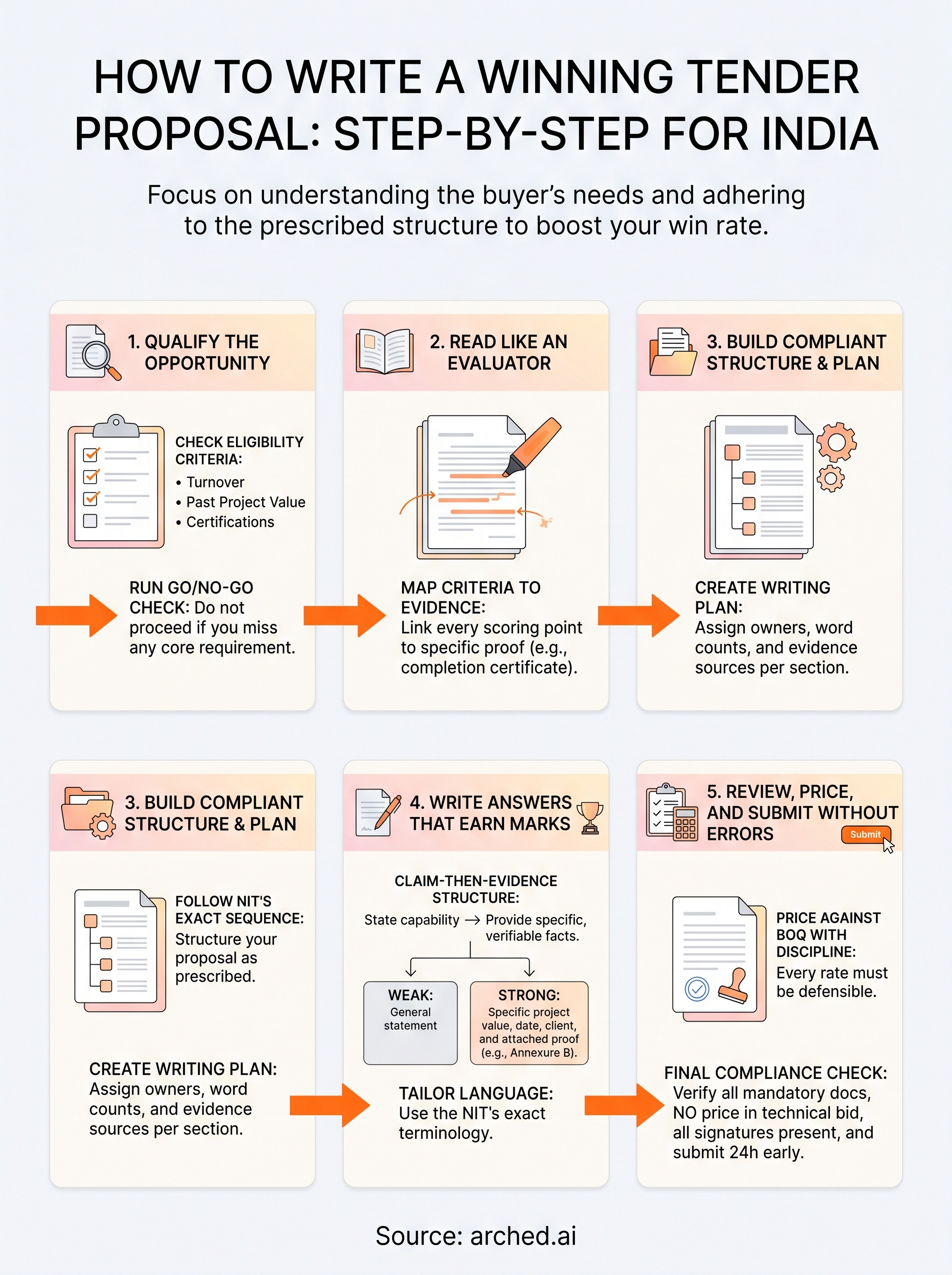
Writing a proposal takes significant time, so spending hours on a bid your firm cannot legally win is the most avoidable mistake in government contracting. Before you learn how to write a tender proposal that scores well, you need to confirm that your firm actually qualifies. Opening the tender document and scanning for your annual turnover requirement, technical experience thresholds, and any mandatory certifications takes less than 30 minutes but saves days of wasted effort.
Check the eligibility criteria against your credentials
Most Indian tenders publish eligibility conditions in the first few pages of the NIT (Notice Inviting Tender). Pull out three numbers immediately: the minimum average annual turnover, the minimum value of a single similar completed work, and the timeline window the buyer specifies (typically the last 5 to 7 financial years). Compare each figure directly against your audited financials and project completion certificates before you do anything else.
If you do not meet even one mandatory eligibility condition, submitting a technically strong proposal will not help you. The bid gets rejected at the screening stage regardless.
Run a go/no-go check before committing
Use a simple checklist to make this decision fast and consistent across your team.
- Turnover meets or exceeds the specified threshold
- At least one similar completed project matches the required individual value
- All mandatory certifications (ISO, MSME registration, contractor grade) are current
- EMD amount falls within your available liquidity
- Submission deadline allows at least 10 working days of preparation time
If any core eligibility item is a no, stop and redirect your effort to the next viable opportunity.
Step 2. Read the tender like an evaluator
Most contractors skim a tender document looking for the price schedule and deadline. Evaluators read it looking for disqualifying conditions and scoring criteria. When you learn how to write a tender proposal that actually scores, the first skill is shifting your reading lens from "what do I need to submit" to "what does this buyer want to reward."
Read the evaluation methodology section before you read the scope of work. It tells you exactly where your marks will come from.
Mark up the document before you write a word
Print or annotate the full tender PDF and highlight every weighted criterion you find. Pay close attention to sections titled "Evaluation Criteria," "Technical Marking Scheme," or "Qualification Criteria." Number each criterion and write the maximum marks available next to it. This annotation becomes your writing checklist once you start drafting.
Flag every place the document uses "shall," "must," or "mandatory". These are hard requirements with zero partial credit, and missing one is an automatic fail regardless of how strong the rest of your proposal is.
Map criteria to your strongest evidence
Once you have your list of weighted criteria, match each one to a specific piece of evidence your firm can provide. Use this three-column format as your mapping tool:
| Criterion | Evidence you hold | Location in submission |
|---|---|---|
| Similar completed work value | Completion certificate | Technical Bid, Section 3 |
| Team qualifications | CV with degree and registration | Technical Bid, Section 4 |
| Financial turnover | Audited balance sheet | Eligibility Documents |
This mapping exercise prevents you from over-writing low-value sections while missing the criteria that carry the most marks in evaluation.
Step 3. Build a compliant structure and plan
Once you know what criteria you're being scored on, you need to organize your proposal so the evaluator can find your evidence instantly. The biggest structural mistake in how to write a tender proposal for Indian government buyers is arranging content in an order that makes sense to your firm instead of following the sequence the NIT prescribes. Evaluators work through submissions in a fixed order, and a well-placed answer in the wrong section often goes uncounted.
Build your proposal structure directly from the NIT's table of contents, not from any previous submission you've made.
Follow the prescribed sequence
Every tender document either specifies an explicit structure or implies one through its evaluation table. Copy that sequence exactly as your proposal's skeleton before you write a single sentence. Number your sections to match the NIT's numbering. If the document asks for "Methodology" in Section 4 and "Team Composition" in Section 5, your proposal reflects that exact ordering without resequencing for your own convenience.
Create a section-by-section writing plan
Before drafting, build a one-page plan that assigns each section a writing owner, word budget, and evidence source. This prevents over-writing early sections and running out of space for high-mark criteria near the end.
| Section | Owner | Target length | Evidence source |
|---|---|---|---|
| Company Overview | BD Manager | 200 words | Company profile document |
| Similar Work Experience | Project Lead | 400 words | Completion certificates |
| Methodology | Technical Lead | 600 words | Site-specific work plan |
| Team CVs | HR | 150 words per CV | Updated CVs |
| Financial Documents | Finance | Compile only | Audited statements |
Distribute this plan to every contributor before anyone starts writing.
Step 4. Write answers that earn technical marks
Once your structure is in place, the actual writing begins. Most firms know how to write a tender proposal that looks professional, but fewer know how to write answers that directly earn marks from evaluators. The difference comes down to one principle: every sentence in your technical submission should link back to a specific evaluation criterion, not to your general company history or capabilities.
An evaluator has limited time per submission. If your answer forces them to search for evidence, they will score it lower than an answer that presents evidence upfront.
Lead with evidence, then explain
Your strongest answers follow a claim-then-evidence structure. State the relevant capability or experience in the opening sentence, then immediately back it with specific, verifiable facts such as project values, completion dates, client names, and measurable outcomes.

Here is a short template for a typical "similar work experience" answer:
Weak version: "Our firm has extensive experience in road widening projects across multiple states."
Strong version: "[Firm Name] completed a 4-lane highway widening project for [Client Name] in FY 2022-23, valued at Rs. 18.7 crore, delivered 3 weeks ahead of schedule. The completion certificate is attached as Annexure B."
The strong version gives the evaluator something they can verify and score in under 10 seconds.
Tailor every answer to the specific tender
Reusing text from previous bids is the fastest way to score below your actual capability. Match your language to the NIT's exact terminology, using the same phrases the buyer used in the scope of work. If the tender says "flexible pavement rehabilitation," your answer should use that exact phrase, not a synonym you prefer internally.
Step 5. Review, price, and submit without errors
The final stage of how to write a tender proposal is where many technically strong bids fall apart. Pricing errors, missing signatures, and corrupted file uploads disqualify submissions that took weeks to prepare. Treat this stage as a separate discipline from writing, not a rushed final hour.
Price your bid against the BOQ with discipline
Fill the Bill of Quantities line by line using your actual cost build-up, not a percentage guess or a competitor's historic rate. Every rate you enter should be traceable to a supplier quote, labor rate card, or equipment hire figure you can defend during a price negotiation or audit. Round numbers with no supporting logic are a red flag during tender evaluation.
Never submit a financial bid before a second person independently checks every rate and total against your cost sheet.
Run a final compliance check before you upload
Before you submit, work through a structured compliance review against the NIT's submission requirements. This takes under an hour and catches errors that automatic document generators miss.
- Confirm every mandatory document is present and bears a current date
- Verify that no price references appear anywhere in the technical envelope
- Check all page numbers, section headings, and cross-references are accurate
- Confirm the authorized signatory has signed and stamped every required page
- Test every uploaded file opens correctly before the portal deadline closes
Submit your bid at least 24 hours before the deadline to absorb any portal technical issues without losing your window.
Wrap-up
Knowing how to write a tender proposal that scores well comes down to discipline at every stage: qualifying before you write, reading like an evaluator, following the prescribed structure exactly, leading with verifiable evidence, and reviewing every document before you hit submit. Each step removes a disqualification risk or adds a scoring advantage that your competitors are likely skipping.
The hardest part for most BD teams is finding the right tenders to apply this process to in the first place. Manually scanning hundreds of portals burns hours that should go toward writing stronger bids. Arched uses AI to match your firm's specific credentials and past project history to the most viable opportunities across GeM, CPPP, and state-level systems, so you spend your preparation time on tenders you can actually win.
Start with better opportunity discovery and see what Arched can surface for your firm by visiting the Arched product page.