What Is Proposal Writing? Types, Structure, And Examples
Learn what is proposal writing and how to structure bids that win government contracts. Explore types, examples, and strategies to improve win rates.
If you've ever bid on a government tender, say, a road-widening project on GeM or a bridge construction contract on a state e-procurement portal, you've already done some form of proposal writing, whether you called it that or not. So, what is proposal writing, exactly? At its core, it's the act of building a structured, persuasive document that convinces a decision-maker to say yes. That decision-maker might be a government agency evaluating technical bids, a private client comparing consultants, or a funding body reviewing research grants.
For infrastructure firms and government contractors operating in India's public procurement space, proposals aren't just paperwork. They're the mechanism that converts opportunity into revenue. A strong proposal demonstrates eligibility, addresses evaluation criteria, prices work competitively, and manages risk, all within strict submission deadlines. A weak one gets disqualified on page two. The difference between the two often comes down to understanding structure, knowing what evaluators actually look for, and having clarity on your own qualifications before you start writing.
That's a problem we think about constantly at Arched. Our platform helps AEC firms identify the right tenders and parse document requirements using AI, but winning those tenders still depends on what you put on paper. This guide breaks down the types of proposals, their standard structure, and real examples to show how each element works in practice.
What proposal writing is and what it is not
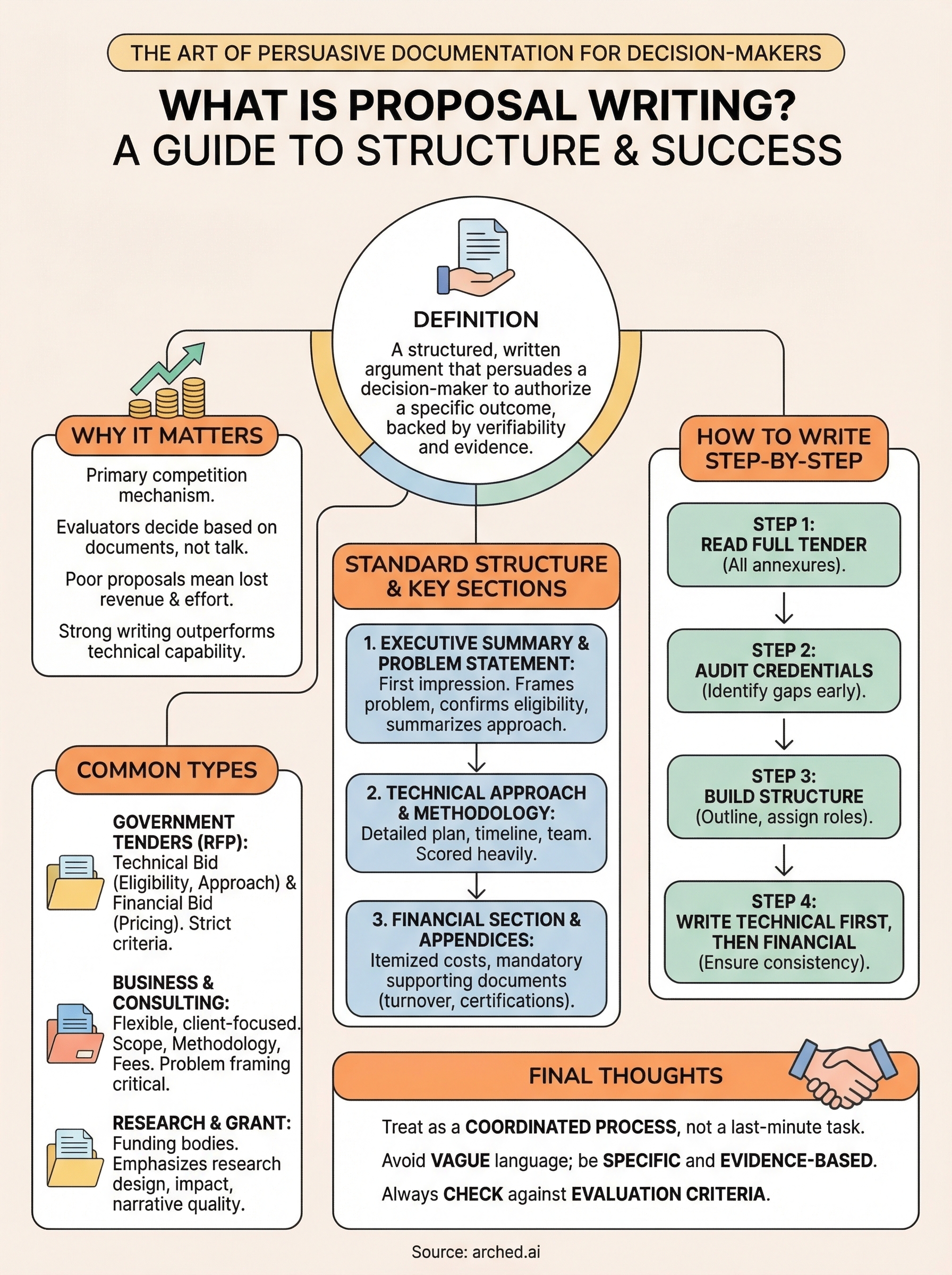
Proposal writing is the process of building a formal document that argues a case and requests a specific outcome. That outcome might be a contract award, a budget approval, a partnership agreement, or a grant. The document connects what you can do with what the other party needs, and it does so in a structured, verifiable way. Unlike a verbal pitch, a proposal commits you to specific deliverables, timelines, and costs in writing.
The core definition: what is proposal writing
When people ask what is proposal writing, they often expect a narrow answer tied to business proposals or academic grants. The reality is broader. Proposal writing covers any situation where you need a decision-maker to authorize something based on your written argument. In government contracting, that means responding to a tender notice with a technical and financial bid that proves your firm meets all qualification criteria. In private consulting, it means producing a scoped document that outlines your approach, fee structure, and expected results for a client comparing multiple firms.
The common thread across all proposal types is persuasion backed by evidence. You're not simply telling someone what you want to do; you're proving you can do it, that your approach is sound, and that the cost is justified. In the Indian AEC sector specifically, this means referencing past project credentials, certifications like ISO or BIS compliance, and financial turnover figures that match the eligibility requirements stated in the tender notice.
A proposal is not a wish list. It's a structured argument with supporting evidence that directly addresses what the evaluator needs to see.
What proposal writing is not
Many firms confuse proposal writing with routine report writing or internal documentation. These are different activities. A report describes what happened. A proposal argues for what should happen next. Mixing up the two is a common reason proposals fail: they describe a firm's capabilities at length but never make a clear, direct case for why those capabilities solve the specific problem in front of the evaluator.
Proposal writing is also not the same as filling out a form. Some government portals ask you to enter structured data into fields, but the narrative sections, your technical approach, methodology, or executive summary, still require the same persuasive logic as a free-form proposal. Copying boilerplate text into those fields and expecting the numbers to carry the document rarely works in competitive tenders, where evaluators score narrative sections with equal or greater weight than financials.
Finally, proposal writing is not a last-minute task. The firms that consistently win high-value government contracts treat proposal development as a coordinated process involving BD managers, technical leads, finance teams, and sometimes legal review. The document is the output of that process, not the process itself. If you're writing the executive summary the evening before a GeM submission closes, you've already reduced your chances of winning significantly.
Why proposal writing matters in real decisions
Understanding what is proposal writing goes further than knowing its definition. It matters because proposals are the primary mechanism through which firms compete for contracts. In India's public procurement system, evaluators often review dozens of bids from qualified firms with similar credentials. The proposal is your only opportunity to differentiate your firm on paper, and the decision to award a contract worth several crores often rests entirely on how well you've argued your case in writing.
Evaluators make decisions based on documents, not conversations
Government procurement evaluators in India work within strict scoring frameworks defined by the tender notice itself. They cannot factor in a phone call you made or a site visit you offered informally. They score what's in front of them. When your technical bid doesn't directly address the evaluation criteria, or when your methodology section is vague, you lose points regardless of how strong your actual delivery capability is. The written document is the entire basis for comparison across competing firms.
Evaluators cannot reward what they cannot read. If your qualifications, approach, and pricing are not clearly structured in the document, they effectively do not exist.
Firms that invest in strong proposal writing consistently outperform competitors with equal or even superior technical capability. Your score on paper, not your reputation in the market, is what moves you to the next evaluation stage.
Poor proposals cost firms real revenue
In competitive tendering, a disqualified or low-scoring proposal means zero return on the time and cost you invested in business development. BD managers spend weeks tracking relevant tenders across multiple portals, reviewing eligibility criteria, and assembling supporting documents. A poorly written technical narrative or a missing credential statement can eliminate all of that effort at the evaluation stage. The financial impact accumulates across multiple submission cycles, and firms often don't trace the revenue loss back to proposal quality.
Treating proposal writing as a core business function rather than an administrative task produces measurable results over time. This applies whether you're bidding on a state irrigation project worth two crores or a national highway consultancy assignment worth fifty. The discipline you apply to your written argument is the same discipline that compounds into a stronger win rate.
Common proposal types and when to use each
Not every proposal serves the same purpose, and understanding the differences between proposal types helps you apply the right structure and tone to each. When firms ask what is proposal writing in the context of government contracting, they're usually thinking about tender submissions. But the category is broader, and the underlying logic of persuasion, evidence, and structure applies across all types.
Government tender proposals
Government tender proposals respond to a formal Request for Proposal (RFP) or a tender notice published on portals like GeM, CPPP, or state e-procurement systems. These proposals split into two components: a technical bid and a financial bid. The technical bid covers your firm's eligibility credentials, project experience, methodology, and team qualifications. The financial bid contains your pricing, and evaluators only open it after your technical bid clears the minimum qualification threshold.
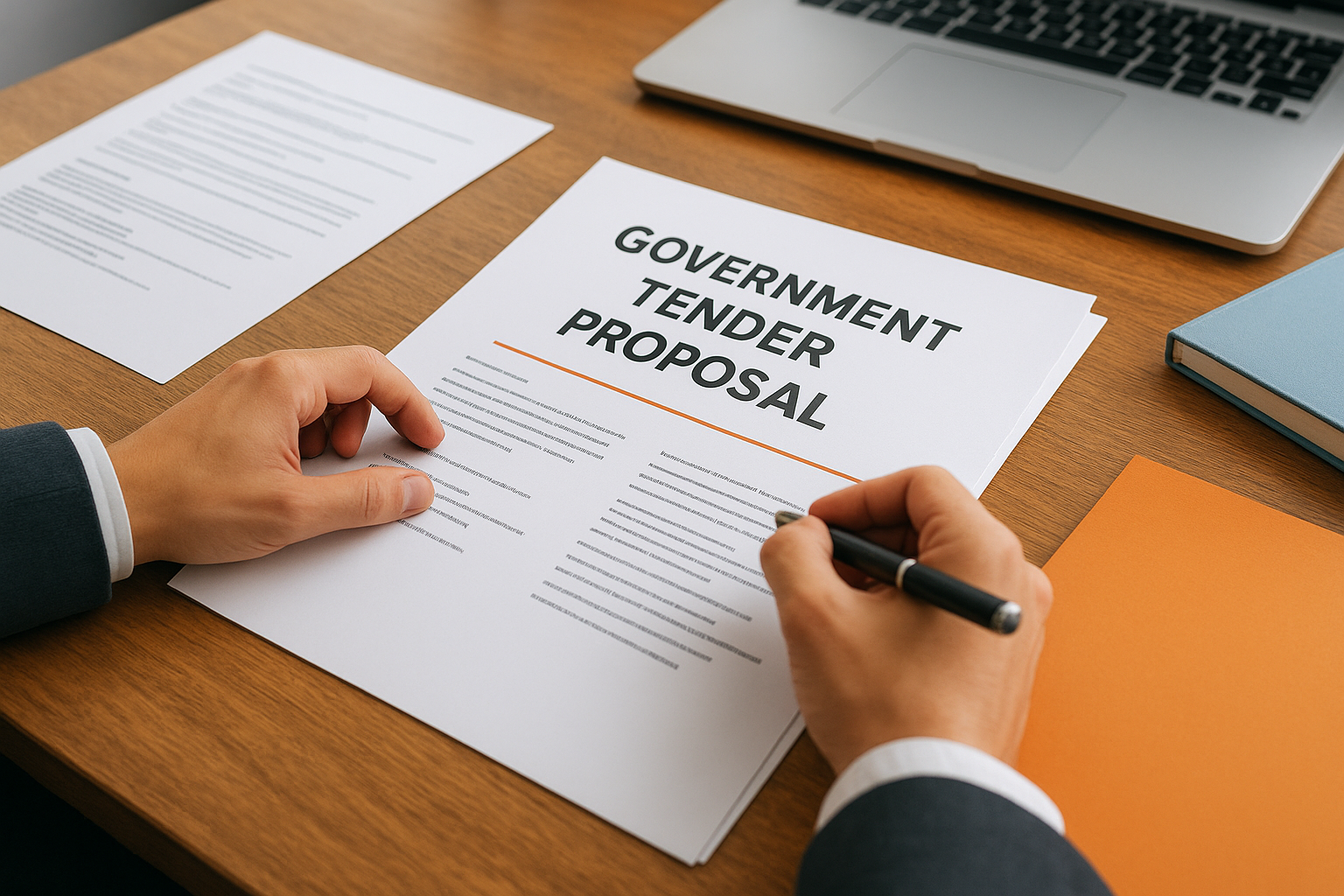
In government tenders, the technical bid is your written argument that you belong in the running. The financial bid only matters if that argument succeeds.
These proposals carry strict format requirements defined in the tender notice itself, and deviating from them can lead to disqualification even if your credentials are strong. Your job is to respond precisely to every stated requirement, not to write creatively around them.
Business and consulting proposals
Business and consulting proposals respond to a private client's request or are submitted proactively to secure a project. Unlike government tenders, these proposals have no fixed evaluation rubric. Your client decides what matters most, which makes your executive summary and problem framing carry more weight than in a formal bid. A consulting proposal in the AEC sector typically includes:
- Scope of work
- Proposed methodology
- Team CVs and relevant experience
- Timeline with key milestones
- Fee schedule
Research and grant proposals
Research and grant proposals target funding bodies and institutions. In the AEC context, these appear when firms pursue government-backed research funding or international grants for infrastructure innovation. You'll spend more space justifying your research design and expected impact than on commercial credentials.
Most grant bodies also require a background section that situates your work within existing knowledge, and review panels score narrative quality heavily. Pricing plays a secondary role compared to the rigor of your proposed approach and the strength of your supporting evidence.
Standard proposal structure and key sections
Most proposals follow a predictable sequence of sections that evaluators expect to see in a specific order. Whether you're answering what is proposal writing for the first time or refining a submission process your firm has used for years, understanding this structure helps you build documents that score consistently across different tender types. Deviating from the standard sequence without a clear reason signals inexperience to evaluators and can cost you points before they've even read your methodology.

A well-structured proposal signals competence before the evaluator reads a single word of your technical argument.
Executive summary and problem statement
The executive summary is the first section evaluators read, and it shapes how they interpret everything that follows. Keep it to one or two pages. State the problem you're solving, confirm that you meet eligibility requirements, and summarize your approach and pricing clearly. Don't bury this information under general background text. Evaluators reviewing a stack of competitive bids move quickly, and a vague opening loses their attention fast.
Your problem statement, sometimes folded into the executive summary, frames why your proposal exists. It should reflect the specific language and priorities from the tender notice, not generic boilerplate your firm reuses across submissions.
Technical approach and methodology
Your methodology section is where most evaluators spend the most time in a technical bid. Explain how you'll deliver the work, what processes you'll follow, and why your approach suits this specific project. Use numbered phases, milestones, or a simple table to show your project timeline and key deliverables. Vague sections that rely on generic language are a consistent reason for low technical scores in government tenders.
Include your team structure and CVs here or in a directly adjacent section. Evaluators need to match named personnel against experience requirements stated in the tender notice.
Financial section and supporting appendices
Your financial bid should be clean, itemized, and directly tied to the scope you described in the technical section. Attach all mandatory supporting documents, such as turnover certificates, past project completion letters, and registration credentials, as clearly labeled appendices. Missing or mislabeled attachments are among the most common reasons technically strong proposals get disqualified before evaluators reach the scoring stage.
How to write a proposal step by step
Knowing what is proposal writing in theory only takes you so far. The actual process requires a specific sequence, and skipping steps early creates problems that are hard to fix at the submission stage. Most firms that consistently win government tenders follow a disciplined drafting process rather than working section by section in a single sitting.
Steps 1 and 2: Read the tender fully, then audit your credentials
Before you open a blank document, read the full tender notice, including all annexures and corrigenda. Identify the evaluation criteria, minimum qualification thresholds, and any mandatory format requirements. Government portals like GeM and CPPP sometimes attach format templates you must follow exactly. Submitting content in the wrong order or missing a required section can trigger disqualification regardless of how strong your credentials are.
After completing that review, audit your firm's qualifications against each stated requirement. List your relevant past projects, certifications, financial turnover figures, and key personnel credentials side by side with the eligibility criteria. If gaps exist, decide early whether a joint venture or subcontracting arrangement can address them. Knowing your qualification position before you start drafting prevents you from building a strong technical narrative that fails at the eligibility check stage.
Reading the tender completely before writing saves you from building your argument around requirements you misunderstood.
Steps 3 and 4: Build your structure, then write technical sections before financials
Once you know what the tender requires and which requirements you meet, outline every section the document calls for and assign a responsible team member to each one. Your BD manager might own the executive summary and commercial sections while a technical lead handles methodology. Separating ownership prevents duplication and keeps each section focused on the specific requirement it covers.
Complete your technical bid narrative before you finalize pricing. Your scope definition in the technical section directly determines how you itemize costs in the financial bid. Writing them in parallel often produces inconsistencies that evaluators notice quickly. Once both sections are drafted, review the full document against the original evaluation criteria as a final check before submission closes.
Examples and mini templates you can copy
Understanding what is proposal writing becomes practical only when you see how the structure actually looks on paper. The two templates below are stripped-down models you can adapt for your own submissions. They reflect the core logic of each section's purpose: state the problem, confirm your qualifications, explain your approach, and make the decision easy for the evaluator. Use them as starting points, not finished documents.
The fastest way to improve your next proposal is to compare your current draft against a clean template and identify every section where your language is vague or missing.
Government tender executive summary template
Your executive summary for a government tender needs to confirm eligibility and frame your approach within the first few lines. Evaluators reviewing competitive bids often read this section first and use it to set their expectations for the rest of the document.
Use this structure as your base:
- Project reference: [Tender number, portal name, submission deadline]
- Firm name and registration: [Legal name, CIN, relevant registration numbers]
- Eligibility confirmation: We confirm that [Firm Name] meets all qualification criteria stated in the tender notice, including minimum annual turnover of [X crores] (average over three years), [number] of similar completed projects, and valid [certification type].
- Proposed approach summary: Our technical approach follows [methodology name or phased structure], with a total project duration of [X weeks/months] from the date of award.
- Financial bid summary: Our total quoted cost is [X], inclusive of all applicable taxes and site-specific provisions.
Consulting proposal scope of work template
A consulting proposal for a private AEC client needs a clearly defined scope section that prevents scope creep and sets mutual expectations from the start. Keep each deliverable specific and tied to a named milestone so the client can track progress without ambiguity.
Use this structure:
- Phase 1: [Activity description] | Deliverable: [Document or output name] | Duration: [X weeks]
- Phase 2: [Activity description] | Deliverable: [Document or output name] | Duration: [X weeks]
- Exclusions: The following items fall outside this scope: [List specific exclusions clearly]
- Client responsibilities: [List what the client must provide, such as site access, existing drawings, or approval sign-offs]
Adapt the number of phases to match your actual project structure. A two-phase irrigation consultancy looks different from a five-phase urban infrastructure study, so don't force a template to fit a scope it doesn't match.
Final thoughts
Proposal writing sits at the center of how government contractors compete and win. Once you understand what is proposal writing at a structural level, you can see exactly where most firms lose points: vague methodology sections, missing eligibility statements, and financial bids that don't match the scope they described. These are fixable problems.
Your win rate improves when you treat every proposal as a coordinated process rather than a document you assemble under deadline pressure. Start with a full tender review, audit your credentials honestly, build your structure before you write, and check your final draft against the evaluation criteria line by line. The firms that do this consistently outperform competitors with comparable technical capability.
If you want to spend less time tracking tenders and more time writing strong proposals, Arched's AI platform for government contracting intelligence handles the discovery and document analysis work so your BD team can focus on what actually wins contracts.