FIDIC Red Book vs Yellow Book: Key Differences Explained
Compare FIDIC Red Book vs Yellow Book to master design liability and risk allocation. Learn how these contracts impact your Indian infrastructure bid strategy.
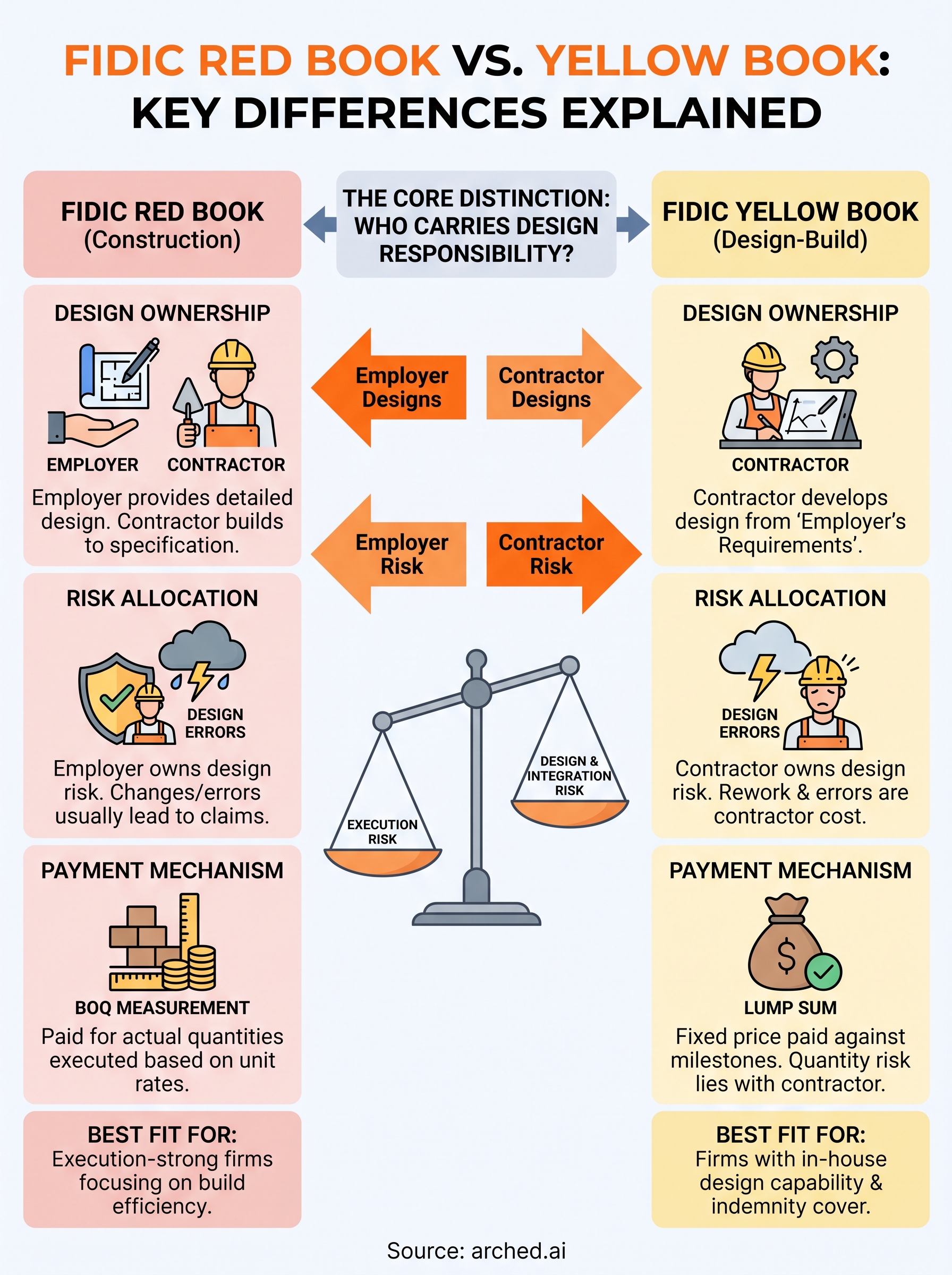
Choosing the wrong contract form on a government infrastructure project doesn't just create paperwork headaches, it shifts millions of rupees in risk to the wrong party. That's exactly why the distinction between FIDIC Red Book vs Yellow Book matters so much for contractors and consultants bidding on public works in India. Both are published by the International Federation of Consulting Engineers (FIDIC) and both are used extensively across road, bridge, irrigation, and urban infrastructure projects. But they differ fundamentally in one critical area: who carries the design responsibility.
The Red Book places design squarely on the employer's side, while the Yellow Book shifts it to the contractor. That single difference cascades into how risks are allocated, how variations are handled, how payments are structured, and ultimately, how profitable or painful a project becomes. For BD managers and bid teams evaluating tenders, especially those pulled from platforms like GeM, CPPP, or state e-procurement portals, recognizing which FIDIC form governs a contract is a front-line risk assessment skill.
At Arched, our AI platform parses tender documents across 500+ government portals to flag exactly these kinds of contractual details, from qualification criteria to unusual risk clauses buried deep in PDF notices. Understanding the FIDIC framework makes that analysis far more actionable. This article breaks down the key differences between the Red Book and Yellow Book, covers design responsibility, risk allocation, payment mechanisms, and project suitability, so you can match the right contract form to your next bid with confidence.
Why the Red vs Yellow choice matters
The contract form a project uses isn't just a legal formality. It defines who is liable when drawings are wrong, who pays when scope changes, and which party absorbs the cost of unforeseen ground conditions. When you're evaluating a government tender in India, the FIDIC form in use determines your exposure before a single brick is laid. Bid teams that treat contract forms as an afterthought routinely absorb risk they never priced for, and that's a slow, steady drain on project margins.
Design responsibility changes everything
Most bid errors trace back to one misread: assuming you understand the scope without checking who carries design. Under the Red Book, the employer provides the design, and you as the contractor build to that specification. Under the Yellow Book, you carry design responsibility, which means your team is accountable for both engineering decisions and their consequences on site. That difference determines how large your pre-bid engineering team needs to be, how much professional indemnity cover you require, and how you structure subcontractor appointments.

The scope of design liability also shapes your variation claims directly. When the employer holds the design and that design changes, you have a clear entitlement to additional time and money under the Red Book. When you hold the design under the Yellow Book, many scope changes become your problem to absorb, unless the employer has specifically modified the employer's requirements in writing.
The biggest source of disputed claims on design-build projects is contractors who priced a job as if design liability sat with the employer when the contract clearly placed it on them.
Risk allocation follows design
Design responsibility and risk allocation are inseparable. Whichever party owns the design owns the risk of that design being inadequate, which means the cost of rework, engineering errors, and late design decisions falls on them. On a Red Book project, if the employer's drawings contain errors, you submit a claim. On a Yellow Book project, if your design fails to meet the employer's requirements, you fix it at your own expense.
Risk for unforeseeable physical conditions is treated differently too. The Red Book gives contractors a stronger claim pathway for ground conditions that differ materially from what the contract documents indicated. The Yellow Book still provides some protection, but because you've taken design responsibility, the threshold for what qualifies as genuinely unforeseeable is higher and far more contested in dispute resolution.
Why this matters on Indian government tenders
Indian public sector contracts issued under central agencies like NHAI, NHIDCL, and various state PWD bodies increasingly reference FIDIC conditions, though often with substantial General Conditions of Contract (GCC) amendments that modify the standard clauses. Bid teams who understand the baseline fidic red book vs yellow book distinction can immediately spot where those amendments deviate from the norm and what additional risk the government has introduced.
Several state-level tenders also blend elements of both forms without explicitly labeling the contract type. Recognizing the underlying design responsibility structure from the contract's payment mechanism and variation clauses helps you assess actual project risk rather than assumed risk. When you're dealing with contracts worth tens of crores, that assessment goes well beyond a desk exercise. It directly determines your bid price, your contingency buffer, and whether the project makes commercial sense to pursue at all.
Red Book explained in plain English
The FIDIC Red Book's full title is the Conditions of Contract for Construction, and that subtitle tells you exactly what it covers: projects where the employer handles the design and the contractor builds to specification. First published in 1999 and updated with the 2017 edition, it remains the most widely used FIDIC form in Indian public infrastructure procurement. If you're bidding on a road widening or irrigation canal project where the government's consultant has already prepared drawings, you're almost certainly looking at Red Book conditions.
Who holds the design pen
Under the Red Book, the employer's team produces the design, including the drawings, specifications, and technical requirements, before the contractor steps in. Your job is to build what the drawings say, to the standards they specify. This means your bid price reflects construction cost and risk, not design development cost. If the drawings turn out to be wrong or incomplete, you submit a variation claim rather than absorbing a rework cost. That's a fundamentally different commercial position from a design-build arrangement.
Contractors who treat Red Book projects as design-build by default, for example by accepting verbal scope changes without a formal variation order, forfeit claims they're contractually entitled to pursue.
A named role called the engineer acts as the contract administrator under the Red Book. They issue instructions, certify payments, and rule on claims. You deal with this third party throughout project delivery, and their decisions carry significant weight in dispute resolution, which is why understanding the engineer's authority before you sign is non-negotiable.
How payment works under the Red Book
Red Book contracts typically use a bill of quantities (BOQ) based measurement approach. You get paid for the actual quantities of work executed, priced at the rates you submitted in your tender. This means payment tracks real progress rather than a pre-agreed lump sum, giving both parties a transparent mechanism to handle small quantity shifts without triggering a full contract amendment every time.
When you're navigating the fidic red book vs yellow book decision, the BOQ payment model is often your clearest signal that a contract follows Red Book logic. State PWD and NHAI tenders routinely specify unit rates across dozens of line items, which strongly indicates the contract places design with the employer. Recognize that structure early and you'll price your bid far more accurately.
Yellow Book explained in plain English
The FIDIC Yellow Book's full title is the Conditions of Contract for Plant and Design-Build, and that label is your first clue about how it operates. Published alongside the Red Book in 1999 and updated in 2017, the Yellow Book governs projects where the contractor takes on both design and construction. Think of toll road packages, water treatment plants, or turnkey infrastructure schemes where the government hands you an outcome to deliver rather than a set of drawings to build from. If the tender asks you to produce detailed engineering and then construct to your own specifications, you're operating under Yellow Book logic.
Who holds the design pen
Under the Yellow Book, your firm carries full design responsibility from concept through to construction. The employer issues what the contract calls "Employer's Requirements," a document that defines the project's function, performance standards, and constraints, but not the detailed engineering. Your team develops the actual design, submits it for review, and then builds to it. That means engineering errors become your liability, not a variation claim against the employer.
This design ownership fundamentally changes how you staff a bid. You need in-house or subcontracted design capacity priced into your tender before submission, not brought in later as an afterthought. When comparing the fidic red book vs yellow book frameworks, this is the sharpest operational difference you'll encounter on site: one contract makes you an executor of someone else's engineering; the other makes you accountable for the engineering itself.
Firms that treat Employer's Requirements as equivalent to a Red Book specification routinely underprice design development and lose margin before construction even starts.
How payment works under the Yellow Book
Yellow Book contracts typically use a lump sum payment structure rather than a BOQ-based measurement approach. You agree on a total contract price and draw it down against agreed milestones or activity schedules. This removes the per-unit quantity adjustment mechanism that the Red Book provides, which means quantity overruns generally sit with you unless the employer formally changes the Employer's Requirements.
That lump sum structure rewards tight design control and punishes scope creep. Your contingency pricing must account for design risk, ground conditions that your engineering choices must accommodate, and any interface risk between your design packages. Recognizing this payment model in a tender document immediately tells you which contract regime you're operating under and how aggressively you need to protect your scope boundaries from day one.
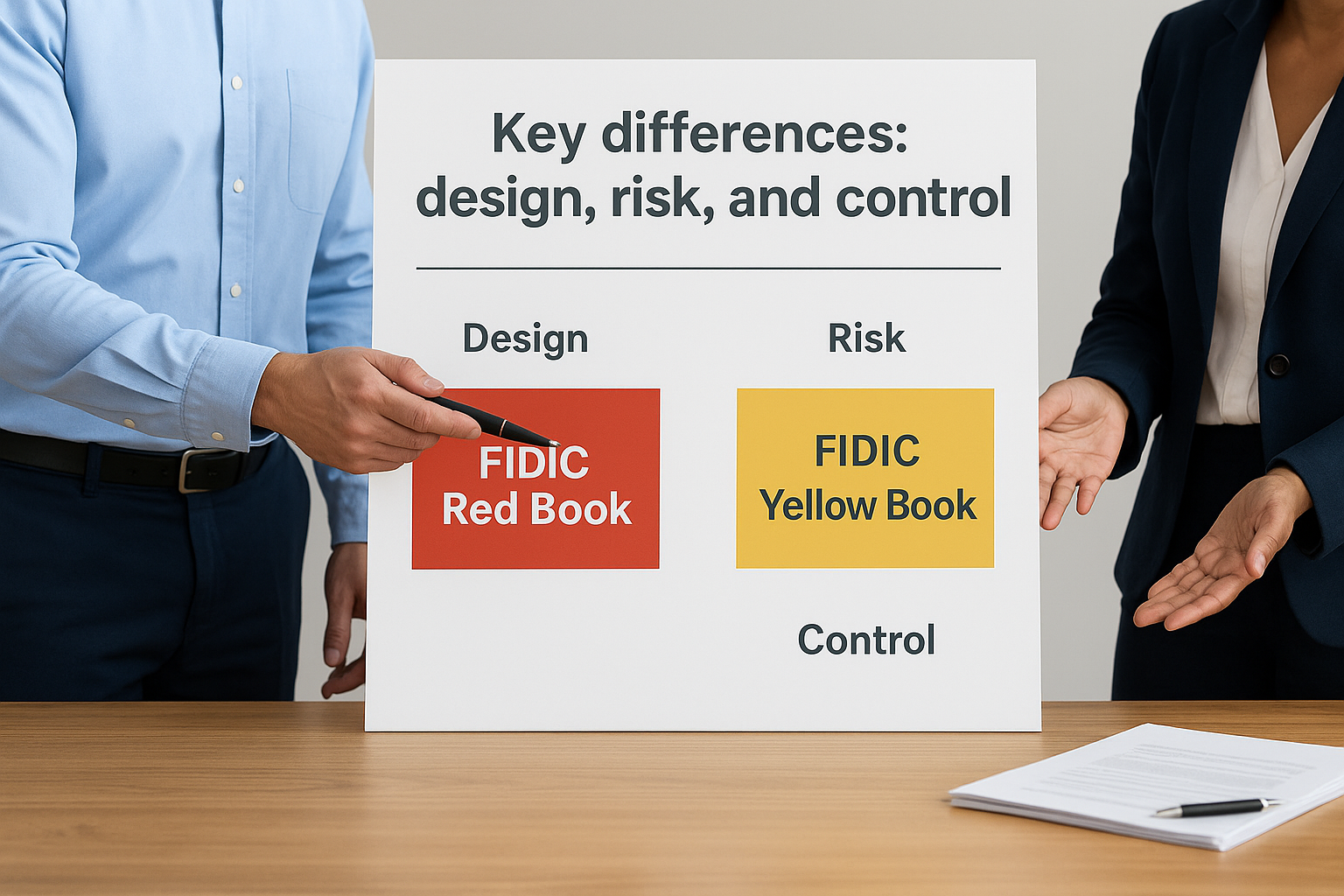
Key differences: design, risk, and control
Pulling the fidic red book vs yellow book comparison into a single frame starts with three variables: who designs, who absorbs risk when things go wrong, and who holds day-to-day control over how the work proceeds. Every other contract difference flows from these three factors. Get them wrong in your bid analysis and you'll misprice the job before your team even starts writing the technical submission.
Design responsibility: the core divide
The Red Book makes the employer the designer of record, which means the contractor executes instructions rather than generates engineering solutions. If a drawing contains an error, the contractor notifies the engineer, submits a variation, and recovers cost. The Yellow Book inverts this entirely: your firm develops the engineering from the Employer's Requirements, which means design errors, coordination gaps between structural and MEP packages, and specification shortfalls all land on your balance sheet. That isn't a subtle distinction. It determines the size of your pre-construction team, your professional indemnity requirements, and the risk premium embedded in your overhead recovery rates.
Contractors who price Yellow Book jobs at Red Book margins are essentially giving away design development as a free service.
Both contracts require the contractor to scrutinize the documents provided before bidding. Under the Red Book, that scrutiny focuses on checking that the drawings are complete enough to price accurately. Under the Yellow Book, that scrutiny must assess whether the Employer's Requirements are achievable within the budget and program implied by the tender, because your design will be held against those requirements for the life of the contract.
Risk ownership and control authority
Risk allocation under the Red Book leans toward a cleaner split: the employer owns design risk, the contractor owns construction execution risk, and both parties share certain physical conditions risk through the engineer's determinations. Under the Yellow Book, the contractor absorbs a broader band of risk because the design choices made by your team directly influence whether ground conditions, material performance, and interface coordination become problems at all.
Control authority also differs materially. The Red Book's engineer acts as an independent certifier with defined powers to instruct and certify. The Yellow Book still uses an engineer role, but because the contractor owns the design, there is less day-to-day instruction flow and more employer review of design submissions against the Employer's Requirements. Your internal quality and design management processes carry far more weight on a Yellow Book project than a Red Book one.
Key differences: payment, time, and claims
The fidic red book vs yellow book gap extends well beyond design responsibility. Payment structure, program risk, and how you pursue claims all shift significantly depending on which form governs your contract. Understanding these differences before you price a tender prevents costly assumptions from embedding themselves in your bid.
Payment mechanisms and price certainty
Red Book contracts pay you on measured quantities, which means your final contract value adjusts as actual work quantities fluctuate from those in the BOQ. If the employer's drawings underestimate excavation volumes, you get paid for the extra cubic meters at your tendered rate. That measurement-based model gives you a defensible commercial position when scope grows, as long as you keep your site records clean.
Yellow Book contracts pay against a lump sum, which means you carry quantity risk for every design decision your team makes. If your structural design requires more reinforcement than you estimated, that overrun comes out of your contingency, not an adjusted payment certificate. Your pricing must therefore account for design maturity risk, because the Employer's Requirements rarely provide the level of detail you'd find in a fully developed Red Book drawing set.
Firms that apply Red Book quantity-based thinking to Yellow Book lump sum projects routinely exhaust their contingency before the project reaches structural completion.
Time risk and program ownership
Under the Red Book, program delays caused by late employer design or late information give you a clear entitlement to an extension of time through the engineer. The contract explicitly recognizes that the employer's failure to supply drawings on time is a compensable event. You carry execution risk, not design development risk.
Yellow Book contracts shift a broader band of time risk to your team, because your design program and construction program are interlinked. A delay in your design approval process, even when the employer's review takes longer than specified, can be harder to recover because your design program directly drove the construction sequence. Protecting your program under the Yellow Book requires tight contractual notice discipline and formal approval tracking from day one.
Claims and entitlements
Both contracts require strict notice periods, typically 28 days from when you first became aware of the event giving rise to a claim. Missing that window can extinguish your entitlement entirely, regardless of how legitimate the underlying claim is. Red Book claims more frequently arise from design changes and late information, while Yellow Book claims cluster around scope interpretation disputes over what the Employer's Requirements actually required your design to deliver.
How to choose between Red and Yellow
The fidic red book vs yellow book decision ultimately comes down to two questions: does your firm carry in-house design capability, and are you prepared to hold design liability for the life of the contract? If both answers are yes, the Yellow Book fits your delivery model. If your firm builds to others' engineering and your margin depends on clear scope boundaries, the Red Book is your natural home. Neither form is superior in the abstract; they serve fundamentally different project delivery structures, and the wrong choice costs you money before site work begins.

Match the contract to your firm's design capacity
Your first filter is an honest capability assessment: does your team have qualified engineers on staff, professional indemnity cover sized to your design exposure, and internal QA processes that can withstand employer review and adjudication? Bidding a Yellow Book project without those resources in place before tender submission puts your entire margin at risk before a single drawing is issued. If you lack credible design capacity, you need a design subcontractor fully committed and costed into your bid, not considered as an afterthought post-award.
Red Book projects reward firms whose competitive edge sits in site execution efficiency, procurement performance, and disciplined variation management rather than engineering origination. If your organisation runs well against a complete drawing set, chasing Yellow Book packages to access higher contract values frequently destroys the very margin advantage that makes your Red Book pipeline profitable.
If your firm's core strength is construction execution rather than engineering origination, forcing your business model into a Yellow Book design-build project rarely ends well commercially.
Use the payment structure as your final check
Lump sum pricing signals Yellow Book risk, and if your estimating team cannot price design development, coordination uncertainty, and scope interpretation risk into that lump sum with confidence, the contract will drain margin from day one. Measurement-based BOQ pricing signals Red Book conditions, where profitability depends on execution rates, accurate quantity tracking, and a robust variation management process throughout the project lifecycle.
Before you commit to any bid, read the payment mechanism clause first, not the scope narrative. That single detail tells you which risk profile the project carries and whether your firm's current capabilities genuinely match what the contract demands. Chasing contract value without aligning your capability profile to the contract form is one of the most reliable ways to absorb losses you never modeled in your original bid.
Common pitfalls in Indian tenders
Indian government tenders routinely reference FIDIC conditions but layer them with General Conditions of Contract (GCC) amendments that alter the standard framework significantly. These amendments often shift more risk onto the contractor, cap the engineer's authority to certify additional payments, or compress notice periods below the standard 28-day window. If you read only the FIDIC baseline and skip the GCC schedule, you're pricing assumptions that the contract has already overridden.
Treating GCC amendments as minor edits
Many bid teams skim GCC schedules expecting small administrative tweaks. In practice, central agencies like NHAI and state PWD bodies frequently use amendments to flip design responsibility clauses without relabeling the contract form. A project that looks like a Red Book arrangement on the cover sheet may carry Yellow Book design obligations buried in a GCC addendum. The fidic red book vs yellow book distinction only protects you if you've confirmed which obligations the full amendment schedule actually imposes, not just what the contract title suggests.
When you identify a GCC amendment that alters design responsibility, flag it immediately in your bid risk register and reprice accordingly. Absorbing Yellow Book design liability at Red Book margin is one of the fastest ways to turn a nominally profitable contract into a financial drain before the site mobilizes.
Reading the contract title and assuming you understand the risk profile is the single most expensive shortcut a bid team can take on an Indian government tender.
Missing the notice period traps
Amended Indian government contracts frequently compress the standard FIDIC 28-day notice window down to 14 or even 7 days for specific claim types. Miss that window on a variation claim or a physical conditions event and your entitlement lapses, regardless of how legitimate the underlying event was. Your bid team must map every notice period in the full contract document before submission, not after award.
Site teams also routinely fail to connect contractual notice obligations to daily site reporting processes. A project manager who logs a problem in a site diary but never issues a formal contractual notice has documented the event for internal purposes while extinguishing the legal claim. Build a notice checklist into your site management protocol from day one, calibrated to the specific notice windows in each contract, and treat it as a non-negotiable part of every weekly site review.
Next steps
The fidic red book vs yellow book distinction is not an academic exercise. It determines your design liability, your payment exposure, and your claims position on every government tender you pursue. Read the full contract document, including every GCC amendment, before you commit to a bid. Confirm who carries design responsibility, map every notice period, and price your contingency to match the actual risk profile the contract imposes, not the one you assumed from the cover sheet.
Doing that analysis manually across hundreds of state and central government portals takes significant time your bid team does not have. Arched's AI platform parses tender documents automatically, flags unusual risk clauses, identifies qualification gaps, and surfaces the contract details that matter before you invest resources in a submission. If you want to see how that works on live tenders relevant to your firm, explore what Arched can do for your pipeline.