Independent Engineer: Roles, Scope, And Why Lenders Use IEs
Learn how an independent engineer manages technical risk, verifies milestones, and issues drawdown certificates to control funding for infrastructure projects.
When a bank or financial institution funds a highway, bridge, or irrigation project worth hundreds of crores, they don't just wire the money and hope for the best. They appoint an independent engineer, a neutral technical professional (or firm) whose job is to protect the lender's interest by monitoring construction progress, verifying milestones, and flagging risks before they become expensive problems. For contractors and infrastructure consultancies operating in India's public procurement space, understanding what an IE does, and why, is essential to navigating large-scale, lender-backed projects.
The IE sits at the intersection of finance and engineering. They review designs, certify drawdowns, assess completion milestones, and provide lenders with an honest, third-party picture of whether a project is on track. If you've bid on (or plan to bid on) EPC or HAM contracts, you'll almost certainly encounter an IE appointment clause buried in the tender documents. Knowing what this clause means for your obligations can shape how you plan execution and manage cash flow throughout the project lifecycle.
This article breaks down the independent engineer's role, scope of work, appointment process, and the specific reasons lenders rely on them. At Arched, our platform parses tender documents and flags exactly these kinds of critical clauses, including IE-related obligations, so that firms can assess project complexity before committing to a bid. Below, we'll give you the full picture of how IEs operate within India's infrastructure financing ecosystem.
Why lenders and investors use independent engineers
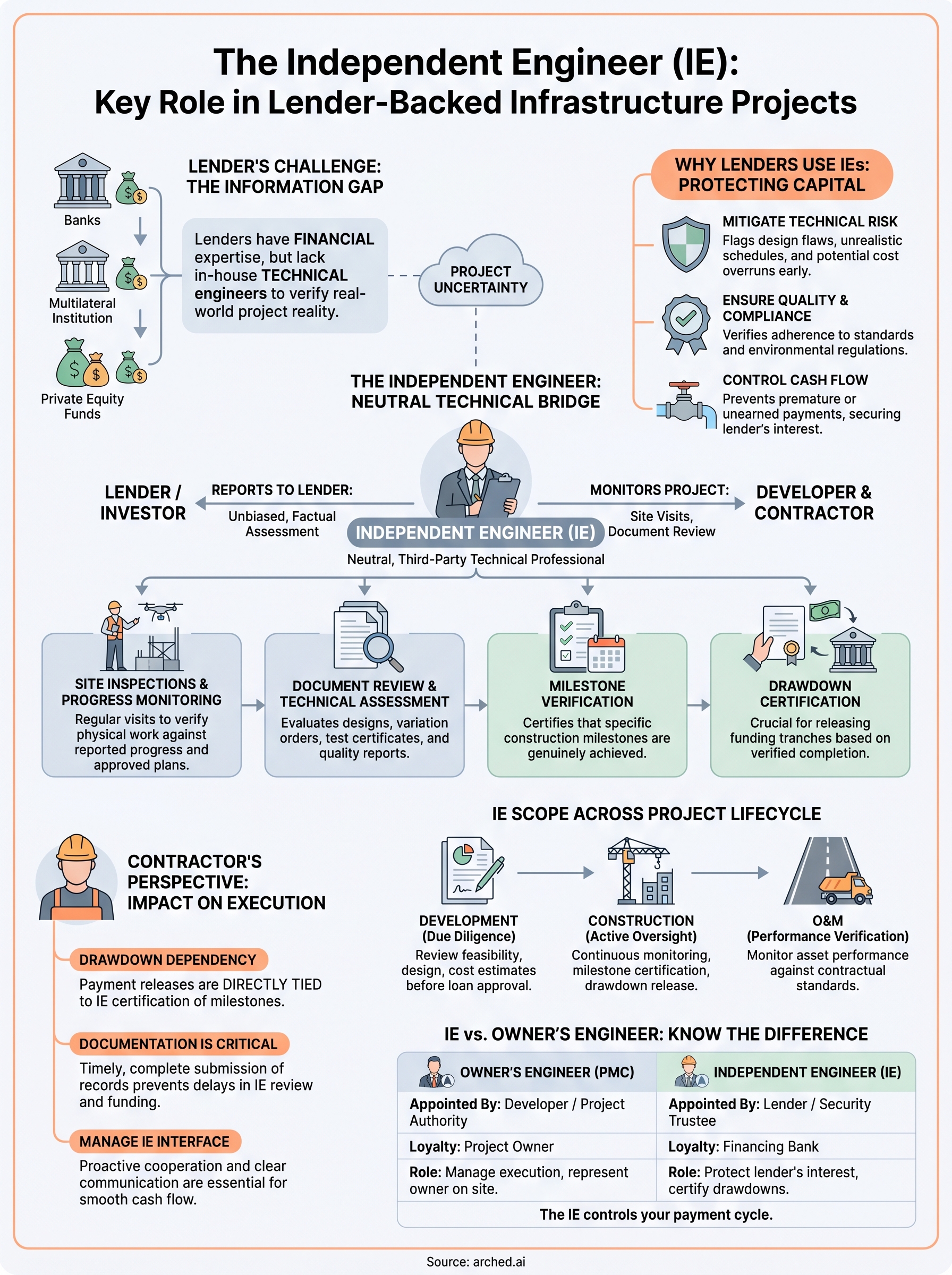
When a lender commits capital to an infrastructure project, they're making a bet on technical execution, not just financial modeling. Banks, multilateral institutions, and private equity funds typically employ credit analysts and financial modelers, but they rarely have civil engineers on staff who can assess whether a BOQ is realistic, whether a contractor's timeline is achievable, or whether a soil report justifies the foundation design chosen. This gap between financial expertise and technical reality is precisely why lenders appoint an independent engineer.
The information gap lenders face
A lender reviewing a 500-crore HAM project sees a financial model, a concession agreement, and a stack of engineering reports produced by the developer's team. Every document in that stack was created by someone with a financial interest in getting the loan approved. Without an independent technical reviewer, the lender has no reliable way to verify that the construction cost estimate reflects real site conditions, that the design meets applicable standards, or that the projected schedule is achievable given the contractor's actual resource capacity.
Lenders don't distrust developers by default, but they need technical verification from someone with no stake in the project proceeding.
This is a structural problem built into project finance. The developer, the contractor, and the EPC firm all benefit when the lender approves funding quickly and releases drawdowns on schedule. The independent engineer breaks that alignment by introducing a party whose mandate is to report what is actually happening on the ground, not what the developer wants the lender to hear.
How an IE protects lender capital
Once a project moves into construction, cash flow risk becomes concrete. Lenders typically release funds in tranches tied to verified construction milestones. Without an independent engineer certifying those milestones, a lender would have to accept the developer's own claim that, say, 30% of civil work is complete. That kind of self-certification creates obvious moral hazard. The IE physically inspects the site, reviews progress against the approved construction program, and issues a drawdown certificate only when the work genuinely meets the agreed threshold.

Beyond drawdown verification, the IE also monitors for cost overruns and scope changes that could threaten the project's financial viability. If a contractor hits unexpected rock strata during excavation and needs a design revision, the IE assesses whether that change is technically justified and what it means for the completion timeline. Lenders use this information to decide whether to approve additional funding, trigger covenant provisions, or take action under the security package.
Why neutral verification matters in India's infrastructure sector
India's public infrastructure pipeline is large and actively expanding. Projects financed under the HAM model, NHAI concessions, and state-level PPP frameworks all involve lenders who carry significant capital exposure over construction periods that routinely stretch three to five years. The independent engineer role has become standard across these structures because it directly reduces the lender's technical risk without requiring the lender to build an in-house engineering team.
From your perspective as a contractor or BD manager, the presence of an IE on a project is not bureaucratic overhead you can safely ignore. The IE's certification schedule directly controls when you receive drawdown payments. If you fail to meet a milestone that the IE verifies, your payment is delayed. If you propose a design change that the IE flags as insufficiently documented, the lender won't release funds until the IE formally signs off. Understanding the IE's scope before you submit a bid lets you build realistic cash flow projections and set internal milestone targets that already account for the verification timeline, which protects your working capital throughout execution.
What an independent engineer does day to day
The independent engineer's work is not limited to issuing a quarterly report and moving on. On an active construction project, the IE maintains a continuous presence through scheduled site visits, document reviews, and structured communication with both the developer and the lender. The frequency and format of that engagement depend on the contract structure and the technical complexity of the project, but the core tasks remain consistent across most infrastructure assignments in India.
Site inspections and progress monitoring
Site inspection is the foundation of the IE's day-to-day work. The IE visits the project site on a regular basis, typically monthly during active construction, to physically verify that work reported as complete actually matches field conditions. They check that materials meet approved specifications, that construction methodology follows the approved drawings, and that labor and equipment deployment is consistent with the contractor's submitted program.
What the IE observes on site carries more weight with the lender than any progress report the developer submits, because the IE has no financial incentive to overstate completion.
If the IE finds a gap between reported and actual progress, they document the discrepancy formally and communicate it directly to the lender. You cannot resolve these findings informally. They go on record, and the lender uses that record to decide whether to release the next drawdown tranche.
Document review and technical assessment
Site visits alone don't cover the full picture. Between inspections, the IE works through a steady stream of design revisions, contractor submissions, variation orders, and test certificates. If you submit a request for a design change, the IE evaluates whether the change is technically justified and whether it affects the approved cost or schedule. They also assess insurance certificates, quality control reports, and third-party test results to confirm the project remains compliant with applicable standards throughout the construction period.
On a complex infrastructure project, the volume of documents the IE processes each month is significant. Submitting required documentation to the IE on a delayed or incomplete basis stalls their review cycle, which directly pushes back lender approval for your next payment. As a contractor or project manager, building a documentation submission schedule that stays ahead of the IE's review window is one of the most concrete steps you can take to protect your working capital and avoid avoidable cash flow gaps mid-construction.
IE scope across development, construction, and O&M
The independent engineer's involvement doesn't start when the first shovel breaks ground. On most lender-backed infrastructure projects in India, the IE's mandate spans three distinct phases: pre-construction development, active construction, and post-completion operations. Each phase carries a different set of tasks, but the IE's core function remains the same throughout: give the lender a reliable, technically grounded view of what is actually happening with their capital.

Development phase: technical due diligence
Before a lender finalizes a loan agreement, they need to know whether the project is technically bankable. The IE reviews the feasibility study, the detailed project report, and the engineering design during this phase to assess whether the project is structurally sound before any money moves. They check cost estimates against current market rates, evaluate the realism of the construction schedule, and flag any gaps in the design that could create risk later.
If the IE identifies a significant flaw during due diligence, the lender has the option to require remediation before drawdown conditions are set, which protects both parties from expensive mid-project corrections.
Your bid documents and technical proposal feed directly into this review. If your cost breakdown doesn't match standard benchmarks, or your program is unrealistically compressed, the IE will note it. Submitting well-supported technical documentation from the outset reduces friction during this phase and sets a cleaner foundation for the construction-period relationship.
Construction phase: active oversight
This is where the IE's workload is heaviest. Milestone verification, design change assessment, and drawdown certification all happen in rapid sequence throughout the construction period. The IE also monitors environmental and social compliance requirements on projects that involve land acquisition or community displacement, which is common in road and irrigation work across Indian states. They track whether the contractor is resolving non-conformances raised in earlier inspection cycles and whether corrective actions are actually being implemented on site rather than just documented on paper.
O&M phase: performance verification
Once construction completes and the project enters operations, the IE's role shifts from oversight to performance monitoring. On road concessions, for example, the IE verifies that the operator is meeting the contractual pavement quality index and maintenance response standards. On power or water projects, they track output metrics against the projections used to justify the original financing. If the asset underperforms materially, the IE's O&M reports give lenders early warning that covenant triggers may be approaching, allowing structured intervention before a default occurs.
Key deliverables and reports from an IE
The independent engineer produces a structured set of formal outputs that carry contractual weight and directly govern lender decisions on fund releases. These aren't informal advisory notes. Lenders use IE deliverables as the primary basis for releasing drawdown tranches, triggering covenant provisions, or requiring corrective action from the project developer.
Progress reports and drawdown certificates
Every month during active construction, the IE submits a progress report to the lender covering physical completion against the approved construction program, site inspection findings, material compliance, and outstanding non-conformances. If the project is running behind schedule, the IE quantifies the gap and assesses whether the contractor's recovery plan is realistic. You feed the raw inputs for this report through your own submissions, which means incomplete or late documentation directly shapes how the IE characterizes your performance to the lender each month.
The lender reads the IE's monthly report before reviewing anything the developer submits, which means your on-site performance and documentation discipline are what the lender actually sees.
Drawdown certificates are the most operationally critical deliverable the IE issues. Each certificate confirms that a defined milestone has been physically achieved and that the associated payment claim is supported by verified field evidence. Your next tranche will not move without a valid certificate, regardless of what the developer reports independently. If the IE certifies a milestone but attaches conditions, such as unresolved test results or outstanding non-conformances, the lender may release only a partial payment until those conditions clear.
Completion reports and final sign-off
At the end of construction, the IE issues a substantial completion report confirming that the project meets the technical specifications in the concession or EPC agreement. This report formally triggers the transition from the construction financing period to the O&M phase and typically releases retained security held by the lender against the developer's performance obligations. Missing items on this report don't close automatically. The IE tracks them until resolved.
Alongside the substantial completion report, the IE produces a punch-list of outstanding defects or incomplete works the contractor must rectify before final completion is certified. Treating this list as a formality is a mistake. Unresolved punch-list items delay the release of retention amounts and keep the lender's security provisions active, creating unnecessary friction at exactly the point where you want the project financially closed and your team moving on to the next contract.
Independent engineer vs owner's engineer
Two senior technical roles appear on almost every large infrastructure project in India, and contractors frequently confuse them. The independent engineer and the owner's engineer both review designs, assess progress, and produce technical reports, but they answer to entirely different principals and carry entirely different mandates. Mixing up these two roles when reading a tender document can lead you to misread your reporting obligations and misunderstand who controls your payment cycle.

Who each party works for
The owner's engineer, sometimes called the project management consultant or PMC, is appointed by and works for the developer or project authority. Their job is to help the owner execute the project to specification, manage contractor interfaces, and keep the program on track. They are the developer's technical representative on site, which means their loyalty and reporting line runs to the same party paying the contractor.
The independent engineer works for the lender, not the developer, which means their assessment of your work is the one that directly governs fund releases.
The independent engineer's appointment runs to the lender's security trustee or the lead financing bank. When the IE raises a concern, they report it upward to the financier, not sideways to the project authority. This structural difference means the IE can flag a problem even when the developer wants it kept quiet, and the lender is the party who decides what happens next.
How their mandates differ in practice
The table below captures the core differences you need to understand before you start execution on a lender-backed project.
| Factor | Owner's Engineer | Independent Engineer |
|---|---|---|
| Appointed by | Developer / project authority | Lender or lender's trustee |
| Primary loyalty | Project owner | Financing bank |
| Controls drawdown certification | No | Yes |
| Reviews design on owner's behalf | Yes | Only for lender risk assessment |
| Issues non-conformances to contractor | Yes | Yes, with lender consequences |
Why the distinction matters for your cash flow
On a project where both roles are active, you are essentially reporting to two separate technical reviewers with different interests. Satisfying the owner's engineer does not automatically satisfy the independent engineer, because their evaluation criteria and reporting thresholds are set by different principals. A milestone the PMC considers substantially complete may not meet the IE's certification threshold if there are unresolved test certificates or open non-conformances.
Knowing this in advance lets you structure your internal QA processes to meet both sets of requirements simultaneously, rather than discovering the gap when a drawdown is delayed and your working capital is already stretched.
How to hire and manage an IE in India
On most lender-financed infrastructure projects in India, the independent engineer appointment is not something you initiate as the contractor. The lender specifies the IE firm, either by naming a shortlist in the loan agreement or by running their own selection process. Your obligation as the developer or EPC contractor is typically to cooperate fully with whoever the lender appoints, which means understanding the appointment process matters even if you don't control it directly.
Who appoints the IE and who pays
The lender or the lender's security trustee formally appoints the IE, but the cost of the IE's engagement is usually passed to the developer or borrower as a project cost. This is worth flagging when you build your project budget: IE fees on a complex highway or bridge project can run into several lakhs per month over a multi-year construction period. Read the financing term sheet carefully for provisions that govern who selects the IE, how their scope is defined, and whether the borrower has any input on the appointment.
If the loan agreement allows you input on the IE shortlist, use that opportunity. Firms with prior experience on similar Indian infrastructure projects will run the process more efficiently, which directly benefits your drawdown cycle.
What to look for in an IE firm
When you do have a say, or when you're advising a developer client on their financing structure, prioritize firms with demonstrated experience on comparable project types in India's regulatory environment. An IE firm that understands NHAI HAM concession structures, state PWD procurement conditions, and the technical standards of the Ministry of Road Transport and Highways will process milestone certifications faster than a generalist firm learning the framework on your project. Check their prior assignments in your project's sector and ask for references from lenders who have used them on previous deals.
Managing the IE relationship during execution
Once the IE is appointed, your day-to-day relationship with them runs through documentation and communication discipline. Submit your monthly progress reports, test certificates, and variation requests on time and in the format the IE specifies. Delayed or incomplete submissions are the single biggest avoidable cause of certification delays, and the lender notices when the IE flags recurring documentation gaps in their monthly reports. Assign a dedicated liaison from your project team to manage the IE interface, maintain a submission log, and track open items until the IE formally closes them. That single operational discipline protects your drawdown cycle across the entire construction period.
Final takeaways
The independent engineer sits at the center of every lender-backed infrastructure project, controlling the drawdown cycle that funds your construction program. Their certification decisions are not formalities. They directly determine when money moves, which makes your documentation discipline, milestone planning, and site compliance as important as the technical work itself.
Three things directly affect how smoothly you work with an IE: submitting complete documentation on time, building an internal QA process that meets both the IE's and the owner's engineer's requirements simultaneously, and understanding the IE's scope before you commit to a bid. Firms that treat the IE relationship as a legal obligation to manage rather than a technical checkpoint to clear will always struggle with delayed drawdowns and working capital pressure.
If you want to identify lender-backed tenders and parse IE-related clauses before you bid, explore what Arched can do for your business development pipeline before the next opportunity closes.